Expressionism
Embarkation (Emil Nolde)
Emil Nolde (1867–1956) made Embarkation. It belongs to the Expressionism movement.

 Preview

 Hand Made Oil Painting
 Send
 Share
 Fact sheet


 Download
 Similars
 X-Ray
 Diaporama
 Q&A

 Stats
Embarkation, in brief
- Title
- Embarkation
- Artist
- Emil Nolde (1867–1956)
- Artist born in
- Nolde, Denmark
- Movement
- Expressionism
- Subject
- embarkation, ship, shoreline, movement, expressionism, voyage
What does Embarkation depict?
A Dynamic Voyage: Exploring Nolde's 'Embarkation'
Emil Nolde’s ‘Embarkation’ is a captivating Expressionist work that plunges viewers into a scene of bustling movement and raw emotion. The artwork depicts figures and horses surging towards a ship at the shoreline, capturing a moment of transition and potential adventure. Painted with an intensity characteristic of Nolde's style, this piece isn't merely a representation of boarding a vessel; it’s a visceral exploration of human energy and the allure of the unknown. The composition is deliberately unbalanced, drawing the eye to the left side where the action unfolds, creating a sense of urgency that permeates the entire canvas.Expressionist Technique & Bold Color
Nolde's mastery lies in his expressive technique. ‘Embarkation’ exemplifies this through its vigorous application of oil paints using an impasto style. Thick layers of paint create a pronounced textural quality, with visible brushstrokes that contribute to the dynamism and energy of the scene. The color palette is equally striking – dominated by vibrant blues representing the water and sky, contrasted sharply with yellows illuminating the ship’s hull and sails. Accents of red, pink, and purple punctuate the rocks and clothing, adding visual complexity and intensifying the emotional impact. This isn't about precise realism; it's about conveying feeling through color and form. Nolde deliberately eschews traditional perspective, flattening the space to heighten the emotional intensity rather than create a sense of depth.Historical Context & Artistic Influences
‘Embarkation’ was created during a period of significant artistic upheaval in Europe. Nolde was a founding member of *Die Brücke* (The Bridge), an Expressionist group that sought to break away from academic traditions and express subjective experiences through bold, often distorted forms. The movement reacted against the perceived materialism and complacency of Wilhelmine Germany, seeking instead to convey raw emotion and spiritual intensity. Nolde’s work reflects these influences, drawing inspiration from primitive art – particularly African masks and carvings – as well as artists like Vincent van Gogh and Paul Gauguin who explored expressive color and simplified forms. His later works were impacted by the political climate of Nazi Germany; despite being declared a "degenerate artist" by the regime, Nolde continued to paint in secret, often focusing on religious themes.Symbolism & Emotional Resonance
Beyond its visual impact, ‘Embarkation’ carries symbolic weight. The act of embarking – leaving one place for another – is inherently laden with meaning: transition, hope, uncertainty, and the pursuit of new horizons. The dynamic brushstrokes and vibrant colors evoke a powerful sense of energy and movement, suggesting not just physical travel but also an emotional journey. It speaks to humanity’s innate desire to explore, to venture into the unknown, and to embrace change – even when tinged with apprehension. The painting's subdued intensity, despite its bright palette, hints at the underlying anxieties that often accompany significant life transitions. Ultimately, ‘Embarkation’ is a testament to Nolde’s ability to translate profound human emotions onto canvas, creating a work that continues to resonate with viewers today.High-resolution images of Embarkation
Emil Nolde, Embarkation. Public domain.
Colours matched to the original by a digital expert, the file finely retouched, faithful to the artist's brushwork.
Own the high-resolution fileQuestions on Embarkation, answered
What does "Embarkation" by Emil Nolde depict?
The themes present in "Embarkation" by Emil Nolde include embarkation, ship, shoreline, movement, expressionism, voyage, figures, water. Together they summarize the artwork's subject matter.
Is "Embarkation" by Emil Nolde in the public domain?
Regarding copyright, "Embarkation" is in the public domain - its copyright has expired.
Who is the artist behind "Embarkation"?
"Embarkation" was created by Emil Nolde. The information on this page describes Emil Nolde's original work.
What art movement does "Embarkation" by Emil Nolde belong to?
"Embarkation" by Emil Nolde belongs to the Expressionism movement. This movement provides the stylistic context of the work.
Where does "Embarkation" fall in Emil Nolde's career?
"Embarkation" represents the Mature Period of Emil Nolde.
Is "Embarkation" by Emil Nolde in the public domain, and why?
"Embarkation" by Emil Nolde is in the public domain - its copyright has expired. Copyright terms are measured from the artist's death, and Emil Nolde died in 1956.
How does "Embarkation" fit into Emil Nolde's themes and style?
"Embarkation" belongs to Emil Nolde's Expressionism work, whose recorded themes include van gogh & gauguin inspiration, folk art & primitive carvings, expressionist movement impact, transition and adventure themes, exploration of the unknown, reflects expressionist anxieties, part of nolde's maritime series, demonstrates his impasto technique.
How does the subject of "Embarkation" relate to Emil Nolde's usual themes?
"Embarkation" depicts embarkation, ship, shoreline, movement, expressionism, voyage, figures, water, while Emil Nolde's recorded themes are van gogh & gauguin inspiration, folk art & primitive carvings, expressionist movement impact, transition and adventure themes, exploration of the unknown, reflects expressionist anxieties, part of nolde's maritime series, demonstrates his impasto technique. Comparing the two shows how the work relates to the artist's usual subjects.
About the artist, Emil Nolde
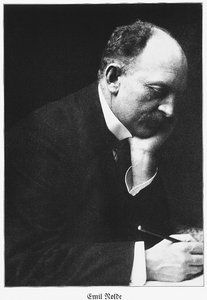
1867–1956, Denmark
Emil Nolde
The Life and Identity of Emile Nolde Born Hans Emil Hansen on 7 August 1867, the man who would become known as Emile Nolde grew up near the village of Nolde in the Duchy of Schleswig. His early years were shaped by the rural, agrarian life of his family. He eventually moved away from this path, choosing instead to work as a wood carver and furniture decorator. This tactile, physical labor preceded his shift toward painting and printmaking.
Also by Emil Nolde
 Sunset
 Sea with Red Sky
 Couple on the beach1903
 Masks1911
Essays around Embarkation
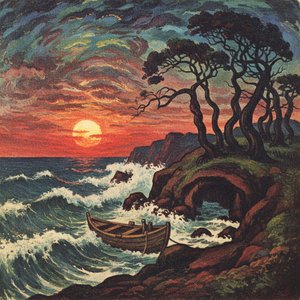 Emile Nolde: A Journey into Expressionist Nature & the Primal SelfExplore the powerful Expressionism of Emile Nolde – a pioneer of emotive landscapes & spiritual themes. Discover his journey, influences, a…
 Creative Alchemy: How to Translate Human Emotion into Masterpiece Oil PaintingsDiscover the profound art of translating emotion into oil paintings. Explore the technical mastery of impasto, light, and color through an …
 Impressionism vs. Post-Impressionism: Understanding the Shift in Modern ArtMaster the differences between Impressionism and Post-Impressionism with our expert guide. Learn to distinguish these iconic art movements …