
 Send
Send Share
Share
 Details
 Guide
Guide

 Download
 Similars
 Diaporama
 Q&A
Q&A Stats
StatsThe Tears Dress


 Read More
The artwork displayed on this page is protected by copyright law, which means we cannot legally create or sell an identical reproduction. This protection is enforced under international agreements such as the Berne Convention and by national laws, including those outlined by the U.S. Copyright Law - Title 17.
This method fully complies with copyright regulations because it does not involve copying or duplicating the protected artwork. Instead, it is a creative reinterpretation - a new painting that is influenced by the original but not identical to it.
Giclée / Art Print
Museum-quality giclée or canvas print with fast production and flexible finish options. ( Buy Hand Made Painting Switch to Digital Image)




































Pick from our preset sizes that match the artwork's original proportions.

Type the width and the height you need, to fit your frame or your wall. A print can only be cut, never made bigger than the picture, so a size with a different shape loses a part of the image. We send you a digital mockup to approve before we print anything. The picture shown on this page does not show the real cut — only the mockup does.
Worldwide Delivery () in 2 weeks instead of standard 4/5 weeks. (2 November)

Free Worldwide Express Shipping

High-Quality Linen Canvas

Full Shipping Insurance

Customs Tax Refund Guarantee

True Color Matching Guarantee

100-Day Return Policy (Defects Only)

100% Money-Back Guarantee

Bulk Discount Offer
 Glass option is only available in size under 110 CM

The Tears Dress
Giclée / Art Print
Reproduction Size
-


Total Price
$ 81
A Fracture in Silk
The gown hangs with a heavy, quiet grace. It is a sheath of viscose rayon and silk marocain, pale and smooth before the disruption begins. Across this surface, jagged lines cascade like sudden wounds. These irregular shapes mimic the appearance of shredded flesh, a trompe-l'œil trick that blurs the boundary between fabric and skin. The print creates an illusion of something torn, a visual echo of the psychological fractures felt in 1938. A matching veil rests upon the head, its edges lined with pink and magenta fabric to suggest the raw interior of a tear.
The silhouette remains simple, yet the texture is violent. The jagged edges interrupt the fluid drape of the crepe material. It is a garment that wears its own destruction.
Shadows of 1938
The air of the late 1930s carried a specific weight, a tension felt in the escalating movements toward war. This dress, born from the Circus collection, captures that encroaching darkness. The design draws from unsettling imagery, specifically the way flesh and fabric can appear indistinguishable when wounded. It reflects a period where the stability of the world seemed to be fraying at the seams.
The woman in the photograph rests her hand against her face. Her pose is inward, caught in a moment of private sorrow. The monochrome tones of the image deepen the sense of melancholy, stripping away color to focus on the stark contrast between light and shadow. There is no movement here, only the stillness of a grief that has already arrived.
The fabric holds its shape even as it appears to fall apart.
Questions & Answers
Can I examine "The Tears Dress" in more detail?
The X-Ray view of "The Tears Dress" by Elsa Schiaparelli is on the artwork's X-Ray page: an interactive examination of the image through eleven optical layers.
What atmosphere would a reproduction of "The Tears Dress" by Elsa Schiaparelli bring to a room?
The dramatic atmosphere of "The Tears Dress" by Elsa Schiaparelli matches its recommended space: a living room.
How is the mood of "The Tears Dress" by Elsa Schiaparelli described?
"The Tears Dress" has a dramatic atmosphere.
Artist Biography
A Rebel Spirit in Haute Couture: The World of Elsa Schiaparelli
Elsa Luisa Maria Schiaparelli, a name synonymous with audacious style and surrealist innovation, irrevocably altered the landscape of 20th-century fashion. Born into an aristocratic Roman family in 1890, her life was anything but conventional. Unlike many of her contemporaries who embraced established societal norms, Schiaparelli possessed a fiercely independent spirit, fueled by intellectual curiosity and a penchant for challenging expectations. Her father, Celestino Schiaparelli, a renowned scholar of Islamic studies and Sanskrit, cultivated an environment rich in learning, while her uncle, the astronomer Giovanni Schiaparelli – famed for his observations of Martian “canals” – sparked within her a lifelong fascination with the cosmos and the unconventional. This unique upbringing instilled a love for art, mythology, and esoteric thought that would profoundly shape her aesthetic vision. Early rebellious tendencies manifested not only in defying societal expectations but also in a tumultuous personal life, including a marriage to the enigmatic Wilhelm de Kerlor, a self-proclaimed psychic whose influence further propelled her into a world of spiritualism and occult practices – themes that subtly permeated her later designs.From Knitwear to Surrealist Statements: The Rise of a Fashion House
Schiaparelli’s journey into the world of fashion was initially pragmatic, born from dissatisfaction with existing styles. She began by experimenting with knitwear in the late 1920s, recognizing a gap in the market for comfortable yet sophisticated clothing. In 1927, she established her own fashion house in Paris, quickly expanding beyond knitwear to encompass a full range of haute couture designs. However, it was during the 1930s that Schiaparelli truly came into her own, forging groundbreaking collaborations with leading artists of the Surrealist movement. This period marked a radical departure from the prevailing elegance of Parisian fashion, characterized by flowing silhouettes and understated glamour. Schiaparelli’s designs were deliberately provocative, playful, and often unsettling, embracing the absurd and challenging conventional notions of beauty. Her partnership with Salvador Dalí proved particularly fruitful, resulting in iconic creations like the Lobster Dress (1937), featuring a vibrant lobster painted onto silk, and the Shoe Hat (1938), a whimsical headpiece shaped like a high-heeled shoe. Jean Cocteau also contributed significantly to her work, designing striking embroidery and accessories that further enhanced the surrealist aesthetic.Shocking Pink and Trompe-l'œil: Defining a Unique Aesthetic
Schiaparelli’s designs were instantly recognizable for their bold use of color, most notably her signature “shocking pink” – a vibrant, almost aggressive hue that defied the muted palettes favored by many of her contemporaries. This audacious choice became emblematic of her rebellious spirit and her determination to challenge established norms. Beyond color, Schiaparelli masterfully employed *trompe-l'œil* effects, creating illusions that blurred the boundaries between art and fashion. She incorporated unexpected materials into her designs – leather, metal, even newspaper print – pushing the limits of textile innovation. Her collections often drew inspiration from mythology, nature, and everyday objects, transforming them into wearable works of art. The Circus Collection of 1938 stands as a testament to this playful approach, featuring theatrical costumes adorned with whimsical motifs and exaggerated silhouettes. An Evening Coat from 1936 showcased her daring use of leather in high fashion, demonstrating her willingness to experiment with unconventional materials. Schiaparelli didn’t simply design clothes; she created immersive experiences that captivated the imagination and challenged perceptions.Legacy and Revival: An Enduring Influence
Despite facing financial difficulties and a decline in popularity after World War II, Elsa Schiaparelli's influence on fashion remains undeniable. She paved the way for future designers to embrace artistic collaborations and push creative boundaries. Her innovative use of materials, her playful approach to design, and her fearless experimentation continue to inspire contemporary artists and fashion houses. Her work is featured in prominent museums worldwide, including the Kyoto Costume Institute and the Victoria and Albert Museum, solidifying her place in fashion history. The Maison Schiaparelli, after decades of dormancy, was re-established in 2014, demonstrating the enduring appeal of her visionary designs. This revival has brought her avant-garde spirit to a new generation, proving that her legacy extends far beyond the confines of the mid-20th century. Elsa Schiaparelli’s true innovation lay not just in creating beautiful clothes but in redefining fashion as an art form – a bold statement that continues to resonate today.Key Works and Collections
- Circus Collection (1938): A dazzling display of innovative design featuring theatrical costumes and whimsical motifs.
- Evening Coat (1936): An example of her use of unconventional materials like leather in high fashion.
- Lobster Dress (1937): A collaboration with Salvador Dalí, showcasing a lobster image printed on silk.
- Shoe Hat (1938): Another iconic creation by Schiaparelli and Dalí, a hat shaped like a shoe.

Elsa Schiaparelli
1890 - 1973 , Italy
Quick Facts
- Full Name: Elsa Luisa Maria Schiaparelli
- Nationality: Italian
- Date Of Birth: 1890
- Date Of Death: 1973
- Place Of Birth: Rome, Italy
- Notable Artworks:
- Lobster Dress
- Shoe Hat
- Evening Coat
- Circus Collection
- Artistic Movement Or Style: Surrealist fashion
- Artists Or Movements Influenced By This Artist: ['Contemporary designers']
Related Articles
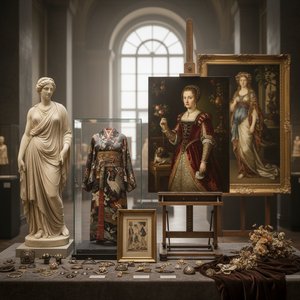
Draped Narratives: Fashion as Symbol & Subject in Historical Art
Explore the fascinating history of fashion as a symbol of power & status in art! Discover masterpieces from Gainsborough to Tissot and learn how clothing shaped societal narratives. Find museum-quality reproductions at OriginalUniqueArt.

Mikhail Larionov: Rayonism, Primitivism & the Dawn of Russian Avant-Garde Painting
Explore the revolutionary art of Mikhail Larionov & the Russian Avant-Garde. Discover Rayonism, Primitivism's influence, and his lasting impact on modern painting. Expert insights for collectors.
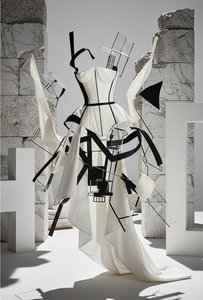
Gianfranco Ferré: Deconstructing Haute Couture – A Legacy of Architectural Form
Explore the revolutionary world of Gianfranco Ferré, 'the architect of fashion.' Discover his architectural approach to haute couture, iconic Dior designs, and lasting influence on luxury style. A deep dive for collectors & enthusiasts.

Breaking Tradition: A Definitive Guide to the Evolution of Early Modernism and the Avant-Garde
Explore the transformative era of Early Modernism. From Cézanne's Post-Impressionism to the radical Russian Avant-Garde and Cubism, discover how masters broke tradition to redefine art history through our expert-led guide for collectors and enthusiasts.

The Lens of Luxury: A Visual Journey Through the Evolution and Artistry of Fashion Photography
Embark on a visual journey through the evolution of fashion photography. Discover how masters like Gianfranco Ferré blended geometry, surrealism, and texture to redefine high-fashion art for collectors and connoisseurs of luxury imagery.


