The Precursors: Russian Art Before the Avant-Garde
The Russian avant-garde was a large, influential wave of avant-garde modern art that flourished in the Russian Empire and the Soviet Union, approximately from 1890 to 1930—although some have placed its beginning as early as 1850 and its end as late a...
Before the explosive burst of Rayonism and other radical movements, the Russian art scene was a fascinating tapestry woven with threads of academic tradition, religious iconography, and a burgeoning national identity. The late 19th century witnessed a growing dissatisfaction with purely imitative styles, a yearning for something authentically Russian that resonated beyond mere replication of Western masters. Artists like Viktor Vasnetsov, with his romanticized depictions of folklore and epic tales, laid the groundwork for a distinctly Slavic aesthetic. Simultaneously, the Peredvizhniki (Wanderers), a realist movement committed to social commentary, dominated the landscape, focusing on the lives of peasants and the hardships of everyday existence. While seemingly disparate, both groups contributed to an atmosphere ripe for change – Vasnetsov by igniting a passion for national roots and the Peredvizhniki by challenging conventional subject matter. This search for authenticity, coupled with increasing exposure to European modernism, created a fertile ground where artists began questioning the very foundations of artistic representation.
Rayonism Emerges: A New Language of Light and Color
 Wikipedia: Rayonism
Rayonism (or Rayism or Rayonnism) was a style of abstract art that developed in Russia in 1910–1914. Founded and named by Russian Cubo-Futurists Mikhail Larionov and Natalia Goncharova, it was one of Russia's first abstract art movements. == Backgr...
The year 1910 marked a pivotal moment in Russian art history with the birth of Rayonism, conceived by Mikhail Larionov and his partner Natalia Goncharova. Dissatisfied with the limitations of Cubo-Futurism – which they initially embraced – Larionov sought to move beyond depicting objects themselves and instead capture the very *essence* of vision: the reflected rays of light that constitute our perception of reality. This wasn’t merely an aesthetic shift; it was a quasi-scientific exploration, informed by contemporary theories about radioactivity and X-rays. Larionov believed that by analyzing and representing these intersecting “rays,” he could unlock a new dimension in painting, one free from the constraints of form and narrative. The 1913 exhibition, aptly named “Target,” served as Rayonism’s public debut, showcasing canvases ablaze with dynamic lines and contrasting colors – an attempt to visually translate the invisible forces shaping our world. Goncharova's early experiments were crucial in developing this language, her works demonstrating a growing abstraction that prioritized color relationships and spatial dynamics over recognizable forms. The Rayonist Manifesto, published shortly before the exhibition, boldly declared their intention to create “spatial forms…obtained arising from the intersection of reflected rays,” effectively severing ties with representational art.
Primitivism’s Influence: Folklore, Peasant Art & Artistic Rebellion
In the arts of the Western world, Primitivism is a mode of aesthetic idealization that means to recreate the experience of the primitive time, place, and person, either by emulation or by re-creation. In Western philosophy, Primitivism proposes that ...
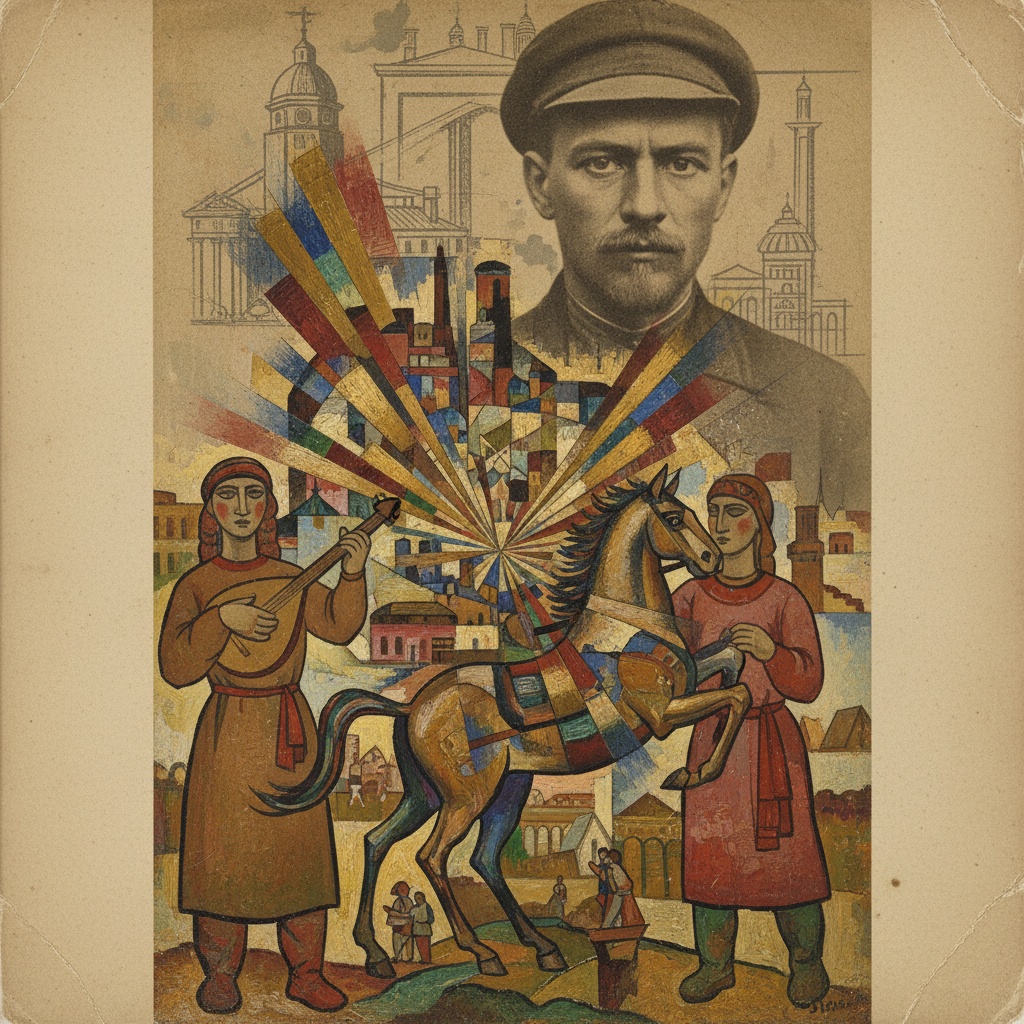
Rayonism didn't emerge in a vacuum. A powerful undercurrent of Primitivism profoundly influenced Larionov and Goncharova’s artistic trajectory. This fascination wasn’t simply an exotic appropriation of non-Western cultures; it was a deliberate rejection of academic refinement in favor of the raw, uninhibited expression found in folk art, peasant crafts, and icon painting. Russian artists were captivated by the directness and spiritual intensity of these forms, seeing them as embodying a purity lost in centuries of artistic convention. Goncharova’s exploration of Russian lubok prints – cheap, brightly colored woodcuts depicting everyday life and folklore – is particularly telling. She didn't merely copy these images; she absorbed their bold compositions, flattened perspectives, and vibrant color palettes, integrating them into her increasingly abstract works. This embrace of “primitive” aesthetics wasn’t solely stylistic. It was also a form of artistic rebellion against the perceived decadence of Western art and a celebration of Russia’s unique cultural heritage. The simplification of forms, the emphasis on pattern and symbolism, and the rejection of traditional perspective all contributed to a distinctly Russian brand of modernism.
Larionov's Synthesis: Bridging Cubo-Futurism and Rayonist Aesthetics
Mikhail Larionov’s genius lay in his ability to synthesize diverse artistic influences. While he initially embraced the energy and dynamism of Cubo-Futurism, he quickly recognized its limitations. He wasn't content with merely fracturing forms; he wanted to explore the underlying forces that *created* those forms – the interplay of light, color, and space. Rayonism can be seen as a logical extension of Cubo-Futurism, pushing abstraction further by eliminating recognizable objects altogether. However, Larionov’s work also retained a distinctly lyrical quality absent in some of his contemporaries' more rigidly geometric compositions. His paintings often evoke a sense of movement and energy, achieved through the layering of intersecting rays and the use of vibrant, contrasting colors. Furthermore, Larionov wasn’t solely focused on painting. He extended Rayonist principles to other mediums, including stage design and textile art – exemplified by works like ‘Fleet on the Sea’, demonstrating a holistic approach to artistic expression. This willingness to experiment across disciplines solidified his position as a leading figure in the Russian avant-garde.
The Impact and Legacy of Larionov and the Russian Avant-Garde
The period between the 1917 Revolution and 1932 witnessed an unprecedented flourishing of artistic experimentation in Russia. Larionov, along with Goncharova and other pioneers like Kazimir Malevich and El Lissitzky, played a pivotal role in shaping this revolutionary movement. However, the rise of Socialist Realism under Stalin brought a swift end to their radical vision. The emphasis shifted from abstract expression to politically charged realism, effectively silencing many of the avant-garde’s most innovative voices. Despite this suppression, the legacy of Larionov and his contemporaries continues to resonate today. Their exploration of abstraction, their embrace of new materials and techniques, and their commitment to challenging artistic conventions paved the way for countless subsequent generations of artists. The influence of Rayonism can be seen in abstract expressionism, minimalism, and contemporary color field painting. Moreover, the Russian avant-garde’s emphasis on art as a tool for social change continues to inspire artists and activists around the world.
Collecting Larionov Today: A Guide for Enthusiasts
Acquiring works by Mikhail Larionov is undoubtedly a significant undertaking, given their rarity and historical importance. Paintings from his Rayonist period are particularly sought after, commanding high prices at auction. However, exploring his earlier Cubo-Futurist works or his stage designs can offer more accessible entry points for collectors. Authenticity is paramount; careful provenance research is essential. Consulting with reputable art dealers and appraisers specializing in Russian avant-garde art is highly recommended. OriginalUniqueArt.com
offers high-quality reproductions of Larionov’s masterpieces, allowing enthusiasts to experience the vibrancy and energy of his work firsthand. While a reproduction cannot replicate the texture and nuance of an original painting, it provides an excellent opportunity to appreciate his artistic vision and understand his lasting impact on modern art. Consider focusing on specific themes or periods within Larionov's oeuvre – his exploration of Russian folklore, his experiments with light and color, or his innovative stage designs – to build a cohesive collection that reflects your personal aesthetic preferences. Investing in Larionov’s work, even through reproductions, is an investment in a pivotal moment in art history.