The Dawn of Modernity: From Realism to Impressionism
The late 19th century witnessed a seismic shift in artistic perception, a departure from the meticulously rendered realities championed by academic tradition. Realism, with its unflinching gaze upon contemporary life – Courbet’s stark depictions of laborers and Millet’s poignant portrayals of rural existence – laid the groundwork for questioning established norms. However, it was the burgeoning Impressionist movement that truly fractured the conventions of representation. Artists like Monet, Renoir, and Degas weren't interested in depicting *what* they saw, but rather *how* they saw it: fleeting moments captured through broken color and light. The 1863 Salon des Refusés, a showcase for works rejected by the official academy, became a symbolic battleground – Manet’s “Déjeuner sur l'herbe” scandalizing audiences with its unconventional subject matter and loose brushwork. This wasn’t merely a stylistic shift; it was a philosophical one, prioritizing subjective experience over objective truth. The emphasis moved from narrative detail to the ephemeral qualities of light and atmosphere, paving the way for further experimentation and abstraction.
Avant-Garde & The Rejection of Tradition: Cubism, Futurism, and Beyond
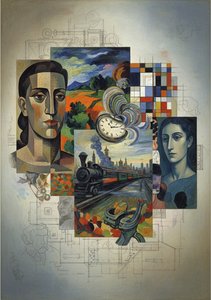
As Modernism gained momentum, a spirit of radical innovation took hold. The term “avant-garde,” meaning ‘advance guard,’ aptly described artists who challenged the very foundations of artistic expression. This rejection of tradition wasn’t simply about new techniques; it was a deliberate attempt to dismantle established aesthetic values and reflect the rapidly changing world. Cubism, pioneered by Picasso and Braque, shattered pictorial space, presenting objects from multiple perspectives simultaneously – a revolutionary approach that questioned the nature of perception itself. Simultaneously, Futurism in Italy celebrated speed, technology, and dynamism, glorifying the machine age with bold colors and fragmented forms. These movements weren’t isolated phenomena; they were interconnected expressions of a broader cultural upheaval, fueled by industrialization, urbanization, and a growing sense of alienation. The influence extended beyond painting to sculpture, literature, and even architecture, fundamentally altering the landscape of artistic creation.
Suprematism & Analytical Realism: A Radical Abstraction of Form and Spirit
Pushing abstraction to its logical extreme was Suprematism, founded by Kazimir Malevich in Russia around 1915. Rejecting any reference to the visible world, Malevich sought pure artistic feeling through basic geometric forms – squares, circles, lines – floating on a white ground. His iconic “Black Square” (1915) wasn’t simply an absence of representation; it was a declaration of non-objectivity, a spiritual quest for ultimate purity in art. Concurrently, Pavel Filonov developed Analytical Realism, a uniquely Russian approach that sought to dissect and reconstruct reality through microscopic analysis of form and color. Unlike Suprematism's stark simplicity, Filonov’s works were intensely detailed, almost obsessive in their rendering of organic forms and textures. Natalia Goncharova, another key figure of the Russian avant-garde, explored Rayonism – a dynamic interplay of intersecting lines representing rays of light – further demonstrating the diverse approaches to abstraction emerging at this time. These artists weren't merely creating aesthetically pleasing compositions; they were attempting to access a deeper level of consciousness and express universal truths through pure form.
Modernism's Legacy: Influence on Contemporary Art and Collecting
The impact of Modernism reverberates throughout contemporary art. Abstract Expressionism, Minimalism, Conceptual Art – all owe a debt to the pioneers who dared to break with tradition. The emphasis on subjective experience, experimentation, and challenging established norms continues to shape artistic practice today. For collectors, understanding the historical context of these movements is crucial. Identifying key works by artists like Malevich, Goncharova, and those associated with Cubism and Futurism represents not only an investment in aesthetic value but also a connection to a pivotal moment in art history. The scarcity of original works from this period makes them highly sought after, demanding careful research and expert appraisal. Beyond the monetary value, owning a piece from this era is possessing a tangible link to the intellectual and cultural ferment that defined the 20th century.
Navigating the Market: Identifying Key Works and Emerging Trends
The art market surrounding Modernist works can be complex. Authenticity is paramount, requiring thorough provenance research and expert examination of technique and materials. Focusing on artists who consistently pushed boundaries – those whose work embodies the core principles of their respective movements – often yields the most rewarding results. Kazimir Malevich’s “Three Suprematic Figures” exemplifies the purity of his vision, while Natalia Goncharova’s Rayonist paintings showcase a unique dynamism and energy. Beyond established masters, exploring lesser-known figures within these movements can uncover hidden gems with significant potential. Consulting with art advisors and utilizing resources like museum collections and scholarly publications are invaluable steps in building a discerning collection. The enduring appeal of Modernism lies not only in its aesthetic innovation but also in its intellectual depth – a legacy that continues to inspire and captivate collectors worldwide.