Text size

() ·

A painting made for you, by hand

Going to the Hayfield

Hand Made Oil Reproduction

Hand-painted oil on canvas in your size and frame, made to order by our artists. ( Switch to Print Switch to Digital Image)

Collectible Description

David Cox's "Going to the Hayfield" captures a serene rural scene with loose brushstrokes and atmospheric lighting, reflecting Romantic landscape painting’s beauty.

Artist Biography

Discover David Cox (1783-1859), a pivotal English landscape painter & precursor to Impressionism. Explore his emotive watercolors, oil paintings of British countryside, and influence on 19th-century art.

from ·

Chapter 1

How large should it be?

Slide to change the size; the picture on the left shows the frame at its real width. The proportions of the original are kept.

Standard
custom
CM
INCH

Pick from our preset sizes that match the artwork's original proportions.

width
height

Type the width and the height you need, to fit your frame or your wall. This is hand-painted, so for a size with a different shape the artist can paint a bit more around the picture, or cut a bit — you choose. We send you a digital mockup to approve before the painting starts. The picture shown on this page does not show the real result — only the mockup does.

Chapter 2

How should it arrive?

Choose the edges of the stretched canvas

Choose your frame

Corner sample of the WhiteWrap canvas edge finish, stretched on solid wood bars
White $1
Corner sample of the BlurSideWrap canvas edge finish, stretched on solid wood bars
Blurside $1
Corner sample of the ExtendedWrap canvas edge finish, stretched on solid wood bars
Extended $1
Corner sample of the P118B picture frame: moulded polystyrene, 5 cm wide and 3 cm thick
P118B $10
Corner sample of the P118H picture frame: moulded polystyrene, 5 cm wide and 3 cm thick
P118H $10
Corner sample of the P118W picture frame: moulded polystyrene, 5 cm wide and 3 cm thick
P118W $10
Corner sample of the P438Z picture frame: moulded polystyrene, 5.5 cm wide and 3.5 cm thick
P438Z $10
Corner sample of the P508JH picture frame: moulded polystyrene, 7 cm wide and 3.5 cm thick
P508JH $12
Corner sample of the P508YH picture frame: moulded polystyrene, 7 cm wide and 3.5 cm thick
P508YH $12
Corner sample of the P805H picture frame: moulded polystyrene, 5 cm wide and 3.5 cm thick
P805H $10
Corner sample of the P805Z picture frame: moulded polystyrene, 5 cm wide and 3.5 cm thick
P805Z $10
Corner sample of the P919BZ picture frame: moulded polystyrene, 7 cm wide and 3.5 cm thick
P919BZ $10
Corner sample of the P919G picture frame: moulded polystyrene, 7 cm wide and 3.5 cm thick
P919G $10
Corner sample of the P919XJ picture frame: moulded polystyrene, 7 cm wide and 3.5 cm thick
P919XJ $10
Corner sample of the P959ZH picture frame: moulded polystyrene, 5 cm wide and 3 cm thick
P959ZH $10
Corner sample of the P968JZ picture frame: moulded polystyrene, 6 cm wide and 4 cm thick
P968JZ $12
Corner sample of the W106C picture frame: solid wood, 5 cm wide and 3 cm thick
W106C $8
Corner sample of the W218G picture frame: solid wood, 5 cm wide and 3 cm thick
W218G $10
Corner sample of the W218JH picture frame: solid wood, 5 cm wide and 3 cm thick
W218JH $8
Corner sample of the W218Y picture frame: solid wood, 5 cm wide and 3 cm thick
W218Y $10
Corner sample of the W307PJ picture frame: solid wood, 6 cm wide and 3 cm thick
W307PJ $10
Corner sample of the W316G picture frame: solid wood, 6 cm wide and 3 cm thick
W316G $10
Corner sample of the W316PJ picture frame: solid wood, 6 cm wide and 3 cm thick
W316PJ $8
Corner sample of the W316Y picture frame: solid wood, 6 cm wide and 3 cm thick
W316Y $10
Corner sample of the W398PJ picture frame: solid wood, 5 cm wide and 3 cm thick
W398PJ $8
Corner sample of the W4111J picture frame: solid wood, 6.5 cm wide and 3.5 cm thick
W4111J $10
Corner sample of the W500HY picture frame: solid wood, 7 cm wide and 5 cm thick
W500HY $15
Corner sample of the W500JH picture frame: solid wood, 7 cm wide and 5 cm thick
W500JH $15
Corner sample of the W692G picture frame: solid wood, 8 cm wide and 4 cm thick
W692G $12
Corner sample of the W849H picture frame: solid wood, 5 cm wide and 3 cm thick
W849H $8
Corner sample of the W940BG picture frame: solid wood, 7.5 cm wide and 4.5 cm thick
W940BG $15
Corner sample of the W953PJ picture frame: solid wood, 6 cm wide and 3.5 cm thick
W953PJ $8
Corner sample of the H24-GOLD picture frame: carved wood with gesso, 10 cm wide and 6 cm thick
H24-GOLD $30
Corner sample of the H24-SILVER picture frame: carved wood with gesso, 10 cm wide and 6 cm thick
H24-SILVER $30
Corner sample of the H36-GOLD picture frame: carved wood with gesso, 15 cm wide and 6.5 cm thick
H36-GOLD $45
Corner sample of the H36-SILVER picture frame: carved wood with gesso, 15 cm wide and 6.5 cm thick
H36-SILVER $45
Frame preview
Framed

Moulding: . Overall size with the frame: .

Chapter 3

Who paints it, and should anything change?

Examples of what can be changed: Replace face with customer photo; Add pet (e.g., replace cat with dog); Include hidden message in background; Change background landscape or elements.
After order, OriginalUniqueArt.com team will email client for instructions and provide a mockup preview

Worldwide Delivery () in 3/4 weeks instead of standard 5 weeks. (31 October). No compromise on quality.

Chapter 4

The finishing touches

A nameplate, as in a museum?

Engraved Bronze Plaque Details

This elegant plaque features the artist's name and the title of the artwork, finely engraved for a timeless presentation.

It is made from bronze with a refined, elegant finish. The text is precisely laser-engraved for a sharp and permanent result. Measuring 9x2 cm, the plaque is compact yet easy to read. It's built to be durable and scratch-resistant, offering a professional, museum-quality look. Mounting is simple thanks to the included adhesive backing.

Transparent Acrylic Plaque Details

The plaque includes essential engraved details such as the artist's name, the title of the artwork, the date it was created, the type of media used-like oil on canvas or watercolor-a brief description of the piece, and a QR code that links to the complete artwork information.

It is crafted from clear acrylic, offering a sleek, modern appearance. The text is UV-engraved in black to ensure strong visual contrast. With a size of 10x15 cm, it ensures optimal readability. It comes equipped with two metal hooks for secure wall mounting. The plaque is designed to be weather-resistant, making it suitable for various environments, and it includes interactive features that work seamlessly with smartphone scanning.

Black Acrylic Plaque Details

This elegant plaque includes engraved information such as the artist's name, the title of the artwork, the date it was created, the type of media used (like oil on canvas or watercolor), a short description of the artwork, and a QR code for quick access to more information.

The plaque itself is made from refined black acrylic with a premium finish. The text is laser-engraved in white for high contrast and readability. Its size is 10x15 cm, designed to be easy to read. It comes with two metal hooks for professional mounting. The design is sleek and fits any interior style. It is also weather-resistant and durable, with built-in digital integration for mobile compatibility.

A protective varnish?

When do you need it?

Chapter 5

Your painting, as you ordered it

Going to the Hayfield

Reproduction Medium

Reproduction Size

-

Elite Senior Artist

More detail, finesse, and extra production time

-

Reproduction Frame

-

-

For artworks or reproductions larger than 105 cm (approximately 41 inches) on any side, the frame will be shipped as a kit, disassembled. This method ensures safe delivery and prevents damage during transport.

Professional assembly required - this is not a DIY product.
The kit must be assembled and the canvas stretched by an experienced professional framer, using wood glue (not supplied), a canvas stretching plier and clamps to hold the bars square while the glue dries. Incorrect assembly or uneven canvas tension can permanently damage the artwork and is not covered by our warranty.

  • All solid wood bars are included, precisely cut to size.

  • Assembled with the screws provided, plus wood glue for the corner joints, which is not supplied and must be sourced by your framer.

  • Professional tools are required and not included: a canvas stretching plier (tensioner) and clamps to hold the bars square while the glue dries.

Important:
The corner joints require wood glue, the bars must be held with clamps until the glue is fully dry, and tightening the canvas on the assembled frame requires a canvas stretching plier. None of these are included in the kit. Please arrange an experienced professional framer before ordering this size.

Nameplate

-

-

Protective Varnish

Glossy Varnish (enhances colors, protects against light/moisture)

-

Customize My Artwork

Examples of what can be changed: Replace face with customer photo; Add pet (e.g., replace cat with dog); Include hidden message in background; Change background landscape or elements.

-

Urgent

Worldwide Delivery () in 3/4 weeks instead of standard 5 weeks. (31 October). No compromise on quality.

-

Express Shipping

Worldwide Delivery () in 5 weeks. (7 November).

Included

Total Price

$ 350

Total Price $ 350

Glass option is only available in size under 110 CM

Included with every order

  • Free Worldwide Express Shipping
  • High-Quality Linen Canvas
  • Full Shipping Insurance
  • Customs Tax Refund Guarantee
  • True Color Matching Guarantee
  • 100-Day Return Policy (Defects Only)
  • 100% Money-Back Guarantee
  • Bulk Discount Offer

A Moment of Rural Tranquility: Exploring David Cox’s “Going to the Hayfield”

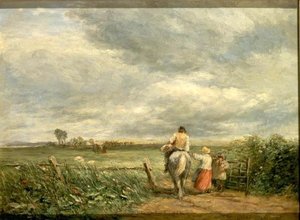
David Cox's "Going to the Hayfield," painted in 1849, isn’t merely a landscape; it’s a carefully constructed distillation of Romantic sensibility and a profound connection to the English countryside. This evocative piece, now beautifully reproduced, transports us to a specific moment – a quiet afternoon as figures journey towards a hayfield bathed in the diffused light of an overcast sky. Cox, a pivotal figure bridging the gap between earlier landscape traditions and the burgeoning Impressionism of his time, masterfully captures not just the visual elements but also the atmosphere and emotional resonance of rural life.

Cox’s style is distinctly Romantic, prioritizing mood and feeling over precise detail. He eschews sharp outlines and meticulous rendering in favor of loose, expressive brushstrokes that create a sense of movement and texture throughout the canvas. The painting feels less like a photographic representation and more like an emotional response to the scene – a memory imbued with tranquility and a subtle melancholy. The muted color palette—dominated by earthy greens, browns, and grays punctuated by hints of red in the figures’ clothing—further enhances this atmospheric effect, suggesting a timelessness that transcends any specific date or season.

Composition and Perspective: Framing a Pastoral Scene

The composition is deliberately horizontal, emphasizing the vast expanse of the sky which dominates nearly two-thirds of the canvas. This expansive view immediately establishes a sense of scale and invites the viewer to lose themselves in the landscape. A subtle foreground—a simple fence and patches of foliage—serves as a gentle guide, drawing our eye towards the middle ground where the figures are positioned. The low horizon line reinforces this feeling of openness and amplifies the drama of the sky. Cox skillfully employs atmospheric perspective; distant elements recede into a hazy blue distance, creating an illusion of depth and suggesting the immense scale of the countryside.

The placement of the figures – a small group riding horseback and walking alongside a fence – is crucial to the painting’s narrative. They are not imposing subjects but rather integrated seamlessly within the landscape, representing humanity's quiet interaction with nature. Their presence anchors the scene while simultaneously highlighting its inherent beauty and solitude.

Symbolism and Emotional Resonance: A Reflection of Romantic Ideals

“Going to the Hayfield” is rich in symbolic meaning, reflecting the core tenets of the Romantic movement. The overcast sky, often interpreted as a symbol of introspection or contemplation, lends a subtle melancholy to the scene. It’s not a bright, celebratory landscape; rather, it evokes a sense of quiet reflection and connection to something larger than oneself. The hayfield itself represents abundance and sustenance – a vital element of rural life and a reminder of nature's generosity. Cox’s choice of subject matter—a simple, everyday activity—elevates it to an artistic statement about the beauty and value of the natural world.

Technique and Materials: The Art of Layered Impressionism

Cox’s technique is characterized by a layering of colors applied with loose brushstrokes. He builds up the image gradually, creating a sense of depth and texture through subtle variations in tone and hue. The use of oil paint on canvas allows for rich color saturation and blending—essential to achieving the painting's atmospheric effect. The artist’s deliberate avoidance of sharp lines contributes to the overall feeling of softness and fluidity. It is a testament to Cox’s skill that this seemingly simple landscape feels so profoundly alive, capturing not just what he saw but also how he *felt* about it.

Questions & Answers

What feeling does "Going to the Hayfield" by David Cox convey?

The recorded mood of "Going to the Hayfield" by David Cox is calm, and its emotional tone is tranquil.

How does the style of "Going to the Hayfield" relate to its creator's era?

"Going to the Hayfield" belongs to the Romantic Landscape Painting movement, and its creator worked in the 19th-Century era.

How can I view "Going to the Hayfield" by David Cox as a slideshow?

The diaporama of "Going to the Hayfield" can be watched on the artwork's Diaporama page.

More about this painting

Preview AR preview Switch to Print Switch to Digital Image Send
Details Guide Add to favorites Download Similars X-Ray Diaporama Q&A Stats

In numbers

  • 1849the year it was painted
  • 29frames to choose from
  • standard sizes, in its own proportions
  • 5weeks to paint and deliver it
David Cox

David Cox

1783 - 1859, United Kingdom

Quick facts about David Cox

  • Name: David Cox
  • Movement: English Landscape, Pre-Impressionism
  • Birth Date: April 29, 1783
  • Death Date: 1859
  • Birth Place: Deritend, Birmingham, United Kingdom
  • Nationality: British
  • Date Of Birth: 1783
  • Date Of Death: 1859
  • Notable Works:
    • The Wind on the Heath
    • Cottage in Herefordshire
    • Junction of the Severn and the Wye with Chepstow in the distance
    • Moonlight Landscape
  • Place Of Birth: Birmingham, United Kingdom

Artist Biography

David Cox: A Life in Landscape

Early Life and Training

  • Born: April 29, 1783, in Deritend, Birmingham, United Kingdom.
  • David Cox’s father was a blacksmith and whitesmith supplying components to the Birmingham gun trade. His mother, from a farming background, possessed a superior education and strong character.
  • He initially enrolled at the academy of Joseph Barber in Great Charles Street, where he met fellow students Charles Barber and William Radclyffe.
  • At age 15, Cox became apprenticed to Albert Fielder, a Birmingham painter specializing in portrait miniatures and decorative paintings for objects like snuffboxes. This early training provided him with foundational skills.

Career Development & Artistic Journey

  • In 1804, Cox moved to London and married his landlord’s daughter, Mary Ragg.
  • A pivotal trip to Wales in 1805 with Charles Barber marked the beginning of numerous sketching tours throughout his lifetime. These travels profoundly influenced his artistic style.
  • He regularly exhibited at the Royal Academy from 1805, initially earning a living as a drawing master. Colonel Hon. H. Windsor became one of his first pupils in 1808.
  • Cox’s early work focused on detailed watercolor landscapes, often depicting rural scenes and architectural subjects.

Artistic Style & Influences

  • Cox's style evolved over time. He moved from precise topographical depictions to a more expressive and atmospheric approach.

  • Influences: While specific influences are debated, his work demonstrates an affinity for the Dutch landscape painters of the 17th century and a keen observation of nature reminiscent of Constable.
  • He became known for his loose brushwork, vibrant colors, and ability to capture the effects of light and weather. His later oil paintings were particularly innovative.

Major Achievements & Legacy

  • Cox painted over 300 works in oil towards the end of his career, now recognized as “one of the greatest, but least recognised, achievements of any British painter.”
  • He is considered one of the greatest English landscape painters and a major figure of the Golden Age of English Watercolour.
  • His work significantly influenced subsequent generations of landscape artists.
  • Notable Works: The Wind on the Heath, Cottage in Herefordshire, Junction of the Severn and the Wye with Chepstow in the distance, and Moonlight Landscape are among his most celebrated paintings.

Historical Significance

  • David Cox is recognized as an early precursor to Impressionism. His emphasis on capturing fleeting atmospheric effects and his loose brushwork anticipated many of the techniques later adopted by the Impressionists.
  • He played a crucial role in establishing British landscape painting as a distinct genre, moving away from purely topographical representations towards more expressive and emotional interpretations of nature.
  • His work continues to be admired for its beauty, sensitivity, and enduring appeal.

Quick Facts

  • Year: 1849
  • Medium: Oil on canvas
  • Artistic style: Atmospheric
  • Artist: David Cox
  • Influences: Cox's work

Art Quiz

There is only one correct answer for each question.

Question 1:
What is the primary subject matter depicted in David Cox’s ‘Going to the Hayfield’?
Question 2:
The painting ‘Going to the Hayfield’ is characteristic of which artistic movement?
Question 3:
What is a key feature of David Cox’s painting style as evidenced in ‘Going to the Hayfield’?
Question 4:
Based on the description, what is the dominant color palette used in ‘Going to the Hayfield’?
Question 5:
In what year was ‘Going to the Hayfield’ painted?