Preview
 Send
Send Share
Share
 Details
 Guide
Guide

 Download
 Similars
 X-Ray
X-Ray Diaporama
 Q&A
Q&A Stats
StatsGoing to the Hayfield


 Read More
Giclée / Art Print
Museum-quality giclée or canvas print with fast production and flexible finish options. ( Buy Hand Made Painting Switch to Digital Image)




P118B $10

P118H $10

P118W $10

P438Z $10

P508JH $12

P508YH $12

P805H $10

P805Z $10

P919BZ $10

P919G $10

P919XJ $10

P959ZH $10

P968JZ $12

W106C $8

W218G $10

W218JH $8

W218Y $10

W307PJ $10

W316G $10

W316PJ $8

W316Y $10

W398PJ $8

W4111J $10

W500HY $15

W500JH $15

W692G $12

W849H $8

W940BG $15

W953PJ $8




Pick from our preset sizes that match the artwork's original proportions.

Type the width and the height you need, to fit your frame or your wall. A print can only be cut, never made bigger than the picture, so a size with a different shape loses a part of the image. We send you a digital mockup to approve before we print anything. The picture shown on this page does not show the real cut — only the mockup does.
Worldwide Delivery () in 2 weeks instead of standard 4/5 weeks. (31 October)

Free Worldwide Express Shipping

High-Quality Linen Canvas

Full Shipping Insurance

Customs Tax Refund Guarantee

True Color Matching Guarantee

100-Day Return Policy (Defects Only)

100% Money-Back Guarantee

Bulk Discount Offer
 Glass option is only available in size under 110 CM

Going to the Hayfield
Giclée / Art Print
Reproduction Size
-


Total Price
$ 81
A Moment of Rural Tranquility: Exploring David Cox’s “Going to the Hayfield”
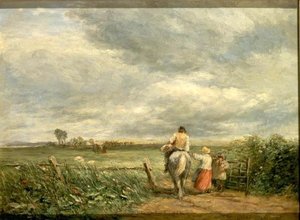
David Cox's "Going to the Hayfield," painted in 1849, isn’t merely a landscape; it’s a carefully constructed distillation of Romantic sensibility and a profound connection to the English countryside. This evocative piece, now beautifully reproduced, transports us to a specific moment – a quiet afternoon as figures journey towards a hayfield bathed in the diffused light of an overcast sky. Cox, a pivotal figure bridging the gap between earlier landscape traditions and the burgeoning Impressionism of his time, masterfully captures not just the visual elements but also the atmosphere and emotional resonance of rural life.
Cox’s style is distinctly Romantic, prioritizing mood and feeling over precise detail. He eschews sharp outlines and meticulous rendering in favor of loose, expressive brushstrokes that create a sense of movement and texture throughout the canvas. The painting feels less like a photographic representation and more like an emotional response to the scene – a memory imbued with tranquility and a subtle melancholy. The muted color palette—dominated by earthy greens, browns, and grays punctuated by hints of red in the figures’ clothing—further enhances this atmospheric effect, suggesting a timelessness that transcends any specific date or season.
Composition and Perspective: Framing a Pastoral Scene
The composition is deliberately horizontal, emphasizing the vast expanse of the sky which dominates nearly two-thirds of the canvas. This expansive view immediately establishes a sense of scale and invites the viewer to lose themselves in the landscape. A subtle foreground—a simple fence and patches of foliage—serves as a gentle guide, drawing our eye towards the middle ground where the figures are positioned. The low horizon line reinforces this feeling of openness and amplifies the drama of the sky. Cox skillfully employs atmospheric perspective; distant elements recede into a hazy blue distance, creating an illusion of depth and suggesting the immense scale of the countryside.
The placement of the figures – a small group riding horseback and walking alongside a fence – is crucial to the painting’s narrative. They are not imposing subjects but rather integrated seamlessly within the landscape, representing humanity's quiet interaction with nature. Their presence anchors the scene while simultaneously highlighting its inherent beauty and solitude.
Symbolism and Emotional Resonance: A Reflection of Romantic Ideals
“Going to the Hayfield” is rich in symbolic meaning, reflecting the core tenets of the Romantic movement. The overcast sky, often interpreted as a symbol of introspection or contemplation, lends a subtle melancholy to the scene. It’s not a bright, celebratory landscape; rather, it evokes a sense of quiet reflection and connection to something larger than oneself. The hayfield itself represents abundance and sustenance – a vital element of rural life and a reminder of nature's generosity. Cox’s choice of subject matter—a simple, everyday activity—elevates it to an artistic statement about the beauty and value of the natural world.
Technique and Materials: The Art of Layered Impressionism
Cox’s technique is characterized by a layering of colors applied with loose brushstrokes. He builds up the image gradually, creating a sense of depth and texture through subtle variations in tone and hue. The use of oil paint on canvas allows for rich color saturation and blending—essential to achieving the painting's atmospheric effect. The artist’s deliberate avoidance of sharp lines contributes to the overall feeling of softness and fluidity. It is a testament to Cox’s skill that this seemingly simple landscape feels so profoundly alive, capturing not just what he saw but also how he *felt* about it.
Questions & Answers
What feeling does "Going to the Hayfield" by David Cox convey?
The recorded mood of "Going to the Hayfield" by David Cox is calm, and its emotional tone is tranquil.
How does the style of "Going to the Hayfield" relate to its creator's era?
"Going to the Hayfield" belongs to the Romantic Landscape Painting movement, and its creator worked in the 19th-Century era.
How can I view "Going to the Hayfield" by David Cox as a slideshow?
The diaporama of "Going to the Hayfield" can be watched on the artwork's Diaporama page.
Artist Biography
David Cox: A Life in Landscape
Early Life and Training
- Born: April 29, 1783, in Deritend, Birmingham, United Kingdom.
- David Cox’s father was a blacksmith and whitesmith supplying components to the Birmingham gun trade. His mother, from a farming background, possessed a superior education and strong character.
- He initially enrolled at the academy of Joseph Barber in Great Charles Street, where he met fellow students Charles Barber and William Radclyffe.
- At age 15, Cox became apprenticed to Albert Fielder, a Birmingham painter specializing in portrait miniatures and decorative paintings for objects like snuffboxes. This early training provided him with foundational skills.
Career Development & Artistic Journey
- In 1804, Cox moved to London and married his landlord’s daughter, Mary Ragg.
- A pivotal trip to Wales in 1805 with Charles Barber marked the beginning of numerous sketching tours throughout his lifetime. These travels profoundly influenced his artistic style.
- He regularly exhibited at the Royal Academy from 1805, initially earning a living as a drawing master. Colonel Hon. H. Windsor became one of his first pupils in 1808.
- Cox’s early work focused on detailed watercolor landscapes, often depicting rural scenes and architectural subjects.
Artistic Style & Influences
- Cox's style evolved over time. He moved from precise topographical depictions to a more expressive and atmospheric approach.
- Influences: While specific influences are debated, his work demonstrates an affinity for the Dutch landscape painters of the 17th century and a keen observation of nature reminiscent of Constable.
- He became known for his loose brushwork, vibrant colors, and ability to capture the effects of light and weather. His later oil paintings were particularly innovative.
Major Achievements & Legacy
- Cox painted over 300 works in oil towards the end of his career, now recognized as “one of the greatest, but least recognised, achievements of any British painter.”
- He is considered one of the greatest English landscape painters and a major figure of the Golden Age of English Watercolour.
- His work significantly influenced subsequent generations of landscape artists.
- Notable Works: The Wind on the Heath, Cottage in Herefordshire, Junction of the Severn and the Wye with Chepstow in the distance, and Moonlight Landscape are among his most celebrated paintings.
Historical Significance
- David Cox is recognized as an early precursor to Impressionism. His emphasis on capturing fleeting atmospheric effects and his loose brushwork anticipated many of the techniques later adopted by the Impressionists.
- He played a crucial role in establishing British landscape painting as a distinct genre, moving away from purely topographical representations towards more expressive and emotional interpretations of nature.
- His work continues to be admired for its beauty, sensitivity, and enduring appeal.
David Cox
1783 - 1859 , United Kingdom
Quick Facts
- Name: David Cox
- Movement: English Landscape, Pre-Impressionism
- Birth Date: April 29, 1783
- Death Date: 1859
- Birth Place: Deritend, Birmingham, United Kingdom
- Nationality: British
- Date Of Birth: 1783
- Date Of Death: 1859
- Notable Works:
- The Wind on the Heath
- Cottage in Herefordshire
- Junction of the Severn and the Wye with Chepstow in the distance
- Moonlight Landscape
- Place Of Birth: Birmingham, United Kingdom
Related Articles

Romantic Landscapes: 10 Masterpieces for Your Home | OriginalUniqueArt
Journey through 10 Romantic landscape masterpieces by Friedrich, Turner & Cole. Explore emotional art, sublime nature scenes & iconic 19th-century paintings. Find museum-quality reproductions for your home at OriginalUniqueArt.com – discover the full collection online!

Mastering the English Landscape: The Top 25 John Constable Artworks
Experience the soul of English landscapes through John Constable's top 25 works. Explore the full collection online at OriginalUniqueArt.com.

Watercolor Wonders: 10 Masterpieces That Redefined Art History | OriginalUniqueArt
Journey through 10 legendary watercolor masterpieces by Sargent, Turner & Homer! Explore iconic landscapes, portraits & floral art that redefined history. Find museum-quality reproductions and curated decor ideas at OriginalUniqueArt.com.

David Cox the Elder: Landscape, Light & the Romantic Vision of Rural England
Explore the captivating landscapes of David Cox the Elder, a pivotal figure in British Romanticism. Discover his masterful watercolour techniques, enduring legacy & find timeless art for your home at OriginalUniqueArt.

Ephemeral Visions: Exploring the Artistic Legacy & Contemporary Practice of Watercolor Painting
Explore the captivating world of watercolor painting! Discover its rich history, essential techniques, influential artists & collecting tips. A comprehensive guide for art enthusiasts from OriginalUniqueArt.