Menu

() ·

A painting made for you, by hand

Shells

Hand Made Oil Reproduction

Hand-painted oil on canvas in your size and frame, made to order by our artists. ( Switch to Print Switch to Digital Image)

Collectible Description

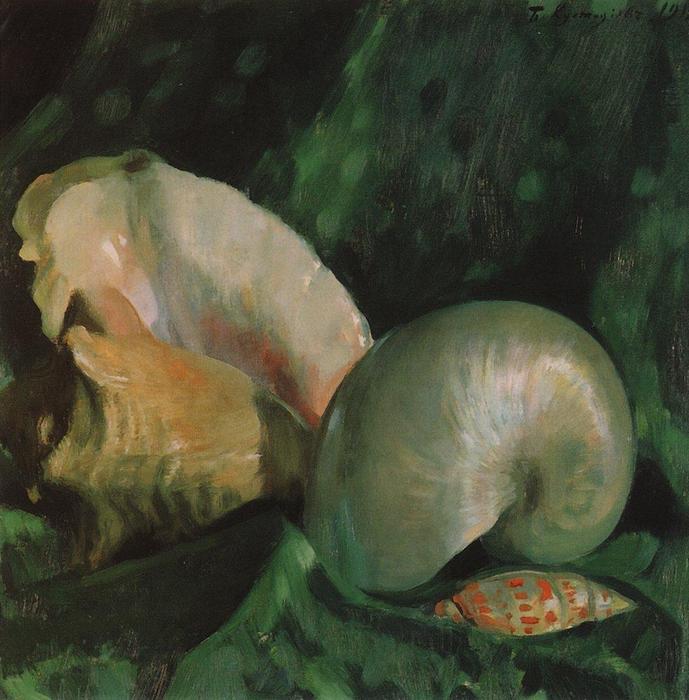
Explore Boris Mikhailovich Kustodiev’s ‘Shells,’ a captivating depiction of Russian rural life featuring prominent shells alongside everyday objects like an apple and banana – a testament to Repin's influence.

Artist Biography

Boris Kustodiev (1878-1927) was a renowned Russian painter celebrated for his vibrant depictions of Russian life, merchant culture, and genre scenes. Explore his colorful realism & stage designs!

from ·

Chapter 1

How large should it be?

Slide to change the size; the picture on the left shows the frame at its real width. The proportions of the original are kept.

Standard
custom
CM
INCH

Pick from our preset sizes that match the artwork's original proportions.

width
height

Type the width and the height you need, to fit your frame or your wall. This is hand-painted, so for a size with a different shape the artist can paint a bit more around the picture, or cut a bit — you choose. We send you a digital mockup to approve before the painting starts. The picture shown on this page does not show the real result — only the mockup does.

Chapter 2

How should it arrive?

Choose the edges of the stretched canvas

Choose your frame

Corner sample of the WhiteWrap canvas edge finish, stretched on solid wood bars
White $1
Corner sample of the BlurSideWrap canvas edge finish, stretched on solid wood bars
Blurside $1
Corner sample of the ExtendedWrap canvas edge finish, stretched on solid wood bars
Extended $1
Corner sample of the P118B picture frame: moulded polystyrene, 5 cm wide and 3 cm thick
P118B $10
Corner sample of the P118H picture frame: moulded polystyrene, 5 cm wide and 3 cm thick
P118H $10
Corner sample of the P118W picture frame: moulded polystyrene, 5 cm wide and 3 cm thick
P118W $10
Corner sample of the P438Z picture frame: moulded polystyrene, 5.5 cm wide and 3.5 cm thick
P438Z $10
Corner sample of the P508JH picture frame: moulded polystyrene, 7 cm wide and 3.5 cm thick
P508JH $12
Corner sample of the P508YH picture frame: moulded polystyrene, 7 cm wide and 3.5 cm thick
P508YH $12
Corner sample of the P805H picture frame: moulded polystyrene, 5 cm wide and 3.5 cm thick
P805H $10
Corner sample of the P805Z picture frame: moulded polystyrene, 5 cm wide and 3.5 cm thick
P805Z $10
Corner sample of the P919BZ picture frame: moulded polystyrene, 7 cm wide and 3.5 cm thick
P919BZ $10
Corner sample of the P919G picture frame: moulded polystyrene, 7 cm wide and 3.5 cm thick
P919G $10
Corner sample of the P919XJ picture frame: moulded polystyrene, 7 cm wide and 3.5 cm thick
P919XJ $10
Corner sample of the P959ZH picture frame: moulded polystyrene, 5 cm wide and 3 cm thick
P959ZH $10
Corner sample of the P968JZ picture frame: moulded polystyrene, 6 cm wide and 4 cm thick
P968JZ $12
Corner sample of the W106C picture frame: solid wood, 5 cm wide and 3 cm thick
W106C $8
Corner sample of the W218G picture frame: solid wood, 5 cm wide and 3 cm thick
W218G $10
Corner sample of the W218JH picture frame: solid wood, 5 cm wide and 3 cm thick
W218JH $8
Corner sample of the W218Y picture frame: solid wood, 5 cm wide and 3 cm thick
W218Y $10
Corner sample of the W307PJ picture frame: solid wood, 6 cm wide and 3 cm thick
W307PJ $10
Corner sample of the W316G picture frame: solid wood, 6 cm wide and 3 cm thick
W316G $10
Corner sample of the W316PJ picture frame: solid wood, 6 cm wide and 3 cm thick
W316PJ $8
Corner sample of the W316Y picture frame: solid wood, 6 cm wide and 3 cm thick
W316Y $10
Corner sample of the W398PJ picture frame: solid wood, 5 cm wide and 3 cm thick
W398PJ $8
Corner sample of the W4111J picture frame: solid wood, 6.5 cm wide and 3.5 cm thick
W4111J $10
Corner sample of the W500HY picture frame: solid wood, 7 cm wide and 5 cm thick
W500HY $15
Corner sample of the W500JH picture frame: solid wood, 7 cm wide and 5 cm thick
W500JH $15
Corner sample of the W692G picture frame: solid wood, 8 cm wide and 4 cm thick
W692G $12
Corner sample of the W849H picture frame: solid wood, 5 cm wide and 3 cm thick
W849H $8
Corner sample of the W940BG picture frame: solid wood, 7.5 cm wide and 4.5 cm thick
W940BG $15
Corner sample of the W953PJ picture frame: solid wood, 6 cm wide and 3.5 cm thick
W953PJ $8
Corner sample of the H24-GOLD picture frame: carved wood with gesso, 10 cm wide and 6 cm thick
H24-GOLD $30
Corner sample of the H24-SILVER picture frame: carved wood with gesso, 10 cm wide and 6 cm thick
H24-SILVER $30
Corner sample of the H36-GOLD picture frame: carved wood with gesso, 15 cm wide and 6.5 cm thick
H36-GOLD $45
Corner sample of the H36-SILVER picture frame: carved wood with gesso, 15 cm wide and 6.5 cm thick
H36-SILVER $45
Frame preview
Framed

Moulding: . Overall size with the frame: .

Chapter 3

Who paints it, and should anything change?

Examples of what can be changed: Replace face with customer photo; Add pet (e.g., replace cat with dog); Include hidden message in background; Change background landscape or elements.
After order, OriginalUniqueArt.com team will email client for instructions and provide a mockup preview

Worldwide Delivery () in 3/4 weeks instead of standard 5 weeks. (30 October). No compromise on quality.

Chapter 4

The finishing touches

A nameplate, as in a museum?

Engraved Bronze Plaque Details

This elegant plaque features the artist's name and the title of the artwork, finely engraved for a timeless presentation.

It is made from bronze with a refined, elegant finish. The text is precisely laser-engraved for a sharp and permanent result. Measuring 9x2 cm, the plaque is compact yet easy to read. It's built to be durable and scratch-resistant, offering a professional, museum-quality look. Mounting is simple thanks to the included adhesive backing.

Transparent Acrylic Plaque Details

The plaque includes essential engraved details such as the artist's name, the title of the artwork, the date it was created, the type of media used-like oil on canvas or watercolor-a brief description of the piece, and a QR code that links to the complete artwork information.

It is crafted from clear acrylic, offering a sleek, modern appearance. The text is UV-engraved in black to ensure strong visual contrast. With a size of 10x15 cm, it ensures optimal readability. It comes equipped with two metal hooks for secure wall mounting. The plaque is designed to be weather-resistant, making it suitable for various environments, and it includes interactive features that work seamlessly with smartphone scanning.

Black Acrylic Plaque Details

This elegant plaque includes engraved information such as the artist's name, the title of the artwork, the date it was created, the type of media used (like oil on canvas or watercolor), a short description of the artwork, and a QR code for quick access to more information.

The plaque itself is made from refined black acrylic with a premium finish. The text is laser-engraved in white for high contrast and readability. Its size is 10x15 cm, designed to be easy to read. It comes with two metal hooks for professional mounting. The design is sleek and fits any interior style. It is also weather-resistant and durable, with built-in digital integration for mobile compatibility.

A protective varnish?

When do you need it?

Chapter 5

Your painting, as you ordered it

Shells

Reproduction Medium

Reproduction Size

-

Elite Senior Artist

More detail, finesse, and extra production time

-

Reproduction Frame

-

-

For artworks or reproductions larger than 105 cm (approximately 41 inches) on any side, the frame will be shipped as a kit, disassembled. This method ensures safe delivery and prevents damage during transport.

Professional assembly required - this is not a DIY product.
The kit must be assembled and the canvas stretched by an experienced professional framer, using wood glue (not supplied), a canvas stretching plier and clamps to hold the bars square while the glue dries. Incorrect assembly or uneven canvas tension can permanently damage the artwork and is not covered by our warranty.

  • All solid wood bars are included, precisely cut to size.

  • Assembled with the screws provided, plus wood glue for the corner joints, which is not supplied and must be sourced by your framer.

  • Professional tools are required and not included: a canvas stretching plier (tensioner) and clamps to hold the bars square while the glue dries.

Important:
The corner joints require wood glue, the bars must be held with clamps until the glue is fully dry, and tightening the canvas on the assembled frame requires a canvas stretching plier. None of these are included in the kit. Please arrange an experienced professional framer before ordering this size.

Nameplate

-

-

Protective Varnish

Glossy Varnish (enhances colors, protects against light/moisture)

-

Customize My Artwork

Examples of what can be changed: Replace face with customer photo; Add pet (e.g., replace cat with dog); Include hidden message in background; Change background landscape or elements.

-

Urgent

Worldwide Delivery () in 3/4 weeks instead of standard 5 weeks. (30 October). No compromise on quality.

-

Express Shipping

Worldwide Delivery () in 5 weeks. (6 November).

Included

Total Price

$ 300

Total Price $ 300

Glass option is only available in size under 110 CM

Included with every order

  • Free Worldwide Express Shipping
  • High-Quality Linen Canvas
  • Full Shipping Insurance
  • Customs Tax Refund Guarantee
  • True Color Matching Guarantee
  • 100-Day Return Policy (Defects Only)
  • 100% Money-Back Guarantee
  • Bulk Discount Offer

A Snapshot of Rural Russia: Exploring Boris Mikhailovich Kustodiev’s “Shells”

Boris Mikhailovich Kustodiev (1878-1927), born in Astrakhan amidst challenging circumstances—his father's untimely demise leaving his family burdened by financial difficulties—became a pivotal figure in Russian Modernism. His artistic vision was profoundly shaped by encounters with the everyday lives of merchants and common folk, resulting in paintings that capture the spirit of rural Russia with remarkable sensitivity and detail. This captivating depiction, “Shells,” exemplifies Kustodiev’s distinctive style and offers a glimpse into his worldview.

The Painting's Composition and Visual Narrative

“Shells” presents a deceptively simple scene: three seashells resting on the earth—one notably larger than the others—accompanied by a solitary apple and a banana. Yet, within this seemingly unassuming tableau lies a rich tapestry of visual storytelling. Kustodiev’s meticulous observation of nature combined with his penchant for incorporating symbolic elements elevates the artwork beyond mere representation. The positioning of the shells suggests an awareness of geological time and decay, mirroring perhaps the broader anxieties surrounding societal change during the turbulent years leading up to the Russian Revolution.

Kustodiev's Artistic Technique: Impressionistic Influences

Kustodiev’s artistic approach leaned heavily on Impressionistic principles, particularly evident in his use of loose brushstrokes and vibrant color palettes. Like Repin before him, he prioritized capturing fleeting moments of light and atmosphere rather than striving for photographic realism. The artist skillfully blended hues to create a luminous effect, emphasizing the textures of the seashells and subtly hinting at the warmth of the sunlit landscape. This technique contributes significantly to the painting’s emotive power—a feeling of tranquil contemplation mingled with an undercurrent of melancholy.

Symbolism Embedded in Everyday Objects

The inclusion of seemingly mundane objects – the apple and banana – is far from accidental. These items serve as symbols of fertility, abundance, and perhaps even nostalgia for a bygone era. They juxtapose against the shells’ quiet permanence, prompting viewers to consider themes of continuity versus transformation. Kustodiev's deliberate choices resonate with broader cultural anxieties about preserving tradition in the face of modernization—a preoccupation that characterizes much of Russian art during his time.

A Legacy of Rustic Beauty and Psychological Depth

“Shells” stands as a testament to Kustodiev’s ability to distill complex emotions into deceptively serene imagery. It's more than just a depiction of shells; it’s an encapsulation of the Russian soul—a soulful reflection on life, death, and the passage of time. Reproductions of this artwork offer collectors and interior designers alike the opportunity to experience Kustodiev’s masterful technique and profound artistic vision, transporting them back to a moment in Russian art history where beauty resided not just in form but also in feeling.

Questions & Answers

Is "Shells" available as a fine art print?

To get a print of "Shells" by Boris Mikhailovich Kustodiev, simply order it on its Fine Art Print page: a fine art print on cotton canvas or archival canvas paper.

What is the recommended print size for "Shells" by Boris Mikhailovich Kustodiev?

A large reproduction is suggested for "Shells" by Boris Mikhailovich Kustodiev. Size can be adjusted while keeping the proportions.

What is the luminance of "Shells" by Boris Mikhailovich Kustodiev?

The colors of "Shells" show a dark luminance.

More about this painting

Preview AR preview Switch to Print Switch to Digital Image Send
Details Guide Add to favorites Download Similars X-Ray Diaporama Q&A Stats

In numbers

  • 1918the year it was painted
  • 29frames to choose from
  • standard sizes, in its own proportions
  • 5weeks to paint and deliver it
Boris Mikhailovich Kustodiev

Boris Mikhailovich Kustodiev

1878 - 1927, Russia

Quick facts about Boris Mikhailovich Kustodiev

  • Full Name: Boris Mikhailovich Kustodiev
  • Nationality: Russian
  • Date Of Birth: 1878
  • Date Of Death: 1927
  • Place Of Birth: Astrakhan, Russia
  • Notable Artworks:
    • The Merchant's Wife
    • Fontanka
    • Maslenitsa
  • Artistic Movement Or Style: Realism, Art Nouveau
  • Artists Who Influenced This Artist:
    • Ilya Repin
    • Vasily Perov

Artist Biography

A Life Immersed in Russian Spirit

Boris Mikhailovich Kustodiev, born on March 7, 1878, in Astrakhan, Russia, was an artist whose work became synonymous with a vibrant and often idealized depiction of Russian life. His early years were marked by a sense of provinciality, shaped by the financial struggles following his father’s untimely death – a professor of philosophy, history, and logic. This exposure to the lives of merchants and common folk would deeply influence the themes that permeated his art throughout his career. Kustodiev's formative education began within the theological seminary in Astrakhan, yet it was private lessons with Pavel Vlasov, a student of Vasily Perov, that truly ignited his artistic passion. This foundation led him to St. Petersburg and the prestigious Imperial Academy of Arts, where he studied under the renowned Ilya Repin from 1896 to 1903. Repin recognized Kustodiev’s talent early on, even inviting him to assist with a monumental commemorative painting, providing invaluable experience and mentorship. This period was crucial in honing his skills and establishing his commitment to capturing the essence of Russian identity.

Artistic Development and Key Themes

Kustodiev's artistic journey unfolded across various genres – portraiture, genre scenes, and book illustration – but he consistently returned to portraying the richness and complexity of Russian culture. His style evolved over time, initially influenced by Realism and later embracing elements of Art Nouveau. He possessed a remarkable ability to depict not just *what* he saw, but also the atmosphere and spirit of a place or moment. The merchant class, with their traditions and customs, became a recurring motif in his work, reflecting those early impressions from his childhood. Paintings like The Merchant’s Wife, completed in 1918, stand as powerful testaments to this fascination, showcasing the dignity and character of these often-overlooked figures. Beyond portraits, Kustodiev masterfully captured scenes of everyday life – bustling marketplaces, lively festivals such as Maslenitsa (Pancake Week) depicted vividly in his 1916 painting of the same name, and serene landscapes that evoked a deep sense of national pride. His work wasn’t merely representational; it was infused with a palpable love for Russia and its people. He traveled extensively throughout Europe – France, Spain, Italy – but always felt drawn back to his homeland, believing that true artistic inspiration lay within the Russian soul.

Overcoming Adversity: Art as Resilience

In 1916, Kustodiev’s life took a dramatic turn when he was struck with paraplegia. Confined to a wheelchair, his physical suffering could have easily extinguished his creative flame. However, it instead fueled an even greater artistic output and a remarkable shift in perspective. Despite the immense challenges, he continued to paint prolifically, his later works characterized by an intensified joyfulness and vibrant color palette. It’s as if, unable to physically experience life fully, he poured all of his energy into recreating its beauty on canvas. This period saw him further refine his style, embracing a more decorative approach that celebrated the simple pleasures of life. His resilience in the face of adversity became an integral part of his artistic legacy, demonstrating the power of art as a source of strength and solace. The market painting by Alexey Petrovich Bogolyubov is a testament to this enduring influence.

Legacy and Historical Significance

Boris Kustodiev’s contribution to Russian art lies in his ability to capture the spirit of an era – a time of immense social change, political upheaval, and cultural awakening. He wasn't simply documenting reality; he was interpreting it through a lens of nostalgia, affection, and profound understanding. His paintings offer invaluable insights into the lives of ordinary Russians during the late 19th and early 20th centuries, preserving their traditions, customs, and values for posterity. His work resonated deeply with audiences then and continues to captivate viewers today. Kustodiev’s influence can be seen in the works of subsequent generations of Russian artists who sought to celebrate their national identity and depict the beauty of everyday life. His paintings are now held in prominent collections across Russia, including the Kramskoy Museum of Fine Arts in Voronezh and the Kharkov Museum of Art in Ukraine, ensuring that his artistic vision will continue to inspire and enrich for years to come.

Notable Works & Collections

  • The Merchant’s Wife (1918): A seminal work embodying Kustodiev's mastery of Russian realism and his affectionate portrayal of the merchant class.
  • Fontanka (1916): A vibrant depiction of St. Petersburg life, showcasing his ability to capture atmosphere and movement.
  • Pancake Tuesday/Maslenitsa (1916): A joyous celebration of a traditional Russian festival, brimming with color and energy.
  • Trinity Day: Captures the lively spirit of a Russian religious celebration.
  • The Attack on the Wedding Carriage: A dramatic woodcut illustrating a historical conflict with striking intensity.
Kustodiev’s art remains a powerful testament to the enduring beauty and resilience of the human spirit, forever etched in the annals of Russian artistic history.

Quick Facts

  • Subject or theme: Nature
  • Location: Private Collection
  • Year: 1918
  • Influences: Vasily Repin
  • Notable elements or techniques: Realistic depiction of shells

Art Quiz

There is only one correct answer for each question.

Question 1:
What is the primary subject matter depicted in Boris Mikhailovich Kustodiev’s painting ‘Shells’?
Question 2:
The image description mentions a banana and an apple. What role do these objects serve in enhancing the painting's visual narrative?
Question 3:
Boris Kustodiev studied under Ilya Repin at the Imperial Academy of Arts. What was Repin’s influence on Kustodiev's artistic development?
Question 4:
What artistic movement is Boris Mikhailovich Kustodiev associated with?
Question 5:
According to the biographical information, what was a significant factor shaping Kustodiev’s artistic vision?