Preview
 Send
Send Share
Share
 Details
 Guide
Guide

 Download
 Similars
 X-Ray
X-Ray Diaporama
 Stats
StatsAugust 1956 (Val d'Orcia)


 Read More
The artwork displayed on this page is protected by copyright law, which means we cannot legally create or sell an identical reproduction. This protection is enforced under international agreements such as the Berne Convention and by national laws, including those outlined by the U.S. Copyright Law - Title 17.
This method fully complies with copyright regulations because it does not involve copying or duplicating the protected artwork. Instead, it is a creative reinterpretation - a new painting that is influenced by the original but not identical to it.
Giclée / Art Print
Museum-quality giclée or canvas print with fast production and flexible finish options. ( Buy Hand Made Painting Switch to Digital Image)




P118B $10

P118H $10

P118W $10

P438Z $10

P508JH $12

P508YH $12

P805H $10

P805Z $10

P919BZ $10

P919G $10

P919XJ $10

P959ZH $10

P968JZ $12

W106C $8

W218G $10

W218JH $8

W218Y $10

W307PJ $10

W316G $10

W316PJ $8

W316Y $10

W398PJ $8

W4111J $10

W500HY $15

W500JH $15

W692G $12

W849H $8

W940BG $15

W953PJ $8




Pick from our preset sizes that match the artwork's original proportions.

Type the width and the height you need, to fit your frame or your wall. A print can only be cut, never made bigger than the picture, so a size with a different shape loses a part of the image. We send you a digital mockup to approve before we print anything. The picture shown on this page does not show the real cut — only the mockup does.
Worldwide Delivery () in 2 weeks instead of standard 4/5 weeks. (27 October)

Free Worldwide Express Shipping

High-Quality Linen Canvas

Full Shipping Insurance

Customs Tax Refund Guarantee

True Color Matching Guarantee

100-Day Return Policy (Defects Only)

100% Money-Back Guarantee

Bulk Discount Offer
 Glass option is only available in size under 110 CM

August 1956 (Val d'Orcia)
Giclée / Art Print
Reproduction Size
-


Total Price
$ 81
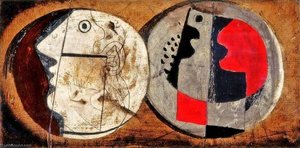
A Fragmented Landscape: Unpacking the Essence of Nicholson’s “August 1956”
Ben Nicholson’s “August 1956 (Val d’Orcia)” isn't merely a depiction of a Tuscan hillside; it’s an invitation to contemplate the very nature of perception and memory. Painted in 1956, during a period of profound artistic exploration for the British painter, this work embodies his signature style – a masterful blend of geometric abstraction and subtle landscape suggestion. It’s a piece that rewards patient observation, revealing layers of meaning within its deceptively simple composition.
Nicholson, a key figure in the post-war British art scene, moved away from representational painting in the late 1920s, seeking to capture not what he *saw*, but rather the underlying structure and essence of his subjects. “August 1956” exemplifies this shift. The Val d’Orcia landscape is reduced to a series of interlocking planes and angular forms – rectangles, triangles, and subtly curved lines – arranged against a textured background that hints at earth tones and weathered stone. This isn't an attempt to recreate the scene photographically; instead, Nicholson uses these geometric elements as building blocks, suggesting the contours of hills, fields, and perhaps even the architecture of a distant village.
The Language of Geometry: Technique and Composition
The painting’s power lies in its carefully orchestrated composition. The dominant diagonal lines create a dynamic sense of movement, drawing the eye across the canvas and inviting exploration. Nicholson masterfully employs layering – shapes are partially obscured by others, creating depth and a feeling of spatial complexity without relying on traditional perspective. Notice how the lighter tones, strategically placed, act as highlights, defining forms and adding to the overall sense of dynamism. The texture itself is crucial; it’s achieved through a combination of impasto techniques—thickly applied paint—and subtle blending, creating a surface that feels both solid and ethereal.
Nicholson's technique reveals a deliberate control alongside moments of fluidity. Sharp, defined lines delineate the edges of shapes, while softer transitions suggest areas where colors merge. This interplay between precision and spontaneity contributes to the painting’s captivating quality. The use of muted earth tones—beige, grey, rusty orange—grounds the abstract forms in a tangible reality, evoking the rugged beauty of the Tuscan landscape.
Symbolism and Emotional Resonance
While undeniably abstract, “August 1956” resonates with deeper symbolic meanings. The fragmented nature of the composition can be interpreted as representing the breakdown of familiar structures – memory, experience, or even the very notion of a fixed reality. Nicholson’s work often explored themes of time and loss, and this painting certainly carries a sense of quiet contemplation and perhaps a touch of melancholy. The geometric forms themselves might symbolize order imposed upon chaos, or the inherent tension between structure and spontaneity.
Consider the title itself: “August 1956.” The specificity of the date anchors the abstract composition in a particular moment in time, suggesting that the painting is not simply about a landscape, but also about capturing a fleeting impression – a memory, perhaps, or a feeling associated with that specific August day. It’s a testament to Nicholson's ability to distill complex emotions and ideas into a powerfully evocative visual form.
A Legacy of Abstraction: Ben Nicholson and Beyond
Ben Nicholson’s “August 1956 (Val d’Orcia)” stands as a pivotal work in the development of British abstract art. Influenced by Cubism, Constructivism, and the pioneering work of artists like Mondrian, Nicholson developed his own distinctive style characterized by geometric forms, layered textures, and a profound exploration of perception. His legacy continues to inspire artists today, and reproductions of this captivating painting offer a window into the mind of one of Britain’s most important 20th-century painters.
Questions & Answers
Are there works similar to "August 1956 (Val d'Orcia)"?
Works similar to "August 1956 (Val d'Orcia)" are listed on the artwork's Similars page.
What placement suits the format of "August 1956 (Val d'Orcia)" by Ben Nicholson OM?
The panoramic format of "August 1956 (Val d'Orcia)" by Ben Nicholson OM is recommended for a living room. Format and space together guide the placement of a reproduction.
What does "August 1956 (Val d'Orcia)" by Ben Nicholson OM depict?
The subjects of "August 1956 (Val d'Orcia)" are geometric abstraction, val d’orcia, landscape, ben nicholson, cubism, relief, 1956.
Artist Biography
Ben Nicholson OM: A Life in Abstract Art
- Born: April 10, 1894, Denham, Buckinghamshire, United Kingdom
- Died: February 6, 1982, London, United Kingdom
Early Life and Artistic Training
- Ben Nicholson was born into an artistic family; his father, Sir William Nicholson, and mother, Mabel Pryde, were both accomplished painters. This environment fostered a deep appreciation for art from a young age.
- He received early education at Tyttenhangar Lodge Preparatory School, Seaford, Heddon Court, Hampstead, and Gresham's School in Holt, Norfolk.
- Nicholson formally studied at the Slade School of Fine Art (1910-1911), where he was a contemporary of notable artists like Paul Nash, Stanley Spencer, Mark Gertler, and Edward Wadsworth. Anecdotally, he spent considerable time playing billiards during this period, finding aesthetic appeal in the game's geometry and movement.
Artistic Development and Influences
- Early Works: Nicholson’s initial artistic endeavors involved naturalistic still lifes, influenced by his father’s style.
- Cubist Influence: Around 1926, he began to explore abstraction, heavily influenced by Synthetic Cubism and the work of Pablo Picasso.
- Neoplasticism & Primitive Style: A meeting with Piet Mondrian introduced him to Neoplasticism, while his encounter with Henri Rousseau sparked an interest in a primitive style. These influences significantly shaped his artistic direction.
- Key Movements: Nicholson became involved with several important art movements of the time, including the Seven and Five Society (of which he was chair), Unit One, and Abstraction-Création.
Major Works and Artistic Style
- Reliefs: Nicholson is particularly renowned for his abstract reliefs, beginning in 1933. These works combined painting with sculptural elements, creating a unique visual experience. The white reliefs of the mid-1930s are considered among his most significant achievements.
- Still Lifes and Landscapes: While known for abstraction, Nicholson also produced compelling still lifes and landscapes, often incorporating geometric forms and muted colors.
- The Nicholson Wall: A notable public work is the "Nicholson Wall," a mural created for the garden of Sutton Place in Guildford, Surrey, demonstrating his belief that abstract art should be accessible to a wider audience.
- Materials & Techniques: He experimented with various materials and techniques, including oil paint, pencil, gravel, and masonite, often combining them in innovative ways.
Legacy and Historical Significance
- Modern British Art: Ben Nicholson is recognized as a pivotal figure in modern British art, contributing significantly to the development of abstraction and relief sculpture.
- International Recognition: His work garnered international acclaim, with exhibitions at prestigious venues like the Venice Biennale and retrospectives at major museums worldwide. He received numerous awards, including the Order of Merit in 1968.
- Auction Records: Nicholson’s paintings command high prices at auction, reflecting their artistic merit and historical importance. For example, "Sept 53 (Balearic)" sold for $1,650,500 at Christie's New York in 2011, and “Fiddle and Spanish Guitar” fetched €3,313,000 at Christie’s Paris in 2012.
- Influence on Subsequent Artists: Nicholson’s innovative approach to abstraction and his exploration of form and space have influenced generations of artists.

Ben Nicholson OM
1894 - 1982 , United Kingdom
Quick Facts
- Full Name: Ben Nicholson OM
- Nationality: British
- Date Of Birth: 1894
- Date Of Death: 1982
- Place Of Birth: London, United Kingdom
- Notable Artworks:
- Sept 53 (Balearic)
- Fiddle and Spanish guitar
- 1946 (still life)
- Artistic Movement Or Style:
- Abstract art
- Cubism
- Constructivism
- Artists Who Influenced This Artist:
- Henri Rousseau
- Piet Mondrian
- Pablo Picasso
- Cezanne
Related Articles

Kandinsky's Masterpieces: 25 Paintings That Define Abstract Art | OriginalUniqueArt
Journey through Wassily Kandinsky's 25 most iconic abstract paintings. Explore his revolutionary use of color, form & spiritual expressionism. Find museum-quality Kandinsky reproductions and elevate your home decor with OriginalUniqueArt.com. Discover all masterpieces on OriginalUniqueArt.com!
The Soul of Color: A Journey into the Emotional Resonance of Lyrical Abstraction
Embark on a cultural journey through Lyrical Abstraction. Explore how masters like Kandinsky used color and motion to translate emotion into visual poetry. Discover the profound beauty of abstract expressionism and learn to curate emotional resonance in your own art collection.

Abstract Expressionism's 10 Defining Masterpieces |
Explore 10 defining Abstract Expressionism masterpieces by Pollock, Rothko & de Kooning. Discover the stories behind these iconic paintings and find museum-quality art reproductions to elevate your home decor on .

Ben Nicholson OM: Modernism's Abstract Pioneer & the Poetics of Relief
Explore the revolutionary abstract art of Ben Nicholson OM. Discover his geometric masterpieces, collaborations with Barbara Hepworth & investment potential. Expert insights for collectors.

Geometric Abstraction's 10 Defining Masterpieces | Art for Your Home - OriginalUniqueArt
Explore 10 defining masterpieces of Geometric Abstraction! Discover Kandinsky, Mondrian & Malevich’s iconic works. Find museum-quality art reproductions and curated decor ideas to elevate your home at OriginalUniqueArt.com.