Post-Impressionism · 1909
Caspar (Augustus Edwin John, 1909)
Augustus Edwin John (1878–1961) made Caspar. It dates from 1909. It belongs to the Post-Impressionism movement. It is made in oil on canvas. It is kept at Fitzwilliam College in Cambridge, United Kingdom. It measures 41 × 33 cm.
- 1909
- Oil On Canvas
- 41 × 33 cm
- Fitzwilliam College, Cambridge

 Preview

 Hand Made Oil Painting
 Send
 Share
 Fact sheet


 Download
 Similars
 X-Ray
 Diaporama
 Q&A

 Stats
Caspar, in brief
- Title
- Caspar
- Artist
- Augustus Edwin John (1878–1961)
- Artist born in
- Tenby, United States of America
- Date
- 1909
- Medium
- Oil On Canvas
- Dimensions
- 41 × 33 cm
- Where to see it
- Fitzwilliam College, Cambridge, United Kingdom
- Movement
- Post-Impressionism
- Period
- Modern
- Subject
- portrait, youth, innocence, reflection, texture, observation
What does Caspar depict?
A Glimpse into Youthful Innocence
In the tenderly rendered portrait Caspar, created in 1909 by the celebrated Welsh artist Augustus Edwin John, we are invited into a moment of profound quietude. This intimate work captures the essence of a young boy, whose face serves as the emotional anchor of the composition. Through a masterful use of realistic brushstrokes and a soft, diffused light, John breathes life into the subject, presenting a study of youthful innocence that feels both timeless and deeply personal. The close-up framing pulls the viewer into the boy's immediate orbit, creating a sense of gentle observation that borders on the voyeuristic, yet remains entirely respectful of the subject's quiet contemplation.
The painting is a triumph of texture and light, where the organic forms of the boy’s features are balanced against a rich, layered background. The artist employs a technique reminiscent of Post-Impressionism, where visible brushwork does not merely define shape but adds a rhythmic, tactile quality to the canvas. This textured approach allows the background to pulse with a life of its own, providing a sense of depth and atmosphere without ever distracting from the central figure. The interplay of light and shadow across the boy's face emphasizes the soft contours of his skin and the structural elements of his clothing, lending a sculptural weight to an otherwise ethereal moment.
Symbolism and Artistic Legacy
Beyond its surface beauty, Caspar carries subtle symbolic weight. The inclusion of the boy's hat serves as more than just a compositional element; it hints at identity and perhaps a burgeoning sense of social standing or persona. Within the broader context of Augustus Edwin John’s career, this piece reflects his ability to blend exceptional draughtsmanship—honed during his years at the Slade School of Fine Art—with a bohemian, expressive spirit. The painting captures a pivotal era in British art, where the boundaries between realism and impressionistic emotion were being beautifully redrawn.
For the discerning collector or interior designer, this reproduction offers more than just a decorative element; it provides a focal point of emotional depth. The muted palette and soft textures make it an ideal addition to spaces that require a sense of calm, sophistication, and historical resonance. Whether placed in a sunlit study or a contemporary living space, Caspar acts as a window into the early 20th century, evoking a nostalgic longing for simplicity and the quiet beauty found in the most fleeting of human expressions.
Which museum holds Caspar?
Fitzwilliam College
Cambridge, United Kingdom
The Origins and History of Fitzwilliam College Fitzwilliam College is a constituent college of the University of Cambridge, England. Its origins date back to 1869, when it was established as the Non-Collegiate Students Board. This venture was created to provide academically excellent students from all backgrounds the opportunity to study at the university.


High-resolution images of Caspar
Protected by copyright: these files are for personal reference, not a licence to republish.
Augustus Edwin John, Caspar (1909), Fitzwilliam College.
Questions on Caspar, answered
Which museum holds the original "Caspar"?
"Caspar" by Augustus Edwin John is on display at the Fitzwilliam College, Cambridge, United Kingdom. The museum listing refers to the original work, not to reproductions.
What is the creation date of "Caspar" by Augustus Edwin John?
"Caspar" dates from 1909. The date places the work within Augustus Edwin John's career and its era.
What is "Caspar" made with?
The medium of "Caspar" by Augustus Edwin John is oil on canvas. Reproductions aim to render the appearance of this technique.
What are the dimensions of the original "Caspar" by Augustus Edwin John?
The recorded dimensions of "Caspar" by Augustus Edwin John are 41 x 33 cm. Reproductions can be ordered in other sizes while keeping the same proportions.
What is "Caspar" about?
"Caspar" by Augustus Edwin John depicts: portrait, youth, innocence, reflection, texture, observation, victorian, welshart.
Can the image of "Caspar" by Augustus Edwin John be freely reproduced?
"Caspar" by Augustus Edwin John is still protected by copyright. This status governs how the image of the work may be reproduced.
Which artist is "Caspar" attributed to?
"Caspar" is attributed to Augustus Edwin John.
What style does "Caspar" belong to?
The movement associated with "Caspar" by Augustus Edwin John is Post-Impressionism. This classification situates the work among related artists and artworks.
Where does "Caspar" fall in Augustus Edwin John's career?
"Caspar" represents the Mature Period of Augustus Edwin John.
About the artist, Augustus Edwin John

1878–1961, United States of America
Augustus Edwin John
A Welsh Bohemian: The Life and Art of Augustus Edwin John Augustus Edwin John emerged as a pivotal figure in early 20th-century British art, a painter whose life was as vibrant and unconventional as the canvases he produced. Born in Tenby, Wales, on January 4, 1878, his artistic journey began under the nurturing influence of his mother, who instilled in him a love for drawing from a young age. This early encouragement led him to the Tenby School of Art at seventeen, where his natural aptitude quickly became apparent. However, it was his subsequent enrollment at the Slade School of Fine Art, University College London (1894-1898), that truly ignited his artistic development.
About Augustus Edwin John Notable works by Augustus Edwin John
Also by Augustus Edwin John
 Portrait of a Young Man1929
 Air Mechanic Shaw (Colonel T. E. Lawrence of Arabia, 1888–1935)1935
 Two Jamaican Girls1937
 Girl Leaning on a Stick1910
Essays around Caspar
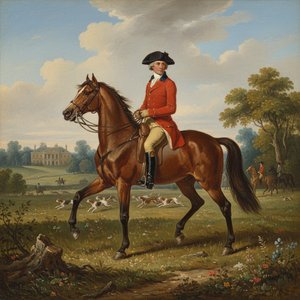 John Nost Sartorius: Equestrian Portraiture & the Shifting Social Landscape of 18th-Century EnglandExplore the captivating equestrian art of John Nost Sartorius (1759-1828). Discover his detailed paintings of racehorses, hunting scenes & …
 British pre-raphaelite paintersMasterpieces by Rossetti and Millais define British Pre-Raphaelite art. Explore the full collection online at OriginalUniqueArt.com.
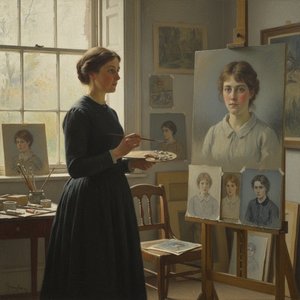 Gwen John: Intimacy, Modernity & the Quiet Power of Welsh PortraitureExplore the captivating world of Gwen John, a pioneering Welsh artist renowned for her intimate portraits & subtle style. Discover her life…