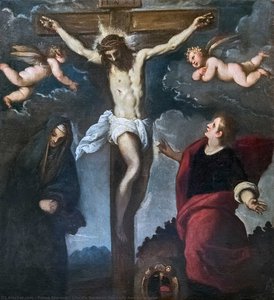
Portrait of Palma il Giovane

The 100 Most Famous Palma il Giovane Paintings, a Gallery Selection

Updated November 2026 · ranked by our popularity score (searches, visits and orders for each work) · 161 works by Palma il Giovane in our catalogue

In short

Of all the originals Palma il Giovane left, the most famous is The Crucifixion of St Peter (1614), in the collection of the Gallerie dell'Accademia di Venezia, Venice. Close behind it come Pietà with Angels (1620) and Paolo Veronese (1600). Our catalog holds 161 works by Palma il Giovane; the gallery has kept the 100 the world admires most, each shown with its date, its museum and its story.

1550 – 1628, Venice Baroque Most works: Bavarian State Painting Collections

Palma il Giovane's top 10 paintings: the gallery's choice

1
The Crucifixion of St Peter (1614) by Palma il Giovane

The Crucifixion of St Peter

1614 · Oil On Canvas · Gallerie dell'Accademia di Venezia, Venice

Michelangelo Palma il Giovane’s “The Crucifixion of St Peter,” painted in 1614, is not merely a depiction of a pivotal moment in Christian history; it's a profound exploration of suffering, faith, and the raw emotion of martyrdom. This monumental canvas, measuring 170 x 135 cm, transports the viewer directly into the heart of the scene – a chaotic yet deeply moving tableau unfolding outdoors beneath a dramatic, stormy sky. Palma,…

2
Pietà with Angels (1620) by Palma il Giovane

Pietà with Angels

1620 · Oil · Kunsthistorisches Museum, Vienna

A heavy, limp body rests across the lap of the Virgin Mary. The pale skin of Christ contrasts against the deep red of her tunic and the dark blue of her mantle. Shadows swallow the background, pushing the figures forward into a sharp, theatrical light. Two large angels flank the upper scene, their faces etched with grief. Below, small cherubs support the weight of the limbs, one near the arm…

3
Paolo Veronese (1600) by Palma il Giovane

Paolo Veronese

1600 · Oil · Galleria degli Uffizi, Florence

A dark, shadow-filled void recedes behind the subject, stripping away the distractions of the physical world. This absence of background detail pushes the figure forward, creating a sudden sense of depth. The man emerges from this gloom, his presence anchored by a crisp white collar that catches the light. His gaze is direct, meeting the viewer with an unwavering eye contact that bridges the gap between the painted space and…

4
The Conversion of Saint Paul (1590) by Palma il Giovane

The Conversion of Saint Paul

1590 · Oil · Museo del Prado, Madrid

The air thickens with sudden, celestial violence as the scene erupts in a chaotic swirl of motion. Saul, once a persecutor of the faithful, is caught in a moment of profound physical and spiritual disorientation. He is thrown from his horse, a heavy, muscular form tumbling toward the earth, while the animal recoils in a tangle of limbs and frantic energy. Above this earthly commotion, a brilliant, piercing light breaks…

5
The Crucifixion (1596) by Palma il Giovane

The Crucifixion

1596 · Oil On Canvas · Metropolitan Museum of Art, New York

The composition reflects the transition from the High Renaissance to the burgeoning drama of the Baroque. The style is characterized by intense emotional weight and dynamic movement typical of the late Renaissance or Mannerist period. The texture appears smooth yet painterly, capturing the anatomical detail of Christ's torso and the heavy fabric of the mourning figures. Through the use of light as a narrative tool, the composition guides the eye…

6
Venus and Mars (1605) by Palma il Giovane

Venus and Mars

1605 · Oil On Canvas · J. Paul Getty Museum, Los Angeles

The oil on canvas work titled Venus and Mars presents a mythological encounter between the personification of love and the god of war. Painted by Palma il Giovane, the scene captures these lovers in a moment of intimate proximity. The figures of Venus and Mars respond to one another through anticipatory gestures, their bodies arranged in a way that suggests a shared, private space. A small Cupid occupies the lower…

7
The prophet Nathan admonishes King David (1600) by Palma il Giovane

The prophet Nathan admonishes King David

1600 · Oil On Canvas · Kunsthistorisches Museum, Vienna

The oil painting The prophet Nathan admonishes King David presents an emotionally charged biblical scene set within a shallow, stage-like space. The composition centers on two primary figures engaged in an intense interaction. On the left, King David is depicted sitting in a large, ornate golden throne. He wears a red velvet robe trimmed with thick white ermine fur and a prominent gold crown, his posture heavy and dejected with…

8
Portrait of a Sculptor (1605) by Palma il Giovane

Portrait of a Sculptor

1605 · Oil On Canvas · Kunsthistorisches Museum, Vienna

The room falls into a heavy, quiet stillness as we gaze upon an elderly man, his face etched with the deep lines of a life spent in focused labor. He sits in a three-quarter view, caught in a moment of profound introspection. A sharp, directional light enters from the upper left, carving his features out of the surrounding darkness. This intense chiaroscuro pulls his weathered forehead and greyish-white beard into…

9
Lamentation with angels (1612) by Palma il Giovane

Lamentation with angels

1612 · Oil · Kunsthistorisches Museum, Vienna

In this 1612 oil painting, we find ourselves drawn into the immediate, heavy atmosphere of the Lamentation. The composition centers on the pale, lifeless body of Christ, which lies horizontally across the lower half of the frame. There is a stillness here that feels almost physical, a quietude that contrasts with the intense emotional weight of the scene. To the left, a figure draped in deep red robes holds a…

10
Judith Placing the Head of Holofernes onto a Cloth Held by Another Female Figure, the Foreshortened Body of Holofernes Gushes with Blood from the Neck (1628) by Palma il Giovane

Judith Placing the Head of Holofernes onto a Cloth Held by Another Female Figure, the Foreshortened Body of Holofernes Gushes with Blood from the Neck

1628 · Etching

In this etching print, we find ourselves witnessing a scene of profound, sudden movement. The composition centers on the aftermath of a decisive act: Judith is captured in the precise, heavy moment of placing the severed head of Holofernes onto a cloth. Another female figure assists, her hands steadying the fabric to catch the weight of the deed. There is a certain anatomical tension here, particularly in the foreshortened body…

The Palma il Giovane selection continues, 11 to 100

11Portrait of Niccolo da Ponte (1491-1585), Doge of Venice (1580) by Palma il GiovanePortrait of Niccolo da Ponte (1491-1585), Doge of Venice1580 · Kunsthistorisches Museum 12The Pope allows Otto to go to his father to negotiate peace (1582) by Palma il GiovaneThe Pope allows Otto to go to his father to negotiate peace1582 · Doge's Palace 13Pietá (1611) by Palma il GiovanePietá1611 · Museo del Prado 14David with Goliath's Head (1590) by Palma il GiovaneDavid with Goliath's Head1590 · Museo del Prado 15Salomé with the Head of John the Baptist (1599) by Palma il GiovaneSalomé with the Head of John the Baptist1599 · Kunsthistorisches Museum 16Moses Brings the Tablets of the Law (1586) by Palma il GiovaneMoses Brings the Tablets of the Law1586 · Bavarian State Painting Collections 17St Sebastian (1590) by Palma il GiovaneSt Sebastian1590 · Hermitage Museum 18Dead Christ Supported by an Angel (1612) by Palma il GiovaneDead Christ Supported by an Angel1612 · Kunsthistorisches Museum 19Adoration of the Shepherds (1575) by Palma il GiovaneAdoration of the Shepherds1575 · Bavarian State Painting Collections 20Flagellation of Christ (1586) by Palma il GiovaneFlagellation of Christ1586 · Bavarian State Painting Collections 21Christ calling Zacchaeus (1575) by Palma il GiovaneChrist calling Zacchaeus1575 · Fitzwilliam Museum 22Elijah and the Angel (1575) by Palma il GiovaneElijah and the Angel1575 · Fitzwilliam Museum 23Portrait of a Gentleman (1590) by Palma il GiovanePortrait of a Gentleman1590 · Art Institute of Chicago 24Fighting soldiers (1569) by Palma il GiovaneFighting soldiers1569 25soldiers on horseback (1569) by Palma il Giovanesoldiers on horseback1569 26Soldiers on horseback (1569) by Palma il GiovaneSoldiers on horseback1569 27supraporte: fighting soldiers (1569) by Palma il Giovanesupraporte: fighting soldiers1569 28fighting soldiers (1569) by Palma il Giovanefighting soldiers1569 29Battle - scene in landscape with town (1569) by Palma il GiovaneBattle - scene in landscape with town1569 30soldiers on horseback (1569) by Palma il Giovanesoldiers on horseback1569 31soldiers on horseback (1569) by Palma il Giovanesoldiers on horseback1569 32six citizens after war scene (1569) by Palma il Giovanesix citizens after war scene1569 33Gentlemen on horse - back (1569) by Palma il GiovaneGentlemen on horse - back1569 34Victory of Francesco Bembo over Filippo Maria Visconti (1578) by Palma il GiovaneVictory of Francesco Bembo over Filippo Maria Visconti1578 · Doge's Palace 35The Descent of Manna (1575) by Palma il GiovaneThe Descent of Manna1575 36Christ Deposed In The Sepulchre (1575) by Palma il GiovaneChrist Deposed In The Sepulchre1575 37Crucifix Between Our Lady And Saint John (1575) by Palma il GiovaneCrucifix Between Our Lady And Saint John1575 38The Paschal Lamb (1575) by Palma il GiovaneThe Paschal Lamb1575 39St Lawrence Giving the Wealth to the Poor (1575) by Palma il GiovaneSt Lawrence Giving the Wealth to the Poor1575 40Lamentation of Christ (1586) by Palma il GiovaneLamentation of Christ1586 · Bavarian State Painting Collections 41Lamentation of Christ (1586) by Palma il GiovaneLamentation of Christ1586 · Bavarian State Painting Collections 42Thetis on the Sea (1586) by Palma il GiovaneThetis on the Sea1586 · Bavarian State Painting Collections 43Lamentation of Christ (1586) by Palma il GiovaneLamentation of Christ1586 · Bavarian State Painting Collections 44Annunciation of Mary (1585) by Palma il GiovaneAnnunciation of Mary1585 · Bavarian State Painting Collections 45Christ and the Samaritan Woman (1586) by Palma il GiovaneChrist and the Samaritan Woman1586 · Bavarian State Painting Collections 46Saint Sebastian (1586) by Palma il GiovaneSaint Sebastian1586 · Bavarian State Painting Collections 47Ecce homo (1586) by Palma il GiovaneEcce homo1586 · Bavarian State Painting Collections 48The Expulsion of the Vices of the Church (1582) by Palma il GiovaneThe Expulsion of the Vices of the Church1582 · Royal Collection 49Venus and Cupid (1590) by Palma il GiovaneVenus and Cupid1590 · Royal Collection 50Prometheus Chained to the Caucasus (1589) by Palma il GiovanePrometheus Chained to the Caucasus1589 · Royal Collection 51Massacre of the Inhabitants of Hippo (1593) by Palma il GiovaneMassacre of the Inhabitants of Hippo1593 · Musée Fabre 52Scene from the History of Joseph (1587) by Palma il GiovaneScene from the History of Joseph1587 · Isabella Stewart Gardner Museum 53Scene from the History of Joseph (1587) by Palma il GiovaneScene from the History of Joseph1587 · Isabella Stewart Gardner Museum 54Judas Cyriacus (1593) by Palma il GiovaneJudas Cyriacus1593 55Sant'elena Ritrova La Vera Croce (1593) by Palma il GiovaneSant'elena Ritrova La Vera Croce1593 56L'imperatore Eraclio Riporta La Croce Al Calvario (1593) by Palma il GiovaneL'imperatore Eraclio Riporta La Croce Al Calvario1593 57Pius II (1593) by Palma il GiovanePius II1593 58Judith and Holofernes (1600) by Palma il GiovaneJudith and Holofernes1600 59The Virgin and Child, Saint Luke and a Donor (1602) by Palma il GiovaneThe Virgin and Child, Saint Luke and a Donor1602 · Royal Collection 60The Penitent Magdalene (1600) by Palma il GiovaneThe Penitent Magdalene1600 · Royal Collection 61Return of the Prodigal Son (1595) by Palma il GiovaneReturn of the Prodigal Son1595 · Gallerie dell'Accademia di Venezia 62The Virgin and Child with Saints and Angels (1620) by Palma il GiovaneThe Virgin and Child with Saints and Angels1620 · National Gallery of Ireland 63Lamentation of Christ (1620) by Palma il GiovaneLamentation of Christ1620 · Bavarian State Painting Collections 64Self Portrait (1614) by Palma il GiovaneSelf Portrait1614 65Studies of an Arm, and of the Heads of an Old Man and Young Woman (1628) by Palma il GiovaneStudies of an Arm, and of the Heads of an Old Man and Young Woman1628 66Seated Female Holding a Book, Two Heads of Bearded Men, Seated Male Nude, and Four Sketches for Christ Judging (recto); Studies for Cain Slaying Abel (verso) (1628) by Palma il GiovaneSeated Female Holding a Book, Two Heads of Bearded Men, Seated Male Nude, and Four Sketches for Christ Judging (recto); Studies for Cain Slaying Abel (verso)1628 67Apostles at the Virgin's Tomb (1582) by Palma il GiovaneApostles at the Virgin's Tomb1582 · Hermitage Museum 68Cain and Abel (1603) by Palma il GiovaneCain and Abel1603 · Kunsthistorisches Museum 69Annunciation (1600) by Palma il GiovaneAnnunciation1600 · Madonna dell'Orto 70Martirio Di San Giovanni Battista Tra San Lanfranco Beccari E San Liberio (1593) by Palma il GiovaneMartirio Di San Giovanni Battista Tra San Lanfranco Beccari E San Liberio1593 71Washing of the Feet (1591) by Palma il GiovaneWashing of the Feet1591 · San Giovanni in Bragora 72Lamentation (1620) by Palma il GiovaneLamentation1620 · National Gallery of Art 73Joseph and Potiphar's Wife by Palma il GiovaneJoseph and Potiphar's WifeStatens Museum For Kunst 74Allegory of the Victory over the League of Cambrai (detail) (1590) by Palma il GiovaneAllegory of the Victory over the League of Cambrai (detail)1590 · Doge's Palace 75The Dead Christ Supported by An Angel with Two Putti Each Supporting a Cero (1575) by Palma il GiovaneThe Dead Christ Supported by An Angel with Two Putti Each Supporting a Cero1575 76The Paschal Lamb (1575) by Palma il GiovaneThe Paschal Lamb1575 77Eucharist Worshipped By The Four Evangelists (1575) by Palma il GiovaneEucharist Worshipped By The Four Evangelists1575 78Elia Cibato From angel (1575) by Palma il GiovaneElia Cibato From angel1575 79The Parish Priest Da Ponte in front of the Virgin, Saint Mark, Saint Sylvester and Saint James (1575) by Palma il GiovaneThe Parish Priest Da Ponte in front of the Virgin, Saint Mark, Saint Sylvester and Saint James1575 80Red Sea Passage (1575) by Palma il GiovaneRed Sea Passage1575 81The Flagellation by Palma il GiovaneThe FlagellationMuseo del Prado 82Papa Cleto (1593) by Palma il GiovanePapa Cleto1593 83Elia nutrito dall'angelo (1593) by Palma il GiovaneElia nutrito dall'angelo1593 84Lanfranco Beccari (1593) by Palma il GiovaneLanfranco Beccari1593 85David riceve dal sacerdote Achimelec i pani offerti nel santuario (1593) by Palma il GiovaneDavid riceve dal sacerdote Achimelec i pani offerti nel santuario1593 86Saint Helena (1593) by Palma il GiovaneSaint Helena1593 87Il Serpente Di Bronzo (1593) by Palma il GiovaneIl Serpente Di Bronzo1593 88Alexander III confirms the Crucifixes and gives them the rule (1593) by Palma il GiovaneAlexander III confirms the Crucifixes and gives them the rule1593 89Pope San Cleto Founds the Order of the Crucifer - St. Cyril's Bishop of Jerusalem Reaffirms the Order (1593) by Palma il GiovanePope San Cleto Founds the Order of the Crucifer - St. Cyril's Bishop of Jerusalem Reaffirms the Order1593 90David and Achimelech (1590) by Palma il GiovaneDavid and Achimelech1590 · Il Redentore 91The Pool (1592) by Palma il GiovaneThe Pool1592 · Collezione Molinari Pradelli 92The Martyrdom of St Lawrence (1581) by Palma il GiovaneThe Martyrdom of St Lawrence1581 · San Giacomo dall'Orio 93Sketch for An Entablature (1628) by Palma il GiovaneSketch for An Entablature1628 94The Arrest of Christ, Christ and the Canaanite Woman, Seated Male Figures, and Head of a Child (1628) by Palma il GiovaneThe Arrest of Christ, Christ and the Canaanite Woman, Seated Male Figures, and Head of a Child1628 95Studies of Horsemen and Study of a Figure for a Deposition (1628) by Palma il GiovaneStudies of Horsemen and Study of a Figure for a Deposition1628 96Seated Female Holding a Book, Two Heads of Bearded Men, Seated Male Nude, and Four Sketches for Christ Judging (recto); Studies for Cain Slaying Abel (verso) (1628) by Palma il GiovaneSeated Female Holding a Book, Two Heads of Bearded Men, Seated Male Nude, and Four Sketches for Christ Judging (recto); Studies for Cain Slaying Abel (verso)1628 97Sheet of Studies with St. Jerome, Seated at Right and Resting His Right Forearm on a Book, at Left An Ecclesiastical Figure Wearing a Cope and Miter, and at Bottom Two Putti (1628) by Palma il GiovaneSheet of Studies with St. Jerome, Seated at Right and Resting His Right Forearm on a Book, at Left An Ecclesiastical Figure Wearing a Cope and Miter, and at Bottom Two Putti1628 98A Venetian Senator by Palma il GiovaneA Venetian SenatorMuseo del Prado 99Amusements of the Prodigal Son (1595) by Palma il GiovaneAmusements of the Prodigal Son1595 · Gallerie dell'Accademia di Venezia 100Christ as Teacher by Palma il GiovaneChrist as TeacherBavarian State Painting Collections

Palma il Giovane's famous paintings, period by period

The subjects that held Palma il Giovane's eye

The four subjects that come back most often in these originals, each with its finest example.

The museums that keep Palma il Giovane's originals

The 8 museums that hold the most of the paintings on this page.

Museum City Works by Palma il Giovane Paintings from this list
Bavarian State Painting Collections, MunichBavarian State Painting Collections Munich 14 Moses Brings the Tablets of the Law, Adoration of the Shepherds, Flagellation of Christ
Kunsthistorisches Museum, ViennaKunsthistorisches Museum Vienna 8 Pietà with Angels, The prophet Nathan admonishes King David, Portrait of a Sculptor
Museo del Prado, MadridMuseo del Prado Madrid 5 The Conversion of Saint Paul, Pietá, David with Goliath's Head
Royal Collection, LondonRoyal Collection London 5 The Expulsion of the Vices of the Church, Venus and Cupid, Prometheus Chained to the Caucasus
Doge's Palace, VeniceDoge's Palace Venice 4 The Pope allows Otto to go to his father to negotiate peace, Victory of Francesco Bembo over Filippo Maria Visconti, Allegory of the Victory over the League of Cambrai (detail)
Gallerie dell'Accademia di Venezia, VeniceGallerie dell'Accademia di Venezia Venice 3 The Crucifixion of St Peter, Return of the Prodigal Son, Amusements of the Prodigal Son
Hermitage Museum, Saint PetersburgHermitage Museum Saint Petersburg 2 St Sebastian, Apostles at the Virgin's Tomb
Fitzwilliam MuseumFitzwilliam Museum 2 Christ calling Zacchaeus, Elijah and the Angel

Palma il Giovane decade by decade: the original that defines each

Works per decade

Pick a decade to see the original that defines it.

Collectors' questions about Palma il Giovane's paintings

Which work is Palma il Giovane most famous for?Reveal the answer

The Crucifixion of St Peter (1614), Gallerie dell'Accademia di Venezia, Venice. Pietà with Angels (1620) and Paolo Veronese (1600) come next.

What age was Palma il Giovane when The Crucifixion of St Peter was made?Reveal the answer

64 years old: The Crucifixion of St Peter dates from 1614, and Palma il Giovane was born in 1550.

What are the ten most famous Palma il Giovane paintings?Reveal the answer

The Crucifixion of St Peter, Pietà with Angels, Paolo Veronese, The Conversion of Saint Paul, The Crucifixion, Venus and Mars, The prophet Nathan admonishes King David, Portrait of a Sculptor, Lamentation with angels and Judith Placing the Head of Holofernes onto a Cloth Held by Another Female Figure, the Foreshortened Body of Holofernes Gushes with Blood from the Neck. The ranking above gives each one's year and museum.

How many paintings did Palma il Giovane leave?Reveal the answer

Our catalog holds 161 works by Palma il Giovane, dated from 1569 to 1628.

In which museums do Palma il Giovane's masterpieces hang?Reveal the answer

Mostly in Bavarian State Painting Collections (Munich), Kunsthistorisches Museum (Vienna) and Museo del Prado (Madrid). The museum table above lists them all.

In which years did Palma il Giovane paint the most famous works?Reveal the answer

In 1590s: 27 of the 100 works on this page were made then, The Conversion of Saint Paul among them.

What are the first and the last famous originals of Palma il Giovane?Reveal the answer

On this page, the earliest is Fighting soldiers (1569) and the latest Judith Placing the Head of Holofernes onto a Cloth Held by Another Female Figure, the Foreshortened Body of Holofernes Gushes with Blood from the Neck (1628).

Which subjects did Palma il Giovane choose most often?Reveal the answer

Man (38), People (24) and Woman (23), across the 100 works on this page.

Which technique did Palma il Giovane use most?Reveal the answer

Oil, for 43 of the 100 works on this page.

To which art movement does Palma il Giovane belong?Reveal the answer

Baroque and Renaissance, judging by the originals on this page.

Which Palma il Giovane works hang at the Bavarian State Painting Collections?Reveal the answer

Moses Brings the Tablets of the Law, Adoration of the Shepherds and Flagellation of Christ: the Bavarian State Painting Collections, Munich holds 13 of the works on this page.

Palma il Giovane: life and work

The Radiant Legacy of Jacopo Palma il Giovane

In the golden twilight of the Venetian Renaissance, a period defined by unparalleled mastery of color and light, there emerged a painter whose brush bridged the gap between the High Renaissance and the burgeoning drama of the Baroque. Jacopo Palma il Giovane, born Iacopo Negretti around 1548, was not merely a successor to the great masters but a vital link in the continuity of the Venetian School. As the great-nephew of the celebrated Palma Vecchio, he was born into a lineage of artistic excellence, inheriting a profound understanding of the chromatic richness that defines the Venetian tradition. His life and work represent a seamless transition, carrying the luminous elegance of his predecessors into a new era of emotional intensity and theatrical grandeur.

The foundations of Palma’s artistry were laid in the workshops of Venice, where the air was thick with the legacies of Titian and Tintoretto. While historical accounts suggest he may have polished his technique through the study of Titian’s breathtaking color palettes, it was the dynamic energy of Tintoretto that truly shaped his mature vision. Following the death of Tintoretto in 1594, Palma il Giovane ascended to a position of preeminence, becoming the dominant artistic force in Venice. He possessed a rare ability to synthesize these two disparate influences: from Titian, he drew a sophisticated command of light and skin tones; from Tintoretto, he adopted a sense of movement, dramatic chiaroscuro, and narrative urgency that resonated deeply with the religious fervor of the Counter-Reformation.

A Master of Narrative and Emotion

Palma il Giovane’s oeuvre is a testament to his ability to transform biblical and mythological themes into visceral human experiences. His paintings are rarely static; they pulse with a life force that draws the viewer into the heart of the drama. Whether depicting the solemnity of a religious martyrdom or the lively chaos of a tavern scene, his work utilizes light as a narrative tool, guiding the eye through complex compositions to find the emotional core of the story. His mastery is particularly evident in works such as Martyrdom of St Catherine of Alexandria, where the interplay of shadow and brilliance heightens the sense of divine struggle, and Apostles at the Virgin's Tomb, which captures a profound moment of collective grief through sweeping, energetic brushwork.

Beyond his religious commissions, Palma’s versatility allowed him to explore a wide spectrum of subject matter. His talent for capturing the human spirit is perhaps most intimately seen in his Self-Portrait, a work that reveals a soulful introspection and a technical prowess capable of rendering the subtle nuances of expression. Even in more secular or anecdotal scenes, such as the Amusements of the Prodigal Son, he maintains a vibrant, rhythmic quality that celebrates the textures and colors of Venetian life. This ability to oscillate between the profound and the playful ensured his relevance across various patronage circles, from the ecclesiastical authorities of Venice to the imperial courts of Central Europe.
Historical Significance and Enduring Influence

The historical importance of Jacopo Palma il Giovane extends far beyond the borders of the Venetian Republic. His influence radiated outward, reaching as far as Bergamo and the court of Emperor Rudolf II in Prague, marking him as an artist of international stature. He did not merely replicate the past; he evolved it, preparing the ground for the more emotive and dramatic styles that would define the 17th century. By mentoring subsequent generations, including figures who would further refine the Venetian aesthetic, he ensured that the traditions of his lineage remained vibrant and transformative.

Today, we recognize Palma il Giovane as a pivotal figure whose work serves as a bridge between eras. His legacy is found in:

  • The Synthesis of Styles: The seamless integration of Titian’s coloristic brilliance with Tintoretto’s dramatic dynamism.
  • Counter-Reformation Artistry: The use of powerful imagery to communicate the spiritual intensity required by the Catholic Church during a period of profound religious change.
  • The Continuation of the Venetian School: Maintaining Venice's status as a global epicenter of art through his widespread commissions and pedagogical influence.

Through his expressive brush and masterful use of light, Palma il Giovane captured the very essence of a changing world, leaving behind a body of work that continues to enchant and move the modern observer.