Portrait of Jean Jouvenet

Jean Jouvenet Paintings: The 88 Most Famous, Through a Gallery's Eye

Updated November 2026 · ranked by our popularity score (searches, visits and orders for each work) · 89 works by Jean Jouvenet in our catalogue

In short

To the gallery's eye, Jean Jouvenet's most famous painting is LA MORT DE SAINT FRANCOIS. Claude-François Poullart des Places (1679-1709) (1700) and Head of an old man. (1687) complete the trio every eye recognises. Of the 89 works by Jean Jouvenet in our catalog, the gallery presents the 88 most famous below, each original with its year, its museum and what makes it unique.

1644 – 1717, Rouen Baroque Most works: The Louvre

The gallery's top 10 Jean Jouvenet paintings

1
LA MORT DE SAINT FRANCOIS by Jean Jouvenet

LA MORT DE SAINT FRANCOIS

Oil On Canvas

The scene captures the final moments of Saint Francis, lying upon a simple wooden bed within a crowded monastic cell. Surrounding the saint, a group of monks gather in various states of grief and prayer, their presence filling the interior space with a sense of solemnity. From above, an angel descends, extending a crown of leaves toward the dying man. This gesture signals a divine reward and the transition from…

2
Claude-François Poullart des Places (1679-1709) (1700) by Jean Jouvenet

Claude-François Poullart des Places (1679-1709)

1700 · Oil On Canvas · Bavarian State Painting Collections, Munich

This three-quarter length portrait presents a young man positioned with a slight turn toward the viewer. He gazes directly forward with a composed expression. The subject is rendered against a dark, indeterminate background that lacks specific architectural or landscape details. His pale complexion and the white of his collar provide the primary points of light within the composition. A dark garment covers his shoulders and upper torso, its folds defined…

3
Head of an old man. (1687) by Jean Jouvenet

Head of an old man.

1687 · Oil On Canvas · National Museum in Warsaw, Warsaw

The oil on canvas painting titled Head of an old man. is a portrait created by the French artist Jean Jouvenet. This work, which dates to 1687, depicts an elderly man. The subject is presented in a close-up bust-length view, focusing on the physical characteristics of the man's face and head.

4
Venus in the Vulkan forge (1700) by Jean Jouvenet

Venus in the Vulkan forge

1700 · Oil On Canvas · National Museum in Warsaw, Warsaw

The oil on canvas painting titled Venus in the Vulkan forge is a work by the artist Jean Jouvenet. This piece depicts a mythological scene involving the goddess Venus and the god Vulcan. The composition centers on the figure of Venus, who is accompanied by a small Cupid within a subterranean setting. The artist, Jean Jouvenet, was born in 1644 in Rouen, France, and lived until 1717.

5
Descent from the Cross (1697) by Jean Jouvenet

Descent from the Cross

1697 · Oil On Canvas · The Louvre, Paris

In the grand, sweeping tapestry of the French Baroque, few works resonate with as much visceral intensity as Jean-Baptiste Jouvenet’s Descent from the Cross. Completed in 1697, this monumental canvas serves as a profound meditation on grief, faith, and the raw physicality of human suffering. The scene captures the harrowing moment when the body of Jesus Christ is lowered from the cross, a pivotal instant of transition between death and…

6
PORTRAIT DE CHANOINE by Jean Jouvenet

PORTRAIT DE CHANOINE

Chalk

The gaze of the sitter meets us directly in PORTRAIT DE CHANOINE, a work by the French artist Jean Jouvenet. This portrait captures a man known as Chanoine, whose presence fills the frame with a quiet, steady dignity. He sits as a church official, a man of status and religious duty, presented to the viewer through a lens of solemnity. The subject's identity is tied closely to his vocation, which…

7
Zéphyr et Flore by Jean Jouvenet

Zéphyr et Flore

Oil On Canvas · Opera House, Versailles

The scene known as Zéphyr et Flore unfolds through the brush of Jean Jouvenet, a painter who captures the very essence of a mythological encounter. This work emerges from the late 17th century, specifically dating to about 1688. It breathes with the energy of a moment caught in mid-motion, where the wind and the bloom meet in a lush, natural setting.

8
Saint Jean by Jean Jouvenet

Saint Jean

Oil On Canvas

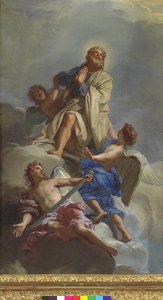
A golden chalice catches the light, suspended between the mortal and the celestial. Saint John reaches upward, his arms open to receive the vessel offered by a seated angel. The scene is a fragment of a larger movement, a vertical slice of a heavenly encounter. Clouds, thick and billowing, form a soft foundation for the figures, while the background dissolves into a hazy, indeterminate sky. The light descends from an…

9
Jesus Christ at the Home of Martha and Mary (1675) by Jean Jouvenet

Jesus Christ at the Home of Martha and Mary

1675 · Oil

The air in the room feels heavy with the weight of a profound teaching. Light spills across the scene, catching the folds of heavy drapery and the soft contours of skin, while the shadows retreat into the corners of the stone architecture. Jesus Christ sits at the center of this domestic sanctuary, his presence commanding the space through a quiet, steady authority. He is engaged in conversation, his gestures guiding…

10
God the Father (1685) by Jean Jouvenet

God the Father

1685 · Oil · Musee des Beaux-Arts, Reims

In this 1685 oil painting, we encounter a celestial presence emerging from a swirling expanse of clouds. The figure of God the Father is rendered as an elderly man, his presence defined by flowing white hair and a beard that merges into the ethereal atmosphere. He is positioned in a three-quarter view, arms outstretched in a gesture that suggests both expansive movement and a reaching toward the heavens. The composition…

Jean Jouvenet paintings, ranked 11 to 88

11Portrait of Father Louis Bourdaloue (1680) by Jean JouvenetPortrait of Father Louis Bourdaloue1680 · Bavarian State Painting Collections 12Winter (1699) by Jean JouvenetWinter1699 · Musée-promenade de Marly-le-Roi 13Jesus Healing the Sick by the Shore of the Lake of Gennesaret (1689) by Jean JouvenetJesus Healing the Sick by the Shore of the Lake of Gennesaret1689 14The Triumph of Justice (1695) by Jean JouvenetThe Triumph of Justice1695 · Petit Palais 15Louis XIV touchant les malades des écrouelles (1690) by Jean JouvenetLouis XIV touchant les malades des écrouelles1690 16The Sacrifice of Iphigenia (1688) by Jean JouvenetThe Sacrifice of Iphigenia1688 · Statens Museum For Kunst 17Jean Jouvenet (1700) by Jean JouvenetJean Jouvenet1700 · Opera House 18The Last Supper (1700) by Jean JouvenetThe Last Supper1700 19Self-Portrait of Jean-Baptiste Jouvenet Reduction of the painting kept in the Musée de Rouen (1701) by Jean JouvenetSelf-Portrait of Jean-Baptiste Jouvenet Reduction of the painting kept in the Musée de Rouen1701 · Carnavalet Museum 20The Deposition (1709) by Jean JouvenetThe Deposition1709 · Toledo Museum of Art 21Cena (1700) by Jean JouvenetCena1700 · National Museum in Warsaw 22The Miraculous Draught (1706) by Jean JouvenetThe Miraculous Draught1706 23The Ascension of Christ (1711) by Jean JouvenetThe Ascension of Christ1711 24Jesus Driving the Merchants from the Temple (1714) by Jean JouvenetJesus Driving the Merchants from the Temple1714 25Adoration of the Magi (1700) by Jean JouvenetAdoration of the Magi1700 · Detroit Institute of Arts 26Dr Raymond Finot (1704) by Jean JouvenetDr Raymond Finot1704 · The Louvre 27LA RESURRECTION DE LAZARE by Jean JouvenetLA RESURRECTION DE LAZAREThe Louvre 28Portrait of an Unknown Man (1700) by Jean JouvenetPortrait of an Unknown Man1700 · Hermitage Museum 29The Education of the Virgin (1700) by Jean JouvenetThe Education of the Virgin1700 · Galleria degli Uffizi 30LA DESCENTE DE CROIX by Jean JouvenetLA DESCENTE DE CROIXThe Louvre 31L'EXTREME ONCTION by Jean JouvenetL'EXTREME ONCTIONThe Louvre 32The Martyrdom of Saint Ovid by Jean JouvenetThe Martyrdom of Saint OvidMusée de Grenoble 33The Presentation in the Temple by Jean JouvenetThe Presentation in the TempleBrest national naval museum 34Christ healing the sick by Jean JouvenetChrist healing the sickNational Museum in Warsaw 35St thomas by Jean JouvenetSt thomas 36Saint André by Jean JouvenetSaint André 37Saint Pierre by Jean JouvenetSaint Pierre 38Saint Paul by Jean JouvenetSaint Paul 39Saint Jude by Jean JouvenetSaint Jude 40Saint Thomas by Jean JouvenetSaint Thomas 41LA PENTECOTE by Jean JouvenetLA PENTECOTE 42Saint Simon by Jean JouvenetSaint Simon 43Saint Jacques le majeur by Jean JouvenetSaint Jacques le majeur 44Saint Philippe by Jean JouvenetSaint Philippe 45APOLLON SUR SON CHAR SE PRESENTE A THETYS by Jean JouvenetAPOLLON SUR SON CHAR SE PRESENTE A THETYSChâteau de Versailles 46Saint Jacques le mineur by Jean JouvenetSaint Jacques le mineur 47Saint Barthélémy by Jean JouvenetSaint Barthélémy 48Latone et les paysans de Lycie by Jean JouvenetLatone et les paysans de Lycie 49Portrait de l'artiste par lui même by Jean JouvenetPortrait de l'artiste par lui mêmeNationalmuseum 50Autoportrait by Jean JouvenetAutoportrait 51Apothéose de Saint Jean by Jean JouvenetApothéose de Saint Jean 52Apothéose de Saint Luc by Jean JouvenetApothéose de Saint Luc 53L'ANNONCIATION by Jean JouvenetL'ANNONCIATION 54Le Christ descendu de la Croix by Jean JouvenetLe Christ descendu de la Croix 55Isaac bénissant Jacob by Jean JouvenetIsaac bénissant Jacob 56SAINT LOUIS SOIGNANT LES BLESSES APRES LA BATAILLE DE MANSOURAH.1250 by Jean JouvenetSAINT LOUIS SOIGNANT LES BLESSES APRES LA BATAILLE DE MANSOURAH.1250 57Le départ de Phaéton by Jean JouvenetLe départ de Phaéton 58PORTRAIT D'UN MAGISTRAT by Jean JouvenetPORTRAIT D'UN MAGISTRAT 59Saint Mathias (titre moderne) saint Mathieu (titre ancien) by Jean JouvenetSaint Mathias (titre moderne) saint Mathieu (titre ancien) 60JESUS AU JARDIN DES OLIVIERS by Jean JouvenetJESUS AU JARDIN DES OLIVIERS 61LA PRESENTATION AU TEMPLE by Jean JouvenetLA PRESENTATION AU TEMPLE 62MARC ANTOINE FAISANT CONSUL ALBINUS by Jean JouvenetMARC ANTOINE FAISANT CONSUL ALBINUS 63CYRUS HARANGUANT SES TROUPES by Jean JouvenetCYRUS HARANGUANT SES TROUPES 64LE TRIOMPHE DE LA JUSTICE by Jean JouvenetLE TRIOMPHE DE LA JUSTICE 65LA DESCENTE DU SAINT ESPRIT SUR LES APOTRES by Jean JouvenetLA DESCENTE DU SAINT ESPRIT SUR LES APOTRES 66JESUS CHRIST CHEZ MARTHE ET MARIE by Jean JouvenetJESUS CHRIST CHEZ MARTHE ET MARIEThe Louvre 67LA MESSE DU CHANOINE DE LA PORTE OU LE MAITRE AUTEL DE NOTRE DAME by Jean JouvenetLA MESSE DU CHANOINE DE LA PORTE OU LE MAITRE AUTEL DE NOTRE DAMEThe Louvre 68The Miraculous Draught by Jean JouvenetThe Miraculous DraughtThe Louvre 69Isaac blessing jacob by Jean JouvenetIsaac blessing jacob 70The Presentation in the Temple by Jean JouvenetThe Presentation in the Temple 71The Descent from the Cross by Jean JouvenetThe Descent from the Cross 72The Death of St Francis by Jean JouvenetThe Death of St Francis 73Apotheosis of st. nicholas by Jean JouvenetApotheosis of st. nicholasPlantin-Moretus Museum 74Christ in the House of Martha and Mary by Jean JouvenetChrist in the House of Martha and Mary 75Foundation of a Town in Germania by the Tectosages by Jean JouvenetFoundation of a Town in Germania by the Tectosages 76The Mass of Canon Antoine de La Porte or The Altar of Notre Dame by Jean JouvenetThe Mass of Canon Antoine de La Porte or The Altar of Notre Dame 77LA VICTOIRE SOUTENUE PAR HERCULE ET ACCOMPAGNEE DE L'ABONDANCE, DE LA FELICITE ET DE LA PAIX by Jean JouvenetLA VICTOIRE SOUTENUE PAR HERCULE ET ACCOMPAGNEE DE L'ABONDANCE, DE LA FELICITE ET DE LA PAIX 78Head of a man looking to the left by Jean JouvenetHead of a man looking to the left 79Fondation d'une ville en Germanie par les Tectosages by Jean JouvenetFondation d'une ville en Germanie par les Tectosages 80Esther devant Assuérus Evanouissement d'Ester (ancien titre) by Jean JouvenetEsther devant Assuérus Evanouissement d'Ester (ancien titre) 81Madonna of the Magnificat by Jean JouvenetMadonna of the Magnificat 82The Raising of Lazarus by Jean JouvenetThe Raising of LazarusLos Angeles County Museum of Art 83The marriage of the virgin by Jean JouvenetThe marriage of the virgin 84Madame de Maintenon as Saint Cecilia and a Boy (possibly the Duc de Maine) as an Angel Blowing an Organ by Jean JouvenetMadame de Maintenon as Saint Cecilia and a Boy (possibly the Duc de Maine) as an Angel Blowing an Organ 85LE MEDECIN RAYMOND FINOT DIT AUTREFOIS LE MEDECIN FAGON by Jean JouvenetLE MEDECIN RAYMOND FINOT DIT AUTREFOIS LE MEDECIN FAGONThe Louvre 86LA PECHE MIRACULEUSE by Jean JouvenetLA PECHE MIRACULEUSEThe Louvre 87JESUS CHEZ SIMON LE PHARISIEN by Jean JouvenetJESUS CHEZ SIMON LE PHARISIENMuseum of Fine Arts of Lyon 88The Raising of Lazarus (1706) by Jean JouvenetThe Raising of Lazarus1706 · The Louvre

Jean Jouvenet's famous paintings, period by period

The subjects that held Jean Jouvenet's eye

The four subjects that come back most often in these originals, each with its finest example.

The museums that keep Jean Jouvenet's originals

The 8 museums that hold the most of the paintings on this page.

Museum City Works by Jean Jouvenet Paintings from this list
The Louvre, ParisThe Louvre Paris 11 Descent from the Cross, Dr Raymond Finot, LA RESURRECTION DE LAZARE
National Museum in Warsaw, WarsawNational Museum in Warsaw Warsaw 4 Head of an old man., Venus in the Vulkan forge, Cena
Bavarian State Painting Collections, MunichBavarian State Painting Collections Munich 2 Claude-François Poullart des Places (1679-1709), Portrait of Father Louis Bourdaloue
Opera House, VersaillesOpera House Versailles 2 Zéphyr et Flore, Jean Jouvenet
Musee des Beaux-Arts, ReimsMusee des Beaux-Arts Reims 1 God the Father
Musée-promenade de Marly-le-Roi, Marly-le-RoiMusée-promenade de Marly-le-Roi Marly-le-Roi 1 Winter
Petit Palais, ParisPetit Palais Paris 1 The Triumph of Justice
Statens Museum For Kunst, CopenhagenStatens Museum For Kunst Copenhagen 1 The Sacrifice of Iphigenia

Jean Jouvenet, one signature painting per decade

Works per decade

Pick a decade to see the original that defines it.

Jean Jouvenet's paintings: the gallery answers

Which Jean Jouvenet painting is the most famous of all?Reveal the answer

LA MORT DE SAINT FRANCOIS. Claude-François Poullart des Places (1679-1709) (1700) and Head of an old man. (1687) come next.

Which are Jean Jouvenet's top 10 paintings?Reveal the answer

LA MORT DE SAINT FRANCOIS, Claude-François Poullart des Places (1679-1709), Head of an old man., Venus in the Vulkan forge, Descent from the Cross, PORTRAIT DE CHANOINE, Zéphyr et Flore, Saint Jean, Jesus Christ at the Home of Martha and Mary and God the Father. The ranking above gives each one's year and museum.

How many works did Jean Jouvenet create?Reveal the answer

Our catalog holds 89 works by Jean Jouvenet, dated from 1675 to 1714.

Where do Jean Jouvenet's most famous originals hang?Reveal the answer

Mostly in The Louvre (Paris), National Museum in Warsaw (Warsaw) and Bavarian State Painting Collections (Munich). The museum table above lists them all.

When did Jean Jouvenet create the most famous paintings?Reveal the answer

In 1700s: 13 of the 88 works on this page were made then, Claude-François Poullart des Places (1679-1709) among them.

Which are Jean Jouvenet's earliest and latest famous works?Reveal the answer

On this page, the earliest is Jesus Christ at the Home of Martha and Mary (1675) and the latest Jesus Driving the Merchants from the Temple (1714).

Which subjects did Jean Jouvenet return to most?Reveal the answer

Man (14), Saints (10) and Figures (7), across the 88 works on this page.

Which medium did Jean Jouvenet work in most?Reveal the answer

Oil On Canvas, for 29 of the 88 works on this page.

Which movement is Jean Jouvenet associated with?Reveal the answer

Baroque, judging by the originals on this page.

Which Jean Jouvenet originals does the The Louvre hold?Reveal the answer

Descent from the Cross, Dr Raymond Finot and LA RESURRECTION DE LAZARE: the The Louvre, Paris holds 11 of the works on this page.

Jean Jouvenet: the artist

A Legacy of Divine Light: The Life and Art of Jean-Baptiste Jouvenet

In the grand, sweeping tapestry of the French Baroque, few threads shine with as much dramatic intensity and spiritual depth as those woven by Jean-Baptiste Jouvenet. Born in 1644 in the historic city of Rouen, Jouvenet was destined for a life steeped in the pigments and philosophies of his ancestors. He emerged from an illustrious artistic lineage; his father, Laurent Jouvenet, provided his initial guidance, while whispers of a connection to the legendary Nicolas Poussin through his grandfather, Noel Jouvenet, suggest a pedigree rooted in the very foundations of European classical tradition. This early immersion in the language of art allowed him to develop a sensitivity to light and form that would eventually captivate the most prestigious courts in France.

Jouvenet’s ascent within the Parisian art world was nothing short of meteoric. Upon arriving in the capital, his prodigious talent caught the eye of Charles Le Brun, the titan of French royal painting. Under Le Brun’s mentorship, Jouvenet found himself at the heart of the most significant artistic endeavor of the age: the decoration of the Salon de Mars at Versailles. This period of intense collaboration and exposure to royal grandeur served as a crucible for his developing style. By 1675, he had been admitted into the Académie Royale de Peinture et de Sculpture, an achievement that signaled his transition from a promising pupil to a master in his own right. His influence within the Academy grew steadily, eventually leading him to the prestigious roles of professor and one of the four perpetual rectors, where he shaped the aesthetic sensibilities of the next generation of French painters.

The Mastery of Baroque Naturalism

What truly distinguishes Jouvenet from his contemporaries was his ability to marry the monumental scale of the Baroque with a profound, touching naturalism. While many artists of the era leaned heavily into the theatrical and the artificial, Jouvenet sought a deeper truth in his subjects. His religious compositions, though grand in scope, possess an intimate emotional resonance that draws the viewer into the sacred narrative. Whether depicting the tender domesticity found in Jesus Christ chez Marthe et Marie or the dynamic, swirling energy of La Peche Miraculeuse, he utilized a rich palette and masterful chiaroscuro to breathe life into the divine.

His technical prowess was particularly evident in his handling of movement and light. In works such as Saint Philippe, one can observe how he employs vibrant colors and a sense of rhythmic motion to convey the majesty of Christ. This ability to balance the epic with the human allowed him to undertake massive fresco projects in iconic locations like the Louvre and the Tuileries Palace, where his brushwork could command vast architectural spaces without losing its essential intimacy. His portraits, such as the evocative Dr Raymond Finot, further demonstrate this versatility, showcasing a keen eye for psychological depth and a realistic rendering of character that remains strikingly modern.

Historical Significance and Enduring Influence

The historical importance of Jean-Baptiste Jouvenet lies in his role as a bridge between the rigid classicism of the early 17th century and the more emotive, fluid styles that would follow. He was a central figure in the Le Brun school, yet he infused that tradition with a unique vitality that prevented it from becoming stagnant. His career, which spanned the height of Louis XIV's reign, mirrored the era's shift toward a more sophisticated and emotionally complex visual language.

As we reflect on his body of work today, several key elements of his legacy remain unmistakable:

  • The Synthesis of Styles: His unique ability to blend the structural discipline of the French classical tradition with the dramatic emotionalism of the Baroque.
  • Spiritual Naturalism: A transformative approach to religious iconography that emphasized human emotion and tangible reality over mere allegory.
  • Academic Leadership: His profound impact on the Académie Royale, ensuring the continuity of high-level technical training in France.
  • Versatility of Scale: The rare skill required to execute both monumental palace frescoes and intimate, psychologically complex portraiture.

Though he passed away in Paris in 1717, the echoes of Jouvenet’s brush can still be felt in the halls of the great museums of Europe. He remains a master of the "divine moment," an artist who could capture the intersection of the earthly and the eternal with unparalleled grace.