Preview
 Send
Send Share
Share
 Details
 Guide
Guide

 Download
 Similars
 X-Ray
X-Ray Diaporama
 Stats
StatsJeune homme travaillant, dit aussi Jeune homme écrivant


 Read More
Hand Made Oil Reproduction
Hand-painted oil on canvas in your size and frame, made to order by our artists. ( Switch to Print Switch to Digital Image)




P118B $10

P118H $10

P118W $10

P438Z $10

P508JH $12

P508YH $12

P805H $10

P805Z $10

P919BZ $10

P919G $10

P919XJ $10

P959ZH $10

P968JZ $12

W106C $8

W218G $10

W218JH $8

W218Y $10

W307PJ $10

W316G $10

W316PJ $8

W316Y $10

W398PJ $8

W4111J $10

W500HY $15

W500JH $15

W692G $12

W849H $8

W940BG $15

W953PJ $8




Pick from our preset sizes that match the artwork's original proportions.

Type the width and the height you need, to fit your frame or your wall. This is hand-painted, so for a size with a different shape the artist can paint a bit more around the picture, or cut a bit — you choose. We send you a digital mockup to approve before the painting starts. The picture shown on this page does not show the real result — only the mockup does.
After order, OriginalUniqueArt.com team will email client for instructions and provide a mockup preview
Worldwide Delivery () in 3/4 weeks instead of standard 5 weeks. (18 October). No compromise on quality.

Free Worldwide Express Shipping

High-Quality Linen Canvas

Full Shipping Insurance

Customs Tax Refund Guarantee

True Color Matching Guarantee

100-Day Return Policy (Defects Only)

100% Money-Back Guarantee

Bulk Discount Offer
 Glass option is only available in size under 110 CM

Jeune homme travaillant, dit aussi Jeune homme écrivant
Reproduction Medium
Reproduction Size
-


Total Price
$ 300
The Quiet Ritual of Intellect
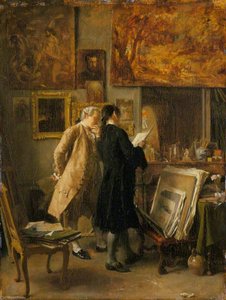
This evocative portrait captures a moment suspended in time—the quiet industry of thought itself. We find ourselves before a young man seated at a substantial desk, surrounded by the tangible evidence of a cultivated mind. He is absorbed in his work, whether transcribing thoughts onto paper or deeply immersed in the pages before him. The composition immediately draws the viewer into this intimate sphere, suggesting that true genius often blossoms not amidst grand pronouncements, but within the hushed confines of study.
The arrangement of objects—the scattered books, the steady presence of the chair, and the watchful clock on the wall—all contribute to a sense of ordered contemplation. It is a scene steeped in the atmosphere of the Enlightenment's enduring reverence for knowledge, inviting us to pause our own hurried modern lives and simply observe the act of creation.
Mastery in Miniature Realism: The Meissonier Touch
The hand that painted this work belongs to Jean-Louis Ernest Meissonier, an artist whose career defined a period of meticulous observation within French painting. Meissonier’s genius lay in his ability to elevate the everyday—the bourgeois drawing room, the scholar at work—to the level of high art. His technique is characterized by an almost breathtaking realism; every fold of fabric, every spine on the book, and the subtle texture of the wood desk speaks to a profound dedication to detail.
One can sense his influence from the Dutch masters he so admired, translating their intimate genre scenes into a grander narrative format. This painting is not merely a likeness; it is a demonstration of technical virtuosity, where light seems to fall with palpable weight upon the polished surface and the vellum.
Symbolism of Study and Enlightenment
Beyond the portrait itself, the symbolism woven into this scene is rich for any collector or decorator. The books are not mere props; they represent accumulated wisdom, the dialogue between past knowledge and present inquiry. The act of writing or reading symbolizes progress, the continuous human quest to understand the world through art and intellect. For those who value learning, scholarship, or the quiet pursuit of a craft, this piece serves as a powerful talisman.
The inclusion of the clock subtly reminds us that while time passes relentlessly, the act of thoughtful engagement—the moment captured here—is what gives life its enduring meaning. It speaks to a timeless balance between temporal passage and eternal contemplation.
Bringing Academic Serenity Home
For the discerning interior designer or art lover seeking to infuse a space with intellectual gravitas, this reproduction offers unparalleled depth. Imagine this piece gracing a library, an executive study, or a refined drawing-room. It does more than decorate; it suggests a history of thoughtful habitation.
Owning a work echoing Meissonier’s style allows one to curate an atmosphere of cultured repose. It is a visual anchor that grounds a room in tradition while celebrating the enduring power of human creativity. It whispers tales of quiet dedication, making any space feel instantly more profound and richly lived-in.
CLASSIFICATION: Art ReproductionQuestions & Answers
How intense are the colors in "Jeune homme travaillant, dit aussi Jeune homme écrivant" by Jean-Louis Ernest Meissonier?
"Jeune homme travaillant, dit aussi Jeune homme écrivant" by Jean-Louis Ernest Meissonier shows a balanced color intensity.
Can I examine "Jeune homme travaillant, dit aussi Jeune homme écrivant" in more detail?
The X-Ray page of "Jeune homme travaillant, dit aussi Jeune homme écrivant" by Jean-Louis Ernest Meissonier is an interactive viewer that lets you slide through eleven optical layers of the artwork's image, including an X-ray style view.
Where and for what purpose is "Jeune homme travaillant, dit aussi Jeune homme écrivant" recommended?
"Jeune homme travaillant, dit aussi Jeune homme écrivant" by Jean-Louis Ernest Meissonier is recommended for focal, ideally in an office. Use and space together guide where a reproduction fits.
Artist Biography
A Master of Miniature Realism: The Life and Art of Jean-Louis Ernest Meissonier
Jean-Louis Ernest Meissonier, a name synonymous with meticulous detail and historical narrative in 19th-century French painting, emerged as a pivotal figure bridging the gap between academic tradition and a burgeoning realism. Born in Lyon in 1815, his path to artistic renown was initially met with familial resistance. His father envisioned a career in business for young Ernest, yet the allure of art proved too strong to ignore. At seventeen, he secured permission to pursue his passion, embarking on a journey that would establish him as one of France’s most celebrated and financially successful artists. Early training under Léon Cogniet provided a foundational grounding, but it was through diligent study of the Dutch masters at the Louvre – painters like Gabriel Metsu and Gerard Douw – that Meissonier truly discovered his artistic voice. These masters, renowned for their intimate scenes of bourgeois life rendered with astonishing precision, profoundly influenced his developing style, inspiring a dedication to detail that would become his hallmark.From Genre Scenes to Grand Historical Narratives
Meissonier’s breakthrough arrived in 1831 with *Les Bourgeois Flamands* (Dutch Burghers), exhibited at the Salon. This work immediately signaled his unique talent – a capacity for recreating scenes of everyday life, or historical vignettes, with an almost microscopic level of accuracy. He wasn't merely depicting objects; he was meticulously reconstructing worlds, capturing textures, light, and atmosphere with breathtaking fidelity. This early success allowed him to refine his technique, producing a series of captivating genre paintings like *The Game of Chess* (1841) and *The Young Man Playing the 'Cello* (1842). These works weren’t simply exercises in technical skill; they were insightful observations of human character and social interaction. However, Meissonier's ambitions extended beyond intimate genre scenes. The political upheavals of 1848, during which he served with the National Guard, deeply impacted him, fueling a desire to address larger historical themes. This shift culminated in monumental works like *The Emperor at Solferino*, a departure from his earlier style that showcased his ability to handle complex compositions and grand narratives while retaining his signature precision.A Technique Defined by Patience and Precision
What truly set Meissonier apart was not simply what he painted, but *how* he painted. His technique was legendary for its painstaking detail. He wasn’t content with broad brushstrokes or impressionistic effects; each element within his compositions was rendered with meticulous care, built up layer upon layer to achieve a remarkable sense of realism. He undertook exhaustive research, meticulously studying costumes, weaponry, and architectural details to ensure historical accuracy. This dedication extended to the natural world as well – he famously studied horses extensively, analyzing their anatomy and movement to depict them convincingly in his battle scenes. Some critics even suggested that his work bordered on obsession, but it was precisely this unwavering commitment to detail that captivated audiences and established his reputation. John Ruskin, the influential English art critic, famously examined Meissonier’s paintings under a magnifying glass, marveling at the artist's “manual dexterity and eye for fascinating minutiae.”Legacy and Lasting Influence
By the latter half of the 19th century, Jean-Louis Ernest Meissonier had become one of France’s most celebrated artists. His works commanded exorbitant prices, allowing him to acquire a magnificent estate in Poissy, complete with dedicated studios designed to facilitate his meticulous process. He was lauded for his technical mastery and his ability to bring history to life with unparalleled realism. While some critics questioned the limited range of his subject matter – often focusing on military scenes or historical recreations – there is no denying his profound influence on subsequent generations of artists. His dedication to detail, his commitment to historical accuracy, and his masterful technique continue to inspire painters today. Museums worldwide, including the Musée d'Orsay in Paris and the National Gallery of Art in Washington D.C., proudly display his works, ensuring that his legacy endures as a testament to the power of patience, precision, and artistic vision. To explore more of Meissonier’s art, visit OriginalUniqueArt.com or the Musée d'Orsay website.
Jean-Louis Ernest Meissonier
1815 - 1891 , France
Quick Facts
- Full Name: Jean-Louis Ernest Meissonier
- Nationality: French
- Date Of Birth: 1815
- Date Of Death: 1891
- Place Of Birth: Lyon, France
- Notable Artworks:
- Les bourgeois flamands
- The Game of Chess
- Halt at an inn
- The brawl
- Emperor at Solferino
- Artistic Movement Or Style: Academic art
- Artists Who Influenced This Artist: ['Dutch Masters']
Related Articles

Giclée Prints: Archival Quality & Aesthetic Nuances for the Discerning Collector
Explore the world of giclée prints with OriginalUniqueArt. Learn about archival quality, aesthetic nuances & investment potential. Expert guidance for discerning art collectors seeking museum-quality reproductions and lasting value.

Romantic Realism's Finest: 10 Masterpieces for Your Home | OriginalUniqueArt
Explore 10 defining masterpieces of Romantic Realism! Discover Courbet, Millet & Daumier's powerful paintings—capturing emotion and social realities. Find museum-quality reproductions for your home at OriginalUniqueArt.com.

Academic Realism: Technique, History & Enduring Influence on Art
Explore the captivating world of Academic Realism! Discover key artists, techniques & its lasting impact on art history. Expert insights & high-quality reproductions at OriginalUniqueArt.

Academic Art: Tradition, Technique & the Pursuit of Ideal Form in the 19th Century
Explore the world of Academic Art! Discover its history, key artists like Ingres & Bouguereau, defining techniques, and lasting influence on 19th-century painting. Learn about the Salon system and its legacy.
Academic Realism's Finest: 10 Masterpieces for Art Lovers & Home Decor
Explore 10 defining Academic Realism masterpieces by Bouguereau, Gérôme & Cabanel. Discover the stories behind these iconic paintings and bring timeless art into your home with museum-quality reproductions from OriginalUniqueArt.com. Explore the full collection online!