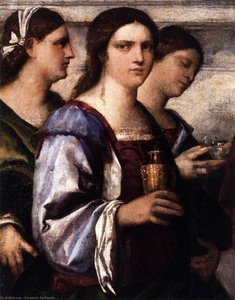
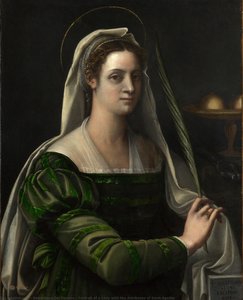
Sebastiano del Piombo, born Sebastiano Luciani around 1485 in the radiant heart of Venice, occupies a unique and often enigmatic position within the High Renaissance. His story is not one of immediate artistic recognition, but rather a compelling journey of adaptation, migration, and ultimately, a distinctive synthesis of Venetian colorism with the imposing gravity of Roman form. Unlike many contemporaries whose paths were clearly defined from youth, Sebastiano’s entry into painting was somewhat delayed; initially drawn to music – he possessed considerable skill as a lutenist – it wasn't until his late teens or early twenties that he seriously embraced the canvas. This formative period in Venice instilled within him an enduring love for rich hues, atmospheric perspective, and a poetic sensibility that would remain hallmarks of his style even after relocating to Rome. The profound influence of Giorgione is particularly palpable in early attributions like the unfinished *Judgement of Solomon*, a work steeped in dramatic narrative and showcasing an innovative approach to composition, hinting at the artistic potential about to unfold.
From Venice to the Heart of Roman Artistic Life
The year 1511 marked a pivotal moment in Sebastiano’s career as he journeyed to Rome, a city then pulsating with artistic energy under the patronage of Popes Julius II and Leo X. This move placed him directly into the orbit of Raphael, whose workshop was at its zenith, and soon after, into the complex world surrounding Michelangelo. Remarkably, unlike some artists who found themselves overshadowed by these titans, Sebastiano managed to carve out his own niche, even earning the respect – and occasional encouragement – of the notoriously critical Michelangelo himself. The two masters recognized a kindred spirit in each other’s pursuit of grandeur and anatomical precision; Michelangelo actively championed Sebastiano's work, urging him to compete with Raphael for prestigious commissions. This rivalry, though perhaps exaggerated by Vasari, undoubtedly fueled Sebastiano’s ambition and contributed to his growing reputation. His early Roman works, such as the frescoes in the Villa Farnesina – notably *Polyphemus* – demonstrate a masterful assimilation of classical motifs and a burgeoning confidence in handling large-scale compositions. He was quickly becoming a force within the Roman art scene, blending Venetian sensibilities with the demands of his new environment.
The Synthesis of Styles: A Unique Artistic Vision
Sebastiano del Piombo’s artistic genius lay in his ability to reconcile the seemingly disparate traditions of Venice and Rome. While firmly rooted in the Venetian school's emphasis on color, light, and texture – a legacy inherited from Giorgione and Titian – he embraced the Roman preoccupation with monumental forms, anatomical accuracy, and dramatic narrative. This fusion is strikingly evident in *The Raising of Lazarus*, a powerful altarpiece commissioned for Narbonne Cathedral and now residing in London’s National Gallery. The painting showcases his command of oil paint to create luminous flesh tones and rich draperies, while the figures themselves possess a sculptural solidity reminiscent of Michelangelo's work. This unique blend set him apart from his contemporaries and established him as a leading figure in Roman art after Raphael’s untimely death in 1520. He wasn’t merely imitating; he was forging a new path, demonstrating that Venetian sensuality and Roman gravitas could coexist harmoniously on the same canvas. The Raising of Lazarus stands as a testament to his ability to synthesize these seemingly opposing forces into a cohesive and emotionally resonant whole.
Later Life and Enduring Legacy
The latter part of Sebastiano's life took an unexpected turn in 1531 when he was appointed *piombatore*, Keeper of the Seals for the Papacy. This prestigious, yet demanding, position required him to attend to the Pope’s administrative duties and curtailed his artistic output considerably. Though financially secure, the responsibilities of office drew him away from painting, and his later works became fewer in number. He continued to receive commissions, primarily portraits, but the fervor and innovation of his earlier period seemed somewhat subdued. Despite this decline in productivity, Sebastiano remained a respected figure within Roman artistic circles until his death in 1547. His influence, however, proved less pervasive than that of Raphael or Michelangelo. This was partly due to a lack of numerous pupils and limited dissemination of his work through prints – a common practice for promoting an artist’s style during the Renaissance. Nevertheless, Sebastiano del Piombo's legacy endures as a testament to the power of artistic synthesis and the enduring allure of Venetian color combined with Roman monumentality.
Explore the groundbreaking art of Antonello da Messina, a pivotal figure of the Renaissance. Discover his innovative oil painting techniques, captivating portraits, and lasting influence on Italian masters. Learn more at OriginalUniqueArt.
Embark on a journey through Venetian history with the 25 greatest masterpieces of Gallerie dell'Accademia. From Titian to Tintoretto, explore the soul of the Renaissance. Find museum-quality art reproductions and decor inspiration. Discover all masterpieces on OriginalUniqueArt.com.
What are the birthplace and birth year of Sebastiano del Piombo?
Sebastiano del Piombo was born in Venice in 1485.
What other names is Sebastiano del Piombo known by?
Sebastiano del Piombo appears under the alternate names Sebastiano Luciani, Sebastiano del Piombino, Sebastiano, Fra Sebastiano del Piombo, Sebastianus Venetus.