Portret Alexandre Calame

58 najsłynniejszych obrazów artysty Alexandre Calame, każdy niepowtarzalny

Aktualizacja: Listopad 2026 · ranking według naszego wskaźnika popularności (liczba wyszukiwań, wizyt i zamówień dla każdego dzieła) · 63 dzieł Alexandre Calame w naszym katalogu

W skrócie

Torrent in the Alps (1849) to obraz autorstwa Alexandre Calame, który przyciąga najwięcej spojrzeń. Następnie wzrok kieruje się na The Mythen (1861) i Valley of Lauterbrunnen (1856). Spośród 63 dzieł Alexandre Calame w naszym katalogu, tych 58 jest najbardziej znanych – każde z nich to unikatowy oryginał, przedstawiony wraz z rokiem powstania, muzeum oraz powodem, dla którego przetrwało próbę czasu.

1810 – 1864, Vevey Romantic landscape painting Najwięcej dzieł: Amsterdam Museum

10 najlepszych obrazów autorstwa Alexandre Calame według oka galerii

1
Torrent in the Alps (1849) autorstwa Alexandre Calame

Torrent in the Alps

1849 · Oil On Canvas

The oil on canvas titled Torrent in the Alps was painted by Alexandre Calame in 1849. This work captures a specific moment of movement within the Swiss landscape. The physical presence of the piece measures 57.8 x 76.0 cm or 58.5 x 76.3 cm.

2
The Mythen (1861) autorstwa Alexandre Calame

The Mythen

1861 · Oil

The painting depicts a mountain landscape dominated by two prominent, snow-covered peaks. One peak occupies the left side of the composition, while the second rises toward the right. The sky above these summits is rendered in shades of purple. Below the rocky heights, several figures are positioned within the scene. Some individuals appear in the foreground, while others are situated at a distance, creating a sense of scale and depth.…

3
Valley of Lauterbrunnen (1856) autorstwa Alexandre Calame

Valley of Lauterbrunnen

1856 · Lithograph

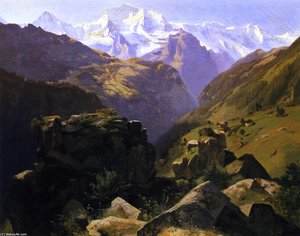
The landscape known as Valley of Lauterbrunnen emerges from the hand of Alexandre Calame, a Swiss landscape painter and lithographer. Created in 1856, this work captures a specific moment in the artist's life, a period when he was already well-established in his craft. Calame, who was born in 1810, brings a deep familiarity with the topography of his homeland to this scene. The piece exists as a window into the…

4
Landscape (1837) autorstwa Alexandre Calame

Landscape

1837 · Print · Rijksmuseum, Amsterdam

The sun hangs low, casting a luminous yellow-gold glow across a sky that promises either a quiet sunrise or a fading sunset. Below this celestial light, a winding river carves its way through the terrain, leading the eye from the immediate, shadowed foreground into a hazy, distant horizon. The air feels heavy with moisture, creating a misty, ethereal quality that softens the edges of the world. Deep forest greens and…

5
High Mountain Gorge (Handeggtal in the Canton of Bern) (1854) autorstwa Alexandre Calame

High Mountain Gorge (Handeggtal in the Canton of Bern)

1854 · Oil On Canvas · Alte Nationalgalerie, Berlin

The rugged terrain of the Handeggtal in the Canton of Bern is rendered with a focus on the overwhelming scale of the natural world. A dark, wind-swept evergreen tree anchors the mid-ground, its verticality contrasting against the steep, diagonal slopes of the gorge. Light breaks through a turbulent, heavy sky to illuminate a distant, rocky peak and a small, cascading waterfall on the left. This composition emphasizes the immense depth…

6
Fallen Tree (1842) autorstwa Alexandre Calame

Fallen Tree

1842 · Oil On Canvas · National Gallery of Art, Waszyngton

The composition is dominated by heavy, diagonal lines created by fallen trunks that cut across the frame. These splintered remains of large trees lie in a state of chaotic movement, their jagged edges pointing into the depths of the forest. The scene focuses on the immediate aftermath of natural destruction, where the structural integrity of the woods has been broken. Deep shadows settle within the hollows of the fractured wood,…

7
Landscape with Oaks (1859) autorstwa Alexandre Calame

Landscape with Oaks

1859 · Oil On Canvas · Ermitaż, Sankt Petersburg

In this 1859 oil on canvas, we find ourselves standing before a scene of profound stillness. A large tree, heavy with green leaves, anchors the center of the composition, its roots seemingly entwined with a rugged, rocky terrain. The ground beneath is a mixture of dirt and grass, suggesting a corner of the world left to its own devices. In the distance, other trees emerge through a soft haze, providing…

8
Lake Lucerne (1853) autorstwa Alexandre Calame

Lake Lucerne

1853 · Oil On Canvas · Alte Nationalgalerie, Berlin

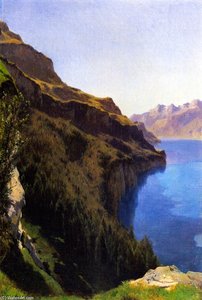
Alexandre Calame captures the stillness of the Swiss landscape in his 1853 oil painting, Lake Lucerne. This landscape painting focuses on the quietude of the water held between steep, rugged cliffs. The artist, born in Vevey, Switzerland, translates the physical weight of the Alps into a study of light and shadow. The composition centers on the lake itself, a serene blue expanse nestled beneath the shadow of the mountains.

9
Chalets at Rigi (1861) autorstwa Alexandre Calame

Chalets at Rigi

1861 · Oil On Canvas · National Gallery, Londyn

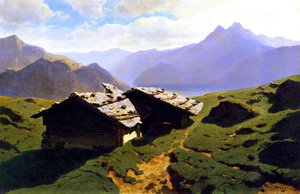
In this oil on canvas, Alexandre Calame presents a quiet moment amidst the high peaks. The work, titled Chalets at Rigi, captures a specific slice of mountain life. We find ourselves looking upon a hillside where three main chalets sit nestled against the landscape. Each structure possesses its own unique size and shape, appearing as if they have grown naturally from the earth itself. The scene unfolds with a sense…

10
Swiss Landscape (1830) autorstwa Alexandre Calame

Swiss Landscape

1830 · Oil On Canvas · National Gallery of Art, Waszyngton

In the work Swiss Landscape by Alexandre Calame, the composition is organized around a wide, panoramic view. The perspective is elevated, providing a high vantage point that looks out over a vast expanse of terrain. The viewer's eye is led from a textured, shadowed foreground through a series of patterned agricultural fields. These fields are defined by the geometric boundaries of cultivated plots and the undulating contours of the hills.…

Słynne obrazy artysty Alexandre Calame, od 11 do 58

11Waterfall of the Handeck at the Grimsel (1839) autorstwa Alexandre CalameWaterfall of the Handeck at the Grimsel1839 · Amsterdam Museum 12landscape: river-valley with rocks in the mountains (1835) autorstwa Alexandre Calamelandscape: river-valley with rocks in the mountains1835 13Mountain Landscape (1838) autorstwa Alexandre CalameMountain Landscape1838 · Amsterdam Museum 14italian landscape with lake (1835) autorstwa Alexandre Calameitalian landscape with lake1835 15Mountain landscape (1835) autorstwa Alexandre CalameMountain landscape1835 16Lake with mountains in the background (1835) autorstwa Alexandre CalameLake with mountains in the background1835 17landscape with figures (1835) autorstwa Alexandre Calamelandscape with figures1835 18Mountain Landscape, Valais, Switzerland (1838) autorstwa Alexandre CalameMountain Landscape, Valais, Switzerland1838 19The Thunderstorm at Handeck (1839) autorstwa Alexandre CalameThe Thunderstorm at Handeck1839 20Edge of the Forest (1847) autorstwa Alexandre CalameEdge of the Forest1847 21In the Berner Oberland (1847) autorstwa Alexandre CalameIn the Berner Oberland1847 · Amsterdam Museum 22Mountain Stream in the Alps (Reichenbach) (1842) autorstwa Alexandre CalameMountain Stream in the Alps (Reichenbach)1842 · Amsterdam Museum 23The Sycamores (1848) autorstwa Alexandre CalameThe Sycamores1848 24Lake at the Edge of a Forest (1848) autorstwa Alexandre CalameLake at the Edge of a Forest1848 · Museum of Fine Arts 25Mountaneous Landscape in Valais (1840) autorstwa Alexandre CalameMountaneous Landscape in Valais1840 · Nationalmuseum 26Pozzuoli and the Bay of Naples (1844) autorstwa Alexandre CalamePozzuoli and the Bay of Naples1844 27Mountainous Landscape with a Torrent (1840) autorstwa Alexandre CalameMountainous Landscape with a Torrent1840 28Part of Lake Geneva (1852) autorstwa Alexandre CalamePart of Lake Geneva1852 29Lake Lucerne (1852) autorstwa Alexandre CalameLake Lucerne1852 · Amsterdam Museum 30Broken Tree at Kerket, near Meyringen (Bernese Oberland) (1850) autorstwa Alexandre CalameBroken Tree at Kerket, near Meyringen (Bernese Oberland)1850 31View Taken in the Ansasca Valley (Piedmont). Evening Effect. (1850) autorstwa Alexandre CalameView Taken in the Ansasca Valley (Piedmont). Evening Effect.1850 32Grimsel Pass (Canton of Berne) (1850) autorstwa Alexandre CalameGrimsel Pass (Canton of Berne)1850 33Winter (1851) autorstwa Alexandre CalameWinter1851 · Musée d'Art et d'Histoire de Genève 34The Sycamores (1854) autorstwa Alexandre CalameThe Sycamores1854 · Cincinnati Art Museum 35Lake of the Four Cantons (1850) autorstwa Alexandre CalameLake of the Four Cantons1850 · Muzeum Narodowe w Warszawie 36The Jungfrau, Switzerland (1853) autorstwa Alexandre CalameThe Jungfrau, Switzerland1853 · Walters Art Museum 37Mountain Torrent before a Storm (also known as The Aare River, Hastital) (1850) autorstwa Alexandre CalameMountain Torrent before a Storm (also known as The Aare River, Hastital)1850 38Mountain Torrent (1850) autorstwa Alexandre CalameMountain Torrent1850 39Trunk of a Beech Tree (1850) autorstwa Alexandre CalameTrunk of a Beech Tree1850 40A View of the Jungfrau Massif seen from Above, Interlaken (1854) autorstwa Alexandre CalameA View of the Jungfrau Massif seen from Above, Interlaken1854 41Study from Nature Near Villeneuve (1855) autorstwa Alexandre CalameStudy from Nature Near Villeneuve1855 42Lake of the Four Cantons (Lake Lucerne), near Brunnen (1852) autorstwa Alexandre CalameLake of the Four Cantons (Lake Lucerne), near Brunnen1852 43Rocky Path (1860) autorstwa Alexandre CalameRocky Path1860 44Cliffs of Seelisberg, Lake Lucern (1861) autorstwa Alexandre CalameCliffs of Seelisberg, Lake Lucern1861 45Riverbed at Rosenlaui (1862) autorstwa Alexandre CalameRiverbed at Rosenlaui1862 46The River Lutschine near Lauterbrunnen (1862) autorstwa Alexandre CalameThe River Lutschine near Lauterbrunnen1862 47Souvenir of Lake Lucerne (1862) autorstwa Alexandre CalameSouvenir of Lake Lucerne1862 48Souvenir of Rosenlaui, Switzerland (1860) autorstwa Alexandre CalameSouvenir of Rosenlaui, Switzerland1860 · Wallace Collection 49Burza nad Handeckiem (1838) autorstwa Alexandre CalameBurza nad Handeckiem1838 · Fitzwilliam College 50Alpine Landscape autorstwa Alexandre CalameAlpine LandscapeFinnish National Gallery 51Alpine Waterfall autorstwa Alexandre CalameAlpine WaterfallFinnish National Gallery 52The Wetterhorn autorstwa Alexandre CalameThe WetterhornKrólewskie Muzeum Sztuk Pięknych Antwerpia 53Etude de montagne autorstwa Alexandre CalameEtude de montagne 54Alpine Landscape autorstwa Alexandre CalameAlpine Landscape 55Etude de torrent autorstwa Alexandre CalameEtude de torrent 56The Lake of Thun autorstwa Alexandre CalameThe Lake of ThunNational Gallery 57Mountainous Riverscape autorstwa Alexandre CalameMountainous Riverscape 58Trees at the Bank autorstwa Alexandre CalameTrees at the Bank

Słynne obrazy Alexandre Calame epoka po epoce

Tematy, które przyciągnęły wzrok Alexandre Calame

Cztery motywy najczęściej powracające w tych oryginałach, z których każdy doczekał się swojego najdoskonalszego przykładu.

Muzea przechowujące oryginały Alexandre Calame

8 muzeów, w których znajduje się najwięcej obrazów z tej strony.

Muzea Miasto Dzieła artysty Alexandre Calame Obrazy z tej listy
Amsterdam Museum, AmsterdamAmsterdam Museum Amsterdam 5 Waterfall of the Handeck at the Grimsel, Mountain Landscape, In the Berner Oberland
Alte Nationalgalerie, BerlinAlte Nationalgalerie Berlin 2 High Mountain Gorge (Handeggtal in the Canton of Bern), Lake Lucerne
National Gallery of Art, WaszyngtonNational Gallery of Art Waszyngton 2 Fallen Tree, Swiss Landscape
National Gallery, LondynNational Gallery Londyn 2 Chalets at Rigi, The Lake of Thun
Finnish National Gallery, HelsinkiFinnish National Gallery Helsinki 2 Alpine Landscape, Alpine Waterfall
Rijksmuseum, AmsterdamRijksmuseum Amsterdam 1 Landscape
Ermitaż, Sankt PetersburgErmitaż Sankt Petersburg 1 Landscape with Oaks
Museum of Fine Arts, BostonMuseum of Fine Arts Boston 1 Lake at the Edge of a Forest

Alexandre Calame na przestrzeni dekad: jeden unikatowy oryginał dla każdego

Dzieła według dekad

Wybierz dekadę, aby zobaczyć dzieło, które ją definiuje.

Obrazy artysty Alexandre Calame: pytania do galerii

Jakie jest najsłynniejsze dzieło artysty Alexandre Calame?Odkryj odpowiedź

Torrent in the Alps (1849). Następne są The Mythen (1861) oraz Valley of Lauterbrunnen (1856).

W jakim wieku Alexandre Calame stworzył/a Torrent in the Alps?Odkryj odpowiedź

39 lat: Torrent in the Alps pochodzi z 1849, a Alexandre Calame urodził(a) się w 1810.

Które dziesięć obrazów Alexandre Calame jest najbardziej znanych?Odkryj odpowiedź

Torrent in the Alps, The Mythen, Valley of Lauterbrunnen, Landscape, High Mountain Gorge (Handeggtal in the Canton of Bern), Fallen Tree, Landscape with Oaks, Lake Lucerne, Chalets at Rigi i Swiss Landscape. Powyższy ranking zawiera rok powstania oraz muzeum dla każdego z nich.

Ile znanych dzieł stworzył Alexandre Calame?Odkryj odpowiedź

Nasz katalog zawiera 63 dzieł artysty Alexandre Calame, datowanych od 1830 do 1862.

Gdzie można zobaczyć najsłynniejsze oryginały Alexandre Calame?Odkryj odpowiedź

W większości znajdują się w Amsterdam Museum (Amsterdam), Alte Nationalgalerie (Berlin) i National Gallery of Art (Waszyngton). Powyższa tabela muzeów zawiera ich pełną listę.

W jakim okresie Alexandre Calame stworzył/a swoje najsłynniejsze obrazy?Odkryj odpowiedź

W 1850s: 19 z 58 dzieł na tej stronie powstało w tym czasie, w tym Valley of Lauterbrunnen.

Który z najsłynniejszych obrazów artysty Alexandre Calame powstał najwcześniej, a który najpóźniej?Odkryj odpowiedź

Na tej stronie najwcześniejszy to Swiss Landscape (1830), a najpóźniejszy Riverbed at Rosenlaui (1862).

Jakie tematy preferował Alexandre Calame?Odkryj odpowiedź

Sky (32), Trees (27) i Rocks (25), w ramach 58 dzieł na tej stronie.

Jakich materiałów Alexandre Calame używał najczęściej?Odkryj odpowiedź

Oil On Canvas, dla 35 z 58 dzieł na tej stronie.

Do jakiego nurtu należy twórczość Alexandre Calame?Odkryj odpowiedź

Romantic landscape painting, sądząc po oryginałach na tej stronie.

Jakie oryginały Alexandre Calame można zobaczyć w Amsterdam Museum?Odkryj odpowiedź

Waterfall of the Handeck at the Grimsel, Mountain Landscape i In the Berner Oberland: Amsterdam Museum, Amsterdam posiada 5 dzieł widocznych na tej stronie.

Alexandre Calame: portret artysty

Alexandre Calame (1810 – 1864): Uchwycenie Alpejskiej Majestatyczności

Alexandre Calame, urodzony w 1810 roku w Arabie (dzisiejszym Vevey) w Szwajcarii, był szwajcarskim malarzem pejzażowym, który zdobył znaczne uznanie w epoce romantyzmu i jest uważany za kluczową postać szkoły düsseldorfskej. Jego artystyczna droga rozpoczęła się w trudnych okolicznościach – finansowa ruina ojca uniemożliwiła mu zdobycie formalnego wykształcenia, zmuszając do pracy jako urzędnik bankowy już w okresie adolescencji. Jednak ta pragmatyczna konieczność rozbudziła w nim pasję do sztuki, którą pielęgnował dzięki spotkaniu z bankierem Diodati, który zapewnił mu nieocenioną naukę u François Diday, słynnego düsseldorfska malarza pejzażowego. Dostrzegając jego wrodzony talent i oddanie, Calame szybko porzucił obowiązki urzędnicze, by podążyć drogą artystycznej doskonałości.

Lata formacyjne Calame'a upłynęły pod znakiem skrupulatnych szkiców szwajcarskich krajobrazów – przede wszystkim widoków Oberlandu Berneńskiego – praktyki doskonalonej pod okiem Diday'a. Ta wczesna koncentracja na naturze ustanowiła jego dożywotnią fascynację alpejskimi sceneriami, odzwierciedlającą romantyczną pasję do nieokiełznanej dziczy i wzniosłego piękna. Powiązania z Duesseldorfem ugruntowały jego reputację jako mistrza perspektywy atmosferycznej i modulacji tonalnej. Artyści tacy jak Wilhelm Leibl i Anton Richter wspierali styl Calame'a, kładąc nacisk na drobiazgową obserwację i ekspresyjne pociągnięcia pędzla, aby oddać emocjonalny wpływ natury.

Styl Artystyczny i Technika

Artystyczny podpis Calame'a tkwił w jego zdolności do przenoszenia majestatu Alp na płótno z niezwykłą dokładnością i wrażliwością. Stosował technikę charakteryzującą się nakładaniem warstw laserunku – cienkich, półprzezroczystych płukania pigmentem nakładanych sekwencyjnie – aby uzyskać świetliste palety barw i uchwycić subtelne wahania światła i cienia. To skrupulatne podejście odzwierciedlało wpływ Diday'a i odróżniało Calame'a od wielu jego współczesnych, którzy preferowali luźniejsze pociągnięcia pędzla. Jego pejzaże nie były jedynie przedstawieniami; były przesiąknięte namacalnym wzruszeniem, przekazującym dramat burz, spokój polodowcowych jezior i żywe barwy alpejskich łąk. Do jego wybitnych dzieł należą „Handeck Fall”, „Torrent in the Alps” oraz „Storm at Handeck”, z których każde demonstruje jego mistrzostwo w harmonii tonalnej i kompozycyjnej równowadze.

Wkład Calame'a wykraczał poza malarstwo; odniósł on sukcesy jako litograf, tworząc oszałamiające grafiki, które jeszcze szerzej rozpowszechniały jego wizję alpejskich krajobrazów.

Wyróżniające się Osiągnięcia i Dziedzictwo

Calame zdobył znaczny uznanie w Niemczech w latach 30. i 40. XIX wieku, stając się ulubieńcem zarówno kolekcjonerów, jak i krytyków. Wystawy w Paryżu zaprezentowały jego talent szerokiej publiczności, umacniając jego pozycję jako jednego z najważniejszych szwajcarskich malarzy pejzażowych. Wykładał na Uniwersytecie w Genewie, wspierając rozwój artystyczny studentów, takich jak Adolf Mosengel, który kontynuował dziedzictwo Calame'a. Jego podróż do Włoch przyniosła nieocenione inspiracje – szczególnie z Rzymu i Neapolu – co zaowocowało obrazami oddającymi istotę włoskiego piękna natury obok jego ukochanych alpejskich widoków. Trwała fascynacja przedstawieniami lodowców i górskich strumieni autorstwa Calame'a świadczy o ich ponadczasowym uroku i nadal inspiruje artystów na całym świecie.

Dzieła Ilustracyjne i Wpływ Artystyczny

Artystyczny wpływ Calame'a rezonował w całym ruchu romantycznym, kształtując wrażliwość estetyczną kolejnych pokoleń. Jego skrupulatna obserwacja i ekspresyjna technika służyły jako wzór dla malarzy pejzażowych dążących do uchwycenia wzniosłego majestatu natury. Co więcej, jego litografie odegrały kluczową rolę w popularyzacji alpejskich scenerii i rozpowszechnianiu romantycznych ideałów w całej Europie. Nieprzemijające piękno i emocjonalna głębia obrazów Calame'a sprawiają, że jego wkład w historię sztuki pozostaje trwale ugruntowany.