Romanticism
Alpine Landscape (Alexandre Calame)
Alexandre Calame (1810–1864) stworzył Alpine Landscape. Należy do nurtu Romanticism. Wykonano w technice Oil On Canvas. Wymiary to 45 × 31 cm.
- Oil On Canvas
- 45 × 31 cm

 Podgląd w skali 1:1

 Ręcznie malowany obraz olejny
 Wyślij jako kartkę
 Udostępnij
 Karta informacyjna


 Pobierz obraz
 Podobne obiekty
 RTG
 Pokaz slajdów
 Pytania i odpowiedzi

 Statystyki
Alpine Landscape w skrócie
- Tytuł
- Alpine Landscape
- Artysta
- Alexandre Calame (1810–1864)
- Miejsce urodzenia artysty
- Vevey, Szwajcaria
- Technika wykonania
- Oil On Canvas
- Wymiary
- 45 × 31 cm
- Ruch
- Romanticism
- Epoka
- 19th Century
- Temat
- alpine landscape, mountain scenery, swiss alps view, river valley scene, atmospheric perspective, landscape painting
Co przedstawia Alpine Landscape?
Identification of the Alpine Landscape
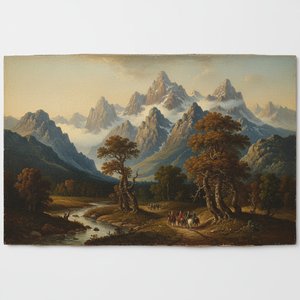
Alpine Landscape is an oil painting by the Swiss artist Alexandre Calame. The canvas captures a mountainous valley where a river winds through the terrain. A rocky outcrop anchors the left side of the scene, leading the eye toward distant, receding peaks. This work reflects the artist's lifelong preoccupation with the rugged topography of his homeland.
Alexandre Calame was born in 1810 in Vevey, Switzerland. He spent much of his life observing the textures of the Alps, from the weight of granite to the movement of mountain streams. The artist eventually passed away in 1864 in Menton, France. In this specific composition, the light remains diffused, as if filtered through an overcast sky or the soft glow of early morning.
The scene focuses on the scale of the natural world. Trees and shrubs ground the foreground, providing a sense of texture against the vastness of the background. The mountains rise in geometric triangles, their forms softening as they vanish into the atmospheric distance. A quiet stillness settles over the valley.
Composition and Visual Elements
A rocky outcrop anchors the left side of the frame, its jagged edges catching the light to pull the eye into the scene. From this stone threshold, the gaze follows a river as it winds through a mountainous valley. In the foreground, the earth is textured with the presence of shrubs and trees, grounding the viewer amidst the wild vegetation. These small, detailed forms provide a tactile entry point before the eye moves toward the vastness of the background.
The composition relies on a steady use of perspective to carve out a sense of immense depth. The mountains recede into the distance, their scale dwarfing the river and the greenery below. This arrangement emphasizes the sheer magnitude of the alpine terrain. The verticality of the peaks meets the horizontal flow of the water, creating a structured balance within the natural chaos. The light remains diffused, casting soft shadows across the mountain slopes and the valley floor. A quiet stillness settles over the stone and the stream.
Technique and Artistic Materials
Oil paint meets canvas in this landscape. The artist applied thin, translucent washes of pigment, layering them one after another in a sequence of glazes. This meticulous process builds a luminous depth, allowing light to settle within the layers. It is a slow accumulation of color. The surface holds the weight of the mountain and the softness of the air.
The brushwork captures the physical reality of the terrain. Roughness defines the stone of the rocky outcrop, while the texture of the foliage is rendered with precise, tactile strokes. Light enters the scene as a diffused glow, suggesting the quiet of an overcast day or the pale clarity of early morning. Shadows settle into the mountain crevices, creating a sense of immense scale through tonal modulation. The atmosphere feels heavy with moisture, as if the light itself is filtered through a mountain mist.
The Artistic Style of Calame
A sense of the sublime anchors this work, a hallmark of the Romanticism movement. Calame was a pivotal figure within the Düsseldorf School of Painting, bringing a disciplined eye to the untamed wilderness. He treats the mountains not as static stone, but as living, breathing entities. Through a mastery of atmospheric perspective, the distant peaks recede into a soft, hazy light, creating a profound sense of depth. This tonal modulation allows the viewer to feel the weight of the air between the rocky foreground and the far horizon.
The brushwork is expressive, capturing the rugged textures of the landscape. He uses these strokes to convey the emotional impact of nature, translating the scale of the valley into a felt experience. There is a palpable emotion in the way light hits the river and the cliffs, suggesting the solitude of the high Alps. His connection to these mountains is evident in the precise, almost tactile rendering of the terrain. The scene remains quiet, held in a delicate balance of light and shadow.
Related Works by Alexandre Calame
The artist’s hand often returned to the weight of the mountains and the movement of the air. In 1838, he captured the tension of a storm at Handeck, where the sky meets the jagged rock. This energy persists in his 1856 work, Storm in the Alps, a scene of chaotic weather and turbulent clouds. He also documented the specific topography of the Valley of Lauterbrunnen in 1856, rendering the deep clefts of the Swiss terrain. These works reflect a lifelong preoccupation with the raw power of the high passes.
Water remains a constant presence in his compositions, shifting from the violent to the still. He painted the Lake of the Four Cantons, near Brunnen, in 1853, finding a different rhythm in the alpine waters. His vision extended beyond the peaks to the warmth of the south, seen in Pozzuoli and the Bay of Naples, 1844. Even in more quiet studies, such as Landscape with Oaks, about 1859, the meticulous observation of nature remains central. The light continues to shift across the stone.
Zdjęcia w wysokiej rozdzielczości dzieła Alpine Landscape
Domena publiczna: artysta zmarł w 1864.
Alexandre Calame, Alpine Landscape.
Alexandre Calame (1810–1864), Alpine Landscape, oil on canvas. Domena publiczna Źródło obrazu: OriginalUniqueArt.com.
Odpowiedzi na pytania dotyczące Alpine Landscape
Z jakiej techniki wykorzystano "Alpine Landscape"?
„Alpine Landscape” wykonano w technice Oil On Canvas.
Jakie są rzeczywiste wymiary dzieła „Alpine Landscape” – Alexandre Calame?
Oryginalne wymiary dzieła „Alpine Landscape” to 45 x 31 cm. Znajomość pierwotnej skali może być pomocna przy wyborze odpowiedniego rozmiaru reprodukcji.
Co przedstawia „Alpine Landscape” – Alexandre Calame?
Tematyka obecna w „Alpine Landscape” – Alexandre Calame obejmuje alpine landscape, mountain scenery, swiss alps view, river valley scene, atmospheric perspective, landscape painting, nature’s grandeur”. Razem stanowią one podsumowanie tematyki dzieła.
Czy dzieło "Alpine Landscape" znajduje się w domenie publicznej?
„Alpine Landscape” – Alexandre Calame znajduje się w domenie publicznej (należy do domeny publicznej – autorskie prawa majątkowe wygasły). Status ten określa zasady reprodukcji obrazu tego dzieła.
Kto jest autorem dzieła "Alpine Landscape"?
Autorem dzieła „Alpine Landscape” jest Alexandre Calame. Praca ta figuruje w katalogu pod nazwiskiem Alexandre Calame.
Do jakiego nurtu w sztuce należy „Alpine Landscape” – Alexandre Calame?
„Alpine Landscape” to dzieło należące do nurtu Romanticism. Nurt ten określa tradycję artystyczną, w której osadzone jest dzieło.
Do którego okresu twórczości Alexandre Calame należy dzieło „Alpine Landscape”?
W dorobku artystycznym Alexandre Calame dzieło „Alpine Landscape” przypada na Mature Period. Ten etap pozwala zestawić je z innymi pracami twórcy.
Czy dzieło „Alpine Landscape” autorstwa Alexandre Calame znajduje się w domenie publicznej i dlaczego?
Dzieło "Alpine Landscape" autorstwa Alexandre Calame znajduje się w należy do domeny publicznej – autorskie prawa majątkowe wygasły. Okres ochrony praw autorskich liczony jest od daty śmierci artysty, a Alexandre Calame zmarł(a) w 1864.
Co łączy "Alpine Landscape" z resztą twórczości Alexandre Calame?
"Alpine Landscape" wpisuje się w nurt Romanticism w twórczości Alexandre Calame, której charakterystyczne motywy obejmują romantic nature's beauty, düsseldorf school influence, swiss landscape focus", alpine sublime ideal, detailed observation, calame's signature style, nature as spiritual space.
O artyście: Alexandre Calame

1810–1864, Szwajcaria
Alexandre Calame
Alexandre Calame (1810 – 1864): Uchwycenie Alpejskiej Majestatyczności Alexandre Calame, urodzony w 1810 roku w Arabie (dzisiejszym Vevey) w Szwajcarii, był szwajcarskim malarzem pejzażowym, który zdobył znaczne uznanie w epoce romantyzmu i jest uważany za kluczową postać szkoły düsseldorfskej. Jego artystyczna droga rozpoczęła się w trudnych okolicznościach – finansowa ruina ojca uniemożliwiła mu zdobycie formalnego wykształcenia, zmuszając do pracy jako urzędnik bankowy już w okresie adolescencji. Jednak ta pragmatyczna konieczność rozbudziła w nim pasję do sztuki, którą pielęgnował dzięki spotkaniu z bankierem Diodati, który zapewnił mu nieocenioną naukę u François Diday, słynnego düsseldorfska malarza pejzażowego. Dostrzegając jego wrodzony talent i oddanie, Calame szybko porzucił obowiązki urzędnicze, by podążyć drogą artystycznej doskonałości.
Inne prace Alexandre Calame
 Torrent in the Alps1849
 Valley of Lauterbrunnen1856
 The Mythen1861
 Landscape1837
Eseje o Alpine Landscape
 Alpine Grandeur: A Study of Mountain Landscapes in Classical and Romantic ArtExplore the evolution of mountain landscapes from Flemish masters to German Expressionism. Discover the sublime power of Alpine art history.
 19th century Swiss paintersLouis Buvelot left Switzerland for Melbourne in 1864 to become the father of Australian landscape painting. How did his Swiss training chan…
 Majestic Peaks on Canvas: A Historical & Artistic Exploration of Mountains in Fine ArtExplore the history of mountain painting! Discover Romantic masterpieces & key artists like Dahl & Calame. Learn about the Sublime & Pictur…