Portrait of William Brown

The 44 Most Famous William Brown Paintings, Each One of a Kind

Updated November 2026 · ranked by our popularity score (searches, visits and orders for each work) · 44 works by William Brown in our catalogue

In short

Summer Pastures (1856) is the William Brown painting that draws the most eyes. After it, the eye goes to Still Life (also known as Fruit and Art Objects) (1888) and Landscape with Two Indians (1855). Among the 44 works of William Brown in our catalog, these 44 are the most famous, each a unique original presented with its year, its museum and the reason it endures.

1823 – 1899, New York City Hudson river school Most works: Toledo Museum of Art

Top 10 paintings by William Brown, through the gallery's eye

1
Summer Pastures (1856) by William Brown

Summer Pastures

1856 · Oil On Canvas

The scene unfolds within the quiet expanse of Summer Pastures, a work that captures a specific moment of pastoral peace. Painted in 1856, this piece brings the viewer into a lush, green world where the air feels heavy with the warmth of a midsummer afternoon. The artist, William Brown, also known by his full name William Mason Brown, directs our gaze across a landscape that feels both vast and intimately…

William Brown's famous paintings, numbers 11 to 44

William Brown's famous paintings, period by period

The subjects that held William Brown's eye

The four subjects that come back most often in these originals, each with its finest example.

The museums that keep William Brown's originals

The 7 museums that hold the most of the paintings on this page.

Museum City Works by William Brown Paintings from this list
Toledo Museum of Art, ToledoToledo Museum of Art Toledo 1 Landscape with Two Indians
Yale Center for British Art, New HavenYale Center for British Art New Haven 1 Tiptree Hall and Farm, Essex
Crystal Bridges Museum of American Art, BentonvilleCrystal Bridges Museum of American Art Bentonville 1 Raspberries in a Wooded Landscape
Cleveland Museum of Art, ClevelandCleveland Museum of Art Cleveland 1 Still Life with Cantaloupe
Birmingham Museum of Art, BirminghamBirmingham Museum of Art Birmingham 1 Still Life with Cantaloupe
National Gallery of Art, WashingtonNational Gallery of Art Washington 1 Mound of Cherries
Fries Museum, LeeuwardenFries Museum Leeuwarden 1 Still Life with Melon, Peach, Fruit-Filled Compote and Glass of Wine on a Marble Table Top

William Brown across the decades: one unique original for each

Works per decade

Pick a decade to see the original that defines it.

William Brown's paintings: questions for the gallery

What is the single most famous work of William Brown?Reveal the answer

Summer Pastures (1856). Still Life (also known as Fruit and Art Objects) (1888) and Landscape with Two Indians (1855) come next.

At what age did William Brown create Summer Pastures?Reveal the answer

33 years old: Summer Pastures dates from 1856, and William Brown was born in 1823.

Which ten paintings by William Brown are the most famous?Reveal the answer

Summer Pastures, Still Life (also known as Fruit and Art Objects), Landscape with Two Indians, Tiptree Hall and Farm, Essex, Untitled (also known as Landscape with Indians), Three Men in a Landscape, Landscape with Two Indians, Raspberries in a Wooded Landscape, Still Life with Watermelon, Grapes, Peaches, Plums and Cantaloupe and Still Life with Melon, Grapes, Peaches, Pears and Black Raspberries. The ranking above gives each one's year and museum.

How many works by William Brown are known?Reveal the answer

Our catalog holds 44 works by William Brown, dated from 1850 to 1888.

Where can the most famous William Brown originals be seen?Reveal the answer

Mostly in Toledo Museum of Art (Toledo), Yale Center for British Art (New Haven) and Crystal Bridges Museum of American Art (Bentonville). The museum table above lists them all.

During which period did William Brown create the best-known paintings?Reveal the answer

In 1850s: 7 of the 44 works on this page were made then, Summer Pastures among them.

Which famous William Brown painting is the earliest, and which the latest?Reveal the answer

On this page, the earliest is Tiptree Hall and Farm, Essex (1850) and the latest Still Life (also known as Fruit and Art Objects) (1888).

What subjects did William Brown favour?Reveal the answer

Landscape (8), Life (8) and Fruits (6), across the 44 works on this page.

Which movement does the work of William Brown belong to?Reveal the answer

Hudson river school, judging by the originals on this page.

William Brown: a portrait of the artist

The Meticulous Vision of William Mason Brown

Born in Troy, New York, William Mason Brown emerged as a distinctive voice within the American art landscape, carving out a legacy defined by an extraordinary devotion to detail. His artistic journey began under the tutelage of Abel Buell Moore, the preeminent portraitist of Troy, which laid the foundation for a career that would traverse several captivating genres. While his early training was rooted in the intimate realm of portraiture, Brown’s creative spirit eventually expanded into the sweeping vistas of the landscape and the hyper-realistic precision of still life painting.

As a prominent member of the second generation of the Hudson River School, Brown’s early work reflected the romantic traditions established by masters such as Thomas Cole. During his time in Newark, New Jersey, starting around 1850, he specialized in landscapes that captured the grandeur and serenity of the natural world. These works often featured a striking balance between vast, atmospheric backgrounds—such as distant mountains and flowing rivers—and an exacting, almost photographic precision in the foreground elements. This duality allowed him to evoke both the sublime scale of nature and a profound sense of tranquility.

A Transition to Hyper-Realistic Still Life

A pivotal shift occurred in 1858 when Brown moved to Brooklyn, New York, a transition that saw him move away from the expansive horizons of landscape painting toward the concentrated intensity of still life. This period marked his emergence as a master of trompe-l'œil, a technique designed to deceive the eye into perceiving three-dimensional reality on a flat canvas. Influenced by the Pre-Raphaelite movement and the teachings of John Ruskin, Brown developed a style characterized by an almost obsessive attention to texture and light.

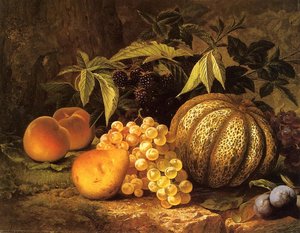
His still lifes became celebrated for their ability to replicate the tactile essence of the subjects they depicted. He possessed a rare talent for textural duplication, capturing the delicate fuzz on a peach or the intricate rind of a cantaloupe with such clarity that his work was often compared to the precision of French academician Jean-Léon Gérôme. In these compositions, Brown avoided visible brushwork, preferring a smooth, seamless finish that allowed the viewer to lose themselves in the luminous highlights and organic weights of fruit, berries, and flowers.

Legacy and Artistic Significance

Throughout his long career, Brown was a consistent and respected presence in the American art community, exhibiting annually at the National Academy of Design for over three decades. His ability to reach a wide audience through chromolithographic reproductions ensured that his meticulous renderings of nature were admired far beyond the gallery walls. His work remains preserved in prestigious institutions, including:

The historical significance of William Mason Brown lies in his unique ability to bridge the gap between the romanticism of the Hudson River School and the rigorous, scientific observation of the Pre-Raphaelite influence. By mastering both the sweeping emotion of the landscape and the quiet, intense reality of the still life, he left behind a body of work that celebrates the profound beauty found in both the vastness of the earth and the smallest details of its bounty.