Portrait of Yoshitoshi

The 100 Most Famous Yoshitoshi Paintings, Each One of a Kind

Updated October 2026 · ranked by our popularity score (searches, visits and orders for each work) · 1,344 works by Yoshitoshi in our catalogue

In short

Kingio Hideaki From Kaidai Hyaku Senso is the Yoshitoshi painting that draws the most eyes. After it, the eye goes to Asakusa and Tokugawa Iemitsu Receiving Lords in Audience (1875). Among the 1,344 works of Yoshitoshi in our catalog, these 100 are the most famous, each a unique original presented with its year, its museum and the reason it endures.

1839 – 1892, Edo Ukiyo-e Most works: Minneapolis Institute of Art

Top 10 paintings by Yoshitoshi, through the gallery's eye

2
Asakusa by Yoshitoshi

Asakusa

Woodblock Print

Tsukioka Yoshitoshi's 1882 depiction of *Asakusa* is more than a simple street scene; it’s a poignant and powerfully rendered snapshot of a Japan on the cusp of profound transformation. Executed in the style quintessential Ukiyo-e, this woodblock print captures not just the physical appearance of the bustling district but also the anxieties, hopes, and ultimately, the melancholic beauty of a society grappling with rapid modernization. Yoshitoshi, considered the last great…

3
Tokugawa Iemitsu Receiving Lords in Audience (1875) by Yoshitoshi

Tokugawa Iemitsu Receiving Lords in Audience

1875 · Woodblock Print · Los Angeles County Museum of Art, Los Angeles

Tsukioka Yoshitoshi's "Tokugawa Iemitsu Receiving Lords in Audience," created in 1875, transcends mere visual representation; it embodies the anxieties and aspirations of Japan at a pivotal moment—the twilight of feudal rule and the dawn of modernization. Executed as a color woodblock print, this artwork exemplifies the zenith of *ukiyo-e*, demonstrating unparalleled detail and capturing an atmosphere steeped in formality and solemn contemplation. It’s more than just a depiction of a…

4
Okuko Hikozaemon Protects The Tokugawa Shogun From The Spear Of Goro Matabei Mototsugu by Yoshitoshi

Okuko Hikozaemon Protects The Tokugawa Shogun From The Spear Of Goro Matabei Mototsugu

Acrylic On Canvas

Dynamic Depiction of Heroism and Mythology This captivating artwork vividly captures a dramatic moment of heroism and mythic confrontation, set against a dark, nocturnal backdrop illuminated by a crescent moon. The scene is filled with intense action, depicting legendary warriors engaged in a fierce battle that embodies themes of bravery, conflict, and divine justice. The central figures, clad in detailed armor and traditional garments, evoke a sense of movement and…

5
Moon Over The Waters At Daimotsu Bay by Yoshitoshi

Moon Over The Waters At Daimotsu Bay

Woodblock Print

Moon Over The Waters At Daimotsu Bay is a significant woodblock print by the Japanese artist Yoshitoshi. This work belongs to his celebrated series, One Hundred Aspects of the Moon, also known as Tsuki hyakkei. Published between 1885 and 1892, the series represents a profound period in the artist's career, capturing a unique intersection of traditional aesthetics and the shifting social landscape of the Meiji era.

6
Uesugi Kenshin Nyudo Terutora Riding into Battle (1883) by Yoshitoshi

Uesugi Kenshin Nyudo Terutora Riding into Battle

1883 · Acrylic · Los Angeles County Museum of Art, Los Angeles

Tsukioka Yoshitoshi’s “Uesugi Kenshin Nyudo Terutora Riding into Battle,” created in 1883, transcends mere depiction; it embodies the anxieties and aspirations of Japan during its pivotal transition from feudal rule to modernization. This monumental woodblock print isn't simply a record of military prowess; it’s a carefully crafted tableau brimming with symbolism that speaks volumes about the era’s psychological landscape.

7
Komori No Godan by Yoshitoshi

Komori No Godan

Woodblock Print

Tsukioka Yoshitoshi’s “Komori No Godan” – literally “Six Bats Under the Umbrella” – is more than just a captivating image; it's a poignant meditation on mortality, protection, and the enduring spirit of Japanese folklore. Executed in stark monochrome with the meticulous precision characteristic of Ukiyo-e woodblock prints, this artwork transports the viewer to a world steeped in layered meaning and evocative atmosphere. Created during a period of immense social change…

8
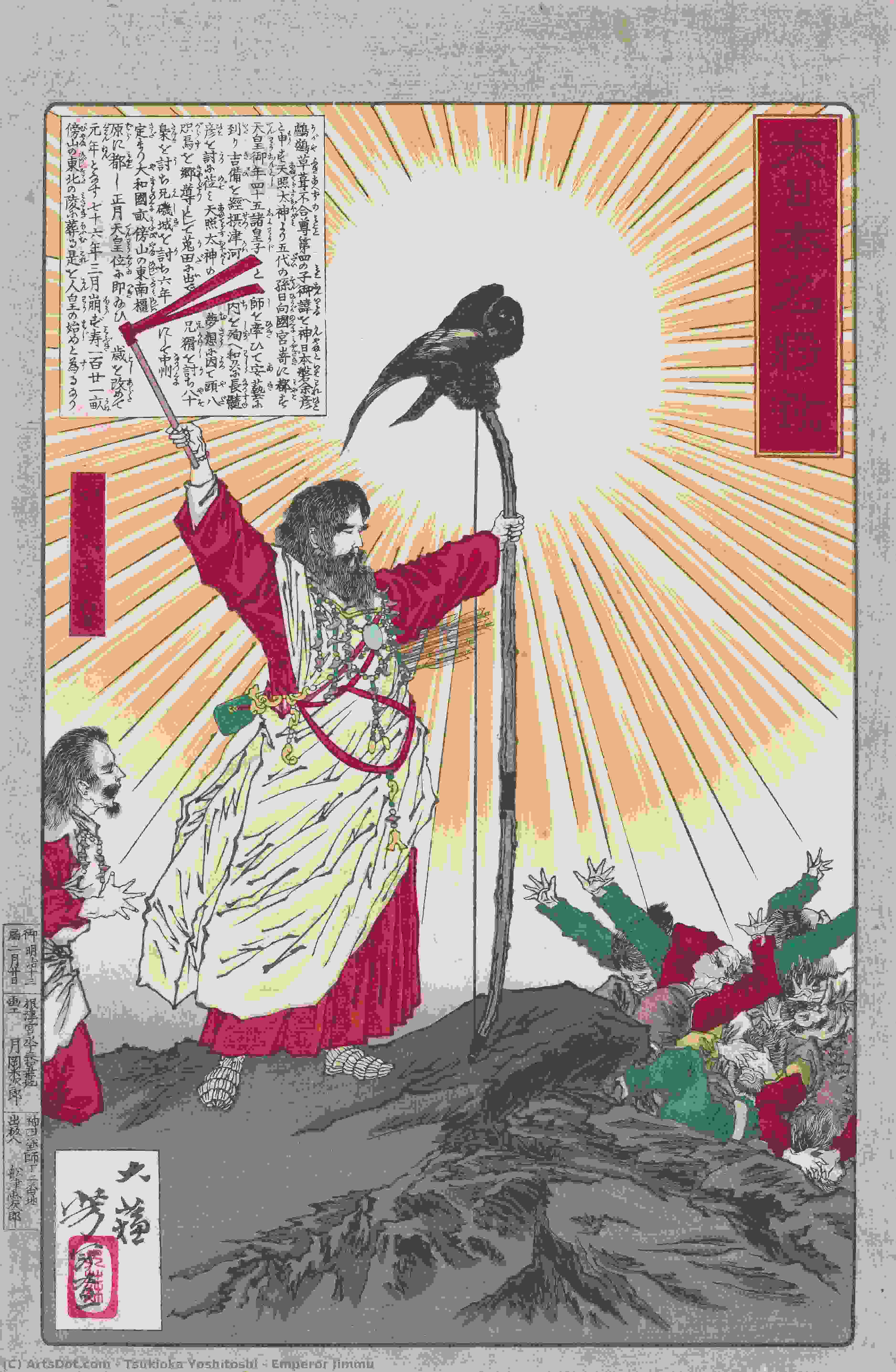
Emperor Jimmu by Yoshitoshi

Emperor Jimmu

Acrylic On Canvas

Tsukioka Yoshitoshi, a luminary of Japan’s Edo period (1603-1868), transcends mere artistic representation; he crafts narratives that breathe life into history. “Emperor Jimmu,” showcased as a meticulously crafted oil reproduction on AllPaintingsStore.com, isn’t simply a depiction of legend—it's an embodiment of Japan’s enduring spirit and Yoshitoshi’s unparalleled artistic vision.

9
Sadanobu Threatening A Demon In The Palace At Night by Yoshitoshi

Sadanobu Threatening A Demon In The Palace At Night

Acrylic On Canvas

A Dramatic Confrontation: Unveiling "Sadanobu Threatening A Demon In The Palace At Night" This striking black and white woodblock print, “Sadanobu Threatening a Demon in the Palace at Night,” is a powerful example of late 19th-century *ukiyo-e* art by Tsukioka Yoshitoshi. It depicts a tense and dramatic scene within a richly decorated palace setting, showcasing a warrior – likely Sadanobu – confronting a fearsome demon. The composition immediately draws the…

10
Restaurant by Yoshitoshi

Restaurant

Acrylic On Canvas

A Moment of Urban Life: Tsukioka Yoshitoshi’s “Restaurant” Tsukioka Yoshitoshi's "Restaurant" offers a captivating glimpse into 19th-century Japan, showcasing the artist’s mastery of ukiyo-e, or “pictures of the floating world.” This woodblock print depicts two elegantly dressed women pausing before a bustling restaurant. The scene isn’t grand or heroic; instead, it captures an everyday moment – a stroll through town, perhaps a planned meal, or simply observing the vibrant energy…

Yoshitoshi's famous paintings, numbers 11 to 100

11Woman With Iris by YoshitoshiWoman With Iris 12The Moon And The Abandoned Old Woman by YoshitoshiThe Moon And The Abandoned Old Woman 13Miyamoto Musashi by YoshitoshiMiyamoto Musashi 14Great Generals of the East and West (1874) by YoshitoshiGreat Generals of the East and West1874 · Minneapolis Institute of Art 15Great Generals of the East and West (1874) by YoshitoshiGreat Generals of the East and West1874 · Minneapolis Institute of Art 16January: Celebrating the New Year (1860) by YoshitoshiJanuary: Celebrating the New Year1860 · Los Angeles County Museum of Art 17Ghost (1883) by YoshitoshiGhost1883 · Minneapolis Institute of Art 18Kiyohime changing into a serpent at Hidaka River, from the series New Forms of Thirty-six Ghosts (1890) by YoshitoshiKiyohime changing into a serpent at Hidaka River, from the series New Forms of Thirty-six Ghosts1890 · The Smithsonian’s National Museum of Asian Art 19The Spirit of the Deceased Yūgao Entwined in Moonflower Vines, based on the print “The Lady of the Evening Faces,” from the series One Hundred Aspects of the Moon (Tsuki hyakushi: Genji Yūgao no maki) (1892) by YoshitoshiThe Spirit of the Deceased Yūgao Entwined in Moonflower Vines, based on the print “The Lady of the Evening Faces,” from the series One Hundred Aspects of the Moon (Tsuki hyakushi: Genji Yūgao no maki)1892 · Metropolitan Museum of Art 20Murasaki Shikibu at Ishiyamadera Temple, based on the print “The Moon at Ishiyama,” from the series One Hundred Aspects of the Moon (Tsuki hyakushi: Ishiyama no tsuki) (1892) by YoshitoshiMurasaki Shikibu at Ishiyamadera Temple, based on the print “The Moon at Ishiyama,” from the series One Hundred Aspects of the Moon (Tsuki hyakushi: Ishiyama no tsuki)1892 · Metropolitan Museum of Art 21Sumidagawa- Koji Of Umewaka by YoshitoshiSumidagawa- Koji Of Umewaka 22Comic Picture by YoshitoshiComic Picture 23Hikoshichi Carries A Demon by YoshitoshiHikoshichi Carries A Demon 24The Great Thieves Of Japan Compared by YoshitoshiThe Great Thieves Of Japan Compared 25A young woman from Kansei period playing with her cat (1888) by YoshitoshiA young woman from Kansei period playing with her cat1888 26Murasaki Shikibu at Ishiyamadera Temple, based on the print “The Moon at Ishiyama,” from the series One Hundred Aspects of the Moon (Tsuki hyakushi: Ishiyama no tsuki) (1892) by YoshitoshiMurasaki Shikibu at Ishiyamadera Temple, based on the print “The Moon at Ishiyama,” from the series One Hundred Aspects of the Moon (Tsuki hyakushi: Ishiyama no tsuki)1892 27Inaba Mountain Moon by YoshitoshiInaba Mountain Moon 28Moon Above The Sea At Daimotsu Bay by YoshitoshiMoon Above The Sea At Daimotsu Bay 29Mt. Yoshino At Midnight by YoshitoshiMt. Yoshino At Midnight 30Susanoo No Mikoto by YoshitoshiSusanoo No Mikoto 31The Takisoba Restaurant At Otowa by YoshitoshiThe Takisoba Restaurant At Otowa 32Oda... Nobunaga by YoshitoshiOda... Nobunaga 33Coast Of Kiyomi by YoshitoshiCoast Of Kiyomi 34Mirror Of The Famous Generals by YoshitoshiMirror Of The Famous Generals 35Sanada Saemon-no-jô Yukimura by YoshitoshiSanada Saemon-no-jô Yukimura 36Female Warrior Hangaku Gozen by YoshitoshiFemale Warrior Hangaku Gozen 37Moon At Kuruwa by YoshitoshiMoon At Kuruwa 38The Underwater Fight by YoshitoshiThe Underwater Fight 39Koi Swimming Beneath Wisteria by YoshitoshiKoi Swimming Beneath Wisteria 40Demon Triptych by YoshitoshiDemon Triptych 41Konkai by YoshitoshiKonkai 42Death Stone Of Nasu Moor by YoshitoshiDeath Stone Of Nasu Moor 43Ôishi Kuranosuke Yoshio by YoshitoshiÔishi Kuranosuke Yoshio 44Yoshitsune And Benkei by YoshitoshiYoshitsune And Benkei 45Shizu Peak Moon by YoshitoshiShizu Peak Moon 46The Great Battle At Okehazama by YoshitoshiThe Great Battle At Okehazama 47Akashi Gidayu And Tiger by YoshitoshiAkashi Gidayu And Tiger 48Taira no Kiyomori sees the skulls of his victims by YoshitoshiTaira no Kiyomori sees the skulls of his victims 49Princess Kaguya by YoshitoshiPrincess Kaguya 50Inamura Promontory Moon by YoshitoshiInamura Promontory Moon 51Ariwara no Yukihira by YoshitoshiAriwara no Yukihira 52Maisaka (1863) by YoshitoshiMaisaka1863 53A scene of Journey to the West (1864) by YoshitoshiA scene of Journey to the West1864 54Onogawa (1865) by YoshitoshiOnogawa1865 55Japanese war in Kagoshima (1879) by YoshitoshiJapanese war in Kagoshima1879 56Warrior (General Yamanaka Shikanasake) (1884) by YoshitoshiWarrior (General Yamanaka Shikanasake)1884 57Looking refined - a court lady of the Kyowa era (1888) by YoshitoshiLooking refined - a court lady of the Kyowa era1888 58Benkei And The Wave by YoshitoshiBenkei And The Wave 59Clam Digging by YoshitoshiClam DiggingMinneapolis Institute of Art 60Sagami Jirô And Taira No Masakado by YoshitoshiSagami Jirô And Taira No Masakado 61Taira No Kiyomori Holding Back The Sun by YoshitoshiTaira No Kiyomori Holding Back The Sun 62Tze Lu by YoshitoshiTze Lu 63Looking Indecisive by YoshitoshiLooking Indecisive 64Katada Bay Moon by YoshitoshiKatada Bay Moon 65Takatoki Tengu by YoshitoshiTakatoki Tengu 66Poem By Hitotose by YoshitoshiPoem By Hitotose 67Tsuki No Monogurui by YoshitoshiTsuki No Monogurui 68The Moon's Four Strings by YoshitoshiThe Moon's Four Strings 69Yugao From The Tale Of Genji by YoshitoshiYugao From The Tale Of Genji 70Hitotose by YoshitoshiHitotose 71The Hag by YoshitoshiThe Hag 7236 Ghosts by Yoshitoshi36 Ghosts 73The Moon And The Helm Of A Boat by YoshitoshiThe Moon And The Helm Of A Boat 74Kinoshita Tokichiro by YoshitoshiKinoshita Tokichiro 75Kabuki Actor - by YoshitoshiKabuki Actor - 76Gojo Bridge Moon by YoshitoshiGojo Bridge Moon 77Yukugawa Sanpei Munenori by YoshitoshiYukugawa Sanpei Munenori 78Moon At Mt Chi-ming by YoshitoshiMoon At Mt Chi-ming 79Uesugi Kenshin by YoshitoshiUesugi Kenshin 80Waiting Since The Crescent Moon by YoshitoshiWaiting Since The Crescent Moon 81Relaxed by YoshitoshiRelaxed 82The Moon At Takakura by YoshitoshiThe Moon At Takakura 83Dawn Moon At Mt. Tobisu by YoshitoshiDawn Moon At Mt. Tobisu 84Near Komakata A Cuckoo Calls by YoshitoshiNear Komakata A Cuckoo Calls 85Matsuo Basho by YoshitoshiMatsuo Basho 86Mountain Moon After Rain - Tokimune by YoshitoshiMountain Moon After Rain - Tokimune 87Moon And The Heavenly River by YoshitoshiMoon And The Heavenly River 88Kityama Moon by YoshitoshiKityama Moon 89Moonlight On The Snow by YoshitoshiMoonlight On The Snow 90The Chapter From The Tale Of Genji by YoshitoshiThe Chapter From The Tale Of Genji 91Taira No Tomomori by YoshitoshiTaira No Tomomori 92Namauo Chojiro by YoshitoshiNamauo Chojiro 93Hirade Iki by YoshitoshiHirade Iki 94Hara by YoshitoshiHara 95Chinese Beauty In The Moonlight by YoshitoshiChinese Beauty In The Moonlight 96Chinzai Hachiro Minamoto No Tametomo by YoshitoshiChinzai Hachiro Minamoto No Tametomo 97The Wife Of Tokugawa Keiki by YoshitoshiThe Wife Of Tokugawa Keiki 98Hyoshit Rinchu Kills The Officer Riku Neat The Temple Of The Mountain by YoshitoshiHyoshit Rinchu Kills The Officer Riku Neat The Temple Of The Mountain 99House Wife Of The Bunsei Era by YoshitoshiHouse Wife Of The Bunsei Era 100Moon And Helm Of A Boat by YoshitoshiMoon And Helm Of A Boat

Yoshitoshi's famous paintings, period by period

The subjects that held Yoshitoshi's eye

The four subjects that come back most often in these originals, each with its finest example.

The museums that keep Yoshitoshi's originals

The 4 museums that hold the most of the paintings on this page.

Museum City Works by Yoshitoshi Paintings from this list
Minneapolis Institute of Art, MinneapolisMinneapolis Institute of Art Minneapolis 4 Great Generals of the East and West, Great Generals of the East and West, Ghost
Los Angeles County Museum of Art, Los AngelesLos Angeles County Museum of Art Los Angeles 3 Tokugawa Iemitsu Receiving Lords in Audience, Uesugi Kenshin Nyudo Terutora Riding into Battle, January: Celebrating the New Year
Metropolitan Museum of Art, New YorkMetropolitan Museum of Art New York 2 The Spirit of the Deceased Yūgao Entwined in Moonflower Vines, based on the print “The Lady of the Evening Faces,” from the series One Hundred Aspects of the Moon (Tsuki hyakushi: Genji Yūgao no maki), Murasaki Shikibu at Ishiyamadera Temple, based on the print “The Moon at Ishiyama,” from the series One Hundred Aspects of the Moon (Tsuki hyakushi: Ishiyama no tsuki)
The Smithsonian’s National Museum of Asian Art, Washington, D.C.The Smithsonian’s National Museum of Asian Art Washington, D.C. 1 Kiyohime changing into a serpent at Hidaka River, from the series New Forms of Thirty-six Ghosts

Yoshitoshi across the decades: one unique original for each

Works per decade

Pick a decade to see the original that defines it.

Yoshitoshi's paintings: questions for the gallery

What is the single most famous work of Yoshitoshi?Reveal the answer

Kingio Hideaki From Kaidai Hyaku Senso. Asakusa and Tokugawa Iemitsu Receiving Lords in Audience (1875) come next.

Which ten paintings by Yoshitoshi are the most famous?Reveal the answer

Kingio Hideaki From Kaidai Hyaku Senso, Asakusa, Tokugawa Iemitsu Receiving Lords in Audience, Okuko Hikozaemon Protects The Tokugawa Shogun From The Spear Of Goro Matabei Mototsugu, Moon Over The Waters At Daimotsu Bay, Uesugi Kenshin Nyudo Terutora Riding into Battle, Komori No Godan, Emperor Jimmu, Sadanobu Threatening A Demon In The Palace At Night and Restaurant. The ranking above gives each one's year and museum.

How many works by Yoshitoshi are known?Reveal the answer

Our catalog holds 1,344 works by Yoshitoshi, dated from 1860 to 1892.

Where can the most famous Yoshitoshi originals be seen?Reveal the answer

Mostly in Minneapolis Institute of Art (Minneapolis), Los Angeles County Museum of Art (Los Angeles) and Metropolitan Museum of Art (New York). The museum table above lists them all.

During which period did Yoshitoshi create the best-known paintings?Reveal the answer

In 1880s: 5 of the 100 works on this page were made then, Uesugi Kenshin Nyudo Terutora Riding into Battle among them.

Which famous Yoshitoshi painting is the earliest, and which the latest?Reveal the answer

On this page, the earliest is January: Celebrating the New Year (1860) and the latest The Spirit of the Deceased Yūgao Entwined in Moonflower Vines, based on the print “The Lady of the Evening Faces,” from the series One Hundred Aspects of the Moon (Tsuki hyakushi: Genji Yūgao no maki) (1892).

What subjects did Yoshitoshi favour?Reveal the answer

Japanese art (15), Traditional japan (15) and Warrior (11), across the 100 works on this page.

What materials did Yoshitoshi paint with most?Reveal the answer

Woodblock Print, for 12 of the 100 works on this page.

Which movement does the work of Yoshitoshi belong to?Reveal the answer

Ukiyo-e, judging by the originals on this page.

What Yoshitoshi originals can I see at the Minneapolis Institute of Art?Reveal the answer

Great Generals of the East and West, Great Generals of the East and West and Ghost: the Minneapolis Institute of Art, Minneapolis holds 4 of the works on this page.

Where can I order a hand-painted Yoshitoshi reproduction?Reveal the answer

Yes, as a reproduction: the original stays in its museum, but any painting on this page can be painted by hand for you, made to order one at a time, from the painting's own page.

Yoshitoshi: a portrait of the artist

The Life and Identity of Tsukioka Yoshitoshi

Born Owariya Yonejiro on 30 April 1839, the man who would become known as Tsukioka Yoshitoshi entered a world in flux. He was raised in the Shimbashi district of old Edo, which is known today as Tokyo. His life was marked by a transition in identity, as he also used the name Taiso Yoshitoshi. He lived through the end of the Edo period and the beginning of the Meiji era, a time when the very fabric of Japanese society was being rewoven by rapid modernization and Western influence.

His career as a Japanese printmaker was defined by a constant struggle to maintain the traditions of his craft while the world around him moved toward new technologies like photography. He worked with a deep sense of purpose, often focusing on the tension between the old ways and the new. This period of upheaval was not merely a backdrop for his art; it was the environment that shaped his perspective and his ability to capture the human condition during a time of profound social change.

The end of his life came unexpectedly at the age of 53. He died on 9 June 1892, following a cerebral hemorrhage. He left behind a significant body of work that documented the shifting landscape of his country, capturing both the quiet moments of daily life and the intense drama of historical legends.

Early Life, Family and Training

Born Owariya Yonejiro in the Shimbashi district of old Edo, the boy who would become Yoshitoshi grew up in a household shaped by social ambition. His father was a wealthy merchant who had successfully purchased his way into samurai status, providing a life of relative stability. However, the family structure changed early on. At the age of three, he left his home to live with his uncle, a pharmacist who had no son of his own. This change in environment would prove fundamental to his development.

By the age of five, he began to show a clear interest in art. He spent his childhood taking lessons from his uncle, finding a sense of purpose in the act of creation. This early instruction provided the foundation for a formal path in the traditional arts. In 1850, at the age of 11, he entered a rigorous apprenticeship under the master Utagawa Kuniyoshi. It was during this time that his mentor gave him the name Yoshitoshi, marking his official entry into the Utagawa School.

Technique and Artistic Style

Yoshitoshi’s hand moved with a precision that captured the very essence of a changing Japan. He was a pioneer in using new printmaking techniques, constantly seeking ways to achieve finer details and more intense colors. His work often blended traditional Japanese aesthetics with Western influences that arrived during the Meiji era. This fusion allowed him to create complex compositions that felt both grounded in history and strikingly modern. He had a particular talent for depicting movement, making a static woodblock print feel as though it were caught in a single, fleeting moment of action.

His subject matter often drifted between the historical and the mythological. He could render a legendary warrior with a sense of psychological depth, or portray a supernatural creature with startling realism. This ability to convey deep emotion was central to his style. Whether he was depicting a scene of quiet contemplation or a moment of intense struggle, his prints carried a weight of feeling that resonated with his audience. He did not rely on mere decoration; instead, he used vivid colors and sharp lines to pull the viewer into the narrative of the print.

  • Saito Oniwakamaru on a Carp (1839–1892)
  • The Battle of Okehazama (1866)
  • The Death of Kiyomori (1883)

Key Works and Famous Series

Yoshitoshi’s output often mirrored the heavy, unsettled atmosphere of the era he lived through. In 1866, he produced a series of prints known as Muzan-e, often called "bloody prints." These works focused on graphic violence and death, reflecting the social unrest and personal tragedies that marked his life. He moved between these darker themes and more narrative-driven subjects, such as his series Tsūzoku saiyūki, also known as A Modern Journey to the West. He also looked toward folklore and legend in Wakan hyaku monogatari, or One Hundred Stories of China and Japan.

As the years passed, his focus shifted toward more contemplative and varied subjects. Between 1885 and 1892, he worked on One Hundred Aspects of the Moon, a series that explored the moon through different perspectives. His later years also saw the creation of New Forms of 36 Spirits between 1889 and 1892, and 32 Aspects of Women in 1888. These series demonstrate his ability to handle both the supernatural and the human form with a sense of psychological depth.

Legacy and Enduring Influence

Yoshitoshi’s career acted as a bridge between two eras, spanning the final years of the Edo period and the dawn of the Meiji era. He lived through a time when the old social structures were dissolving and Western influences were beginning to reshape Japanese life. While many artists struggled to find their footing amidst this rapid change, he was recognized as one of the form's greatest innovators. His ability to adapt his craft to a changing world allowed him to remain relevant even as traditional woodblock printing faced new competition from photography and lithography.

His standing in the art community was solidified by his skill and his lineage. He is now recognized as the most important pupil of Kuniyoshi, having taken the lessons of his master and pushed them into new directions. By 1885, his prominence was undeniable when he was ranked as the number-one ukiyo-e artist in Tokyo. He did not merely follow the traditions of the Utagawa School; he expanded them, bringing a sense of psychological depth to his subjects that helped define the twilight of the ukiyo-e genre.

  • Musha Burui
  • One Hundred Aspects of the Moon
  • New Forms of Thirty-six Spirits

All 1344 works by Yoshitoshi →