Portrait of Theodore Robinson

Theodore Robinson Paintings: The 100 Most Famous, Through a Gallery's Eye

Updated October 2026 · ranked by our popularity score (searches, visits and orders for each work) · 260 works by Theodore Robinson in our catalogue

In short

To the gallery's eye, Theodore Robinson's most famous painting is The Layette (1892), whose original hangs in the National Gallery of Art, Washington. Capri (1890) and In a Daisy Field (1884) complete the trio every eye recognises. Of the 260 works by Theodore Robinson in our catalog, the gallery presents the 100 most famous below, each original with its year, its museum and what makes it unique.

1852 – 1896, Irasburg Impressionism Most works: Condé Museum

The gallery's top 10 Theodore Robinson paintings

1
The Layette (1892) by Theodore Robinson

The Layette

1892 · Oil On Canvas · National Gallery of Art, Washington

There is a profound stillness in this scene, a moment captured where the rush of the world seems to pause. We find a woman seated in a wooden chair, her attention entirely absorbed by the delicate task of needlework. She is positioned slightly to the right, framed by the organic weight of a large tree trunk and the soft, dappled patterns of sunlight filtering through a leafy canopy. The light…

2
Capri (1890) by Theodore Robinson

Capri

1890 · Acrylic On Canvas · Thyssen-Bornemisza Museum, Madrid

The Enchanting Capri by Theodore Robinson The painting “Capri” by Theodore Robinson stands as a testament to Impressionist vision blended with American Romanticism—a captivating glimpse into the Italian island’s ethereal beauty captured in 1890. More than just a scenic depiction, it embodies Robinson's profound engagement with light and color, reflecting his belief that art should convey emotion rather than merely represent reality. Executed on canvas using oil paints, “Capri” showcases…

5
In the Grove (1888) by Theodore Robinson

In the Grove

1888 · Oil On Canvas · Baltimore Museum of Art, Baltimore

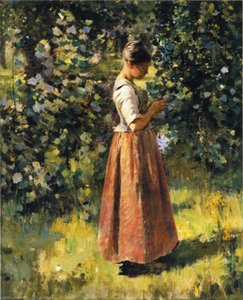
In the quietude of a sun-drenched woodland, Theodore Robinson’s “In the Grove” invites the viewer into a moment of profound stillness. Painted in 1888, this masterpiece serves as a cornerstone of American Impressionism, capturing not just a landscape, but an emotional atmosphere that feels both fleeting and eternal. The scene unfolds with a delicate grace, centered around a woman positioned amidst towering, ancient trees. As she gazes downward, perhaps lost…

Theodore Robinson paintings, ranked 11 to 100

11Girl at Piano (1887) by Theodore RobinsonGirl at Piano1887 · Toledo Museum of Art 12Paysage of Auvergne (1830) by Theodore RobinsonPaysage of Auvergne1830 13Study of rocks (1829) by Theodore RobinsonStudy of rocks1829 · Musée Des Beaux 14Valley in the Auvergne Mountains (1830) by Theodore RobinsonValley in the Auvergne Mountains1830 15Mountain Landscape with fisherman (1830) by Theodore RobinsonMountain Landscape with fisherman1830 · Fries Museum 16The avenue of chestnut trees (1837) by Theodore RobinsonThe avenue of chestnut trees1837 17The Large Oak Tree, Forest of Fontainebleau (1839) by Theodore RobinsonThe Large Oak Tree, Forest of Fontainebleau1839 · Saint Louis Art Museum 18The pond near the road (1848) by Theodore RobinsonThe pond near the road1848 19The avenue of chestnut trees (1840) by Theodore RobinsonThe avenue of chestnut trees1840 20The board of Bellecroix (1848) by Theodore RobinsonThe board of Bellecroix1848 21View of the plain of Montmartre X effect of storm (1848) by Theodore RobinsonView of the plain of Montmartre X effect of storm1848 22Meadows crossed by a river (1851) by Theodore RobinsonMeadows crossed by a river1851 23The hill (1855) by Theodore RobinsonThe hill1855 24Mountain landscape near Fontainebleau (1852) by Theodore RobinsonMountain landscape near Fontainebleau1852 · Museum Boijmans Van Beuningen 25Cows in the mare (1855) by Theodore RobinsonCows in the mare1855 26Spring (1852) by Theodore RobinsonSpring1852 27The passer (1855) by Theodore RobinsonThe passer1855 28Gateway (1855) by Theodore RobinsonGateway1855 29Marshland in Les Landes (1853) by Theodore RobinsonMarshland in Les Landes1853 30Edge of the loire (1855) by Theodore RobinsonEdge of the loire1855 31Look at Barbizon (1850) by Theodore RobinsonLook at Barbizon1850 32The Little Fisherman (1849) by Theodore RobinsonThe Little Fisherman1849 33Edge of river (1849) by Theodore RobinsonEdge of river1849 34Exit drill Fontainebleau, sunset (1849) by Theodore RobinsonExit drill Fontainebleau, sunset1849 35Normandy farms (1867) by Theodore RobinsonNormandy farms1867 · Condé Museum 36Twilight in Sologne (1867) by Theodore RobinsonTwilight in Sologne1867 · Condé Museum 37Sunset in the forest (1866) by Theodore RobinsonSunset in the forest1866 38The Forest of Fontainebleau (1867) by Theodore RobinsonThe Forest of Fontainebleau1867 39On the Housatonic River, Connecticut (1877) by Theodore RobinsonOn the Housatonic River, Connecticut1877 40Garden Bench with Ferns (1878) by Theodore RobinsonGarden Bench with Ferns1878 41Place St. Sulpice, Paris (unfinished) (1876) by Theodore RobinsonPlace St. Sulpice, Paris (unfinished)1876 42Water Lilies (1878) by Theodore RobinsonWater Lilies1878 43Nantucket Girl (1882) by Theodore RobinsonNantucket Girl1882 44Lady in Red (1885) by Theodore RobinsonLady in Red1885 45Venetian Fruit Shop (1879) by Theodore RobinsonVenetian Fruit Shop1879 46Man with Sythe (1882) by Theodore RobinsonMan with Sythe1882 47Self Portrait (1884) by Theodore RobinsonSelf Portrait1884 · Metropolitan Museum of Art 48Girl with Puppies (1881) by Theodore RobinsonGirl with Puppies1881 49Daisy Field, Nantucket (1882) by Theodore RobinsonDaisy Field, Nantucket1882 50The Red Gown (also known as His Favorite Model) (1885) by Theodore RobinsonThe Red Gown (also known as His Favorite Model)1885 51Woman with White Cap (1884) by Theodore RobinsonWoman with White Cap1884 52In the Garden (1889) by Theodore RobinsonIn the Garden1889 53The Old Bridge (1890) by Theodore RobinsonThe Old Bridge1890 · Thyssen-Bornemisza Museum 54Farm Among Hills, Giverny (1887) by Theodore RobinsonFarm Among Hills, Giverny1887 · Minneapolis Institute of Art 55Valley of the Seine, Giverny (1887) by Theodore RobinsonValley of the Seine, Giverny1887 · Los Angeles County Museum of Art 56Winter, Giverny (1889) by Theodore RobinsonWinter, Giverny1889 57Valley of the Seine, Giverny (1887) by Theodore RobinsonValley of the Seine, Giverny1887 58Sea (1889) by Theodore RobinsonSea1889 59Two Boats (1891) by Theodore RobinsonTwo Boats1891 60Gossips (1891) by Theodore RobinsonGossips1891 61Portrait of Madame Baudy (1888) by Theodore RobinsonPortrait of Madame Baudy1888 62Moonlight, Giverny - Study (1892) by Theodore RobinsonMoonlight, Giverny - Study1892 63Summer Hilside, Giverny (1889) by Theodore RobinsonSummer Hilside, Giverny1889 64Farm Among Hills (1887) by Theodore RobinsonFarm Among Hills1887 65The Peasant Girl (1891) by Theodore RobinsonThe Peasant Girl1891 66At the Piano (1887) by Theodore RobinsonAt the Piano1887 67Mediterranean View (1890) by Theodore RobinsonMediterranean View1890 68French Farmhouse (1887) by Theodore RobinsonFrench Farmhouse1887 69Girl with Goat (1886) by Theodore RobinsonGirl with Goat1886 70Girl Sewing (also known as The Layette or The Seamstress) (1891) by Theodore RobinsonGirl Sewing (also known as The Layette or The Seamstress)1891 71The Forge (also known as An Apprentice Blacksmith) (1886) by Theodore RobinsonThe Forge (also known as An Apprentice Blacksmith)1886 72Willows and Wildflowers (1892) by Theodore RobinsonWillows and Wildflowers1892 73Park Scene (1892) by Theodore RobinsonPark Scene1892 74Giverny (1889) by Theodore RobinsonGiverny1889 75Moonrise (1892) by Theodore RobinsonMoonrise1892 76Moonlight, Giverny (1892) by Theodore RobinsonMoonlight, Giverny1892 77Two in a Boat (1891) by Theodore RobinsonTwo in a Boat1891 78Young Girl with Dog (1886) by Theodore RobinsonYoung Girl with Dog1886 79October Sunlight (1891) by Theodore RobinsonOctober Sunlight1891 80Woman Sewing, Giveny (1891) by Theodore RobinsonWoman Sewing, Giveny1891 81From the Hill, Giverny (1889) by Theodore RobinsonFrom the Hill, Giverny1889 82Mother and Child (1892) by Theodore RobinsonMother and Child1892 83View of the Seine (1892) by Theodore RobinsonView of the Seine1892 84Giverny from the River Epte (1890) by Theodore RobinsonGiverny from the River Epte1890 85Saint Martin's Summer, Giverny (1888) by Theodore RobinsonSaint Martin's Summer, Giverny1888 86Girl in Red at the Piano (1888) by Theodore RobinsonGirl in Red at the Piano1888 87The Wedding March (1892) by Theodore RobinsonThe Wedding March1892 88Road by the Mill (1892) by Theodore RobinsonRoad by the Mill1892 89Winter Sunlight, Barbizon (1886) by Theodore RobinsonWinter Sunlight, Barbizon1886 90Winter in New York City (1890) by Theodore RobinsonWinter in New York City1890 91Yellow Apples (1892) by Theodore RobinsonYellow Apples1892 92Girl Raking Hay (1890) by Theodore RobinsonGirl Raking Hay1890 93Church in Snow (1891) by Theodore RobinsonChurch in Snow1891 94Springtime (1892) by Theodore RobinsonSpringtime1892 95The Watering Pots (1890) by Theodore RobinsonThe Watering Pots1890 96Italian Landscape with a Fountain (1891) by Theodore RobinsonItalian Landscape with a Fountain1891 97Street in Barbizon at Sunset (1887) by Theodore RobinsonStreet in Barbizon at Sunset1887 98Winter Landscape (1889) by Theodore RobinsonWinter Landscape1889 99Normandy Farm, A Characteristic Bit, Givernyy (1891) by Theodore RobinsonNormandy Farm, A Characteristic Bit, Givernyy1891 100Path in Frascati (1891) by Theodore RobinsonPath in Frascati1891

The subjects that held Theodore Robinson's eye

The four subjects that come back most often in these originals, each with its finest example.

The museums that keep Theodore Robinson's originals

The 8 museums that hold the most of the paintings on this page.

Museum City Works by Theodore Robinson Paintings from this list
Condé Museum, ChantillyCondé Museum Chantilly 3 Normandy farms, Twilight in Sologne
Thyssen-Bornemisza Museum, MadridThyssen-Bornemisza Museum Madrid 2 Capri, The Old Bridge
Baltimore Museum of Art, BaltimoreBaltimore Museum of Art Baltimore 5 In the Grove
Metropolitan Museum of Art, New YorkMetropolitan Museum of Art New York 5 Self Portrait
National Gallery of Art, WashingtonNational Gallery of Art Washington 3 The Layette
Saint Louis Art Museum, Saint LouisSaint Louis Art Museum Saint Louis 2 The Large Oak Tree, Forest of Fontainebleau
Columbia Museum of Art, ColumbusColumbia Museum of Art Columbus 1 Nantucket
Toledo Museum of Art, ToledoToledo Museum of Art Toledo 1 Girl at Piano

Theodore Robinson, one signature painting per decade

Works per decade

Pick a decade to see the original that defines it.

Theodore Robinson's paintings: the gallery answers

Which Theodore Robinson painting is the most famous of all?Reveal the answer

The Layette (1892), National Gallery of Art, Washington. Capri (1890) and In a Daisy Field (1884) come next.

How old was Theodore Robinson on completing The Layette?Reveal the answer

40 years old: The Layette dates from 1892, and Theodore Robinson was born in 1852.

Which are Theodore Robinson's top 10 paintings?Reveal the answer

The Layette, Capri, In a Daisy Field, Pere Trognon and His Daughter at the Bridge, In the Grove, Study in the forest of Fontainebleau, View of the belfry of Orleans, Nantucket, Flower of Memory and Plain. The ranking above gives each one's year and museum.

How many works did Theodore Robinson create?Reveal the answer

Our catalog holds 260 works by Theodore Robinson, dated from 1866 to 1892.

Where do Theodore Robinson's most famous originals hang?Reveal the answer

Mostly in Condé Museum (Chantilly), Thyssen-Bornemisza Museum (Madrid) and Baltimore Museum of Art (Baltimore). The museum table above lists them all.

When did Theodore Robinson create the most famous paintings?Reveal the answer

In 1880s: 34 of the 100 works on this page were made then, In a Daisy Field among them.

Which are Theodore Robinson's earliest and latest famous works?Reveal the answer

On this page, the earliest is Sunset in the forest (1866) and the latest The Layette (1892).

Which subjects did Theodore Robinson return to most?Reveal the answer

Forests (20), Landscape (10) and Lakes (9), across the 100 works on this page.

Which medium did Theodore Robinson work in most?Reveal the answer

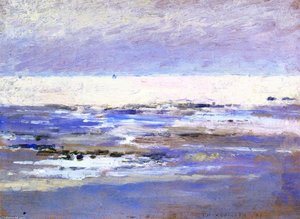
Oil On Canvas, for 4 of the 100 works on this page.

Which movement is Theodore Robinson associated with?Reveal the answer

Impressionism and Realism, judging by the originals on this page.

Which Theodore Robinson originals does the Condé Museum hold?Reveal the answer

Normandy farms and Twilight in Sologne: the Condé Museum, Chantilly holds 2 of the works on this page.

Can I have a Theodore Robinson painting reproduced by hand?Reveal the answer

Yes, as a reproduction: the original stays in its museum, but any painting on this page can be painted by hand for you, made to order one at a time, from the painting's own page.

Theodore Robinson: the artist

A Pioneer of American Light: The Life and Art of Theodore Robinson

Theodore Robinson, a name perhaps less immediately recognizable than those of Monet or Renoir, nevertheless occupies a pivotal position in the story of American art. Born in rural Vermont in 1852, his journey was one of persistent artistic seeking, culminating in a unique synthesis of European Impressionism and distinctly American sensibilities. His life, though tragically cut short at the age of forty-four, left an enduring legacy as a key figure in bringing the shimmering light and broken color of France to a new generation of American painters. Robinson’s early years were marked by frequent relocation; his family moved to Wisconsin when he was just three years old, and he briefly studied art in Chicago before venturing east to New York City in 1874. There, he enrolled at the National Academy of Design and the Art Students League, laying a foundation in traditional techniques that would later be brilliantly transformed by his experiences abroad. These formative years were also shaped by practical necessity; Robinson often supplemented his artistic pursuits with teaching positions, a task he found draining due to chronic asthma which plagued him throughout his life.

From Realism to the Allure of Giverny

Robinson’s initial artistic inclinations leaned towards realism, mirroring the prevailing tastes of the time. He favored scenes of quiet domesticity and agrarian life, depicting figures engaged in everyday activities with a meticulous attention to detail. However, a turning point arrived in 1884 when he embarked on an extended stay in France. It was here, in the idyllic countryside surrounding Paris, that his artistic vision underwent a profound shift. He settled in Giverny, becoming intimately acquainted with Claude Monet and absorbing the principles of Impressionism firsthand. This wasn’t merely a stylistic adoption; it was a complete reimagining of how light, color, and atmosphere could be captured on canvas. Monet's guidance proved invaluable, encouraging Robinson to embrace a more spontaneous approach, focusing on the fleeting effects of light and shadow rather than precise representation. The influence is palpable in works like *Giverny 1*, *Giverny 2*, and *Giverny 3*, where dappled sunlight filters through trees, creating an ethereal quality that transcends mere depiction. He didn’t simply copy Monet; he filtered the Impressionist aesthetic through his own American lens, retaining a sense of structure and form that distinguished his work from its French counterparts.

A Bridge Between Worlds: Sharing the Vision

Robinson's significance extends beyond his individual paintings; he served as a crucial conduit between the European avant-garde and the burgeoning American art scene. His position in Giverny placed him at the center of an American artistic colony, allowing him to share his newfound knowledge and enthusiasm with fellow painters like Julian Alden Weir and John Henry Twachtman. He became a passionate advocate for Impressionism, tirelessly demonstrating its techniques and principles to those who sought his guidance. This role as a mentor and interpreter was particularly important in a time when American art was still largely dominated by academic traditions. His influence is evident in the work of many artists who visited Giverny, helping to establish an American Impressionist style that was both indebted to French innovations and uniquely its own. He brought back not just techniques but also a philosophy – a way of seeing and responding to the world around him.

Later Years and Lasting Legacy

Returning to America in 1892, Robinson sought to apply his Impressionist vision to the landscapes of his native country. He worked alongside Weir and Twachtman at Cos Cob, Connecticut, a thriving art colony, and painted scenes along the canals of New York State before eventually settling in Vermont, hoping to recreate a Giverny-like environment closer to home. However, his health continued to deteriorate, and he faced increasing financial hardship. His final years were marked by isolation and struggle, culminating in his death in 1896. Ironically, many of his paintings remained unsold during his lifetime, only gaining recognition after his passing. Today, Theodore Robinson’s work is held in major museum collections, including the Metropolitan Museum of Art, a testament to his enduring artistic merit. His meticulous diaries, preserved at the Frick Art Reference Library, offer invaluable insights into his creative process and intellectual life.

A Lasting Impression

Theodore Robinson’s contribution to American art lies not only in the beauty of his paintings but also in his role as a catalyst for change. He was a bridge between cultures, a passionate advocate for innovation, and a gifted artist who helped shape the course of American Impressionism. His work embodies a delicate balance between observation and interpretation, realism and abstraction, European influence and American identity. He demonstrated that it was possible to embrace the radical innovations of Impressionism without sacrificing one’s artistic voice or cultural heritage. His paintings continue to captivate viewers with their luminous quality and evocative atmosphere, reminding us of the power of art to transform our perception of the world around us. Robinson's legacy is a testament to the enduring appeal of light, color, and the pursuit of artistic truth.

All 260 works by Theodore Robinson →