


1


Updated October 2026 · ranked by our popularity score (searches, visits and orders for each work) · 132 works by Samuel Walters in our catalogue
In short
To the gallery's eye, Samuel Walters's most famous painting is The 'pride Of Erin'. The Ship 'chevy Chase' and Black Ball Packet Europe complete the trio every eye recognises. Of the 132 works by Samuel Walters in our catalog, the gallery presents the 100 most famous below, each original with its year, its museum and what makes it unique.


 The Ship Frankfield off Table Bay1850
12
 Burning of the Ocean Monarch1850 · Peabody Essex Museum
13
 The Pierhead
14
 'loyal Sam'
15
 The Barque Walter Morrice Calling For A Pilot Off Point Lynas
16
 The Port Of Liverpool
17
 Hark Away
18
 The 'elizabeth Bibby'
19
 Mail Packet From Liverpool To Glasgow
20
 Css 'florida'
21
 Paddle steamer Great Western in a galeNational Maritime Museum
22
 Hms 'agincourt'
23
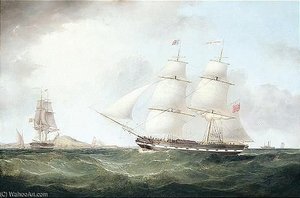 The Brazil Packet In Two Positions Off The Coast
24
 Cunard Steamer Passing A Lighthouse
25
 The Barque Susan Pardew Beating Into Table Bay In A South-easterly Gale
26
 The Naval Auxiliaries Resolute And Assistance Off The Entrance To Portsmouth Harbour
27
 The 'countess Of Ellesmere' And 'weaver' Iron Steam Vessels
28
 A Barque Beating Into Table Bay In A South-easterly Gale
29
 The Iron Steam Ship 'great Britain'
30
 The Iron Screw Steamer African Requesting A Liverpool Pilot Off The Skerries
31
 Hovellers At Deal
32
 The Clipper Ship Challenge
33
 Ps 'rainbow'
34
 Cunarder In A Gale
35
 A. D. Vance
36
 Brig 'robert Quayle'
37
 The Sailing Ship Robin Hood
38
 Sandy Cove
39
 Tynwald Number -
40
 Alabama
41
 Ben My Chree
42
 'liverpool'
43
 The Fully-rigged Ship Inkerman Off The South Stack Lighthouse
44
 Duke Of Lancaster
45
 Arab
46
 Schooner 'domitila'
47
 Ps 'victory'
48
 Dutch River Scene With Barges
49
 Mount Orgueil
50
 The 'duke Of Devonshire'
51
 'mona's Isle'
52
 The 'william Huskisson'
53
 Port And Harbour Of Whitehaven
54
 Dyson Brig Tacking
55
 'irlam', Pilot Sloop
56
 Paddle Steamer 'great Western' In A Gale
57
 The Three-masted Merchantman Thames Under Tow Off Gravesend
58
 British Ship Elinor Outward Bound
59
 Seascape With Rocks
60
 The Brig Mignonette Inward Bound Off Dover
61
 The Great Gale
62
 Ariadne
63
 Wreck Of A Ship Off A Rocky CoastNational Maritime Museum
64
 An Outward-bound Merchantman Heading Down The Channel
65
 Vessel 'mona's Isle'
66
 The Ship 'palestine'National Maritime Museum
67
 Ps 'banshee'
68
 The Three-masted Merchantman
69
 The Steamship 'british Queen'
70
 The U.S. Auxiliary Steam Frigate Niagara Shortening Sail Off Point Lynas
71
 Ship 'queensberry
72
 Confederate Raider Alabama
73
 American Packet Victoria Off Holyhead
74
 The Barque 'andromeda' In Two Positions
75
 'the Frankfield'
76
 'red Gauntlet'
77
 'liver', Pilot Sloop
78
 The Full-rigger Vespasian At Sea
79
 Sy 'said'
80
 Ss 'morocco'
81
 View On The Mersey With Victoria Tower
82
 The Paddle Steamer 'ariel'National Maritime Museum
83
 The Barque 'j. P. Smith'National Maritime Museum
84
 Clipper Steamer 'manx Fairy Of Ramsey'
85
 The S.S. City Of Berlin Outward Bound Passing Cape Pine Lighthouse
86
 The Snow 'trinculo'National Maritime Museum
87
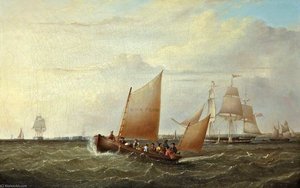 Rock Ferry Ferryboat
88
 Liverpool Paddle
89
 'helen' Arriving In The Mersey
90
 Paddle Steamer, Night Scene, Insc. Scotia
91
 Paddle Steamer 'sirius'
92
 Paddle Steamer 'president' In The Mersey Off LiverpoolNational Maritime Museum
93
 Packet Daniel Webster Off Perch Rock
94
 'city Of Brussels'
95
 Pleasure Yacht 'zephyr'
96
 The Mersey
97
 The Barque 'j P Smith'
98
 The Niger Expedition
99
 The Clipper Ship 'tudor', Outbound Off Holyhead
100
 American Packet Champlain
The four subjects that come back most often in these originals, each with its finest example.
The 3 museums that hold the most of the paintings on this page.
| Museum | City | Works by Samuel Walters | Paintings from this list |
|---|---|---|---|
 National Maritime Museum |
London | 17 | Paddle steamer Sirius, Paddle steamer Great Western in a gale, Wreck Of A Ship Off A Rocky Coast |
 Smithsonian American Art Museum |
Washington, D.C. | 1 | The „Queen of the Ocean“ going to the rescue of the „Ocean Monarch“ |
 Peabody Essex Museum |
Salem | 1 | Burning of the Ocean Monarch |
Some ten years, from 1842 to 1850, were enough for Samuel Walters: the gallery walks through them year by year, one famous original after another.
Pick a year to see its originals.
The 'pride Of Erin'. The Ship 'chevy Chase' and Black Ball Packet Europe come next.
The 'pride Of Erin', The Ship 'chevy Chase', Black Ball Packet Europe, Css 'alabama', Fleet Of Vessels Of War, Portrait Of The 'isis', A Steam And Sail Ship, The Packet Ship Dewitt Clinton Of New York Departing Liverpool, Paddle steamer Sirius, The „Queen of the Ocean“ going to the rescue of the „Ocean Monarch“ and Rescue of passengers of the Ocean Monarch by the Brazilian Frigate Alfonzo. The ranking above gives each one's year and museum.
Our catalog holds 132 works by Samuel Walters, dated from 1842 to 1850.
Mostly in National Maritime Museum (London), Smithsonian American Art Museum (Washington, D.C.) and Peabody Essex Museum (Salem). The museum table above lists them all.
In 1850: 3 of the 100 works on this page were made then, Rescue of passengers of the Ocean Monarch by the Brazilian Frigate Alfonzo among them.
On this page, the earliest is Paddle steamer Sirius (1842) and the latest Rescue of passengers of the Ocean Monarch by the Brazilian Frigate Alfonzo (1850).
Boats (18), Maritime art (5) and 19th century (4), across the 100 works on this page.
Contemporary realism, judging by the originals on this page.
Paddle steamer Sirius, Paddle steamer Great Western in a gale and Wreck Of A Ship Off A Rocky Coast: the National Maritime Museum, London holds 8 of the works on this page.
Yes, as a reproduction: the original stays in its museum, but any painting on this page can be painted by hand for you, made to order one at a time, from the painting's own page.
Samuel Walters (1811 – 1882) stands as a pivotal figure in the history of British art, particularly renowned for his evocative and meticulously detailed depictions of maritime life during the Victorian era. Born into a family deeply rooted in shipbuilding and artistry—his father, Miles Walters, was himself a respected marine artist—Walters’ artistic journey began within this rich tradition, ultimately establishing him as one of the most enduring figures of the Liverpool School of Marine Art. His legacy resides not just in the sheer volume of his work, but also in his ability to capture the dynamism and grandeur of ships at sea, imbued with a sense of realism and romanticism that resonated deeply with Victorian audiences.
Born in London in 1811, Samuel Walters’ formative years were spent immersed in the world of shipbuilding and artistic craftsmanship. His father's profession provided a unique environment for his development; he witnessed firsthand the intricate processes involved in constructing these magnificent vessels and gained an appreciation for their beauty and power. While his father imparted foundational skills, Walters largely pursued his artistic education independently, demonstrating a remarkable self-discipline and innate talent. Crucially, he moved to Liverpool in 1826, a city then at the heart of Britain’s burgeoning maritime trade, providing him with unparalleled access to subject matter and inspiration. This relocation coincided with his enrollment at the Liverpool Academy of Arts, where he honed his skills and began exhibiting his work publicly.
Walters’ arrival in Liverpool marked a turning point in his career and aligned him perfectly with the flourishing “Liverpool School” of marine art. This movement distinguished itself through its focus on depicting ships—particularly large merchant vessels—in their operational context, rather than solely as static subjects. Walters embraced this approach wholeheartedly, mastering the techniques necessary to convey not just the physical appearance of a ship but also its motion, atmosphere, and the skill of its crew. His paintings are characterized by a remarkable attention to detail – from the rigging and sails to the textures of the hull and the expressions on the faces of the sailors—creating an immersive experience for the viewer. He frequently employed watercolor as his medium, lending a luminous quality to his scenes and allowing him to capture the subtle shifts in light and shadow upon the water’s surface.
Walters' career spanned several decades, during which he produced an extensive body of work. His paintings frequently depicted vessels engaged in transatlantic trade, highlighting the vital role Liverpool played as a global hub. Key works include “The Brazil Packet In Two Positions Off The Coast,” a dramatic portrayal of a merchant ship battling a storm, and “The Full-rigged Merchantman Vespasian At Sea,” which showcases his mastery of capturing the scale and complexity of these impressive vessels. He also produced numerous portraits of individual ships, many commissioned by shipping companies eager to celebrate their fleet’s achievements. The artist's work was exhibited at the Royal Academy from 1842 to 1861, solidifying his reputation within the established art world.
Samuel Walters’ contribution to British art extends beyond his individual paintings. He played a crucial role in shaping the visual representation of maritime history during a period of immense technological and economic change. His work offers valuable insights into Victorian shipbuilding practices, trade routes, and the lives of those who worked aboard these magnificent vessels. His influence can be seen in subsequent generations of marine artists, and his paintings continue to be admired for their technical skill, atmospheric quality, and evocative portrayal of a bygone era. Walters’ enduring popularity is testament to his ability to capture not just the appearance of ships at sea, but also the spirit of adventure and the human drama inherent in maritime life.


