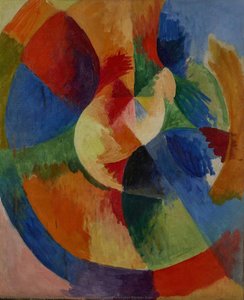
Portrait of Robert Delaunay

The 100 Most Famous Robert Delaunay Paintings, Each One of a Kind

Updated October 2026 · ranked by our popularity score (searches, visits and orders for each work) · 181 works by Robert Delaunay in our catalogue

In short

The City of Paris (1912) is the Robert Delaunay painting that draws the most eyes; the original belongs to the Centre Pompidou, Paris. After it, the eye goes to Eiffel Tower (1914) and The Eiffel Tower (1910). Among the 181 works of Robert Delaunay in our catalog, these 100 are the most famous, each a unique original presented with its year, its museum and the reason it endures.

1885 – 1941, Paris Orphism Most works: Centre Pompidou

Top 10 paintings by Robert Delaunay, through the gallery's eye

1
The City of Paris (1912) by Robert Delaunay

The City of Paris

1912 · Oil On Canvas · Centre Pompidou, Paris

Created in 1912, this captivating work by Robert Delaunay embodies the burgeoning spirit of early modernism and offers a compelling glimpse into the artistic ferment of pre-war Paris. More than just a depiction of a city, it's an energetic exploration of movement, form, and color that anticipates the dynamism of the 20th century.

2
Eiffel Tower (1914) by Robert Delaunay

Eiffel Tower

1914 · Oil On Canvas · Solomon R. Guggenheim Museum, New York City

A Modernist Masterpiece Robert Delaunay's 1914 "Eiffel Tower" is a vibrant testament to the artist's pioneering role in Orphism and Cubism. This iconic artwork captures the essence of Parisian modernity through a dynamic interplay of color, form, and perspective. The Eiffel Tower, one of the world's most recognizable structures, serves as the focal point, rendered in a fragmented, multi-faceted style that challenges traditional representation. Captivating Composition The composition is a…

3
The Eiffel Tower (1910) by Robert Delaunay

The Eiffel Tower

1910 · Oil On Canvas · Staatliche Kunsthalle Karlsruhe, Carlsruhe

In the heart of early twentieth-century Paris, a radical transformation was unfolding, one that sought to dismantle the traditional boundaries of sight and perception. Robert Delaunay’s The Eiffel Tower stands as a breathtaking monument to this era of profound change. Rather than offering a mere photographic record of the iron lattice structure, Delaunay invites us into a world where architecture dissolves into rhythm. The painting is not simply a depiction…

4
Window (1912) by Robert Delaunay

Window

1912 · Oil · Tate Liverpool, Liverpool

In the early twentieth century, as the world stood on the precipice of profound transformation, Robert Delaunay captured a moment of pure, luminous transcendence in his 1912 masterpiece, "Window." This work is far more than a mere depiction of a windowpane; it is an invitation to witness the birth of Orphism, a movement that sought to liberate color from the constraints of representational form. To gaze upon this painting is…

5
The Three Graces (1912) by Robert Delaunay

The Three Graces

1912 · Acrylic On Canvas

Robert Delaunay's "The Three Graces," completed in 1912, stands as a cornerstone of Orphism and a testament to the transformative power of abstract color theory. Painted during a period of intense artistic experimentation—the Belle Époque giving way to the burgeoning avant-garde—this monumental canvas transcends mere representation, immersing viewers in a realm where form and pigment converge to evoke profound emotion.

6
La ville de Paris (1911) by Robert Delaunay

La ville de Paris

1911 · Oil On Canvas · Toledo Museum of Art, Toledo

Created around 1911, La ville de Paris is an oil on canvas painting by the French artist Robert Delaunay. This monumental work measures 1722 x 1195 cm and is currently held at the Toledo Museum of Art in the United States. The composition features a group of nude figures, reminiscent of the Three Graces, standing around each other and positioned throughout the scene, with some in the foreground and others…

7
Endless Rhythm (Rythme sans fin) (1934) by Robert Delaunay

Endless Rhythm (Rythme sans fin)

1934 · Acrylic On Canvas

Robert Delaunay's "Endless Rhythm" is more than just a painting; it’s an immersion in the vibrant, revolutionary spirit of early 20th-century abstraction. Executed in 1934, this artwork embodies the core tenets of Orphism – a movement pioneered by Delaunay and his wife Sonia – that sought to liberate color from representational constraints and explore its inherent power as a visual language. The canvas pulsates with dynamic energy, achieved through a…

8
Political Drama (1914) by Robert Delaunay

Political Drama

1914 · Mixed Media · National Gallery of Art, Washington

To stand before Robert Delaunay’s Political Drama is not merely to observe a painting; it is to step into a vibrant, pulsating field of pure chromatic energy. Created in the charged atmosphere of 1914, this work captures a moment suspended between figuration and abstraction—a visual echo of the tumultuous era from which it emerged. The composition immediately draws the eye into its heart, where two figures seem caught in an…

9
Road in Laon (1912) by Robert Delaunay

Road in Laon

1912 · Oil On Canvas

Robert Delaunay's 1912 painting, ‘Road in Laon,’ isn’t merely a depiction of a street scene; it’s a vibrant manifesto of the Orphism movement – a radical departure from representational art that sought to capture pure emotion through color and geometric form. This oil on canvas, measuring 81 x 100 cm, offers a captivating glimpse into the burgeoning artistic landscape of early 20th-century Europe, showcasing Delaunay’s pioneering approach to abstraction and…

10
Eiffel Tower by Robert Delaunay

Eiffel Tower

Oil On Canvas · Hirshhorn Museum and Sculpture Garden, Washington, D.C.

In the heart of Paris, amidst the rhythmic pulse of a modernizing world, Robert Delaunay captured more than just a landmark; he captured the very vibration of existence. His Eiffel Tower stands as a breathtaking testament to the dawn of abstraction, where the rigid iron lattice of Gustave Eiffel’s masterpiece dissolves into a kaleidoscopic dance of light and geometry. To gaze upon this work is to witness the birth of…

Robert Delaunay's famous paintings, numbers 11 to 100

11Eiffel Tower (1909) by Robert DelaunayEiffel Tower1909 · Philadelphia Museum of Art 12Eiffel Tower (1911) by Robert DelaunayEiffel Tower1911 · Solomon R. Guggenheim Museum 13Woman with a Parasol (1913) by Robert DelaunayWoman with a Parasol1913 · Thyssen-Bornemisza Museum 14Rhythm (1912) by Robert DelaunayRhythm1912 15Windows Open Simultaneously 1st Part, 3rd Motif (1912) by Robert DelaunayWindows Open Simultaneously 1st Part, 3rd Motif1912 · Solomon R. Guggenheim Museum 16Simultaneous Contrasts Sun and Moon by Robert DelaunaySimultaneous Contrasts Sun and MoonMOMA - Museum of Modern Art 17Formes circulaires, soleil (Circular Forms, Sun) by Robert DelaunayFormes circulaires, soleil (Circular Forms, Sun)Museum Folkwang 18Premier Disque by Robert DelaunayPremier Disque 19Portrait of Henri Rousseau (1914) by Robert DelaunayPortrait of Henri Rousseau1914 · Centre Pompidou 20Window, Eiffel Tower by Robert DelaunayWindow, Eiffel TowerKunstsammlung Nordrhein-Westfalen 21Nude woman reading (1915) by Robert DelaunayNude woman reading1915 · National Gallery of Victoria 22The Bowl (1916) by Robert DelaunayThe Bowl1916 23The Red Tower (1911) by Robert DelaunayThe Red Tower1911 · Solomon R. Guggenheim Museum 24The jug (1916) by Robert DelaunayThe jug1916 · Centre Pompidou 25Breton Woman (1904) by Robert DelaunayBreton Woman1904 26In the Garden (1904) by Robert DelaunayIn the Garden1904 · Brooklyn Museum 27Study for the Cardiff Team (1922) by Robert DelaunayStudy for the Cardiff Team1922 · Aichi Prefectural Museum of Art 28Portrait of Dr. Piraz (1907) by Robert DelaunayPortrait of Dr. Piraz1907 · Thyssen-Bornemisza Museum 29Carousel of Pigs (1906) by Robert DelaunayCarousel of Pigs1906 · Solomon R. Guggenheim Museum 30Portrait of Jean Metzinger (1906) by Robert DelaunayPortrait of Jean Metzinger1906 31Portrait of Wilhelm Uhde (1907) by Robert DelaunayPortrait of Wilhelm Uhde1907 32Jean Metzinger (1906) by Robert DelaunayJean Metzinger1906 · Museum of Fine Arts 33Self-portrait (1906) by Robert DelaunaySelf-portrait1906 · Centre Pompidou 34Portugese Still LIfe (1916) by Robert DelaunayPortugese Still LIfe1916 35Portrait of Mrs. Jacques Heim (1922) by Robert DelaunayPortrait of Mrs. Jacques Heim1922 · Israel Museum 36Portrait of Stravinsky (1918) by Robert DelaunayPortrait of Stravinsky1918 · The New Art Gallery Walsall 37The Poet Philippe Soupault (1922) by Robert DelaunayThe Poet Philippe Soupault1922 · Centre Pompidou 38Study for the Portrait of Madame Heim (1927) by Robert DelaunayStudy for the Portrait of Madame Heim1927 39Study for the Portrait of Madame Heim (1926) by Robert DelaunayStudy for the Portrait of Madame Heim1926 40Portrait of Madame Heim (1927) by Robert DelaunayPortrait of Madame Heim1927 41Portrait of Hélène Marre (1923) by Robert DelaunayPortrait of Hélène Marre1923 42Portrait of Madame Heim (1926) by Robert DelaunayPortrait of Madame Heim1926 43Man with a Tulip (also known as Portrait of Jean Metzinger) (1906) by Robert DelaunayMan with a Tulip (also known as Portrait of Jean Metzinger)1906 44Portrait of Maria Lani (1929) by Robert DelaunayPortrait of Maria Lani1929 45Still Life with Parrot (1907) by Robert DelaunayStill Life with Parrot1907 · Thyssen-Bornemisza Museum 46Portrait of Henri Carlier (1906) by Robert DelaunayPortrait of Henri Carlier1906 · Centre Pompidou 47Portuguese Still Life (1915) by Robert DelaunayPortuguese Still Life1915 · Musée Fabre 48Football (1916) by Robert DelaunayFootball1916 · Centre Pompidou 49Saint-Cloud, Landscape Study (1910) by Robert DelaunaySaint-Cloud, Landscape Study1910 · Centre Pompidou 50Still Life in Blue (1907) by Robert DelaunayStill Life in Blue1907 · Centre Pompidou 51Stage Design for Cleopatra (1918) by Robert DelaunayStage Design for Cleopatra1918 · Metropolitan Museum of Art 52Circular Forms, Sun No. 2 (1910) by Robert DelaunayCircular Forms, Sun No. 21910 · Centre Pompidou 53Self-portrait (1909) by Robert DelaunaySelf-portrait1909 · Centre Pompidou 54Rhythm by Robert DelaunayRhythm 55Color Explosion by Robert DelaunayColor ExplosionStatens Museum For Kunst 56Saint-Séverin No. 4 (1909) by Robert DelaunaySaint-Séverin No. 41909 · Philadelphia Museum of Art 57The Laundry Place (1904) by Robert DelaunayThe Laundry Place1904 58Summer (1904) by Robert DelaunaySummer1904 59Market in Brittany (1905) by Robert DelaunayMarket in Brittany1905 · Centre Pompidou 60The Banks of the Yèvre (1903) by Robert DelaunayThe Banks of the Yèvre1903 · Centre Pompidou 61Mountain Landscape (1904) by Robert DelaunayMountain Landscape1904 62Landscape: The Rock before the Sea (1904) by Robert DelaunayLandscape: The Rock before the Sea1904 63Market in Brittany (1905) by Robert DelaunayMarket in Brittany1905 64Landscape, Haystacks (1905) by Robert DelaunayLandscape, Haystacks1905 65Eiffel Tower with Trees (1910) by Robert DelaunayEiffel Tower with Trees1910 · Solomon R. Guggenheim Museum 66White Hollyhock (1909) by Robert DelaunayWhite Hollyhock1909 67The Spire of Notre-Dame (1910) by Robert DelaunayThe Spire of Notre-Dame1910 68The Spire of Notre-Dame (1909) by Robert DelaunayThe Spire of Notre-Dame1909 69Simultaneous Tower (1911) by Robert DelaunaySimultaneous Tower1911 70Flowers (1909) by Robert DelaunayFlowers1909 71Breton Landscape (1906) by Robert DelaunayBreton Landscape1906 72The Eiffel Tower (1911) by Robert DelaunayThe Eiffel Tower1911 · Museum Folkwang 73Landscape with Cows (1906) by Robert DelaunayLandscape with Cows1906 · Musee d'art Moderne de la Ville de Paris 74Still Life with Gloves (1907) by Robert DelaunayStill Life with Gloves1907 75Still Life with a Flower Vase (1907) by Robert DelaunayStill Life with a Flower Vase1907 76Saint-Séverin No. 1 (1909) by Robert DelaunaySaint-Séverin No. 11909 77Saint-Séverin No. 5 (1909) by Robert DelaunaySaint-Séverin No. 51909 · Moderna Museet 78La Ville de Paris (1911) by Robert DelaunayLa Ville de Paris1911 79Window on the City No. 3 (1911) by Robert DelaunayWindow on the City No. 31911 · Solomon R. Guggenheim Museum 80Saint-Séverin No. 2 (1909) by Robert DelaunaySaint-Séverin No. 21909 · Minneapolis Institute of Art 81The Cardiff Team by Robert DelaunayThe Cardiff TeamMusee d'art Moderne de la Ville de Paris 82Poring (1915) by Robert DelaunayPoring1915 83Portuguese Still Life (1916) by Robert DelaunayPortuguese Still Life1916 · Dallas Museum of Art 84Soleil, tour, aéroplane (Sun, Tower, Airplane) (1913) by Robert DelaunaySoleil, tour, aéroplane (Sun, Tower, Airplane)1913 · Buffalo AKG Art Museum 85Fenêtres sur la ville (1914) by Robert DelaunayFenêtres sur la ville1914 · Lenbachhaus 86Window with Orange Curtains (1912) by Robert DelaunayWindow with Orange Curtains1912 87La Verseuse (1916) by Robert DelaunayLa Verseuse1916 88Study for La Verseuse (1916) by Robert DelaunayStudy for La Verseuse1916 89Rainbow (1913) by Robert DelaunayRainbow1913 90Portugese Still LIfe (1916) by Robert DelaunayPortugese Still LIfe1916 91Portugese Still Life (1916) by Robert DelaunayPortugese Still Life1916 92Paris with Rainbow (1914) by Robert DelaunayParis with Rainbow1914 93Colored Discs (1913) by Robert DelaunayColored Discs1913 94Circular Forms, Moon No. 3 (1913) by Robert DelaunayCircular Forms, Moon No. 31913 95Circular Forms, Moon No. 1 (1913) by Robert DelaunayCircular Forms, Moon No. 11913 96Study for L'Équipe de Cardiff (1913) by Robert DelaunayStudy for L'Équipe de Cardiff1913 · Musee d'Art Moderne de Troyes 97Political Drama (1914) by Robert DelaunayPolitical Drama1914 · Staatliche Kunsthalle Karlsruhe 98Windows on the City No. 3 (1912) by Robert DelaunayWindows on the City No. 31912 · Building of the Winterthur Museum of Art 99Hommage to Blériot (1914) by Robert DelaunayHommage to Blériot1914 · Musée de Grenoble 100Circular Forms, Sun No. 1 (1913) by Robert DelaunayCircular Forms, Sun No. 11913 · Wilhelm-Hack-Museum

Robert Delaunay's famous paintings, period by period

The subjects that held Robert Delaunay's eye

The four subjects that come back most often in these originals, each with its finest example.

The museums that keep Robert Delaunay's originals

The 8 museums that hold the most of the paintings on this page.

Museum City Works by Robert Delaunay Paintings from this list
Centre Pompidou, ParisCentre Pompidou Paris 24 The City of Paris, Portrait of Henri Rousseau, The jug
Solomon R. Guggenheim Museum, New YorkSolomon R. Guggenheim Museum New York 9 Eiffel Tower, Windows Open Simultaneously 1st Part, 3rd Motif, The Red Tower
Thyssen-Bornemisza Museum, MadridThyssen-Bornemisza Museum Madrid 4 Woman with a Parasol, Portrait of Dr. Piraz, Still Life with Parrot
Musee d'art Moderne de la Ville de Paris, ParisMusee d'art Moderne de la Ville de Paris Paris 8 Landscape with Cows, The Cardiff Team
Philadelphia Museum of Art, PhiladelphiaPhiladelphia Museum of Art Philadelphia 3 Eiffel Tower, Saint-Séverin No. 4
Staatliche Kunsthalle Karlsruhe, CarlsruheStaatliche Kunsthalle Karlsruhe Carlsruhe 2 The Eiffel Tower, Political Drama
Museum Folkwang, EssenMuseum Folkwang Essen 2 Formes circulaires, soleil (Circular Forms, Sun), The Eiffel Tower
MOMA - Museum of Modern Art, New York CityMOMA - Museum of Modern Art New York City 5 Simultaneous Contrasts Sun and Moon

Robert Delaunay across the decades: one unique original for each

Works per decade

Pick a decade to see the original that defines it.

Robert Delaunay's paintings: questions for the gallery

What is the single most famous work of Robert Delaunay?Reveal the answer

The City of Paris (1912), Centre Pompidou, Paris. Eiffel Tower (1914) and The Eiffel Tower (1910) come next.

At what age did Robert Delaunay create The City of Paris?Reveal the answer

27 years old: The City of Paris dates from 1912, and Robert Delaunay was born in 1885.

Which ten paintings by Robert Delaunay are the most famous?Reveal the answer

The City of Paris, Eiffel Tower, The Eiffel Tower, Window, The Three Graces, La ville de Paris, Endless Rhythm (Rythme sans fin), Political Drama, Road in Laon and Eiffel Tower. The ranking above gives each one's year and museum.

How many works by Robert Delaunay are known?Reveal the answer

Our catalog holds 181 works by Robert Delaunay, dated from 1903 to 1934.

Where can the most famous Robert Delaunay originals be seen?Reveal the answer

Mostly in Centre Pompidou (Paris), Solomon R. Guggenheim Museum (New York) and Thyssen-Bornemisza Museum (Madrid). The museum table above lists them all.

During which period did Robert Delaunay create the best-known paintings?Reveal the answer

In 1910s: 49 of the 100 works on this page were made then, The City of Paris among them.

Which famous Robert Delaunay painting is the earliest, and which the latest?Reveal the answer

On this page, the earliest is The Banks of the Yèvre (1903) and the latest Endless Rhythm (Rythme sans fin) (1934).

What subjects did Robert Delaunay favour?Reveal the answer

Geometric shapes (17), Color theory (5) and Eiffel tower (4), across the 100 works on this page.

What materials did Robert Delaunay paint with most?Reveal the answer

Oil On Canvas, for 22 of the 100 works on this page.

Which movement does the work of Robert Delaunay belong to?Reveal the answer

Orphism and Cubism, judging by the originals on this page.

What Robert Delaunay originals can I see at the Centre Pompidou?Reveal the answer

The City of Paris, Portrait of Henri Rousseau and The jug: the Centre Pompidou, Paris holds 13 of the works on this page.

Robert Delaunay: a portrait of the artist

A Pioneer of Abstract Color: The Life and Art of Robert Delaunay

Robert Delaunay, born in Paris in 1885, emerged as a pivotal figure in the radical artistic shifts of the early twentieth century. Though initially drawn to more traditional forms of painting, his journey led him toward an exploration of color and light that would ultimately define his legacy and contribute significantly to the birth of abstract art. Delaunay wasn’t merely interested in *representing* the world; he sought to capture its very essence through a vibrant language of geometric shapes and luminous hues, co-founding the Orphism movement with his wife, Sonia Delaunay, and others who shared their vision. His early life was marked by a degree of instability – his parents divorced when he was young, and he was raised by relatives – but this perhaps fostered an independent spirit that would serve him well in challenging artistic conventions. He initially pursued decorative arts, but quickly gravitated towards painting, exhibiting at the Salon des Indépendants as early as 1904, demonstrating a burgeoning talent and ambition.

From Divisionism to the Dawn of Orphism

Delaunay’s artistic development was characterized by constant experimentation. He initially engaged with Neo-Impressionism, or Divisionism, absorbing its principles of applying small, distinct dots of color to create a shimmering effect. However, he soon moved beyond simply replicating optical phenomena; he began to investigate the expressive potential of color itself. A crucial friendship with Jean Metzinger proved formative during this period, as they explored the possibilities of fragmented forms and mosaic-like compositions. These early collaborations laid groundwork for their later involvement in Cubism, though Delaunay would ultimately diverge from its more analytical approach. He wasn’t interested in dissecting objects into geometric components; rather, he sought to synthesize them into dynamic arrangements of color and light. This shift culminated in the development of Orphism – a term coined by the poet Guillaume Apollinaire – which aimed to create a purely abstract art that evoked emotional responses through its chromatic intensity. Simultaneous Contrasts: Sun and Moon, exemplifies this approach, showcasing Delaunay’s masterful manipulation of color to convey a sense of energy and movement.

The Power of ‘Simultanéité’ and Artistic Influence

Central to Delaunay's artistic philosophy was the concept of “simultanéité” – the idea that colors interact with each other, creating new sensations and perceptions. He believed that color wasn’t merely a descriptive element but an active force capable of shaping our experience of reality. This belief informed his series of paintings depicting the Eiffel Tower, where he deconstructed the iconic structure into a network of intersecting planes and vibrant hues. These weren't depictions *of* the tower, but rather explorations of how light and color transformed its appearance. Delaunay’s theories resonated deeply with other artists of his time, influencing figures like Paul Klee, Franz Marc, August Macke, and even Russian avant-garde movements. His emphasis on abstraction and the expressive power of color helped pave the way for a new generation of artists who rejected representational conventions in favor of purely visual forms. He wasn’t simply creating paintings; he was developing a theoretical framework for understanding the relationship between color, light, and perception.

Later Years and Enduring Legacy

The outbreak of World War I forced Delaunay and his wife to seek refuge in Spain and Portugal, where they continued to work and exhibit. After returning to Paris in the 1920s, he explored a range of subjects, including portraits and figurative scenes, but always remained committed to his core principles of color and abstraction. In his later years, Delaunay revisited earlier themes, creating increasingly complex and dynamic compositions. He also undertook ambitious projects such as designing large-scale colored reliefs for the 1937 Paris International Exposition, demonstrating his ability to translate his artistic vision into architectural contexts. Robert Delaunay’s untimely death in 1941 marked a loss for the art world, but his influence continues to be felt today. His pioneering work laid the foundation for many subsequent developments in abstract art, and his exploration of color remains a source of inspiration for artists across disciplines. His legacy is not merely one of aesthetic innovation, but also of intellectual inquiry – a testament to the power of art to transform our understanding of the world around us.

Notable Works