Preview
 Send
Send Share
Share
 Details
 Guide
Guide

 Download
 Similars
 X-Ray
X-Ray Diaporama
 Stats
StatsThe Red Tower


 Read More
Hand Made Oil Reproduction
Hand-painted oil on canvas in your size and frame, made to order by our artists. ( Switch to Print Switch to Digital Image)




P118B $10

P118H $10

P118W $10

P438Z $10

P508JH $12

P508YH $12

P805H $10

P805Z $10

P919BZ $10

P919G $10

P919XJ $10

P959ZH $10

P968JZ $12

W106C $8

W218G $10

W218JH $8

W218Y $10

W307PJ $10

W316G $10

W316PJ $8

W316Y $10

W398PJ $8

W4111J $10

W500HY $15

W500JH $15

W692G $12

W849H $8

W940BG $15

W953PJ $8




Pick from our preset sizes that match the artwork's original proportions.

Type the width and the height you need, to fit your frame or your wall. This is hand-painted, so for a size with a different shape the artist can paint a bit more around the picture, or cut a bit — you choose. We send you a digital mockup to approve before the painting starts. The picture shown on this page does not show the real result — only the mockup does.
After order, OriginalUniqueArt.com team will email client for instructions and provide a mockup preview
Worldwide Delivery () in 3/4 weeks instead of standard 5 weeks. (23 October). No compromise on quality.

Free Worldwide Express Shipping

High-Quality Linen Canvas

Full Shipping Insurance

Customs Tax Refund Guarantee

True Color Matching Guarantee

100-Day Return Policy (Defects Only)

100% Money-Back Guarantee

Bulk Discount Offer
 Glass option is only available in size under 110 CM

The Red Tower
Reproduction Medium
Reproduction Size
-


Total Price
$ 300
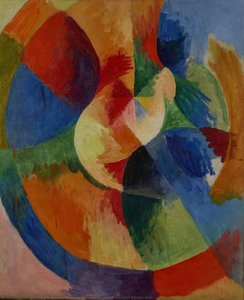
A Symphony of Light and Form: The Red Tower by Robert Delaunay
Robert Delaunay’s “The Red Tower,” painted in 1911, is more than a depiction of the iconic Eiffel Tower; it's a vibrant explosion of color and dynamic energy that encapsulates the revolutionary spirit of early 20th-century Paris. This reproduction captures not just an image, but the very essence of Delaunay’s pioneering approach to art – a move away from representational accuracy towards a profound exploration of light, emotion, and geometric abstraction. The painting's bold red dominates the upper structure, drawing the eye upwards while simultaneously grounding the composition with its assertive hue. This deliberate use of color wasn’t merely decorative; it was integral to Delaunay’s Orphism movement, aiming to evoke pure emotional responses through the manipulation of chromatic relationships.

Contextualizing Modernity: Paris in 1911
To fully appreciate “The Red Tower,” one must understand the historical context of its creation. The Eiffel Tower, erected for the 1889 World’s Fair, was a symbol of France's industrial prowess and technological advancement – a bold statement against the traditional aesthetic sensibilities of the time. Delaunay, however, saw beyond this monumental structure. He captured not just its physical form but also the dynamism of modern life surrounding it: the bustling crowds, the movement of traffic, and the very spirit of innovation that defined the era. The inclusion of figures below the tower – tourists and locals alike – further emphasizes this theme, portraying a society actively engaging with and celebrating this new architectural marvel.
Delaunay’s Technique: Fragmentation and Color
Delaunay's technique is characterized by a masterful blend of fragmentation and vibrant color. The tower itself isn't rendered in smooth, continuous lines; instead, it’s broken down into geometric shapes and planes, creating a sense of movement and visual excitement. This approach aligns with the broader artistic trends of the time – Cubism’s exploration of multiple perspectives and Expressionism’s focus on subjective experience. The use of complementary colors—reds and blues, yellows and purples—intensifies the emotional impact of the painting, generating a powerful sense of energy and visual harmony. Note the careful layering of paint, creating depth and luminosity that draws the viewer into the scene.
Symbolism and Emotional Resonance
Beyond its technical brilliance, “The Red Tower” resonates with profound symbolic meaning. The red tower itself can be interpreted as a symbol of ambition, progress, and even revolution – mirroring the transformative changes occurring in France at the time. Delaunay’s deliberate framing of the tower—with tall buildings and clouds—creates a sense of grandeur and aspiration. The painting invites us to contemplate not just the physical structure but also its place within the broader narrative of human endeavor. This reproduction allows you to experience this powerful artwork firsthand, bringing a touch of Parisian modernity and Delaunay’s visionary spirit into your space.
Questions & Answers
How harmonious are the colors of "The Red Tower" by Robert Delaunay?
"The Red Tower" by Robert Delaunay displays a discordant palette color harmony.
Is "The Red Tower" available as a fine art print?
To get a print of "The Red Tower" by Robert Delaunay, simply order it on its Fine Art Print page: a fine art print on cotton canvas or archival canvas paper.
Can I use augmented reality to see "The Red Tower" by Robert Delaunay in my room?
The AR Preview page of "The Red Tower" by Robert Delaunay uses augmented reality to show the artwork in your own space, on a compatible device.
Artist Biography
A Pioneer of Abstract Color: The Life and Art of Robert Delaunay
Robert Delaunay, born in Paris in 1885, emerged as a pivotal figure in the radical artistic shifts of the early twentieth century. Though initially drawn to more traditional forms of painting, his journey led him toward an exploration of color and light that would ultimately define his legacy and contribute significantly to the birth of abstract art. Delaunay wasn’t merely interested in *representing* the world; he sought to capture its very essence through a vibrant language of geometric shapes and luminous hues, co-founding the Orphism movement with his wife, Sonia Delaunay, and others who shared their vision. His early life was marked by a degree of instability – his parents divorced when he was young, and he was raised by relatives – but this perhaps fostered an independent spirit that would serve him well in challenging artistic conventions. He initially pursued decorative arts, but quickly gravitated towards painting, exhibiting at the Salon des Indépendants as early as 1904, demonstrating a burgeoning talent and ambition.From Divisionism to the Dawn of Orphism
Delaunay’s artistic development was characterized by constant experimentation. He initially engaged with Neo-Impressionism, or Divisionism, absorbing its principles of applying small, distinct dots of color to create a shimmering effect. However, he soon moved beyond simply replicating optical phenomena; he began to investigate the expressive potential of color itself. A crucial friendship with Jean Metzinger proved formative during this period, as they explored the possibilities of fragmented forms and mosaic-like compositions. These early collaborations laid groundwork for their later involvement in Cubism, though Delaunay would ultimately diverge from its more analytical approach. He wasn’t interested in dissecting objects into geometric components; rather, he sought to synthesize them into dynamic arrangements of color and light. This shift culminated in the development of Orphism – a term coined by the poet Guillaume Apollinaire – which aimed to create a purely abstract art that evoked emotional responses through its chromatic intensity. Simultaneous Contrasts: Sun and Moon, exemplifies this approach, showcasing Delaunay’s masterful manipulation of color to convey a sense of energy and movement.The Power of ‘Simultanéité’ and Artistic Influence
Central to Delaunay's artistic philosophy was the concept of “simultanéité” – the idea that colors interact with each other, creating new sensations and perceptions. He believed that color wasn’t merely a descriptive element but an active force capable of shaping our experience of reality. This belief informed his series of paintings depicting the Eiffel Tower, where he deconstructed the iconic structure into a network of intersecting planes and vibrant hues. These weren't depictions *of* the tower, but rather explorations of how light and color transformed its appearance. Delaunay’s theories resonated deeply with other artists of his time, influencing figures like Paul Klee, Franz Marc, August Macke, and even Russian avant-garde movements. His emphasis on abstraction and the expressive power of color helped pave the way for a new generation of artists who rejected representational conventions in favor of purely visual forms. He wasn’t simply creating paintings; he was developing a theoretical framework for understanding the relationship between color, light, and perception.Later Years and Enduring Legacy
The outbreak of World War I forced Delaunay and his wife to seek refuge in Spain and Portugal, where they continued to work and exhibit. After returning to Paris in the 1920s, he explored a range of subjects, including portraits and figurative scenes, but always remained committed to his core principles of color and abstraction. In his later years, Delaunay revisited earlier themes, creating increasingly complex and dynamic compositions. He also undertook ambitious projects such as designing large-scale colored reliefs for the 1937 Paris International Exposition, demonstrating his ability to translate his artistic vision into architectural contexts. Robert Delaunay’s untimely death in 1941 marked a loss for the art world, but his influence continues to be felt today. His pioneering work laid the foundation for many subsequent developments in abstract art, and his exploration of color remains a source of inspiration for artists across disciplines. His legacy is not merely one of aesthetic innovation, but also of intellectual inquiry – a testament to the power of art to transform our understanding of the world around us.Notable Works
- The Eiffel Tower (1909-1911)
- Simultaneous Contrasts: Sun and Moon (1913)
- Windows Open Simultaneously, 1st Part, 3rd Motif (1912)
- Road in Laon (1910)
- Rhythms (1934)

Robert Delaunay
1885 - 1941 , France
Quick Facts
- Full Name: Robert Delaunay
- Nationality: French
- Date Of Birth: 1885
- Date Of Death: 1941
- Place Of Birth: Paris, France
- Notable Artworks:
- Eiffel Tower
- Simultaneous Contrasts
- Windows Open Simultaneously
- Artistic Movement Or Style: Orphism, Cubism
- Artists Who Influenced This Artist: ['Paul Klee']
- Artists Or Movements Influenced By This Artist:
- Stanton Macdonald-Wright
- Sonia Delaunay
- Der Blaue Reiter