Portrait of Michael Pacher

The 44 Most Famous Michael Pacher Paintings, a Gallery Selection

Updated October 2026 · ranked by our popularity score (searches, visits and orders for each work) · 44 works by Michael Pacher in our catalogue

In short

Of all the originals Michael Pacher left, the most famous is Altarpiece of the Church Fathers: St Jerome (1483), in the collection of the Alte Pinakothek, Munich. Close behind it come Altarpiece of the Church Fathers: St Augustine and St Gregory (1483) and St Wolfgang Altarpiece: Resurrection of Lazarus (1479). Our catalog holds 44 works by Michael Pacher; the gallery has kept the 44 the world admires most, each shown with its date, its museum and its story.

1435 – 1498, Pfalzen Northern renaissance Most works: Parish Church

Michael Pacher's top 10 paintings: the gallery's choice

1
Altarpiece of the Church Fathers: St Jerome (1483) by Michael Pacher

Altarpiece of the Church Fathers: St Jerome

1483 · Acrylic On Canvas · Alte Pinakothek, Munich

Michael Pacher’s Altarpiece of the Church Fathers: St. Jerome, completed in 1483, isn't merely a painting; it’s an immersive theatrical experience rendered in oil on wood panel. Created during a pivotal moment in European art – bridging the Gothic and burgeoning Renaissance – this altarpiece transcends its religious function to become a profound meditation on faith, suffering, and the very nature of divine inspiration. Pacher, a Tyrolean artist born amidst…

2
Altarpiece of the Church Fathers: St Augustine and St Gregory (1483) by Michael Pacher

Altarpiece of the Church Fathers: St Augustine and St Gregory

1483 · Oil On Panel · Alte Pinakothek, Munich

The Altarpiece of the Church Fathers: A Synthesis of Gothic Tradition and Renaissance Innovation Michael Pacher’s “Altarpiece of the Church Fathers,” completed in 1483 for the Neustift Monastery near Brixen, South Tyrol, stands as a testament to the transformative artistic currents sweeping across Central Europe during the late fifteenth century. More than just a devotional image, it represents a pivotal moment in art history—a harmonious blend of Gothic sensibilities and…

3
St Wolfgang Altarpiece: Resurrection of Lazarus (1479) by Michael Pacher

St Wolfgang Altarpiece: Resurrection of Lazarus

1479 · Oil On Panel · Parish Church, St. Wolfgang

The air in the scene feels heavy with the scent of damp earth and ancient stone. At the center, a figure of divine authority reaches into the darkness of a tomb to pull a man back from the silence of death. Lazarus emerges, his body a pale contrast against the muted tones of the surrounding architecture. Around him, a crowd of thirteen souls gathers, their faces etched with the sudden,…

4
Mary of Burgundy (1490) by Michael Pacher

Mary of Burgundy

1490 · Oil On Panel · Heinz Kisters Collection, Kreuzlingen

A woman gazes directly at the viewer, her presence defined by a stark, monochromatic palette. She wears a dark dress that absorbs the light, contrasted by a gold necklace that catches a subtle glint. Her long hair falls around a face marked by a steady, unblinking stare. Behind her, a clock hangs upon the wall, a quiet marker of time within the composition. The work utilizes a black and white…

5
Saint Ambrose from Milan (1480) by Michael Pacher

Saint Ambrose from Milan

1480 · Tempera On Panel · Bavarian State Painting Collections, Munich

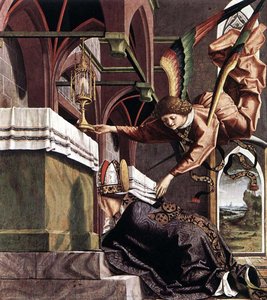
The panel known as Saint Ambrose from Milan emerges from the intricate layers of the Altarpiece of the Church Fathers. Painted by Michael Pacher, this work captures a moment of profound spiritual connection. It exists as one of the four sections of a larger, complex structure designed to honor the great Doctors of the Western Church. The saint appears caught in a state of divine inspiration, a scene that breathes…

7
Laurentius Altar: The Death of Mary (1462) by Michael Pacher

Laurentius Altar: The Death of Mary

1462 · Tempera On Panel · Bavarian State Painting Collections, Munich

The Laurentius Altar: The Death of Mary by Michael Pacher captures a moment of heavy stillness. Created about 1462, the work centers on the Dormition of the Virgin. She lies at the heart of the scene, a figure of quiet transition. Around her, the apostles gather in a dense, crowded assembly. Their presence forms a ring of mourning, each face etched with the weight of the passing. The air in…

The Michael Pacher selection continues, 11 to 44

11Church Fathers Altar, Outer Wing: Disputation of Saint Augustine with the Heretics (1480) by Michael PacherChurch Fathers Altar, Outer Wing: Disputation of Saint Augustine with the Heretics1480 · Bavarian State Painting Collections 12Church Fathers Altar: Saint Augustine (1480) by Michael PacherChurch Fathers Altar: Saint Augustine1480 · Bavarian State Painting Collections 13Scene on the right: Saint Gregory (1471) by Michael PacherScene on the right: Saint Gregory1471 · Bavarian State Painting Collections 14St. Barbara (1485) by Michael PacherSt. Barbara1485 15Joseph is trown into a well (1474) by Michael PacherJoseph is trown into a well1474 16Coronation of the Virgin (1471) by Michael PacherCoronation of the Virgin1471 · Parish Church 17The Engagement of Virgin (1495) by Michael PacherThe Engagement of Virgin1495 · Österreichische Galerie 18Annunciation (1465) by Michael PacherAnnunciation1465 · Alte Pinakothek 19St Catherine (1465) by Michael PacherSt Catherine1465 · Tiroler Landesmuseum Ferdinandeum 20Altarpiece of the Church Fathers: St Augustine Liberating a Prisoner (1483) by Michael PacherAltarpiece of the Church Fathers: St Augustine Liberating a Prisoner1483 · Alte Pinakothek 21St Wolfgang Altarpiece: Circumcision (1479) by Michael PacherSt Wolfgang Altarpiece: Circumcision1479 · Parish Church 22Altarpiece of the Church Fathers: Vision of St Sigisbert (1483) by Michael PacherAltarpiece of the Church Fathers: Vision of St Sigisbert1483 · Alte Pinakothek 23Follower of ) (1400) by Michael PacherFollower of )1400 24Altarpiece of the Church Fathers (1483) by Michael PacherAltarpiece of the Church Fathers1483 · Alte Pinakothek 25St Wolfgang Altarpiece: The Miracle of the Bread (1479) by Michael PacherSt Wolfgang Altarpiece: The Miracle of the Bread1479 · Parish Church 26Coronation of the Virgin between St Wolfgang and St Benedict (1479) by Michael PacherCoronation of the Virgin between St Wolfgang and St Benedict1479 · Parish Church 27St Wolfgang Altarpiece: Temptation of Christ (1479) by Michael PacherSt Wolfgang Altarpiece: Temptation of Christ1479 · Parish Church 28St Wolfgang Altarpiece: The Attempt to Stone Christ (1479) by Michael PacherSt Wolfgang Altarpiece: The Attempt to Stone Christ1479 · Parish Church 29St Wolfgang Altarpiece: Nativity (1479) by Michael PacherSt Wolfgang Altarpiece: Nativity1479 · Parish Church 30St Wolfgang Altarpiece: Purification of the Temple (1479) by Michael PacherSt Wolfgang Altarpiece: Purification of the Temple1479 · Parish Church 31St Wolfgang Altarpiece: Scenes from the Life of Christ (1479) by Michael PacherSt Wolfgang Altarpiece: Scenes from the Life of Christ1479 · Parish Church 32Flagellation (1495) by Michael PacherFlagellation1495 · Österreichische Galerie 33St Lawrence Distributing the Alms (1465) by Michael PacherSt Lawrence Distributing the Alms1465 · Alte Pinakothek 34St. Barbara by Michael PacherSt. Barbara 35st wolfgang altarpiece by Michael Pacherst wolfgang altarpiece 36Temptation of Christ by Michael PacherTemptation of Christ 37Marriage at Cana by Michael PacherMarriage at Cana 38Baptism of Christ by Michael PacherBaptism of Christ 39Christ and the Adulteress by Michael PacherChrist and the Adulteress 40St Augustine and St Gregory by Michael PacherSt Augustine and St GregoryBavarian State Painting Collections 41St augustine freeing a prisoner by Michael PacherSt augustine freeing a prisoner 42Resurrection of Lazar by Michael PacherResurrection of Lazar 43Scenes from the Life of Christ by Michael PacherScenes from the Life of Christ 44The Virgin and Child Enthroned with Angels and Saints by Michael PacherThe Virgin and Child Enthroned with Angels and SaintsNational Gallery

The subjects that held Michael Pacher's eye

The four subjects that come back most often in these originals, each with its finest example.

The museums that keep Michael Pacher's originals

The 7 museums that hold the most of the paintings on this page.

Museum City Works by Michael Pacher Paintings from this list
Parish Church, St. WolfgangParish Church St. Wolfgang 10 St Wolfgang Altarpiece: Resurrection of Lazarus, Coronation of the Virgin, St Wolfgang Altarpiece: Circumcision
Alte Pinakothek, MunichAlte Pinakothek Munich 7 Altarpiece of the Church Fathers: St Jerome, Altarpiece of the Church Fathers: St Augustine and St Gregory, Annunciation
Bavarian State Painting Collections, MunichBavarian State Painting Collections Munich 6 Saint Ambrose from Milan, Laurentius Altar: The Death of Mary, Church Fathers Altar, Outer Wing: Disputation of Saint Augustine with the Heretics
Österreichische Galerie, ViennaÖsterreichische Galerie Vienna 2 The Engagement of Virgin, Flagellation
Heinz Kisters Collection, KreuzlingenHeinz Kisters Collection Kreuzlingen 1 Mary of Burgundy
Tiroler Landesmuseum Ferdinandeum, InnsbruckTiroler Landesmuseum Ferdinandeum Innsbruck 1 St Catherine
National Gallery, LondonNational Gallery London 1 The Virgin and Child Enthroned with Angels and Saints

Michael Pacher decade by decade: the original that defines each

Works per decade

Pick a decade to see the original that defines it.

Collectors' questions about Michael Pacher's paintings

Which work is Michael Pacher most famous for?Reveal the answer

Altarpiece of the Church Fathers: St Jerome (1483), Alte Pinakothek, Munich. Altarpiece of the Church Fathers: St Augustine and St Gregory (1483) and St Wolfgang Altarpiece: Resurrection of Lazarus (1479) come next.

What age was Michael Pacher when Altarpiece of the Church Fathers: St Jerome was made?Reveal the answer

48 years old: Altarpiece of the Church Fathers: St Jerome dates from 1483, and Michael Pacher was born in 1435.

What are the ten most famous Michael Pacher paintings?Reveal the answer

Altarpiece of the Church Fathers: St Jerome, Altarpiece of the Church Fathers: St Augustine and St Gregory, St Wolfgang Altarpiece: Resurrection of Lazarus, Mary of Burgundy, Saint Ambrose from Milan, Saint Lawrence before Emperor Decius, Laurentius Altar: The Death of Mary, St. Peter, Pope Sixtus II. bids farewell to St. Lawrence and St. Paul. The ranking above gives each one's year and museum.

How many paintings did Michael Pacher leave?Reveal the answer

Our catalog holds 44 works by Michael Pacher, dated from 1462 to 1495.

In which museums do Michael Pacher's masterpieces hang?Reveal the answer

Mostly in Parish Church (St. Wolfgang), Alte Pinakothek (Munich) and Bavarian State Painting Collections (Munich). The museum table above lists them all.

In which years did Michael Pacher paint the most famous works?Reveal the answer

In 1470s: 12 of the 44 works on this page were made then, St Wolfgang Altarpiece: Resurrection of Lazarus among them.

What are the first and the last famous originals of Michael Pacher?Reveal the answer

On this page, the earliest is Laurentius Altar: The Death of Mary (1462) and the latest The Engagement of Virgin (1495).

Which subjects did Michael Pacher choose most often?Reveal the answer

Altarpiece (9), Saints (7) and Religious scene (7), across the 44 works on this page.

Which technique did Michael Pacher use most?Reveal the answer

Oil On Panel, for 7 of the 44 works on this page.

To which art movement does Michael Pacher belong?Reveal the answer

Northern renaissance, judging by the originals on this page.

Which Michael Pacher works hang at the Parish Church?Reveal the answer

St Wolfgang Altarpiece: Resurrection of Lazarus, Coronation of the Virgin and St Wolfgang Altarpiece: Circumcision: the Parish Church, St. Wolfgang holds 10 of the works on this page.

Can I commission a reproduction of a Michael Pacher painting?Reveal the answer

Yes, as a reproduction: the original stays in its museum, but any painting on this page can be painted by hand for you, made to order one at a time, from the painting's own page.

Michael Pacher: life and work

A Tyrolean Bridge Between Worlds

Michael Pacher, born around 1435 in the alpine landscapes of Bolzano, stands as a pivotal figure in the transition from Gothic artistry to the burgeoning Renaissance spirit within German-speaking lands. He wasn’t merely an artist; he was a craftsman who seamlessly blended painting and sculpture, architecture and intricate detail, creating altarpieces that were less religious objects and more immersive worlds of faith and storytelling. While his early life remains shrouded in some mystery—details of his initial training are scarce—it's clear that Pacher possessed an innate talent nurtured by the artistic currents flowing through Tyrol during the mid-15th century. His journey took a decisive turn with a visit to Padua, Italy, where he encountered the revolutionary frescoes of Andrea Mantegna. This exposure proved transformative, imbuing his work with a newfound understanding of perspective and spatial composition—elements that would distinguish him from many of his contemporaries.

The St. Wolfgang Altarpiece: A Masterpiece Unveiled

Pacher’s reputation rests most firmly upon the magnificent St. Wolfgang Altarpiece, created between 1471 and 1481 for the pilgrimage church in Austria. This isn't simply a painting; it is an elaborate polyptych, a multi-paneled masterpiece designed to unfold like a sacred narrative. The altarpiece’s ingenious design allows for three distinct displays: one for everyday worship, another more ornate for Sundays, and a fully expanded version reserved for special holy days. Each configuration reveals different scenes from the lives of Jesus and the Virgin Mary, culminating in the breathtaking central panel depicting the Coronation of the Virgin as Queen of Heaven—a sculpted scene radiating with divine majesty. The outer wings portray episodes from the life of Saint Wolfgang himself, patron saint of pilgrims and craftsmen. Scholars suggest his brother, Friedrich Pacher, may have contributed to painting some of the outer panels, highlighting a collaborative spirit within the workshop. What truly sets this work apart is its sheer scale, complexity, and the astonishing level of detail in both the painted elements and the intricately carved figures. It’s a testament to Pacher's ability to command multiple artistic disciplines simultaneously.

Blending Disciplines: Painting, Sculpture, and Architectural Vision

Beyond the St. Wolfgang Altarpiece, Pacher demonstrated his unique synthesis of art forms in works like the Altarpiece of the Church Fathers, completed around 1483 for Neustift Monastery. Here, he masterfully blurred the boundaries between painting and sculpture, creating a unified artistic experience. The monumental figures of the Church Fathers seem to emerge from their niches, imbued with a palpable sense of presence. Pacher’s skill in manipulating light and shadow further enhances this effect, lending depth and realism to the composition. He didn't merely depict space; he *created* it within the confines of the altarpiece structure. This innovative approach significantly influenced subsequent generations of artists in Northern Europe, who sought to emulate his ability to integrate diverse artistic techniques into a cohesive whole.

Legacy and Lasting Influence

By 1467, Pacher had established a thriving workshop in Bruneck, becoming a prominent figure in the Tyrolean art scene. He received commissions from various religious orders, including the Franciscans in Salzburg around 1484. Sadly, many of his works have been lost or damaged over time due to conflicts and natural disasters—a poignant reminder of the fragility of artistic heritage. Despite these losses, the surviving masterpieces stand as enduring testaments to Pacher’s exceptional talent and innovative spirit. He was a true pioneer, successfully bridging the gap between the expressive forms of Northern Gothic art and the emerging principles of Italian Renaissance painting. His legacy lies not only in the beauty and technical brilliance of his creations but also in his ability to forge a uniquely personal style that continues to captivate and inspire viewers centuries later. Pacher’s work represents a crucial moment in art history—a time when tradition and innovation converged, giving rise to new artistic possibilities.

All 44 works by Michael Pacher →