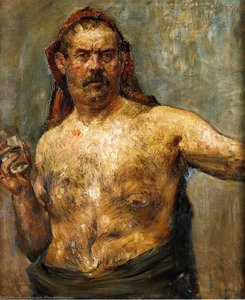
Portrait of Lovis Corinth

The 100 Most Famous Lovis Corinth Paintings, a Gallery Selection

Updated October 2026 · ranked by our popularity score (searches, visits and orders for each work) · 501 works by Lovis Corinth in our catalogue

In short

Of all the originals Lovis Corinth left, the most famous is In the Slaughter House (1893). Close behind it come Wilhelmine with a Ball (1915) and Portrait of the Painter Paul Eugène Gorge (1908). Our catalog holds 501 works by Lovis Corinth; the gallery has kept the 100 the world admires most, each shown with its date, its museum and its story.

1858 – 1925, Gvardeysk Expressionism Most works: Berlinische Galerie

Lovis Corinth's top 10 paintings: the gallery's choice

1
In the Slaughter House (1893) by Lovis Corinth

In the Slaughter House

1893 · Oil On Canvas

Dynamic Depiction of Labor and Industry Lovis Corinth's "In the Slaughter House" is a powerful portrayal of the raw intensity and physical exertion involved in butchery. Created in 1893, this artwork captures the bustling scene of meat processing with a dynamic composition that draws the viewer into the heart of the action. The central focus is on a large piece of meat being hoisted by several figures, symbolizing the labor-intensive…

2
Wilhelmine with a Ball (1915) by Lovis Corinth

Wilhelmine with a Ball

Lovis Corinth’s “Wilhelmine with a Ball,” painted in 1915, stands as a poignant emblem of early 20th-century expressionism – an artistic movement driven by a fervent desire to convey inner psychological states rather than merely mirroring external reality. More than just a depiction of a young girl seated elegantly in a chair, the painting delves into themes of vulnerability and introspection, capturing a moment suspended between youthful innocence and the…

3
Portrait of the Painter Paul Eugène Gorge (1908) by Lovis Corinth

Portrait of the Painter Paul Eugène Gorge

1908 · Acrylic On Canvas · Staatsgalerie Moderner Kunst, Munich

Lovis Corinth’s “Portrait of the Painter Paul Eugène Gorge,” completed in 1908, transcends mere representation; it embodies a pivotal moment in German Expressionism and offers a profound glimpse into Corinth’s artistic vision. Housed within the Staatsgalerie Moderner Kunst in Munich, this oil on canvas painting isn't simply a likeness of another artist—it’s a carefully constructed meditation on identity, creativity, and the complexities of human experience.

5
Reclining Female Nude (1907) by Lovis Corinth

Reclining Female Nude

1907 · Acrylic On Canvas · Austrian Gallery Belvedere, Vienna

Reclining Female Nude – A Study in Expressionist Sensuality The painting “Reclining Female Nude,” created by Lovis Corinth in 1907, stands as a cornerstone of Expressionism’s exploration of the human psyche. More than just a depiction of nudity—though undeniably sensual—it delves into themes of vulnerability, desire, and the confrontation with primal instincts. Corinth's masterful technique employs bold brushstrokes and vibrant color palettes to convey not merely what is seen but…

6
Portrait of Georg Brandes (1925) by Lovis Corinth

Portrait of Georg Brandes

1925 · Oil On Canvas · Koninklijk Museum voor Schone Kunsten, Antwerp

Lovis Corinth’s “Portrait of Georg Brandes” stands as a cornerstone of German Expressionism, capturing not merely likeness but profound psychological insight. Painted in 1925, this monumental canvas – measuring 92 x 70 cm and currently residing at the Koninklijk Museum voor Schone Kunsten in Antwerp – transcends mere representation; it’s an immersive experience into Brandes' inner world and Corinth’s masterful artistic vision.

7
Last Self Portrait (1925) by Lovis Corinth

Last Self Portrait

1925 · Oil On Canvas · Kunsthaus Zürich, Zurich

Lovis Corinth's "Last Self Portrait," painted in 1925, isn’t merely a depiction of an individual; it’s a profound meditation on identity, mortality, and the very nature of self-awareness. Created during a period of intense personal struggle for the artist – marked by the loss of his beloved wife – the painting vibrates with a palpable sense of melancholy and introspection. Corinth, a master of capturing raw emotion through bold brushwork…

8
The Singer Frieda Halbe (1905) by Lovis Corinth

The Singer Frieda Halbe

1905 · Oil On Canvas · Austrian Gallery Belvedere, Vienna

Lovis Corinth's "The Singer Frieda Halbe," painted in 1905, is a captivating portrait that exemplifies the artist’s transition from late Impressionism towards early Expressionism. Measuring 120 x 90 cm and currently residing at the Österreichische Galerie Belvedere in Vienna, Austria, this oil on canvas piece offers a compelling window into the artistic sensibilities of the era and showcases Corinth's remarkable ability to capture both physical likeness and emotional depth.

9
Cesare Borgia (Arthur Kraft) (1914) by Lovis Corinth

Cesare Borgia (Arthur Kraft)

1914 · Oil On Canvas · Alte Nationalgalerie, Berlin

In the evocative portrait Cesare Borgia (Arthur Kraft), created in 1914, we encounter a moment where history and raw emotion collide through the masterful hand of Lovis Corinth. This vertical oil painting transcends mere likeness, offering instead a theatrical and deeply psychological study of a man ensconced in the grandeur of traditional attire. The subject, captured with an intense presence, sits upon a chair that seems almost secondary to the…

10
Self-portrait in armor (1914) by Lovis Corinth

Self-portrait in armor

1914 · Oil On Canvas · Hamburger Kunsthalle, Hamburg

A man stares directly through the canvas, his gaze steady and unyielding. He is encased in metallic armor, the silvery surfaces catching a sharp light that descends from the upper left. This light carves deep shadows into the folds of his skin and the contours of the breastplate, creating a sense of immense physical volume. The armor is not a smooth, polished surface but a landscape of heavy impasto, where…

The Lovis Corinth selection continues, 11 to 100

11Homeric Laughter, First Version (1909) by Lovis CorinthHomeric Laughter, First Version1909 · Bayerische Staatsgemaldesammlungen 12Portrait of Frau Schreiber (1902) by Lovis CorinthPortrait of Frau Schreiber1902 · Staatliche Kunstsammlungen 13Male Portrait (1879) by Lovis CorinthMale Portrait1879 · Hamburger Kunsthalle 14Large Self Portrait at the Walchensee (1924) by Lovis CorinthLarge Self Portrait at the Walchensee1924 · Bayerische Staatsgemaldesammlungen 15Paradise (1911) by Lovis CorinthParadise1911 16Cat's Breakfast (1913) by Lovis CorinthCat's Breakfast1913 17Fishermen's Cemetery at Nidden (1893) by Lovis CorinthFishermen's Cemetery at Nidden1893 · Bayerische Staatsbibliothek 18Portrait of Gerhart Hauptmann (1900) by Lovis CorinthPortrait of Gerhart Hauptmann1900 · Kunsthalle Mannheim 19Hans Rosenhagen (1899) by Lovis CorinthHans Rosenhagen1899 · Alte Nationalgalerie 20Portrait of Dr Ferdinand Mainzer (1899) by Lovis CorinthPortrait of Dr Ferdinand Mainzer1899 · National Gallery 21Reclining Nude (1899) by Lovis CorinthReclining Nude1899 · Kunsthalle Bremen 22Porträt Albert Kaumann (1910) by Lovis CorinthPorträt Albert Kaumann1910 · Hamburger Kunsthalle 23Anny Schaumberg with a doll (1886) by Lovis CorinthAnny Schaumberg with a doll1886 · National Museum in Warsaw 24Italian Woman in a Yellow Chair (1912) by Lovis CorinthItalian Woman in a Yellow Chair1912 · Niedersächsisches Landesmuseum 25Male Nude (1886) by Lovis CorinthMale Nude1886 · Yale University Art Gallery 26Still Life with Chrysanthemums and Amaryllis (1922) by Lovis CorinthStill Life with Chrysanthemums and Amaryllis1922 · Austrian Gallery Belvedere 27Study for the Painting "Die Totenklage" (1908) by Lovis CorinthStudy for the Painting "Die Totenklage"1908 · Staatliche Kunstsammlungen Dresden 28Self-Portrait (1917) by Lovis CorinthSelf-Portrait1917 · Art Institute of Chicago 29Female Nude on Studio Stool (1885) by Lovis CorinthFemale Nude on Studio Stool1885 30The Eighty-Year-Old Woman (1882) by Lovis CorinthThe Eighty-Year-Old Woman1882 31Portrait of Herr Fehleisen (1883) by Lovis CorinthPortrait of Herr Fehleisen1883 32Portrait of a Gentleman (1883) by Lovis CorinthPortrait of a Gentleman1883 33Portrait of the Aunt in Moterau (1880) by Lovis CorinthPortrait of the Aunt in Moterau1880 34Portrait of Ohm in Moterau (1880) by Lovis CorinthPortrait of Ohm in Moterau1880 35Old Italian woman (1883) by Lovis CorinthOld Italian woman1883 36Laughing Girl (1883) by Lovis CorinthLaughing Girl1883 37Portrait des the Artist Albertus Wirth (1884) by Lovis CorinthPortrait des the Artist Albertus Wirth1884 38On the Balcony in Bordighera (1912) by Lovis CorinthOn the Balcony in Bordighera1912 · Museum Folkwang 39Sunday Peace (1887) by Lovis CorinthSunday Peace1887 40Portrait of the Father Franz Heinrich Corinth with Letter (1887) by Lovis CorinthPortrait of the Father Franz Heinrich Corinth with Letter1887 · Kunstforum Ostdeutsche Galerie 41Old Woman (1887) by Lovis CorinthOld Woman1887 42Portrait of the Actor Hugo Rogall (1890) by Lovis CorinthPortrait of the Actor Hugo Rogall1890 43The old drinker (1889) by Lovis CorinthThe old drinker1889 44Woman Reading (1888) by Lovis CorinthWoman Reading1888 45Falschspieler (1887) by Lovis CorinthFalschspieler1887 46Sitting female nude (1886) by Lovis CorinthSitting female nude1886 47Parisian with a high comb (1886) by Lovis CorinthParisian with a high comb1886 48Nude Girl (1886) by Lovis CorinthNude Girl1886 · Minneapolis Institute of Art 49Portrait of a Woman with hat (1898) by Lovis CorinthPortrait of a Woman with hat1898 · Lenbachhaus 50Portrait of the Painter Karl Strathmann (1895) by Lovis CorinthPortrait of the Painter Karl Strathmann1895 51Group of Women (Friends, large version) (1904) by Lovis CorinthGroup of Women (Friends, large version)1904 · Staatliche Kunstsammlungen Dresden 52Portrait of Frau Schreiber (1901) by Lovis CorinthPortrait of Frau Schreiber1901 53Portrait of the Painter Fritz Rumpf (1901) by Lovis CorinthPortrait of the Painter Fritz Rumpf1901 · Berlinische Galerie 54Demon (1899) by Lovis CorinthDemon1899 55Black Shadows (1903) by Lovis CorinthBlack Shadows1903 · Hamburger Kunsthalle 56Portrait Ruederer (1904) by Lovis CorinthPortrait Ruederer1904 57Three graces (1904) by Lovis CorinthThree graces1904 · Bavarian State Painting Collections 58Portrait of Gertrud Mainzer with Lucie (1901) by Lovis CorinthPortrait of Gertrud Mainzer with Lucie1901 59Portrait of the sculptor Friedrich (1904) by Lovis CorinthPortrait of the sculptor Friedrich1904 · Fogg Museum 60Portrait of Eduard, Count Keyserling (1900) by Lovis CorinthPortrait of Eduard, Count Keyserling1900 · Neue Pinakothek 61Hymn to Michelangelo (1911) by Lovis CorinthHymn to Michelangelo1911 · Lenbachhaus 62Draft for Orpheus (1908) by Lovis CorinthDraft for Orpheus1908 · Staatliche Kunstsammlungen Dresden 63Judgment of Paris (1907) by Lovis CorinthJudgment of Paris1907 · Staatliche Kunstsammlungen Dresden 64Portrait of Frau Douglas (1909) by Lovis CorinthPortrait of Frau Douglas1909 · Museum der bildenden Künste 65Two Female Nudes (1910) by Lovis CorinthTwo Female Nudes1910 66Standing Nude (1911) by Lovis CorinthStanding Nude1911 · Niedersächsisches Landesmuseum 67The Apostle Paul (1911) by Lovis CorinthThe Apostle Paul1911 · Kunsthalle Mannheim 68Young Woman in the Greenery (1911) by Lovis CorinthYoung Woman in the Greenery1911 69Spoils of War (1911) by Lovis CorinthSpoils of War1911 · Museum Kunstpalast 70Charlotte Corinth at her Dressing Table (1911) by Lovis CorinthCharlotte Corinth at her Dressing Table1911 · Hamburger Kunsthalle 71The Capture of Samson (1907) by Lovis CorinthThe Capture of Samson1907 · Landesmuseum Mainz 72Magdalena Weeping (1911) by Lovis CorinthMagdalena Weeping1911 · Alte Nationalgalerie 73Höllenfragment [Hell, fragment] (1911) by Lovis CorinthHöllenfragment [Hell, fragment]1911 74Portrait of a man in a slouch hat (after Frans Hals) (1907) by Lovis CorinthPortrait of a man in a slouch hat (after Frans Hals)1907 · New Gallery 75Der Fanatiker (1911) by Lovis CorinthDer Fanatiker1911 · Museum Georg Schäfer 76Ice Skating Rink in The Tiergarten, Berlin (1909) by Lovis CorinthIce Skating Rink in The Tiergarten, Berlin1909 77Self Portrait as Standard Bearer (1911) by Lovis CorinthSelf Portrait as Standard Bearer1911 78The Large Martyrdom (1907) by Lovis CorinthThe Large Martyrdom1907 79Angelica with Dragon (1914) by Lovis CorinthAngelica with Dragon1914 · Berlinische Galerie 80Portrait of a Man (1914) by Lovis CorinthPortrait of a Man1914 · Berlinische Galerie 81Ariosto (1914) by Lovis CorinthAriosto1914 · Berlinische Galerie 82The Suitors Fighting Odysseus (1913) by Lovis CorinthThe Suitors Fighting Odysseus1913 · Berlinische Galerie 83Veiled Dancer (1913) by Lovis CorinthVeiled Dancer1913 84Portrait of Rudolf Rittner as "Florian Geyer" (II. Version) (1912) by Lovis CorinthPortrait of Rudolf Rittner as "Florian Geyer" (II. Version)1912 85Wilhelmine in Traditional Costume (1913) by Lovis CorinthWilhelmine in Traditional Costume1913 86Girl, Undressing (1917) by Lovis CorinthGirl, Undressing1917 87Self-Portrait in Fur and Fur Cap (1916) by Lovis CorinthSelf-Portrait in Fur and Fur Cap1916 88Portrait of a Woman (1917) by Lovis CorinthPortrait of a Woman1917 89Self-Portrait as a Nuremberg Landsknecht (1913) by Lovis CorinthSelf-Portrait as a Nuremberg Landsknecht1913 90The Hairdresser (1915) by Lovis CorinthThe Hairdresser1915 · Alte Nationalgalerie 91Thomas (1912) by Lovis CorinthThomas1912 · Yale University Art Gallery 92Homer (1914) by Lovis CorinthHomer1914 · Berlinische Galerie 93Odysseus in the battle with the suitors (1913) by Lovis CorinthOdysseus in the battle with the suitors1913 · Berlinische Galerie 94Ruggiero and His Page (1914) by Lovis CorinthRuggiero and His Page1914 · Berlinische Galerie 95The Rose – Portrait of Lucie Mainzer (1914) by Lovis CorinthThe Rose – Portrait of Lucie Mainzer1914 96Death and the Maiden (1913) by Lovis CorinthDeath and the Maiden1913 97Old Man in Armour (1915) by Lovis CorinthOld Man in Armour1915 98Grandmother and Granddaughter (1919) by Lovis CorinthGrandmother and Granddaughter1919 · Niedersächsisches Landesmuseum 99Portrait of Admiral Alfred von Tirpitz (1917) by Lovis CorinthPortrait of Admiral Alfred von Tirpitz1917 100Portrait of Frau Luther (1911) by Lovis CorinthPortrait of Frau Luther1911 · Niedersächsisches Landesmuseum

Lovis Corinth's famous paintings, period by period

The subjects that held Lovis Corinth's eye

The four subjects that come back most often in these originals, each with its finest example.

The museums that keep Lovis Corinth's originals

The 8 museums that hold the most of the paintings on this page.

Museum City Works by Lovis Corinth Paintings from this list
Berlinische Galerie, BerlinBerlinische Galerie Berlin 10 Portrait of the Painter Fritz Rumpf, Angelica with Dragon, Portrait of a Man
Hamburger Kunsthalle, HamburgHamburger Kunsthalle Hamburg 15 Self-portrait in armor, Male Portrait, Porträt Albert Kaumann
Alte Nationalgalerie, BerlinAlte Nationalgalerie Berlin 20 Cesare Borgia (Arthur Kraft), Hans Rosenhagen, Magdalena Weeping
Niedersächsisches Landesmuseum, HanoverNiedersächsisches Landesmuseum Hanover 17 Italian Woman in a Yellow Chair, Standing Nude, Grandmother and Granddaughter
Staatliche Kunstsammlungen Dresden, DresdenStaatliche Kunstsammlungen Dresden Dresden 8 Study for the Painting "Die Totenklage", Group of Women (Friends, large version), Draft for Orpheus
Austrian Gallery Belvedere, ViennaAustrian Gallery Belvedere Vienna 11 Reclining Female Nude, The Singer Frieda Halbe, Still Life with Chrysanthemums and Amaryllis
Lenbachhaus, MunichLenbachhaus Munich 15 Portrait of a Woman with hat, Hymn to Michelangelo
Bayerische Staatsgemaldesammlungen, MunichBayerische Staatsgemaldesammlungen Munich 5 Homeric Laughter, First Version, Large Self Portrait at the Walchensee

Lovis Corinth decade by decade: the original that defines each

Works per decade

Pick a decade to see the original that defines it.

Collectors' questions about Lovis Corinth's paintings

Which work is Lovis Corinth most famous for?Reveal the answer

In the Slaughter House (1893). Wilhelmine with a Ball (1915) and Portrait of the Painter Paul Eugène Gorge (1908) come next.

What age was Lovis Corinth when In the Slaughter House was made?Reveal the answer

35 years old: In the Slaughter House dates from 1893, and Lovis Corinth was born in 1858.

What are the ten most famous Lovis Corinth paintings?Reveal the answer

In the Slaughter House, Wilhelmine with a Ball, Portrait of the Painter Paul Eugène Gorge, Self Portrait with a Glass, Reclining Female Nude, Portrait of Georg Brandes, Last Self Portrait, The Singer Frieda Halbe, Cesare Borgia (Arthur Kraft) and Self-portrait in armor. The ranking above gives each one's year and museum.

How many paintings did Lovis Corinth leave?Reveal the answer

Our catalog holds 501 works by Lovis Corinth, dated from 1879 to 1925.

In which museums do Lovis Corinth's masterpieces hang?Reveal the answer

Mostly in Berlinische Galerie (Berlin), Hamburger Kunsthalle (Hamburg) and Alte Nationalgalerie (Berlin). The museum table above lists them all.

In which years did Lovis Corinth paint the most famous works?Reveal the answer

In 1910s: 42 of the 100 works on this page were made then, Wilhelmine with a Ball among them.

What are the first and the last famous originals of Lovis Corinth?Reveal the answer

On this page, the earliest is Male Portrait (1879) and the latest Portrait of Georg Brandes (1925).

Which subjects did Lovis Corinth choose most often?Reveal the answer

Man (10), Portrait (7) and Woman (5), across the 100 works on this page.

Which technique did Lovis Corinth use most?Reveal the answer

Oil On Canvas, for 25 of the 100 works on this page.

To which art movement does Lovis Corinth belong?Reveal the answer

Expressionism and Impressionism, judging by the originals on this page.

Which Lovis Corinth works hang at the Berlinische Galerie?Reveal the answer

Portrait of the Painter Fritz Rumpf, Angelica with Dragon and Portrait of a Man: the Berlinische Galerie, Berlin holds 8 of the works on this page.

Can I commission a reproduction of a Lovis Corinth painting?Reveal the answer

Yes, as a reproduction: the original stays in its museum, but any painting on this page can be painted by hand for you, made to order one at a time, from the painting's own page.

Lovis Corinth: life and work

A Life Forged in Paint: The World of Lovis Corinth

Lovis Corinth, born Franz Heinrich Louis on July 21, 1858, in the Prussian province of East Prussia, was a figure who embodied the tumultuous transition from the 19th to the early 20th-century art world. His journey wasn’t one of immediate acclaim but rather a gradual evolution fueled by relentless study, diverse influences, and ultimately, personal tragedy. Corinth's beginnings were rooted in the rural landscapes of his birthplace, Tapiau, where his father worked as a tanner. This early exposure to the physicality of labor and the raw beauty of nature would subtly permeate his later work, even amidst more sophisticated stylistic explorations. He initially pursued studies at the Academy of Königsberg in 1876, but quickly realized that academic tradition alone wouldn’t satisfy his artistic ambitions. A period of travel followed, taking him to Munich, Antwerp, and finally Paris – each city serving as a crucial stepping stone in his development. In Munich, he absorbed the meticulous realism championed by Ludwig von Löfftz, honing his observational skills and mastering technique. Antwerp introduced him to the dramatic Baroque intensity of Rubens, while Paris exposed him to the burgeoning Impressionist movement, though his initial response was one of cautious observation rather than immediate embrace.

From Naturalism to a Synthesis of Styles

Corinth’s artistic development wasn't marked by swift revolutions but by a gradual assimilation and synthesis of diverse influences. His early work leaned heavily towards naturalism, reflecting the prevailing academic standards of the time. Paintings like “In the Slaughterhouse” (1878), with its unflinching depiction of animal carcasses, demonstrate this commitment to realistic representation, yet even here, a nascent emotional intensity begins to surface. The subject matter itself—gruesome and visceral—hints at a willingness to confront uncomfortable truths, a characteristic that would become increasingly prominent in his later work. His time spent studying the Old Masters, particularly Rubens, instilled in him a love of dynamic composition and expressive brushwork. However, it was his exposure to Impressionism – initially viewed with skepticism – that ultimately proved transformative. He didn’t simply adopt the broken color and fleeting light effects of Monet or Renoir; instead, he integrated these elements into his own unique vision, creating a style that blended impressionistic vibrancy with a distinctly German sensibility. This synthesis would eventually position him as a bridge between Impressionism and Expressionism, two movements that defined the artistic landscape of the early 20th century.

A Master of Portraiture and Landscape

While Corinth explored various genres throughout his career – including biblical scenes and mythological subjects – he is perhaps best remembered for his portraits and landscapes. His portraiture wasn’t merely about capturing physical likeness; it was an attempt to penetrate the psychological depths of his sitters, revealing their inner lives through subtle gestures, expressive eyes, and carefully considered compositions. He possessed a remarkable ability to convey character and emotion with astonishing economy of means. Similarly, his landscapes weren't simply depictions of scenic views but rather emotional responses to nature. The Walchensee region in the Bavarian Alps became a particular source of inspiration, providing him with a wealth of motifs that he explored repeatedly throughout his later years. These paintings are characterized by their bold colors, dynamic brushwork, and a sense of raw energy that reflects Corinth’s own passionate engagement with the natural world. He wasn't interested in idyllic representations; instead, he sought to capture the untamed power and inherent drama of the landscape.

Tragedy, Resilience, and Lasting Legacy

A pivotal moment in Corinth’s life – and arguably in his artistic development – was a stroke he suffered in December 1911. The paralysis it caused on his left side threatened to end his career altogether. However, with unwavering determination and the support of his wife, Charlotte Berend-Corinth, he relearned to paint, adapting to his physical limitations and developing an even more expressive style. This period marked a turning point in his work, as his paintings became increasingly bold, gestural, and emotionally charged. The experience of confronting mortality and physical vulnerability infused his art with a new sense of urgency and authenticity. He embraced a looser brushstroke and intensified color palette, anticipating many of the stylistic innovations that would define Expressionism. Corinth’s influence extended beyond his own painting; he was also a respected teacher and writer on art, publishing essays such as “On Learning to Paint” in 1908, offering insights into his artistic philosophy and technical approach. He served as president of the Berlin Secession from 1915 until his death in 1925, championing progressive artistic ideas and fostering a vibrant creative community. Lovis Corinth’s legacy lies not only in his remarkable body of work but also in his unwavering commitment to artistic integrity and his ability to transform personal tragedy into profound artistic expression. He remains a pivotal figure in the history of German art, a master who bridged two eras and left an indelible mark on generations of artists to come.

Key Works & Their Significance

  • In the Slaughterhouse (1878): A starkly realistic depiction of animal carcasses, showcasing Corinth’s early mastery of technique and his willingness to confront unsettling subjects.
  • Self-Portrait (various years): A series of self-portraits created annually on his birthday, offering a fascinating chronicle of the artist's evolving self-perception and artistic style. These works reveal a profound introspection and a fearless exploration of identity.
  • Female Semi-Nude with Hat (1906): Demonstrates Corinth’s ability to blend classical motifs with impressionistic techniques, creating a sensuous and psychologically compelling portrait.
  • Walchensee Series (various years): A collection of landscapes depicting the Walchensee region in Bavaria, characterized by their vibrant colors, dynamic brushwork, and emotional intensity. These paintings represent Corinth’s mature style at its most powerful and expressive.
  • The Last Self-Portrait (1924): Painted shortly before his death, this work is a poignant testament to the artist's resilience and unwavering spirit in the face of physical adversity. It embodies the culmination of his artistic journey and serves as a powerful symbol of human endurance.

All 501 works by Lovis Corinth →