


1


Updated October 2026 · ranked by our popularity score (searches, visits and orders for each work) · 59 works by Larry Rivers in our catalogue
In short
Of all the originals Larry Rivers left, the most famous is Those who Fire, Those Who Run. Close behind it come Art and the Artist Chairs and Van Gogh and Us from Stones (1960). Our catalog holds 59 works by Larry Rivers; the gallery has kept the 58 the world admires most, each shown with its date, its museum and its story.


Step into a world where playful naivety meets contemplative seriousness in Larry Rivers’ captivating “Cigar Box.” This unique artwork transcends the boundaries of traditional portraiture and still life, offering a glimpse into the artist’s distinctive vision. Created in 1967, it's a fascinating example of Pop Art sensibilities emerging from the Abstract Expressionist landscape.
 Untitled1958
12
 Black revue
13
 Witness drawing
14
 French Money III
15
 Dutch Masters and Cigars III
16
 The studio
17
 Redcoats
18
 Matisse with a model
19
 Tanfastic
20
 Kenneth Koch1953
21
 The Pool1956
22
 The 25 Cent Summer Cap1955
23
 Wrapper front from Stones1960
24
 Deuce of Spades1961
25
 French Money II1962
26
 Cezanne Stamp1963
27
 The Greatest Homosexual1964
28
 Billboard for the First New York Film Festival1963
29
 Eliza1968 · Städel Museum
30
 The Final Portrait of Joe and Olga Hirshhorn1981
31
 Bald Eagle, George and Part of the Constitution1987
32
 The Last Civil War Veteran1961 · Fine Arts Museums of San Francisco
33
 The StudioBavarian State Painting Collections
34
 Untitled (773)
35
 Untitled (670)
36
 The athlete’s dream
37
 For adults only
38
 Shoe sale
39
 Self portrait
40
 Big b signs up
41
 Confederate soldier
42
 Bjork
43
 Ernst and the Rape of the Sabine Women
44
 Camel
45
 How and Thes
46
 Fashion birds
47
 House of Cards-Blue
48
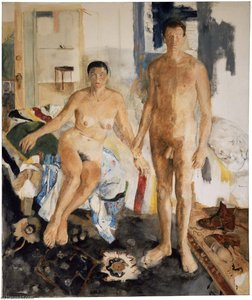 Bedroom
49
 Art and the Artist Jean Helion and the Dummies,
50
 On the Phone
51
 Gilbert and Garbo
52
 Kings
53
 Observation
54
 The last civil war veteran
55
 MeChrysler Museum of Art
56
 I Like Ingres, A Copy1962
57
 Portrait of Joseph H. Hirshhorn1963
58
 Little French Money II1962
The four subjects that come back most often in these originals, each with its finest example.
The 6 museums that hold the most of the paintings on this page.
| Museum | City | Works by Larry Rivers | Paintings from this list |
|---|---|---|---|
 Israel Museum |
Jerusalem | 1 | Advertisement for Helene Spitzer |
 Art Institute of Chicago |
Chicago | 1 | Lions on the Dreyfus Fund III |
 Städel Museum |
Frankfurt | 1 | Eliza |
 Fine Arts Museums of San Francisco |
San Francisco | 1 | The Last Civil War Veteran |
 Bavarian State Painting Collections |
Munich | 1 | The Studio |
 Chrysler Museum of Art |
Norfolk | 1 | Me |
Pick a decade to see the original that defines it.

The Untitled painting by Larry Rivers, created in 1958, is a fascinating example of modern art that continues to intrigue art enthusiasts and scholars alike. Measuring 33 x 51 cm, this paper-based artwork is a testament to the artist's innovative style and technique. The Artist and His Style Larry Rivers was an American artist, musician, and filmmaker who played a significant role in the development of Pop Art. His work…
Those who Fire, Those Who Run. Art and the Artist Chairs and Van Gogh and Us from Stones (1960) come next.
Those who Fire, Those Who Run, Art and the Artist Chairs and Van Gogh, Us from Stones, Advertisement for Helene Spitzer, Lions on the Dreyfus Fund III, Untitled from National Collection of Fine Arts Portfolio, Dutch Masters, Rainbow Rembrandt I, Untitled from Self Portrait in a Convex Mirror and Cigar Box. The ranking above gives each one's year and museum.
Our catalog holds 59 works by Larry Rivers, dated from 1953 to 1987.
Mostly in Israel Museum (Jerusalem), Art Institute of Chicago (Chicago) and Städel Museum (Frankfurt). The museum table above lists them all.
In 1960s: 17 of the 58 works on this page were made then, Us from Stones among them.
On this page, the earliest is Kenneth Koch (1953) and the latest Bald Eagle, George and Part of the Constitution (1987).
Arts (3), Man (2) and Abstract composition (2), across the 58 works on this page.
Pop art, judging by the originals on this page.
Larry Rivers (born Yitzroch Loiza Grossberg) was a multifaceted American artist whose career spanned painting, music, filmmaking, and acting. He is widely recognized as a pivotal figure in the development of Pop Art, bridging the gap between Abstract Expressionism and the burgeoning movement that embraced popular culture imagery. His unique blend of artistic disciplines and his distinctive personality cemented his place as a significant contributor to 20th-century art.


