Portrait of Kurt Schwitters

The 37 Most Famous Kurt Schwitters Paintings, a Gallery Selection

Updated November 2026 · ranked by our popularity score (searches, visits and orders for each work) · 38 works by Kurt Schwitters in our catalogue

In short

Of all the originals Kurt Schwitters left, the most famous is Merz Picture 32A (The Cherry Picture) (1921), in the collection of the MOMA - Museum of Modern Art, New York City. Close behind it come (Elikan) (1925) and Santa Claus (1922). Our catalog holds 38 works by Kurt Schwitters; the gallery has kept the 37 the world admires most, each shown with its date, its museum and its story.

1887 – 1948, Hanover Dadaism Most works: MOMA - Museum of Modern Art

Kurt Schwitters's top 10 paintings: the gallery's choice

1
Merz Picture 32A (The Cherry Picture) (1921) by Kurt Schwitters

Merz Picture 32A (The Cherry Picture)

1921 · Collage · MOMA - Museum of Modern Art, New York City

In the wake of a world shattered by the cataclysm of World War I, the German artist Kurt Schwitters sought to rebuild reality not from the pristine ruins of tradition, but from the very debris left in the aftermath. His masterpiece, Merz Picture 32A (The Cherry Picture), completed in 1921, serves as a profound testament to this reconstructive spirit. This is not merely a painting; it is a carefully orchestrated…

2
(Elikan) (1925) by Kurt Schwitters

(Elikan)

1925 · Collage · MOMA - Museum of Modern Art, New York City

In the fractured landscape of post-World War I Europe, where the very foundations of society seemed to crumble, Kurt Schwitters emerged with a radical new language of creation. His 1925 masterpiece, "Elikan," is not merely an arrangement of materials but a profound visual manifesto of the Dada movement. To gaze upon this work is to witness a deliberate reconstruction of reality from its broken pieces. Through his signature technique of…

3
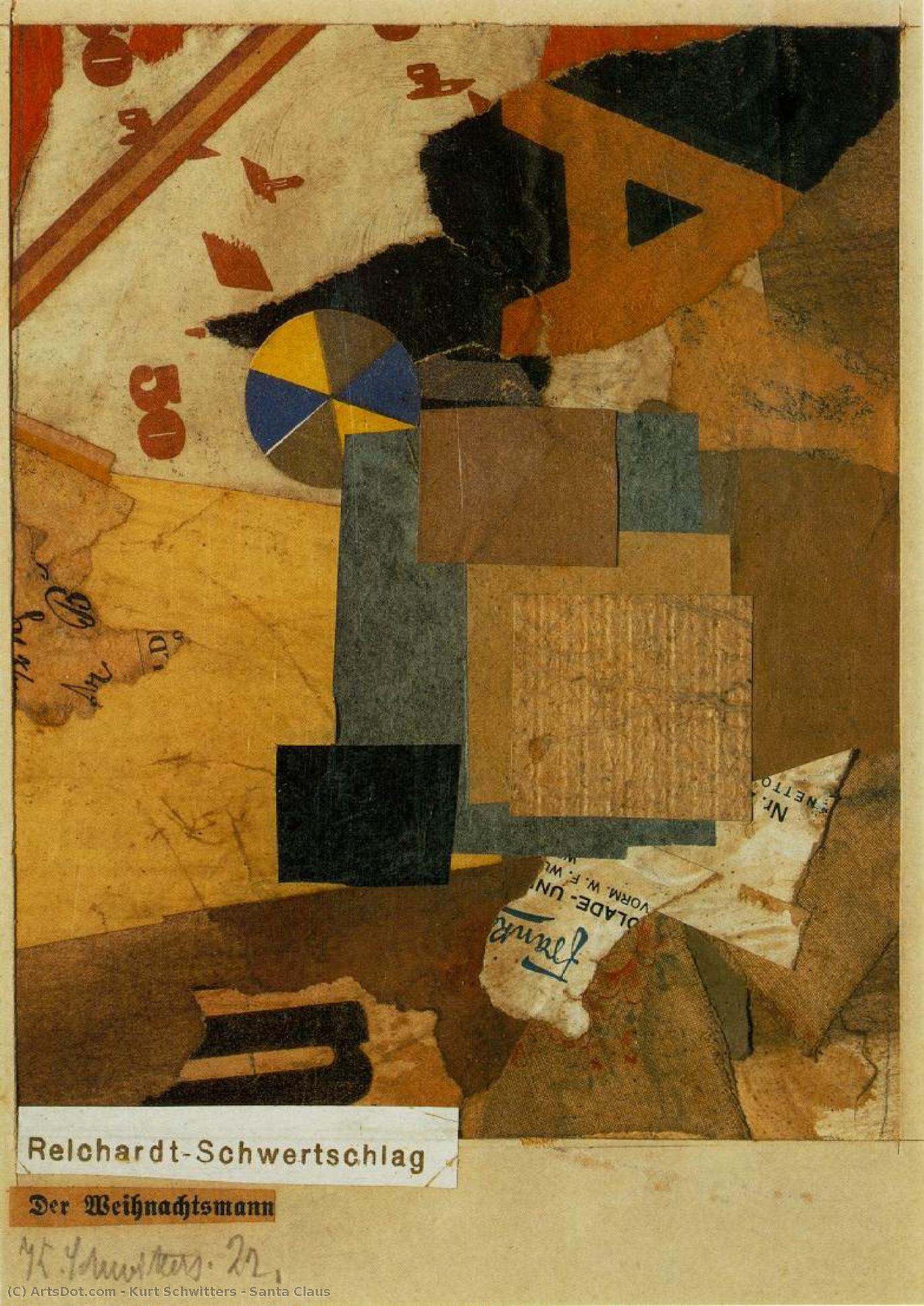
Santa Claus (1922) by Kurt Schwitters

Santa Claus

1922 · Collage · MOMA - Museum of Modern Art, New York City

The artwork Santa Claus consists of cut-and-pasted colored and printed papers applied to paper, finished with a cardstock border. The surface is an assembly of irregular shapes, including rectangles and triangles, that overlap in a non-linear arrangement. A palette of brown, yellow, and red dominates the visual field, punctuated by patches of blue and black. Within this arrangement, specific textual elements are visible, such as the number 30 and individual…

4
Hitler Gang (1944) by Kurt Schwitters

Hitler Gang

1944 · Collage

We are looking at Hitler Gang, a work created by the German artist Kurt Schwitters in 1944. This piece emerged during a period of profound upheaval, as the artist navigated the complexities of life in exile. It is a significant example of his ability to find meaning within the fragments of a fractured reality.

5
Merzbild Rossfett (1919) by Kurt Schwitters

Merzbild Rossfett

1919 · Mixed Media

Created in 1919, this assemblage emerges from the wreckage of a collapsing social order. It is a quintessential expression of the Merz aesthetic, a method of construction born from the necessity of rebuilding from debris. Rather than seeking harmony through traditional perspective, the work utilizes a flattened, two-dimensional space to arrange found objects and printed ephemera. The composition is a dense, chaotic accumulation of materials affixed to a wooden panel,…

6
Mz 231. Miss Blanche (1923) by Kurt Schwitters

Mz 231. Miss Blanche

1923 · Collage

The fragments of a lost world coalesce in Mz 231. Miss Blanche, a collage that breathes with the restless energy of 1923. Kurt Schwitters gathers the discarded remnants of daily life, pulling together scraps of paper and printed text to form something entirely new. This work emerges from a period of profound transformation, where the debris of a fractured society becomes the very substance of creation. The title itself, Mz…

7
N Watercolor 1. (The Heart Goes from Sugar to Coffee) (1919) by Kurt Schwitters

N Watercolor 1. (The Heart Goes from Sugar to Coffee)

1919 · Watercolor · MOMA - Museum of Modern Art, New York City

N Watercolor 1. (The Heart Goes from Sugar to Coffee) (N Aquarell 1. (Das Herz geht vom Zucker zum Kaffee)) was created by Kurt Schwitters in 1919. This work belongs to the Dada movement, an artistic response to the social and political fragmentation of the post-World War I era. The piece reflects the artist's development of the Merz aesthetic, which sought to reconstruct meaning from the discarded remnants of modern…

8
Radiating World (Merzbild 31B) (1920) by Kurt Schwitters

Radiating World (Merzbild 31B)

1920 · Collage · The Phillips Collection, Washington, D.C.

In this work, titled Radiating World (Merzbild 31B), we encounter a significant expression of the Dada movement. Created by Kurt Schwitters in 1920, the piece reflects a period of profound transformation in the artist's approach to form and material. It represents a moment when the traditional boundaries of painting began to dissolve into something entirely new.

9
Merz Picture 25A: The Star Picture (1920) by Kurt Schwitters

Merz Picture 25A: The Star Picture

1920 · Collage · Kunstsammlung Nordrhein-Westfalen, Duesseldorf

The eye meets a chaotic, rhythmic arrangement of shapes that seems to pulse with the restless energy of 1920. In this composition, the traditional boundaries of a painting dissolve, replaced by a dynamic interplay of angular and curvilinear forms. A large star occupies the center, acting as a focal point amidst a swirling sea of disparate elements. This is a world built from the debris of a shattered era, where…

10
Construction for Noble Ladies (1919) by Kurt Schwitters

Construction for Noble Ladies

1919 · Mixed Media · Los Angeles County Museum of Art, Los Angeles

Construction for Noble Ladies is an assemblage created by Kurt Schwitters in 1919. This work emerged from the restless spirit of the Dada art movement, a period defined by the fragmentation of old forms. It exists as a physical gathering of disparate parts, a quiet rebellion against the traditional boundaries of the canvas.

The Kurt Schwitters selection continues, 11 to 37

Kurt Schwitters's famous paintings, period by period

The subjects that held Kurt Schwitters's eye

The four subjects that come back most often in these originals, each with its finest example.

The museums that keep Kurt Schwitters's originals

The 8 museums that hold the most of the paintings on this page.

Museum City Works by Kurt Schwitters Paintings from this list
MOMA - Museum of Modern Art, New York CityMOMA - Museum of Modern Art New York City 5 Merz Picture 32A (The Cherry Picture), (Elikan), Santa Claus
Kunstsammlung Nordrhein-Westfalen, DuesseldorfKunstsammlung Nordrhein-Westfalen Duesseldorf 2 Merz Picture 25A: The Star Picture, Forms in Space
Thyssen-Bornemisza Museum, MadridThyssen-Bornemisza Museum Madrid 2 Merzbild 1A (The Psychiatrist), Merz 1925, 1. Relief in the Blue Square
The Phillips Collection, Washington, D.C.The Phillips Collection Washington, D.C. 1 Radiating World (Merzbild 31B)
Los Angeles County Museum of Art, Los AngelesLos Angeles County Museum of Art Los Angeles 1 Construction for Noble Ladies
Ben Uri Gallery and Museum, LondonBen Uri Gallery and Museum London 1 Fur Frau Fraenkel
Staatliche Kunsthalle Karlsruhe, CarlsruheStaatliche Kunsthalle Karlsruhe Carlsruhe 1 Merzbild 21 b, The Hair-Navel Picture
Sprengel Museum Hannover, HanoverSprengel Museum Hannover Hanover 1 Merzpicture Thirty-One

Kurt Schwitters decade by decade: the original that defines each

Works per decade

Pick a decade to see the original that defines it.

Collectors' questions about Kurt Schwitters's paintings

Which work is Kurt Schwitters most famous for?Reveal the answer

Merz Picture 32A (The Cherry Picture) (1921), MOMA - Museum of Modern Art, New York City. (Elikan) (1925) and Santa Claus (1922) come next.

What age was Kurt Schwitters when Merz Picture 32A (The Cherry Picture) was made?Reveal the answer

34 years old: Merz Picture 32A (The Cherry Picture) dates from 1921, and Kurt Schwitters was born in 1887.

What are the ten most famous Kurt Schwitters paintings?Reveal the answer

Merz Picture 32A (The Cherry Picture), (Elikan), Santa Claus, Hitler Gang, Merzbild Rossfett, Mz 231. Miss Blanche, N Watercolor 1. (The Heart Goes from Sugar to Coffee), Radiating World (Merzbild 31B), Merz Picture 25A: The Star Picture and Construction for Noble Ladies. The ranking above gives each one's year and museum.

How many paintings did Kurt Schwitters leave?Reveal the answer

Our catalog holds 38 works by Kurt Schwitters, dated from 1919 to 1947.

In which museums do Kurt Schwitters's masterpieces hang?Reveal the answer

Mostly in MOMA - Museum of Modern Art (New York City), Kunstsammlung Nordrhein-Westfalen (Duesseldorf) and Thyssen-Bornemisza Museum (Madrid). The museum table above lists them all.

In which years did Kurt Schwitters paint the most famous works?Reveal the answer

In 1920s: 15 of the 37 works on this page were made then, Merz Picture 32A (The Cherry Picture) among them.

What are the first and the last famous originals of Kurt Schwitters?Reveal the answer

On this page, the earliest is Merzbild Rossfett (1919) and the latest Milk Flower (1947).

Which subjects did Kurt Schwitters choose most often?Reveal the answer

Collage (6), Found objects (4) and Assemblage (4), across the 37 works on this page.

Which technique did Kurt Schwitters use most?Reveal the answer

Collage, for 9 of the 37 works on this page.

To which art movement does Kurt Schwitters belong?Reveal the answer

Dadaism, judging by the originals on this page.

Which Kurt Schwitters works hang at the MOMA - Museum of Modern Art?Reveal the answer

Merz Picture 32A (The Cherry Picture), (Elikan) and Santa Claus: the MOMA - Museum of Modern Art, New York City holds 5 of the works on this page.

Kurt Schwitters: life and work

Kurt Schwitters: A Life in Merz

Early Life and Education

  • Born: June 20, 1887, in Hanover, Germany.
  • Schwitters was the only child of Eduard and Henriette Schwitters. His father co-owned a ladies' clothing shop.
  • The family’s financial situation improved after selling the business in 1898, allowing them to live off rental income from properties they acquired.
  • He studied art at the Dresden Academy from 1909-1915 alongside artists like Otto Dix and George Grosz, though he seemingly remained unaware of their work at the time.
  • Schwitters suffered his first epileptic seizure in 1901, which later exempted him from military service for a period during World War I.

Artistic Development and the Birth of Merz

  • Initially, Schwitters worked in a post-impressionist style. His early work reflected this influence.
  • The devastation of World War I profoundly impacted his artistic direction. He felt traditional academic training was irrelevant in the face of societal collapse.
  • “In the war, things were in terrible turmoil…everything had broken down and new things had to be made out of the fragments; and this is Merz.”
  • Around 1918, he began creating abstract collages using found objects – scraps of paper, tickets, and other discarded materials.
  • The term “Merz” itself came from a fragment of text (“Commerz und Privatbank”) cut from an advertisement and incorporated into one of his early works, *Das Merzbild* (1918-19).

Key Works and Artistic Styles

  • Merz Pictures: These collages are arguably Schwitters’ most famous contribution. They represent a radical departure from traditional art, embracing chance and the aesthetics of everyday life.
  • Merzbau: A monumental architectural construction within his home in Hanover, continuously evolving over decades. It was a three-dimensional embodiment of Merz principles – a labyrinthine space filled with niches, grottoes, and found objects.
  • Assemblage & Installation Art: Schwitters pioneered these forms, blurring the boundaries between painting, sculpture, and architecture.
  • He also worked in poetry, sound, graphic design, and typography, exploring a wide range of artistic media.

Influences and Connections

  • Early influences included post-impressionism, but he quickly moved beyond these conventions.
  • He came into contact with members of the Berlin avant-garde – Raoul Hausmann, Hannah Höch, and Hans Arp – through Herwarth Walden’s *Der Sturm* gallery.
  • While associated with Dadaism, Schwitters maintained a distinct artistic identity. He was initially rejected by some Dadaists for his ties to expressionism.

Later Life and Legacy

  • Facing increasing persecution under the Nazi regime due to his “degenerate art,” Schwitters fled Germany in 1937.
  • He spent time in Norway and England, continuing to create Merz works despite challenging circumstances. He was briefly interned as an enemy alien during World War II.
  • Died: January 8, 1948, in Ambleside, England.
  • Kurt Schwitters’ work profoundly influenced subsequent generations of artists, particularly those involved in Pop Art, Minimalism, and Conceptual Art.
  • His innovative use of found objects and his exploration of the relationship between art and everyday life continue to resonate with contemporary audiences.

Historical Significance

  • Schwitters’ Merz aesthetic challenged traditional notions of artistic beauty and authorship.
  • He expanded the definition of art by incorporating non-art materials and blurring the lines between different disciplines.
  • His work remains a powerful testament to the creative potential of fragmentation, reconstruction, and the embrace of chance.