Portrait of John Martin

The 87 Most Famous John Martin Paintings, a Gallery Selection

Updated October 2026 · ranked by our popularity score (searches, visits and orders for each work) · 88 works by John Martin in our catalogue

In short

Of all the originals John Martin left, the most famous is The Great Day of His Wrath (1851), in the collection of the Tate Britain, London. Close behind it come The Destruction of Sodom And Gomorrah (1852) and The Evening of the Deluge (1828). Our catalog holds 88 works by John Martin; the gallery has kept the 87 the world admires most, each shown with its date, its museum and its story.

1789 – 1854, Haydon Bridge Romanticism Most works: Yale Center for British Art

John Martin's top 10 paintings: the gallery's choice

1
The Great Day of His Wrath (1851) by John Martin

The Great Day of His Wrath

1851 · Oil On Canvas · Tate Britain, London

In the heart of the nineteenth century, few images could stir the Victorian soul with as much terror and awe as John Martin’s The Great Day of His Wrath. This monumental oil on canvas is not merely a painting; it is a visceral experience of the sublime. As the eye wanders across the vast, turbulent landscape, one is immediately struck by the sheer scale of destruction. The scene captures the…

2
The Destruction of Sodom And Gomorrah (1852) by John Martin

The Destruction of Sodom And Gomorrah

1852 · Oil On Canvas · Laing Art Gallery, Newcastle upon Tyne

The heavens do not merely darken; they fracture. A massive, swirling vortex of fiery clouds dominates the upper reaches of the canvas, a celestial furnace that seems to swallow the very air. Light does not fall from above in a gentle glow but erupts from the center of a cosmic explosion. It is a violent, directional radiance that carves the landscape into jagged silhouettes of deep black and shadowy blue.…

3
The Evening of the Deluge (1828) by John Martin

The Evening of the Deluge

1828 · Engraving · Victoria and Albert Museum, London

To stand before John Martin's monumental vision, The Evening of the Deluge, is not merely to observe a painting; it is to be submerged within an epochal moment of divine wrath and human fragility. Created in 1828, this work transcends simple depiction, becoming instead a profound meditation on humanity’s place against the overwhelming power of nature. Martin, a master chronicler of the sublime, utilized his immense scale—a staggering 597 x…

4
Eve (1827) by John Martin

Eve

1827 · Engraving · Te Papa, Wellington

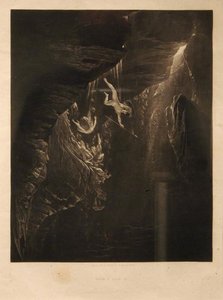
In the engraving Eve, John Martin captures a moment of profound spiritual weight. Created about 1827, the print presents a scene of divine confrontation. Two angelic figures dominate the center of the frame. One angel clutches a sword with an expression of palpable distress, while the other holds the weapon aloft, a symbol of celestial authority. Below them, the human condition is laid bare through two men: one attempts to…

5
Great Day of His Wrath (1851) by John Martin

Great Day of His Wrath

1851 · Oil On Canvas · Tate Gallery, London

The canvas bears the title Great Day of His Wrath. It is a work by the English romantic painter John Martin. Created in 1851, the painting captures a moment of profound upheaval. It exists as a single movement within a larger triptych of judgement pictures. This series draws its heavy inspiration from the Book of Revelation.

6
Destruction of Tyre (1840) by John Martin

Destruction of Tyre

1840 · Oil On Canvas · Toledo Museum of Art, Toledo

John Martin's "Destruction of Tyre," completed in 1840, is not merely a depiction of a historical event; it is a visceral embodiment of Romanticism’s fascination with the sublime – that overwhelming feeling of awe and terror inspired by nature’s power. Measuring an imposing 95 x 838 cm, this oil on canvas transports the viewer directly into the heart of apocalyptic chaos. The scene, based on the biblical account in 2…

7
Satan in Council by John Martin

Satan in Council

Engraving

The scene unfolds through the vision of Satan in Council, a dramatic work by the English romantic painter John Martin. This composition captures a moment of intense celestial and infernal tension, pulling the viewer into a realm of shadow and light. The work is also recognized by the title Satan presiding at the Infernal Council, a name that speaks to the heavy authority commanding the assembly. It exists as a…

8
Pandemonium (1841) by John Martin

Pandemonium

1841 · Oil On Canvas

The Sublime Terror of the Infernal Capital In the annals of Romanticism, few images command the eye with such overwhelming dread and grandeur as John Martin’s Pandemonium. Painted in 1841, this oil on canvas is not merely a depiction of a scene; it is an immersive descent into the heart of cosmic chaos. The viewer is immediately confronted by the sheer, terrifying scale of Hell’s capital, where the architecture of…

9
Fall of Babylon by John Martin

Fall of Babylon

The heavens fracture as the destruction of Babylon unfolds in this dramatic vision by John Martin. The scene captures a terrifying Old Testament biblical narrative, where the once-mighty city faces its ultimate end. Chaos reigns as the landscape is swallowed by upheaval, reflecting a moment of divine judgment that feels immediate and overwhelming. The scale of the catastrophe looms large, turning the sprawling cityscape into a site of profound human…

10
Belshazzar's Feast by John Martin

Belshazzar's Feast

Oil On Canvas · Carnavalet Museum, Paris

The scene unfolds within a vast, architectural interior where a long dining table occupies the central space. Around this table, fourteen figures are positioned in various states of repose and movement. Some individuals sit in chairs, while others kneel or stand near the edges of the gathering. The table is laden with food and drink, set against a backdrop of grand, structural elements. Above the assembly, a clock hangs upon…

The John Martin selection continues, 11 to 87

11The Plains of Heaven by John MartinThe Plains of Heaven 12The Great Day of His Wrath by John MartinThe Great Day of His Wrath 13Satan Arousing the Fallen Angels, Book 1, line 314, from John Milton, Paradise Lost (1824) by John MartinSatan Arousing the Fallen Angels, Book 1, line 314, from John Milton, Paradise Lost1824 14The Last Man (1849) by John MartinThe Last Man1849 · Walker Art Gallery 15Landscape with a Castle (1815) by John MartinLandscape with a Castle1815 · Yale Center for British Art 16Plate from by John MartinPlate fromTate Britain 17Ancestor Worship (1964) by John MartinAncestor Worship1964 · National Gallery of Canada 18Moonlight - Chepstow Castle (1815) by John MartinMoonlight - Chepstow Castle1815 · Art Gallery of South Australia 19Sadak in Search of the Waters of Oblivion by John MartinSadak in Search of the Waters of OblivionMuseum of Fine Arts 20Kensington Garden (1815) by John MartinKensington Garden1815 · Yale Center for British Art 21Kensington Garden (1815) by John MartinKensington Garden1815 · Yale Center for British Art 22Kensington Gardens (1815) by John MartinKensington Gardens1815 · Yale Center for British Art 23Landscape, Possibly the Isle of Wight or Richmond Hill (1815) by John MartinLandscape, Possibly the Isle of Wight or Richmond Hill1815 · Yale Center for British Art 24Hyde Park (1815) by John MartinHyde Park1815 · Yale Center for British Art 25The Court of God: Paradise Lost (Book 3, Line 365) (1824) by John MartinThe Court of God: Paradise Lost (Book 3, Line 365)1824 · National Gallery of Canada 26Diogenes Throwing Away His Cup (1833) by John MartinDiogenes Throwing Away His Cup1833 27Alpheus and Arethusa (1832) by John MartinAlpheus and Arethusa1832 28The Deluge (1834) by John MartinThe Deluge1834 29Joshua Commanding the Sun to Stand Still (1840) by John MartinJoshua Commanding the Sun to Stand Still1840 · Yale Center for British Art 30The Assuaging of the Waters (1840) by John MartinThe Assuaging of the Waters1840 · Fine Arts Museums of San Francisco 31Twilight in the woodlands (1850) by John MartinTwilight in the woodlands1850 · Fitzwilliam Museum 32Landscape: View in Richmond Park (1850) by John MartinLandscape: View in Richmond Park1850 · Fitzwilliam Museum 33The Last Judgement (study) (1851) by John MartinThe Last Judgement (study)1851 · Yale Center for British Art 34Christ Stilleth the Tempest (1852) by John MartinChrist Stilleth the Tempest1852 · Йоркський художній музей 35F shaw brothers tannery maine by John MartinF shaw brothers tannery maineBavarian State Painting Collections 36Paradise Lost. Adam and Eve Driven out of Paradise by John MartinParadise Lost. Adam and Eve Driven out of Paradise 37Seventh Plague by John MartinSeventh Plague 38Gleaners in the Wheat Field by John MartinGleaners in the Wheat Field 39The Last Judgement by John MartinThe Last JudgementTate Britain 40The Isle of Man by John MartinThe Isle of Man 41The Destruction of Sodom and Gomorrah by John MartinThe Destruction of Sodom and Gomorrah 42The Valley of the Tyne, My Native Country, near Henshaw by John MartinThe Valley of the Tyne, My Native Country, near Henshaw 43Destruction of Pharaoh's Host by John MartinDestruction of Pharaoh's Host 44The Covenant by John MartinThe Covenant 45Figures Seated by a Lake in a Wooded Landscape by John MartinFigures Seated by a Lake in a Wooded Landscape 46Psalm CXXVII (by the Waters of Babylon) by John MartinPsalm CXXVII (by the Waters of Babylon) 47Moses Breaketh the Tables by John MartinMoses Breaketh the Tables 48A Man Playing a Harp with other Figures beside a Lake by John MartinA Man Playing a Harp with other Figures beside a Lake 49Ruins of an Ancient City by John MartinRuins of an Ancient CityCleveland Museum of Art 50Joshua Commanding the Sun to Stand Still upon Gibeon by John MartinJoshua Commanding the Sun to Stand Still upon Gibeon 51Landscape with a Ruined Castle by John MartinLandscape with a Ruined Castle 52Edwin and Angelina (also known as The Hermit) by John MartinEdwin and Angelina (also known as The Hermit) 53The Plains of Heaven (1851) by John MartinThe Plains of Heaven1851 · Tate Britain 54Repentance of Nineveh (1840) by John MartinRepentance of Nineveh1840 · Yale University Art Gallery 55The country of the Iguanodon (1837) by John MartinThe country of the Iguanodon1837 · Te Papa 56Plate from by John MartinPlate fromTate Britain 57Plate from by John MartinPlate fromTate Britain 58Fall of the Rebel Angels by John MartinFall of the Rebel AngelsHarvard Art Museums 59Paradise Lost. The Creation of Light by John MartinParadise Lost. The Creation of Light 60Flood at night by John MartinFlood at night 61David Spareth Saul at Hachilah by John MartinDavid Spareth Saul at Hachilah 62Fall of the Walls of Jericho by John MartinFall of the Walls of Jericho 63Fantastic Oriental Landscape by John MartinFantastic Oriental Landscape 64Fall of the Rebel Angels by John MartinFall of the Rebel Angels 65Christ's glorious coming by John MartinChrist's glorious coming 66The Assuaging of the Waters by John MartinThe Assuaging of the Waters 67Creation of Light by John MartinCreation of Light 68View on the River Wye, Looking towards Chepstow by John MartinView on the River Wye, Looking towards Chepstow 69Joshua commanding the Sun to stand still by John MartinJoshua commanding the Sun to stand still 70Eve's Dream - Satan aroused by John MartinEve's Dream - Satan aroused 71The Fallen Angels Entering Pandemonium, from Paradise Lost by John MartinThe Fallen Angels Entering Pandemonium, from Paradise LostTate Britain 72View of Dolbadern Castle, North Wales by John MartinView of Dolbadern Castle, North Wales 73A Country Graveyard, Possibly Bunhill Fields, Finsbury, A Wooded Landscape Beyond by John MartinA Country Graveyard, Possibly Bunhill Fields, Finsbury, A Wooded Landscape Beyond 74Belshazzar (1820) by John MartinBelshazzar1820 · Yale Center for British Art 75Manfred and the Alpine Witch (1837) by John MartinManfred and the Alpine Witch1837 · Whitworth Art Gallery 76Pandemonium - John Martin (2026) by John MartinPandemonium - John Martin2026 77Sadak in Search of the Waters of Oblivion (1812) by John MartinSadak in Search of the Waters of Oblivion1812 · Saint Louis Art Museum 78Seventh Plague of Egypt by John MartinSeventh Plague of EgyptMuseum of Fine Arts 79The Destruction of Pompeii and Herculaneum (1822) by John MartinThe Destruction of Pompeii and Herculaneum1822 80Joshua Commanding the Sun to Stand Still upon Gibeon (1816) by John MartinJoshua Commanding the Sun to Stand Still upon Gibeon1816 · National Gallery of Art 81The Eve of the Deluge (1840) by John MartinThe Eve of the Deluge1840 · Royal Collection 82Manfred on the Jungfrau (1837) by John MartinManfred on the Jungfrau1837 · Birmingham Museum and Art Gallery 83The Celestial City and the River of Bliss (1841) by John MartinThe Celestial City and the River of Bliss1841 84Macbeth by John MartinMacbeth 85The Coronation of Queen Victoria by John MartinThe Coronation of Queen VictoriaTate Britain 86The Bard (1817) by John MartinThe Bard1817 · Yale Center for British Art 87The Deluge (1834) by John MartinThe Deluge1834 · Yale Center for British Art

John Martin's famous paintings, period by period

The subjects that held John Martin's eye

The four subjects that come back most often in these originals, each with its finest example.

The museums that keep John Martin's originals

The 8 museums that hold the most of the paintings on this page.

Museum City Works by John Martin Paintings from this list
Yale Center for British Art, New HavenYale Center for British Art New Haven 11 Landscape with a Castle, Kensington Garden, Kensington Garden
Tate Britain, LondonTate Britain London 8 The Great Day of His Wrath, Plate from, The Last Judgement
Te Papa, WellingtonTe Papa Wellington 2 Eve, The country of the Iguanodon
National Gallery of Canada, OttawaNational Gallery of Canada Ottawa 2 Ancestor Worship, The Court of God: Paradise Lost (Book 3, Line 365)
Museum of Fine Arts, BostonMuseum of Fine Arts Boston 2 Sadak in Search of the Waters of Oblivion, Seventh Plague of Egypt
Fitzwilliam MuseumFitzwilliam Museum 2 Twilight in the woodlands, Landscape: View in Richmond Park
Laing Art Gallery, Newcastle upon TyneLaing Art Gallery Newcastle upon Tyne 1 The Destruction of Sodom And Gomorrah
Victoria and Albert Museum, LondonVictoria and Albert Museum London 1 The Evening of the Deluge

John Martin decade by decade: the original that defines each

Works per decade

Pick a decade to see the original that defines it.

Collectors' questions about John Martin's paintings

Which work is John Martin most famous for?Reveal the answer

The Great Day of His Wrath (1851), Tate Britain, London. The Destruction of Sodom And Gomorrah (1852) and The Evening of the Deluge (1828) come next.

What age was John Martin when The Great Day of His Wrath was made?Reveal the answer

62 years old: The Great Day of His Wrath dates from 1851, and John Martin was born in 1789.

What are the ten most famous John Martin paintings?Reveal the answer

The Great Day of His Wrath, The Destruction of Sodom And Gomorrah, The Evening of the Deluge, Eve, Great Day of His Wrath, Destruction of Tyre, Satan in Council, Pandemonium, Fall of Babylon and Belshazzar's Feast. The ranking above gives each one's year and museum.

How many paintings did John Martin leave?Reveal the answer

Our catalog holds 88 works by John Martin, dated from 1812 to 1852.

In which museums do John Martin's masterpieces hang?Reveal the answer

Mostly in Yale Center for British Art (New Haven), Tate Britain (London) and Te Papa (Wellington). The museum table above lists them all.

In which years did John Martin paint the most famous works?Reveal the answer

In 1810s: 10 of the 87 works on this page were made then, Landscape with a Castle among them.

What are the first and the last famous originals of John Martin?Reveal the answer

On this page, the earliest is Sadak in Search of the Waters of Oblivion (1812) and the latest The Destruction of Sodom And Gomorrah (1852).

Which subjects did John Martin choose most often?Reveal the answer

People (13), Landscape (12) and Mountains (8), across the 87 works on this page.

Which technique did John Martin use most?Reveal the answer

Oil On Canvas, for 16 of the 87 works on this page.

To which art movement does John Martin belong?Reveal the answer

Romanticism, judging by the originals on this page.

Which John Martin works hang at the Yale Center for British Art?Reveal the answer

Landscape with a Castle, Kensington Garden and Kensington Garden: the Yale Center for British Art, New Haven holds 11 of the works on this page.

John Martin: life and work

John Martin: A Master of Melodramatic Romanticism

John Martin (1789-1854) was a celebrated English romantic painter, engraver, and illustrator whose dramatic compositions captivated the Victorian public. Born in Haydon Bridge, Northumberland, on July 19, 1789, he rose from humble beginnings to become one of the most popular artists of his day, renowned for his vast landscapes populated by minute figures and depicting biblical scenes and fantastical narratives with a powerful sense of scale and emotion.

Early Life and Artistic Development

Martin's early life was marked by practical pursuits. He was apprenticed to a coachbuilder in Newcastle upon Tyne, where he learned heraldic painting – a skill that would later inform his meticulous attention to detail. In 1806, he moved to London, marrying at the age of nineteen and supporting himself through drawing lessons and commissions for watercolors and decorative work on china and glass. This period honed his technical skills while allowing him to explore various artistic mediums. His early works show a developing interest in dramatic lighting and composition, foreshadowing his later signature style.

Artistic Style and Notable Works

Martin's distinctive style is characterized by its grand scale, melodramatic intensity, and meticulous detail. He frequently depicted biblical subjects, such as The Destruction of Sodom and Gomorrah and Belshazzar’s Feast, with a theatrical flair that resonated deeply with audiences. His landscapes, like Harnham Church, near Salisbury, demonstrated his ability to capture serene countryside scenes while maintaining a sense of grandeur. Key works showcasing his artistic prowess include:

  • The Destruction of Sodom and Gomorrah: A monumental depiction of divine retribution, demonstrating Martin’s skill in portraying chaos and destruction on a vast scale.
  • Belshazzar's Feast: Illustrating the biblical story with dramatic lighting and intricate detail, highlighting the downfall of Babylon.
  • Manfred and the Alpine Witch: Inspired by Byron’s poem, this work exemplifies Martin’s ability to translate literary narratives into visually stunning compositions.
  • Satan Arousing the Fallen Angels (from Paradise Lost): A powerful interpretation of Milton's epic poem, showcasing his skill in depicting dramatic scenes from literature.
  • Pandemonium: A fantastical depiction of the capital of Hell, demonstrating Martin’s imaginative scope and mastery of perspective.
  • The Country of the Iguanodon: An early example of paleoart, reflecting a burgeoning interest in scientific discovery during his time.

Recognition and Legacy

John Martin achieved considerable recognition during his lifetime. He was referred to as "the most popular painter of his day" by Walter Sickert in 1821 and received a gold medal from the Russian Tsar Nicholas I. He was awarded the Order of Leopold from Prince Leopold of Saxe-Coburg and Gotha, becoming the official historical painter to Prince Leopold. His works were exhibited at both the National Gallery and the Tate Gallery, solidifying his place within the British art establishment.

Despite a period of relative obscurity after his death on February 17, 1854, Martin’s work has experienced a resurgence in appreciation. Today, his paintings are recognized for their unique blend of Romantic drama, meticulous detail, and imaginative scope. His influence can be seen in the works of later artists, including James Francis Danby, who was inspired by Martin's dramatic landscapes. John Martin remains an important figure in British art history, celebrated for his ability to transport viewers to epic worlds filled with both awe-inspiring beauty and terrifying power.