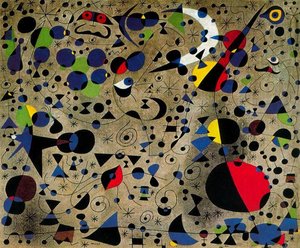
Portrait of Joan Miró

The 100 Most Famous Joan Miró Paintings, a Gallery Selection

Updated October 2026 · ranked by our popularity score (searches, visits and orders for each work) · 428 works by Joan Miró in our catalogue

In short

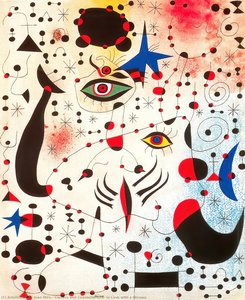
Of all the originals Joan Miró left, the most famous is The Farm (1922). Close behind it come Harlequin's Carnival (1925) and Ciphers and Constellations, in Love with a Woman (1941). Our catalog holds 428 works by Joan Miró; the gallery has kept the 100 the world admires most, each shown with its date, its museum and its story.

1893 – 1983, Barcelona Surrealism Most works: MOMA - Museum of Modern Art

Joan Miró's top 10 paintings: the gallery's choice

1
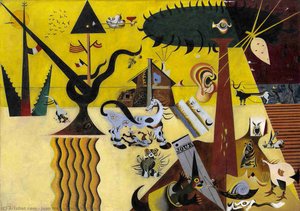
The Farm (1922) by Joan Miró

The Farm

1922 · Oil On Canvas

Painted in 1922, this captivating artwork by Joan Miró transcends a simple depiction of rural life, offering instead a richly symbolic and emotionally resonant vision of the Catalan countryside. Measuring 132 x 147 cm, it's a substantial work that commands attention, inviting viewers into a dreamlike world constructed from memory and imagination.

2
Harlequin's Carnival (1925) by Joan Miró

Harlequin's Carnival

1925 · Oil On Canvas · Buffalo AKG Art Museum, Buffalo

Joan Miró's "Harlequin's Carnival" (1925) is a vibrant and intricate composition that captures the essence of surrealism. This captivating artwork invites viewers into a whimsical world where fantasy and reality intertwine, making it a perfect addition to any art collection or sophisticated interior.

4
Joan Miró- Catalan Landscape (The Hunter) (1924) by Joan Miró

Joan Miró- Catalan Landscape (The Hunter)

1924 · Oil On Canvas · MOMA - Museum of Modern Art, New York City

Painted in 1924, this captivating artwork transports viewers to a dreamlike interpretation of the Catalan countryside, embodying Joan Miró's unique contribution to Surrealism. More than just a landscape, it is an emotional response to his homeland – a vibrant tapestry woven with symbolic forms and playful abstraction.

5
Still Life with Old Shoe (1937) by Joan Miró

Still Life with Old Shoe

1937 · Oil On Canvas · MOMA - Museum of Modern Art, New York City

Painted in 1937, amidst the escalating turmoil of the Spanish Civil War, this captivating still life by Joan Miró transcends a simple depiction of everyday objects. Measuring an impressive 81 x 117 cm, it's a powerful statement rendered with the artist’s signature blend of surrealism and expressive color, offering a glimpse into a world fractured by anxiety and uncertainty.

6
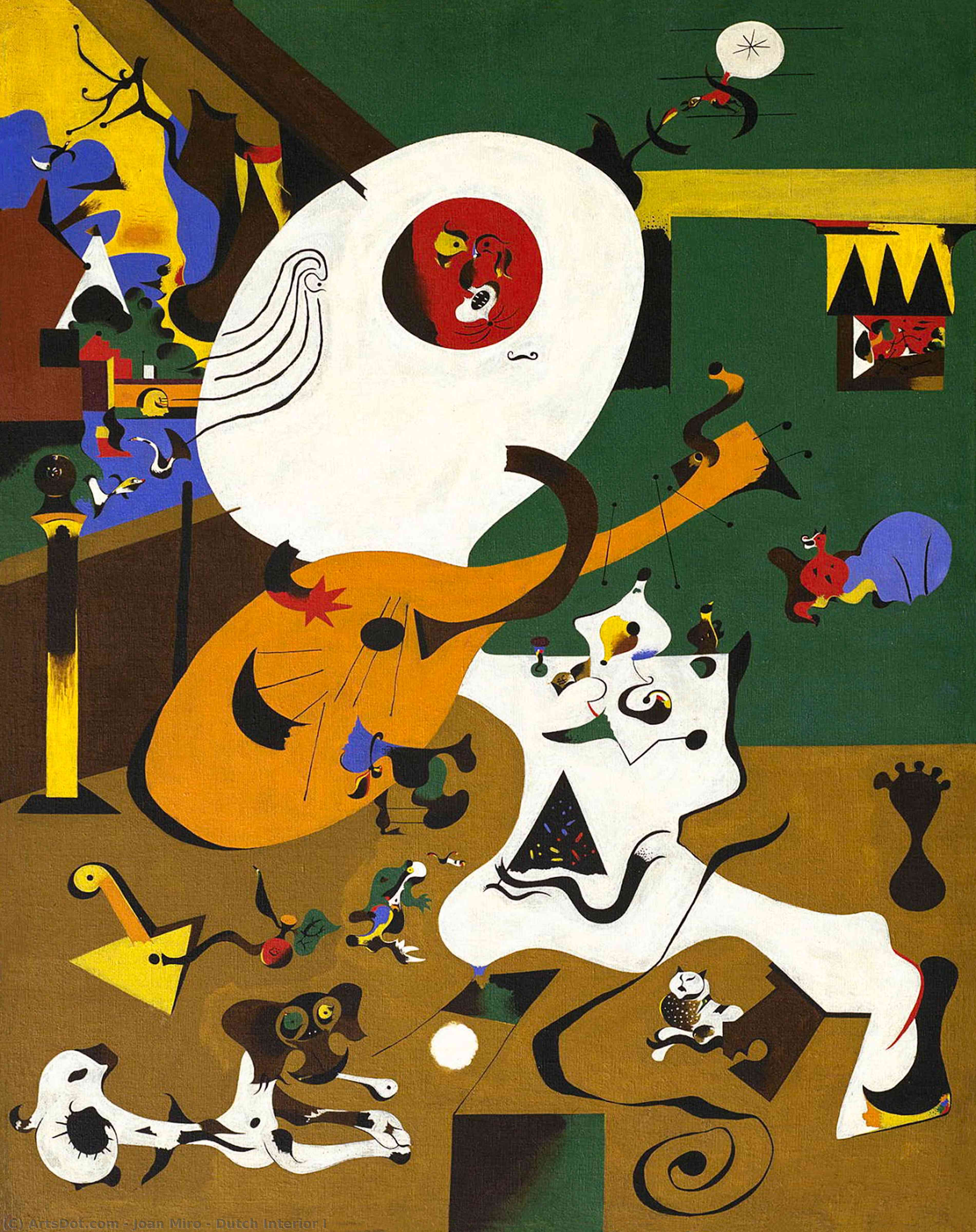
Dutch Interior I (1928) by Joan Miró

Dutch Interior I

1928 · Oil On Canvas · MOMA - Museum of Modern Art, New York City

A Vibrant Exploration of Abstract Surrealism Joan Miró's "Dutch Interior I" is a captivating masterpiece that blends abstract expressionism and surrealism, creating a dynamic and dreamlike atmosphere. Painted in 1928, this artwork exemplifies Miró's unique ability to merge bold colors, intricate shapes, and imaginative symbolism into a cohesive and emotionally resonant composition. Composition and Style The artwork is a vibrant and complex composition that exudes movement and energy. At its…

7
Siesta (1925) by Joan Miró

Siesta

1925 · Oil On Canvas

"Siesta," created in 1925 by the visionary Spanish artist Joan Miró, is a captivating example of abstract surrealism that invites viewers into a world of ethereal beauty and symbolic intrigue. This masterpiece exemplifies Miró's unique ability to blend organic and geometric forms, creating a harmonious yet dynamic composition that continues to inspire art lovers, collectors, and interior designers alike.

8
Blue II (1961) by Joan Miró

Blue II

1961 · Acrylic On Canvas

A Masterpiece of Abstract Surrealism Joan Miró's "Blue II" is a captivating example of abstract surrealism, created in 1961 during the artist's mature period. This large-scale painting (270 x 355 cm) exemplifies Miró's unique ability to blend simplicity with profound symbolism, making it a sought-after piece for art lovers and collectors alike. Composition and Color Palette The artwork features a striking minimalist composition dominated by a vast expanse of vivid…

9
Painting (1933) by Joan Miró

Painting

1933 · Oil On Canvas · Fundació Joan Miró, Barcelona

A Vibrant Dance of Color and Form Immerse yourself in a world of boundless creativity with this captivating abstract masterpiece from 1933. A symphony of bold colors and fluid lines, this artwork invites you to explore the depths of your imagination and experience the raw energy of abstract expressionism. Abstract Expressionism at Its Finest This dynamic composition is a testament to the power of abstract expressionism, a movement that emerged…

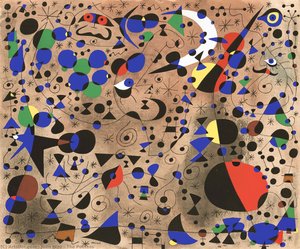
10
Seated Woman II (1938) by Joan Miró

Seated Woman II

1938 · Oil On Canvas · The Solomon R. Guggenheim Foundation, Venice

A Masterpiece of Surrealist Expression Joan Miró's "Seated Woman II" (1938) is a captivating example of Surrealist art that transcends traditional boundaries. This oil on canvas masterpiece, measuring 162 x 130 cm, blends abstract forms with vibrant colors to create a dynamic and emotionally charged composition. Subject and Composition The central figure in "Seated Woman II" is a stylized representation of a seated woman. Miró's abstract approach transforms the human…

The Joan Miró selection continues, 11 to 100

11Self-Portrait (1917) by Joan MiróSelf-Portrait1917 12The Birth of the World (1925) by Joan MiróThe Birth of the World1925 · MOMA - Museum of Modern Art 13The Family (1924) by Joan MiróThe Family1924 · MOMA - Museum of Modern Art 14The Tilled Field (1924) by Joan MiróThe Tilled Field1924 · Solomon R. Guggenheim Museum 15Dog Barking-at the Moon (1926) by Joan MiróDog Barking-at the Moon1926 16The Poetess (1940) by Joan MiróThe Poetess1940 17The Smile of the Flamboyant Wings (1953) by Joan MiróThe Smile of the Flamboyant Wings1953 18Dancer (1925) by Joan MiróDancer1925 19Prades, the Village (1917) by Joan MiróPrades, the Village1917 20Woman and Bird in the Moonlight (1949) by Joan MiróWoman and Bird in the Moonlight1949 21Figures and Dog in Front of the Sun (1949) by Joan MiróFigures and Dog in Front of the Sun1949 22The Flight of the dragonfly in Front of the Sun (1968) by Joan MiróThe Flight of the dragonfly in Front of the Sun1968 23Para David Fernández Miró 1 by Joan MiróPara David Fernández Miró 1 24The Farm by Joan MiróThe Farm 25Mujer y perro cara a la luna by Joan MiróMujer y perro cara a la luna 26Self-Portrait I by Joan MiróSelf-Portrait I 27Blue III (1961) by Joan MiróBlue III1961 28Azul III by Joan MiróAzul III 29RED DISC IN PURSUIT OF A LARK (1953) by Joan MiróRED DISC IN PURSUIT OF A LARK1953 30Photo: This Is the Color of My Dreams (1925) by Joan MiróPhoto: This Is the Color of My Dreams1925 · Metropolitan Museum of Art 31May 1968 (1973) by Joan MiróMay 19681973 · Fundació Joan Miró 32BLUE I (1961) by Joan MiróBLUE I1961 · Centre Pompidou 33La poetisa by Joan MiróLa poetisa 34Constellation: Toward the Rainbow (1941) by Joan MiróConstellation: Toward the Rainbow1941 35Untitled (1931) by Joan MiróUntitled1931 36Woman Encircled by the Flight of a Bird (1941) by Joan MiróWoman Encircled by the Flight of a Bird1941 37The Birth of Day (1968) by Joan MiróThe Birth of Day1968 38Para David Fernández Miró by Joan MiróPara David Fernández Miró 39Personajes y perro ante el sol by Joan MiróPersonajes y perro ante el sol 40Carota (1978) by Joan MiróCarota1978 41Pájaro, insecto, constelación by Joan MiróPájaro, insecto, constelación 42Bottle of Vine (1924) by Joan MiróBottle of Vine1924 43The Gold of the Azure (1967) by Joan MiróThe Gold of the Azure1967 44Fiesta snob para la princesa by Joan MiróFiesta snob para la princesa 45Help Spain (1937) by Joan MiróHelp Spain1937 46Hair Pursued by 2 Planets (1968) by Joan MiróHair Pursued by 2 Planets1968 47The Nightingale's Song at Midnight and the Morning Rain (1940) by Joan MiróThe Nightingale's Song at Midnight and the Morning Rain1940 48El sol rojo roe a la araña by Joan MiróEl sol rojo roe a la araña 49Woman before the luna (1974) by Joan MiróWoman before the luna1974 50Painting (1936) by Joan MiróPainting1936 · Fundació Joan Miró 51Dutch Interior (1928) by Joan MiróDutch Interior1928 52La sonrisa de las alas flameantes by Joan MiróLa sonrisa de las alas flameantes 53Maqueta per a la sèrie Els gossos 2 by Joan MiróMaqueta per a la sèrie Els gossos 2 54La aldea y la iglesia de Mont-roig by Joan MiróLa aldea y la iglesia de Mont-roig 55A Star Caresses the Breasts of a Negro Woman (1938) by Joan MiróA Star Caresses the Breasts of a Negro Woman1938 56Man and Woman in Front of a Pile of Excrement (1936) by Joan MiróMan and Woman in Front of a Pile of Excrement1936 57Portrait of a Spanish Dancer (1919) by Joan MiróPortrait of a Spanish Dancer1919 58Apunts per al llibre Lapidari 4 by Joan MiróApunts per al llibre Lapidari 4 59Perro ladrando a la luna by Joan MiróPerro ladrando a la luna 60Self Portrait II by Joan MiróSelf Portrait IIDetroit Institute of Arts 61Man with pipe by Joan MiróMan with pipe 62Pájaro en la noche by Joan MiróPájaro en la noche 63Swallow,Love (1934) by Joan MiróSwallow,Love1934 64Snail Woman Flower Star by Joan MiróSnail Woman Flower Star 65Bathing Woman (1925) by Joan MiróBathing Woman1925 66The Carbide Lamp (1923) by Joan MiróThe Carbide Lamp1923 67Painting (1950) by Joan MiróPainting1950 68Pintura 11 by Joan MiróPintura 11 69Woman and Bird in the Night (Femme et oiseau dans la nuit) by Joan MiróWoman and Bird in the Night (Femme et oiseau dans la nuit) 70The music-hall usher (1925) by Joan MiróThe music-hall usher1925 · Fundació Joan Miró 71Drawing-Collage with a Hat (1933) by Joan MiróDrawing-Collage with a Hat1933 72La esperanza del condenado a muerte III by Joan MiróLa esperanza del condenado a muerte III 73Head of a Man (1935) by Joan MiróHead of a Man1935 · Centre Pompidou 74Femme en transe par la fuite des étoiles filantes (Woman Entranced by the Escape of Shooting Stars) (1969) by Joan MiróFemme en transe par la fuite des étoiles filantes (Woman Entranced by the Escape of Shooting Stars)1969 · Museo Nacional Centro de Arte Reina Sofía 75Retrato II by Joan MiróRetrato II 76Bird's Flight in Moonlight (1967) by Joan MiróBird's Flight in Moonlight1967 77The Table (Still Life with Rabbit) (1920) by Joan MiróThe Table (Still Life with Rabbit)1920 78Llama en el espacio y mujer desnuda by Joan MiróLlama en el espacio y mujer desnuda 79Pintura mural by Joan MiróPintura mural 80Comedia del Arte by Joan MiróComedia del Arte 81Portrait II (1938) by Joan MiróPortrait II1938 82Barcelona Series XLVII by Joan MiróBarcelona Series XLVII 83The Escape Ladder (1939) by Joan MiróThe Escape Ladder1939 84The Vegetable Garden with Donkey (1918) by Joan MiróThe Vegetable Garden with Donkey1918 85Lienzo quemado I by Joan MiróLienzo quemado I 86Silencio by Joan MiróSilencio 87Nude with Mirror (1919) by Joan MiróNude with Mirror1919 88La esperanza del condenado a muerte I by Joan MiróLa esperanza del condenado a muerte I 89El circo by Joan MiróEl circo 90House with Palm Tree (1918) by Joan MiróHouse with Palm Tree1918 91Pintura (Personajes en la noche) by Joan MiróPintura (Personajes en la noche) 92Caballo, Pipa y Flor roja by Joan MiróCaballo, Pipa y Flor roja 93Mujer sentada 3 by Joan MiróMujer sentada 3 94Mujer, pájaro, estrella by Joan MiróMujer, pájaro, estrella 95Libélula de alas rojas persiguiendo a una serpiente by Joan MiróLibélula de alas rojas persiguiendo a una serpiente 96Composition (1925) by Joan MiróComposition1925 · Bavarian State Painting Collections 97The Red Sun (1948) by Joan MiróThe Red Sun1948 · The Phillips Collection 98Maternity (1924) by Joan MiróMaternity1924 99Paysage (Landscape) (1974) by Joan MiróPaysage (Landscape)1974 · Museo Nacional Centro de Arte Reina Sofía 100Oiseau dans l'espace (Bird in Space) (1976) by Joan MiróOiseau dans l'espace (Bird in Space)1976 · Museo Nacional Centro de Arte Reina Sofía

Joan Miró's famous paintings, period by period

The subjects that held Joan Miró's eye

The four subjects that come back most often in these originals, each with its finest example.

The museums that keep Joan Miró's originals

The 8 museums that hold the most of the paintings on this page.

Museum City Works by Joan Miró Paintings from this list
MOMA - Museum of Modern Art, New York CityMOMA - Museum of Modern Art New York City 5 Joan Miró- Catalan Landscape (The Hunter), Still Life with Old Shoe, Dutch Interior I
Fundació Joan Miró, BarcelonaFundació Joan Miró Barcelona 7 Painting, May 1968, Painting
Museo Nacional Centro de Arte Reina Sofía, MadridMuseo Nacional Centro de Arte Reina Sofía Madrid 6 Femme en transe par la fuite des étoiles filantes (Woman Entranced by the Escape of Shooting Stars), Paysage (Landscape), Oiseau dans l'espace (Bird in Space)
Centre Pompidou, ParisCentre Pompidou Paris 3 BLUE I, Head of a Man
Metropolitan Museum of Art, New YorkMetropolitan Museum of Art New York 7 Photo: This Is the Color of My Dreams
Art Institute of Chicago, ChicagoArt Institute of Chicago Chicago 3 Ciphers and Constellations, in Love with a Woman
Solomon R. Guggenheim Museum, New York CitySolomon R. Guggenheim Museum New York City 2 The Tilled Field
The Phillips Collection, Washington, D.C.The Phillips Collection Washington, D.C. 2 The Red Sun

Joan Miró decade by decade: the original that defines each

Works per decade

Pick a decade to see the original that defines it.

Collectors' questions about Joan Miró's paintings

Which work is Joan Miró most famous for?Reveal the answer

The Farm (1922). Harlequin's Carnival (1925) and Ciphers and Constellations, in Love with a Woman (1941) come next.

What age was Joan Miró when The Farm was made?Reveal the answer

29 years old: The Farm dates from 1922, and Joan Miró was born in 1893.

What are the ten most famous Joan Miró paintings?Reveal the answer

The Farm, Harlequin's Carnival, Ciphers and Constellations, in Love with a Woman, Joan Miró- Catalan Landscape (The Hunter), Still Life with Old Shoe, Dutch Interior I, Siesta, Blue II, Painting and Seated Woman II. The ranking above gives each one's year and museum.

How many paintings did Joan Miró leave?Reveal the answer

Our catalog holds 428 works by Joan Miró, dated from 1917 to 1978.

In which museums do Joan Miró's masterpieces hang?Reveal the answer

Mostly in MOMA - Museum of Modern Art (New York City), Fundació Joan Miró (Barcelona) and Museo Nacional Centro de Arte Reina Sofía (Madrid). The museum table above lists them all.

In which years did Joan Miró paint the most famous works?Reveal the answer

In 1920s: 19 of the 100 works on this page were made then, The Farm among them.

What are the first and the last famous originals of Joan Miró?Reveal the answer

On this page, the earliest is Self-Portrait (1917) and the latest Carota (1978).

Which subjects did Joan Miró choose most often?Reveal the answer

Abstract (20), Dreams (18) and Organic forms (17), across the 100 works on this page.

Which technique did Joan Miró use most?Reveal the answer

Acrylic On Canvas, for 40 of the 100 works on this page.

To which art movement does Joan Miró belong?Reveal the answer

Surrealism, judging by the originals on this page.

Which Joan Miró works hang at the MOMA - Museum of Modern Art?Reveal the answer

Joan Miró- Catalan Landscape (The Hunter), Still Life with Old Shoe and Dutch Interior I: the MOMA - Museum of Modern Art, New York City holds 5 of the works on this page.

Joan Miró: life and work

The Life and Art of Joan Miró

Barcelona, April 20, 1893. Joan Miró i Ferrà enters a world of precision and gears, born into a family of watchmakers. This early environment provides a backdrop of meticulous craftsmanship that persists through his evolution as a painter, sculptor, and ceramicist. He moves through the decades not by following a set path, but by constantly shifting his focus, eventually becoming a central figure in the development of Surrealism and Abstract Art.

His creative output resists easy categorization. While many attempt to pin him to a single movement, Miró remains fiercely independent, often expressing a desire to overturn established aesthetic hierarchies. He works with a restless energy, experimenting across various media to capture the subconscious. His practice is a constant tension between the organic and the geometric, the dreamlike and the tangible. By the time he passes away on December 25, 1983, he has left behind a visual language that challenges the very definition of artistic expression.

Early Life, Family and Training

Barcelona, 1893. The foundations of Joan Miró’s visual language begin in the Catalan capital. His early years are marked by a dual existence. At fourteen, he enters business school, a pragmatic path that runs parallel to his burgeoning creative impulses. He does not choose between commerce and art; he pursues both. While studying business, he concurrently enrolls in art classes at the Escuela Superior de Artes Industriales y Bellas Artes.

The momentum builds. By 1911, Miró is already stepping into the public eye, exhibiting his first painting at the sixth Exposición Internacional de Arte in Barcelona. This early exposure marks a departure from the classroom and into the professional sphere. His formal training deepens between 1912 and 1915, as he studies under Francesc Galí at the Escola d’Art. These years of rigorous instruction provide the technical scaffolding for the radical departures that follow.

The Formative Years in Paris

Paris, 1920. The city pulls him in. Miró arrives in the French capital, a space where the tension between the currents of modernism and his own Catalan identity begins to pull at his creative core. He moves through these streets, encountering the presence of artists like Pablo Picasso. This is a period of intense friction and experimentation. He is not merely absorbing styles; he is navigating the space between the avant-garde and the roots of his own landscape.

The political climate shifts. The outbreak of the Spanish Civil War forces a change in his geography. He finds himself living in involuntary exile in France until mid-1940. This period of displacement marks a departure from his earlier, more settled explorations. Between 1937 and early 1938, the work undergoes a sudden, sharp transformation. He produces two paintings that are stylistically unique, breaking away from his established patterns to create something entirely different from his previous output.

Technique and Unique Artistic Style

Miró rejects the safety of established methods. He views conventional painting as a tool for bourgeois society, an approach he seeks to dismantle through a restless, iconoclastic practice. His work often defies easy classification, frequently interpreted as Surrealist but driven by a deeply personal style that resists any single "ism." He moves through media with a feverish energy, experimenting with painting, pastel, printmaking, sculpture, ceramics, collage, muralism, and tapestry. This versatility allows him to escape the constraints of traditional representation.

His biomorphic paintings emerge through rough shapes and objects that remain only marginally recognizable. There is a tension in these forms, a sense of the subconscious rendered through a unique pictorial idiom. He utilizes acrylic to build luminous, textured surfaces that give his compositions a physical presence. The shapes do not merely sit on the canvas; they exist in a state of flux, often appearing as glyphs or symbols that bridge the gap between the seen and the imagined.

Key Works and Major Masterpieces

The shift toward a personal, symbolic language finds its anchor in The Farm. This work marks a departure from his earlier training, acting as a cornerstone of his oeuvre by grounding his evolving abstraction in the reality of the Catalan landscape. By 1924, this connection to the earth intensified in The Tilled Field, where the boundaries between the physical world and the subconscious begin to blur. The imagery moves away from traditional representation toward a private, coded vocabulary.

In 1925, The Birth of the World emerges, signaling a move into a more fluid, primordial space. Here, the canvas becomes a site for spontaneous creation, where shapes seem to coalesce from nothingness. This experimentation with the origins of form continues through his later years. In 1967, The wing of the lark ... demonstrates a continued mastery of his unique visual language, maintaining a sense of movement and poetic suggestion even as his style matured.

His public presence also manifested in large-scale, monumental works. Dona i Ocell stands as a significant symbol of Catalan liberation, utilizing mosaic and irregular contours to claim space within the urban environment. This work bridges the gap between his intimate, dreamlike paintings and the public, architectural scale of his later vision.

Legacy and Enduring Influence

The passing of Miró at age 90 marks the end of an era; he was widely regarded as the last of the modernist stars. His restless, iconoclastic approach to the canvas did more than just challenge aesthetic hierarchies. By stripping forms to their essence, his work paved the way for abstract expressionism. His unique personages—those idiosyncratic, symbolic figures—left a mark on the trajectory of modern art, influencing later artists such as Robert Motherwell and Louise Bourgeois.

His commitment to the future of art took physical form through the institutions he established to foster experimentation. In 1975, he founded the Fundació Joan Miró in Barcelona. This was followed by the establishment of the Fundació Pilar i Joan Miró in Palma de Mallorca in 1981. These spaces ensure his influence remains active, moving beyond the static display of objects to serve as centers for contemporary exploration.

Where to See the Works Today

The most concentrated encounter with his creative output occurs on the Montjuïc hill in Barcelona, Spain. Here, the Fundació Joan Miró preserves a massive collection of over 10,000 artworks. The museum environment, designed by Josep Lluís Sert, allows the viewer to move through terraces and courtyards that mirror the artist's own organic approach to space. It remains the primary site for studying the evolution of his visual language.

Beyond Spain, his presence is felt in the major institutional hubs of the art world. In New York City, the Museum of Modern Art holds several of his works, while the Metropolitan Museum of Art also maintains pieces in its permanent collection. These collections offer a window into how his specific brand of abstraction and symbolism integrated into the broader narrative of modernism. In Paris, the Centre Pompidou provides another essential location to observe his influence on the European avant-garde.

All 428 works by Joan Miró →