Portrait of Frank Stella

The 51 Most Famous Frank Stella Paintings, Each One of a Kind

Updated November 2026 · ranked by our popularity score (searches, visits and orders for each work) · 55 works by Frank Stella in our catalogue

In short

Hyena Stomp (1962) is the Frank Stella painting that draws the most eyes. After it, the eye goes to Die Fahne Hoch! (1959) and Gran Cairo (1962). Among the 55 works of Frank Stella in our catalog, these 51 are the most famous, each a unique original presented with its year, its museum and the reason it endures.

1936 – 2024, Malden Post-painterly abstraction Most works: Whitney Museum of American Art

Top 10 paintings by Frank Stella, through the gallery's eye

1
Hyena Stomp (1962) by Frank Stella

Hyena Stomp

1962

In the vast landscape of twentieth-century abstraction, few works capture the electric pulse of innovation quite like Frank Stella’s 1962 masterpiece, Hyena Stomp. This painting serves as a breathtaking testament to a pivotal moment in art history when the boundaries of the canvas were being radically redefined. At first glance, the viewer is met with an explosion of color—a rhythmic dance of concentric squares that seem to pulse with their…

2
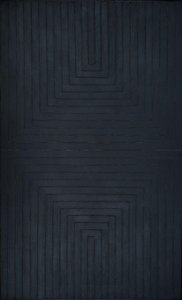
Die Fahne Hoch! (1959) by Frank Stella

Die Fahne Hoch!

1959 · Acrylic On Canvas · Whitney Museum of American Art, New York

Frank Stella’s 1959 painting, *Die Fahne Hoch!*, isn't merely a composition of black lines on white canvas; it’s an arresting declaration of form and a subtle provocation. Emerging from the vibrant, emotionally charged world of Abstract Expressionism, Stella deliberately distanced himself from its subjective gestures, seeking instead to establish art as an object in itself – a flat surface with paint on it, as he famously stated. This painting embodies…

3
Gran Cairo (1962) by Frank Stella

Gran Cairo

1962 · Oil On Canvas · Whitney Museum of American Art, New York

In the vast landscape of twentieth-century abstraction, few works capture the hypnotic allure of pure form as effectively as Frank Stella’s Gran Cairo. Created in 1962, this masterpiece serves as a profound exploration of visual perception, where the boundaries between color and shape begin to dissolve into a mesmerizing dance. At first glance, the viewer is met with a striking interplay of concentric squares, each layer pulsating with a spectrum…

4
Composition (S/1) (1958) by Frank Stella

Composition (S/1)

1958 · Oil On Canvas · Bavarian State Painting Collections, Munich

In 1958, Frank Stella entered his first year of independent work. This period marked a departure from his studies, as he moved to New York City to establish a singular practice. During this pivotal year, he produced a series of monumental abstract canvases. Composition (S/1) emerged from this intense period of production, a time when the artist began to assert a new visual language through scale and form.

5
Basra Gate III by Frank Stella

Basra Gate III

Acrylic On Canvas · Museum Folkwang, Essen

To stand before Basra Gate III is to encounter a moment of pure, structured contemplation. This large-scale composition does not whisper; it declares with the confident precision of mathematical certainty. It presents itself as a magnificent semi-circular expanse, immediately drawing the eye into its vibrant, organized complexity. The dominant field of deep purple acts less as a background and more as a resonant void against which color can finally breathe…

6
Manteneia II by Frank Stella

Manteneia II

Acrylic On Canvas · Chrysler Museum of Art, Norfolk

Manteneia II by Frank Stella utilizes a geometric arrangement of intersecting lines and arcs to organize its visual field. The composition is built upon a grid of horizontal and vertical sections, which Stella used to dictate the placement of sweeping, calculated curves. These arcs of color—including crimson, emerald green, sapphire blue, ochre yellow, and tangerine orange—interlock to create a sense of movement across the large-scale surface. Black elements are integrated…

7
Marrakech (1964) by Frank Stella

Marrakech

1964

This painting is part of Stella’s Morocco series (1964–65), which was inspired in part by Arabic tiles. Using fluorescent paint to disrupt the picture plane, Stella creates not only an illusion of depth but also a pulsating effect that belies the work’s simple, geometric lines.

9
Darabjerd III (1967) by Frank Stella

Darabjerd III

1967

The Darabjerd III painting by Frank Stella is a seminal work in the realm of geometric abstraction. Created in 1967, this acrylic on canvas piece measures 305 x 458 cm and is housed at the National Portrait Gallery in the United States. As a prominent artist of his time, Frank Stella was known for pushing the boundaries of traditional art forms, and Darabjerd III is a testament to his innovative…

Frank Stella's famous paintings, numbers 11 to 51

Frank Stella's famous paintings, period by period

The subjects that held Frank Stella's eye

The four subjects that come back most often in these originals, each with its finest example.

The museums that keep Frank Stella's originals

The 8 museums that hold the most of the paintings on this page.

Museum City Works by Frank Stella Paintings from this list
Whitney Museum of American Art, New YorkWhitney Museum of American Art New York 2 Die Fahne Hoch!, Gran Cairo
National Gallery of Canada, OttawaNational Gallery of Canada Ottawa 2 Maquette for the Mural in the Orchestra Level Lobby, Princess of Wales Theatre, Toronto, Firuzabad (Variation) I
Bavarian State Painting Collections, MunichBavarian State Painting Collections Munich 1 Composition (S/1)
Museum Folkwang, EssenMuseum Folkwang Essen 1 Basra Gate III
Chrysler Museum of Art, NorfolkChrysler Museum of Art Norfolk 1 Manteneia II
National Gallery of Australia, CanberraNational Gallery of Australia Canberra 1 The Fountain
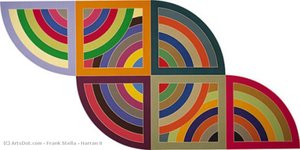
Solomon R. Guggenheim Museum, New YorkSolomon R. Guggenheim Museum New York 1 Harran II
Metropolitan Museum of Art, New YorkMetropolitan Museum of Art New York 1 Haines City

Frank Stella across the decades: one unique original for each

Works per decade

Pick a decade to see the original that defines it.

Frank Stella's paintings: questions for the gallery

What is the single most famous work of Frank Stella?Reveal the answer

Hyena Stomp (1962). Die Fahne Hoch! (1959) and Gran Cairo (1962) come next.

At what age did Frank Stella create Hyena Stomp?Reveal the answer

26 years old: Hyena Stomp dates from 1962, and Frank Stella was born in 1936.

Which ten paintings by Frank Stella are the most famous?Reveal the answer

Hyena Stomp, Die Fahne Hoch!, Gran Cairo, Composition (S/1), Basra Gate III, Manteneia II, Marrakech, The Fountain, Darabjerd III and Maquette for the Mural in the Orchestra Level Lobby, Princess of Wales Theatre, Toronto. The ranking above gives each one's year and museum.

How many works by Frank Stella are known?Reveal the answer

Our catalog holds 55 works by Frank Stella, dated from 1958 to 2001.

Where can the most famous Frank Stella originals be seen?Reveal the answer

Mostly in Whitney Museum of American Art (New York), National Gallery of Canada (Ottawa) and Bavarian State Painting Collections (Munich). The museum table above lists them all.

During which period did Frank Stella create the best-known paintings?Reveal the answer

In 1960s: 19 of the 51 works on this page were made then, Hyena Stomp among them.

Which famous Frank Stella painting is the earliest, and which the latest?Reveal the answer

On this page, the earliest is Composition (S/1) (1958) and the latest Prinz Friedrich von Homburg, Ein Schauspiel, 3X (2001).

What subjects did Frank Stella favour?Reveal the answer

Abstract (4), Geometric (4) and Abstract art (4), across the 51 works on this page.

What materials did Frank Stella paint with most?Reveal the answer

Acrylic On Canvas, for 5 of the 51 works on this page.

Which movement does the work of Frank Stella belong to?Reveal the answer

Post-painterly abstraction and Minimalism, judging by the originals on this page.

What Frank Stella originals can I see at the Whitney Museum of American Art?Reveal the answer

Die Fahne Hoch! and Gran Cairo: the Whitney Museum of American Art, New York holds 2 of the works on this page.

Frank Stella: a portrait of the artist

A Life Dedicated to the Essence of Painting

Frank Stella, who passed away on May 4, 2024, at the age of 87, was a towering figure in American art, a relentless innovator whose career spanned seven decades and challenged conventional notions of painting, sculpture, and architectural design. Born in Malden, Massachusetts, in 1936 to first-generation Italian-American parents, Stella’s artistic journey began with an early exposure to the visual world through his mother's landscape paintings and a formative education at Phillips Academy Andover, where he encountered the rigorous color theories of Josef Albers and the expressive power of Hans Hofmann. These influences, coupled with studies in history at Princeton University and frequent trips to New York City galleries, laid the groundwork for a radical departure from the prevailing Abstract Expressionism of the time. Stella wasn’t interested in the emotional turmoil or subjective gesture that defined artists like Pollock and Kline; he sought something purer, more objective—a distillation of painting down to its most fundamental elements.

Rejecting Illusion: The Rise of Minimalism

Stella's emergence onto the art scene in the late 1950s was nothing short of revolutionary. He famously declared that “a painting should be a flat surface with paint on it—nothing more,” a statement that became a manifesto for the burgeoning Minimalist movement. This philosophy materialized most strikingly in his *Black Paintings* (1958-1960), a series of canvases defined by precisely spaced, symmetrical black stripes separated by bands of exposed canvas. Works like Die Fahne Hoch! (1959) – a title deliberately provocative, referencing the Nazi anthem – weren’t intended as expressions of political sentiment but rather as explorations of form and surface, challenging viewers to confront the painting as an object in itself. The deliberate coolness and rejection of emotional content were jarring at the time, signaling a decisive break from Abstract Expressionism's emphasis on subjective experience. He wasn’t aiming to depict something *about* the world; he was presenting the world—or rather, the painting—as it *is*. This focus on materiality and geometric precision extended into his shaped canvases of the 1960s, where Stella abandoned the traditional rectangular format in favor of complex polygons, often crafted from aluminum and copper paint. These weren’t merely paintings; they were sculptural objects that blurred the boundaries between two and three dimensions, further emphasizing the artwork's physical presence.

Expanding Boundaries: From Protractor Series to Maximalism

The 1970s marked a period of significant experimentation for Stella. The *Protractor Series* (1971) saw him introduce sweeping arcs and vibrant colors arranged within square borders, creating dynamic compositions inspired by the circular cities he visited in the Middle East. Simultaneously, Stella embraced printmaking with enthusiasm, mastering techniques like lithography, screenprinting, and etching to create abstract prints that echoed his painting’s geometric vocabulary. His engagement extended beyond the visual arts; he designed sets and costumes for Merce Cunningham's dance piece *Scramble* in 1967, demonstrating a willingness to collaborate across disciplines. A retrospective at the Museum of Modern Art in 1970—a remarkable achievement for an artist still so young—cemented his status as a leading figure in contemporary art. However, Stella wasn’t content to rest on his laurels. He began incorporating relief into his work, gradually evolving towards what could be described as “maximalist” painting with sculptural qualities, utilizing collage elements and aluminum supports.

A Legacy of Innovation

Stella's later career witnessed a dramatic shift in style. The austere geometry of his earlier works gave way to exuberant compositions characterized by curving forms, bold colors, and seemingly spontaneous brushstrokes—a move towards a more baroque aesthetic that surprised many but demonstrated his unwavering commitment to artistic exploration. His commission for the BMW Art Car Project in 1976 showcased his ability to adapt his distinctive drawing style to an unconventional canvas: a 3.0 CSL racing car. Throughout his life, Stella received numerous accolades, including the National Medal of Arts in 2009 and the Lifetime Achievement Award in Contemporary Sculpture from the International Sculpture Center in 2011. Frank Stella’s impact on art history is undeniable. He didn't just create paintings; he redefined what a painting *could be*. His relentless pursuit of formal clarity, his rejection of illusionism, and his willingness to push boundaries paved the way for generations of artists who followed, solidifying his place as one of the most important and influential figures of the 20th and 21st centuries. He leaves behind not only a vast body of work but also a legacy of intellectual rigor and artistic courage that will continue to inspire for years to come.