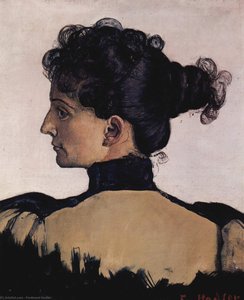
Portrait of Ferdinand Hodler

Ferdinand Hodler Paintings: The 100 Most Famous, Through a Gallery's Eye

Updated November 2026 · ranked by our popularity score (searches, visits and orders for each work) · 609 works by Ferdinand Hodler in our catalogue

In short

To the gallery's eye, Ferdinand Hodler's most famous painting is Eiger, Monch and Jungfrau in Moonlight (1908). Woman in Ecstasy (1911) and Eiger, Monch and Jungfrau in Moonlight (1908) complete the trio every eye recognises. Of the 609 works by Ferdinand Hodler in our catalog, the gallery presents the 100 most famous below, each original with its year, its museum and what makes it unique.

1853 – 1918, Bern Symbolism Most works: National Gallery of Bosnia and Herzegovina

The gallery's top 10 Ferdinand Hodler paintings

1
Eiger, Monch and Jungfrau in Moonlight (1908) by Ferdinand Hodler

Eiger, Monch and Jungfrau in Moonlight

1908 · Oil On Canvas

In the quietude of 1908, Ferdinand Hodler captured a nocturnal moment in his painting, Eiger, Monch and Jungfrau in Moonlight. The scene is dominated by three majestic mountains, arranged with a distinct sense of scale: the leftmost peak appears smaller, followed by a middle mountain with a slightly larger summit, while the rightmost peak stands as the largest of the trio. Above this rugged landscape, two airplanes traverse the sky—one…

2
Woman in Ecstasy (1911) by Ferdinand Hodler

Woman in Ecstasy

1911 · Oil On Canvas

To encounter Ferdinand Hodler’s Woman in Ecstasy is to step into a realm where the boundaries between the physical form and the ethereal spirit dissolve. Painted in 1911, this monumental canvas serves as a cornerstone of the Art Nouveau movement, capturing far more than a mere moment of movement; it embodies an entire era's yearning for beauty, transcendence, and liberation. The painting depicts a woman caught in the throes of…

3
Eiger, Monch and Jungfrau in Moonlight (1908) by Ferdinand Hodler

Eiger, Monch and Jungfrau in Moonlight

1908 · Oil On Canvas

In this 1908 oil on canvas, the landscape is dominated by three majestic mountain peaks: the Eiger, the Monch, and the Jungfrau. These summits are arranged in a rhythmic, ascending scale, with the leftmost peak appearing smaller, followed by a middle mountain with a slightly larger summit, and the rightmost peak standing as the largest of the trio. The scene is set during a moonlight night, characterized by a palette…

4
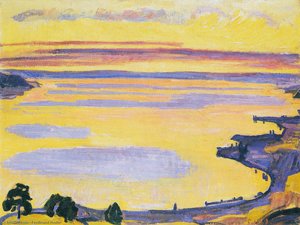
Sunset on Lake Geneva (1915) by Ferdinand Hodler

Sunset on Lake Geneva

1915 · Oil On Canvas · Kunsthaus Zürich, Zurich

The painting depicts a sunset over Lake Geneva. The sky above the water is rendered in shades of yellow, orange, and pink, creating a vibrant atmosphere. In the foreground, mountains are visible, providing depth to the landscape. A boat is positioned on the water, contributing to the serene scene.

5
Study of two figures (1897) by Ferdinand Hodler

Study of two figures

1897 · Acrylic On Paper · National Gallery of Bosnia and Herzegovina, Sarajevo

Ferdinand Hodler’s “Study of Two Figures” is not a grand, dramatic statement; rather, it's an invitation to linger in the quiet intimacy of a shared moment. Painted in 1897, this graphite drawing on paper captures two women seated together, their postures suggesting a profound sense of contemplation and perhaps even melancholy. Hodler, a pivotal figure within Swiss Symbolism, wasn’t interested in literal representation but rather in conveying emotional atmosphere and…

6
Unity (1911) by Ferdinand Hodler

Unity

1911 · Painting

In the monumental mural Unity, created in 1911, Ferdinand Hodler presents a profound meditation on the collective human spirit. This expansive work, stretching across an impressive scale, transcends mere portraiture to become a rhythmic tapestry of existence. The composition is masterfully arranged in rows of figures that seem to pulse with a shared vitality; some individuals press toward the foreground with palpable presence, while others recede into the background, creating…

7
Lake Geneva in Chexbres (1904) by Ferdinand Hodler

Lake Geneva in Chexbres

1904 · Oil On Canvas

To gaze upon Ferdinand Hodler's Lake Geneva in Chexbres is to be invited into a moment suspended between the vastness of nature and the quiet contemplation of the human spirit. This magnificent oil on canvas, dating from 1904, captures more than just a picturesque vista; it encapsulates the very essence of the Swiss landscape filtered through the profound lens of an artistic master. The scene unfolds across a broad expanse…

8
Composition study (1887) by Ferdinand Hodler

Composition study

1887 · Oil On Canvas · National Gallery of Bosnia and Herzegovina, Sarajevo

Ferdinand Hodler's "Composition Study," created in 1887, isn’t merely a sketch of three figures engaged in strenuous activity; it’s a profound meditation on the human condition, rendered with an arresting blend of anatomical precision and evocative symbolism. This work, now housed within the Tretyakov Gallery in Moscow, offers a rare glimpse into the artist's deeply personal vision – a world shaped by loss, contemplation, and a fascination with the ephemeral…

9
Self-portrait with stand (1879) by Ferdinand Hodler

Self-portrait with stand

1879 · Oil On Canvas · Kunst Museum Winterthur | Reinhart am Stadtgarten, Winterthur

To stand before Ferdinand Hodler’s Self-portrait with stand is to encounter a moment suspended between public presentation and private contemplation. This striking work, dating from 1879, captures the artist not merely as a likeness, but as a study in poised masculinity and burgeoning artistic self-awareness. The subject, impeccably dressed in a suit and tie, adopts a formal bearing, suggesting an occasion of importance or perhaps simply the necessary facade required…

10
The Wetterhorn (1912) by Ferdinand Hodler

The Wetterhorn

1912 · Oil On Canvas

To stand before Ferdinand Hodler’s The Wetterhorn is to be enveloped by the sublime majesty of the Swiss Alps, rendered through a lens of profound introspection. Painted in 1912, this oil on canvas masterpiece transcends mere topographical depiction; it is a meditation on permanence against the backdrop of fleeting human experience. The sheer scale of the snow-covered peak dominates the composition, its striking blue hue lending the entire scene an…

Ferdinand Hodler paintings, ranked 11 to 100

11Hilly Landscape with Ravens, in the Bernese Oberland (1910) by Ferdinand HodlerHilly Landscape with Ravens, in the Bernese Oberland1910 12View of Lake Leman from Chexbres (1905) by Ferdinand HodlerView of Lake Leman from Chexbres1905 · Kunstmuseum Basel 13Stockhorn chain (blue sky) by Ferdinand HodlerStockhorn chain (blue sky) 14Woman on her deathbed by Ferdinand HodlerWoman on her deathbed 15Lake Geneva from Chexbres (1904) by Ferdinand HodlerLake Geneva from Chexbres1904 · Musée cantonal des Beaux-Arts 16Portrait of Fraulein Kyburz (1873) by Ferdinand HodlerPortrait of Fraulein Kyburz1873 · Rhode Island School of Design Museum of Art 17Portrait of a Spanish woman by Ferdinand HodlerPortrait of a Spanish woman 18Studies of self-portrait (1911) by Ferdinand HodlerStudies of self-portrait1911 19Portrait of Berthe Hodler (1902) by Ferdinand HodlerPortrait of Berthe Hodler1902 · National Gallery of Bosnia and Herzegovina 20Landscape of the Swiss Alps (1918) by Ferdinand HodlerLandscape of the Swiss Alps1918 · The Israel Museum 21The fall in Silvaplana (1907) by Ferdinand HodlerThe fall in Silvaplana1907 · Kunsthaus Zürich 22Thun with symmetric mirroring (1909) by Ferdinand HodlerThun with symmetric mirroring1909 · Musée d'Art et d'Histoire de Genève 23Jeanne Cerani-Charles by Ferdinand HodlerJeanne Cerani-Charles 24Day (Truth) by Ferdinand HodlerDay (Truth)Art Institute of Chicago 25From Le Grand Muveran Villars (1912) by Ferdinand HodlerFrom Le Grand Muveran Villars1912 · Von der Heydt Museum 26The cobbler by the window (1882) by Ferdinand HodlerThe cobbler by the window1882 27Forest Stream at Champery (1916) by Ferdinand HodlerForest Stream at Champery1916 28The shoemaker (1878) by Ferdinand HodlerThe shoemaker1878 29Modern Rütli (1878) by Ferdinand HodlerModern Rütli1878 · Gottfried Keller Foundation 30The Reaper (1878) by Ferdinand HodlerThe Reaper1878 31Gymnasts' Banquet (1877) by Ferdinand HodlerGymnasts' Banquet1877 · Kunsthaus Zürich 32The Miller, his Son and the Donkey (1888) by Ferdinand HodlerThe Miller, his Son and the Donkey1888 · Musée d'Art et d'Histoire de Genève 33The Disillusioned One (1892) by Ferdinand HodlerThe Disillusioned One1892 · Los Angeles County Museum of Art 34Study of the disappointed souls or Weary of life (1891) by Ferdinand HodlerStudy of the disappointed souls or Weary of life1891 35Overall study of the life of weary (1887) by Ferdinand HodlerOverall study of the life of weary1887 36Surprised by the Storm (1887) by Ferdinand HodlerSurprised by the Storm1887 37Night (1890) by Ferdinand HodlerNight1890 38Worship (1893) by Ferdinand HodlerWorship1893 39Childhood (1893) by Ferdinand HodlerChildhood1893 · Städel Museum 40Battle scenes (1896) by Ferdinand HodlerBattle scenes1896 41The Halberdier (1895) by Ferdinand HodlerThe Halberdier1895 · Dallas Museum of Art 42View into Infinity (1903) by Ferdinand HodlerView into Infinity1903 · Hamburger Kunsthalle 43The Adored Youth (1904) by Ferdinand HodlerThe Adored Youth1904 44Character study (1902) by Ferdinand HodlerCharacter study1902 45The Woodcutter (1910) by Ferdinand HodlerThe Woodcutter1910 · Von der Heydt Museum 46Character study (1906) by Ferdinand HodlerCharacter study1906 47Farewell participating female figure (1908) by Ferdinand HodlerFarewell participating female figure1908 48Pulling soldiers (1908) by Ferdinand HodlerPulling soldiers1908 49The working mower (1909) by Ferdinand HodlerThe working mower1909 50Pulling soldiers (1908) by Ferdinand HodlerPulling soldiers1908 51Woman in Ecstasy (1911) by Ferdinand HodlerWoman in Ecstasy1911 52Jeanne Günzburger (1912) by Ferdinand HodlerJeanne Günzburger1912 · Toledo Museum of Art 53Portrait of Emma Schmidt-Müller (1915) by Ferdinand HodlerPortrait of Emma Schmidt-Müller1915 54Josef Müller (1916) by Ferdinand HodlerJosef Müller1916 55Der Frühling (Fassung IV) (1912) by Ferdinand HodlerDer Frühling (Fassung IV)1912 56The Patient (1914) by Ferdinand HodlerThe Patient1914 · Kunstmuseum Basel 57Head of a Soldier (1917) by Ferdinand HodlerHead of a Soldier1917 · Art Institute of Chicago 58Valentine Godé-Darel one day before her death (1915) by Ferdinand HodlerValentine Godé-Darel one day before her death1915 · Kunstmuseum Basel 59Swearing from behind (1912) by Ferdinand HodlerSwearing from behind1912 60Two swearing (1912) by Ferdinand HodlerTwo swearing1912 61Study of self-portrait (1916) by Ferdinand HodlerStudy of self-portrait1916 62Standing draped figure (1913) by Ferdinand HodlerStanding draped figure1913 63Untitled (529) by Ferdinand HodlerUntitled (529) 64Lake Thun Landscape by Ferdinand HodlerLake Thun Landscape 65Female figure with garland (1895) by Ferdinand HodlerFemale figure with garland1895 · National Gallery of Bosnia and Herzegovina 66Self portrait (1916) by Ferdinand HodlerSelf portrait1916 67Prayer in the Saint Pierre Cathedral in Geneva (1882) by Ferdinand HodlerPrayer in the Saint Pierre Cathedral in Geneva1882 · Building of the Winterthur Museum of Art 68Mother and Child by Ferdinand HodlerMother and Child 69Pulling soldiers (1908) by Ferdinand HodlerPulling soldiers1908 70Walking at the forest edge (1885) by Ferdinand HodlerWalking at the forest edge1885 71Lake Geneva on the evening in Chexbres (1895) by Ferdinand HodlerLake Geneva on the evening in Chexbres1895 72Lake Thun, Symmetric reflection (1905) by Ferdinand HodlerLake Thun, Symmetric reflection1905 73The river Aare in Solothurn (1915) by Ferdinand HodlerThe river Aare in Solothurn1915 74The Orator (1912) by Ferdinand HodlerThe Orator1912 75What are flowers saing (1893) by Ferdinand HodlerWhat are flowers saing1893 76Lake Geneva with Mont Blanc in the morning light (1918) by Ferdinand HodlerLake Geneva with Mont Blanc in the morning light1918 77The Lake Geneva from Chexbres (1898) by Ferdinand HodlerThe Lake Geneva from Chexbres1898 78Spring (1901) by Ferdinand HodlerSpring1901 79Transfiguration (1906) by Ferdinand HodlerTransfiguration1906 80Valentine Godé-Darel on her Deathbed (1915) by Ferdinand HodlerValentine Godé-Darel on her Deathbed1915 81Emotion (study) (1902) by Ferdinand HodlerEmotion (study)1902 82valentine gode darel sun by Ferdinand Hodlervalentine gode darel sun 83The road to Evordes by Ferdinand HodlerThe road to Evordes 84The Black Lutschina (1905) by Ferdinand HodlerThe Black Lutschina1905 85A morning in Interlaken (1875) by Ferdinand HodlerA morning in Interlaken1875 · Kunstmuseum Bern 86Dying cadet (1896) by Ferdinand HodlerDying cadet1896 87Thun, Stockhornkette (1910) by Ferdinand HodlerThun, Stockhornkette1910 88Thunersee with Niesen by Ferdinand HodlerThunersee with Niesen 89The road to a particular interest (1890) by Ferdinand HodlerThe road to a particular interest1890 · Kunst Museum Winterthur | Reinhart am Stadtgarten 90Portrait of Berthe Jacques, wife of the artist (1894) by Ferdinand HodlerPortrait of Berthe Jacques, wife of the artist1894 91Figure study (1901) by Ferdinand HodlerFigure study1901 · National Gallery of Bosnia and Herzegovina 92Sensation (1901) by Ferdinand HodlerSensation1901 93Lake Silvaplana in Autumn (1907) by Ferdinand HodlerLake Silvaplana in Autumn1907 · Kunsthaus Zürich 94Dents du Midi in Clouds (1917) by Ferdinand HodlerDents du Midi in Clouds1917 95Grammont by Ferdinand HodlerGrammont 96Autumn Landscape near Solothurn by Ferdinand HodlerAutumn Landscape near Solothurn 97The reader 1 by Ferdinand HodlerThe reader 1Thyssen-Bornemisza Museum 98untitled (774) by Ferdinand Hodleruntitled (774) 99Prayer in the Cathedral of St. Pierre, Geneva (1882) by Ferdinand HodlerPrayer in the Cathedral of St. Pierre, Geneva1882 100At the foot of the Petit Saleve (1890) by Ferdinand HodlerAt the foot of the Petit Saleve1890

Ferdinand Hodler's famous paintings, period by period

The subjects that held Ferdinand Hodler's eye

The four subjects that come back most often in these originals, each with its finest example.

The museums that keep Ferdinand Hodler's originals

The 8 museums that hold the most of the paintings on this page.

Museum City Works by Ferdinand Hodler Paintings from this list
National Gallery of Bosnia and Herzegovina, SarajevoNational Gallery of Bosnia and Herzegovina Sarajevo 74 Study of two figures, Composition study, Portrait of Berthe Hodler
Kunsthaus Zürich, ZurichKunsthaus Zürich Zurich 16 Sunset on Lake Geneva, The fall in Silvaplana, Gymnasts' Banquet
Kunstmuseum Basel, BaselKunstmuseum Basel Basel 5 View of Lake Leman from Chexbres, The Patient, Valentine Godé-Darel one day before her death
Musée d'Art et d'Histoire de Genève, GenevaMusée d'Art et d'Histoire de Genève Geneva 8 Thun with symmetric mirroring, The Miller, his Son and the Donkey
Art Institute of Chicago, ChicagoArt Institute of Chicago Chicago 3 Day (Truth), Head of a Soldier
Von der Heydt Museum, WuppertalVon der Heydt Museum Wuppertal 3 From Le Grand Muveran Villars, The Woodcutter
Kunst Museum Winterthur | Reinhart am Stadtgarten, WinterthurKunst Museum Winterthur | Reinhart am Stadtgarten Winterthur 2 Self-portrait with stand, The road to a particular interest
Städel Museum, FrankfurtStädel Museum Frankfurt 3 Childhood

Ferdinand Hodler, one signature painting per decade

Works per decade

Pick a decade to see the original that defines it.

Ferdinand Hodler's paintings: the gallery answers

Which Ferdinand Hodler painting is the most famous of all?Reveal the answer

Eiger, Monch and Jungfrau in Moonlight (1908). Woman in Ecstasy (1911) and Eiger, Monch and Jungfrau in Moonlight (1908) come next.

How old was Ferdinand Hodler on completing Eiger, Monch and Jungfrau in Moonlight?Reveal the answer

55 years old: Eiger, Monch and Jungfrau in Moonlight dates from 1908, and Ferdinand Hodler was born in 1853.

Which are Ferdinand Hodler's top 10 paintings?Reveal the answer

Eiger, Monch and Jungfrau in Moonlight, Woman in Ecstasy, Eiger, Monch and Jungfrau in Moonlight, Sunset on Lake Geneva, Study of two figures, Unity, Lake Geneva in Chexbres, Composition study, Self-portrait with stand and The Wetterhorn. The ranking above gives each one's year and museum.

How many works did Ferdinand Hodler create?Reveal the answer

Our catalog holds 609 works by Ferdinand Hodler, dated from 1873 to 1918.

Where do Ferdinand Hodler's most famous originals hang?Reveal the answer

Mostly in National Gallery of Bosnia and Herzegovina (Sarajevo), Kunsthaus Zürich (Zurich) and Kunstmuseum Basel (Basel). The museum table above lists them all.

When did Ferdinand Hodler create the most famous paintings?Reveal the answer

In 1910s: 29 of the 100 works on this page were made then, Woman in Ecstasy among them.

Which are Ferdinand Hodler's earliest and latest famous works?Reveal the answer

On this page, the earliest is Portrait of Fraulein Kyburz (1873) and the latest Landscape of the Swiss Alps (1918).

Which subjects did Ferdinand Hodler return to most?Reveal the answer

Landscape (28), Woman (18) and Man (15), across the 100 works on this page.

Which medium did Ferdinand Hodler work in most?Reveal the answer

Oil On Canvas, for 60 of the 100 works on this page.

Which movement is Ferdinand Hodler associated with?Reveal the answer

Symbolism and Art nouveau, judging by the originals on this page.

Which Ferdinand Hodler originals does the National Gallery of Bosnia and Herzegovina hold?Reveal the answer

Study of two figures, Composition study and Portrait of Berthe Hodler: the National Gallery of Bosnia and Herzegovina, Sarajevo holds 5 of the works on this page.

Ferdinand Hodler: the artist

The Architecture of Mortality

Born in Bern, Switzerland, in 1853, Ferdinand Hodler’s early years were defined by a quiet, persistent grief. Before he reached adolescence, the tuberculosis that claimed his father and two younger brothers left a void in his household. This early encounter with loss became a recurring motif in his work, a shadow that would follow him from the modest beginnings of his apprenticeship to the heights of his professional career. He began his training as a decorative painter, assisting his stepfather with commercial sign-work, a practical education that instilled in him a precise command of line and form. This foundation in craftsmanship provided the technical rigor that would later support his more complex philosophical inquiries.

His move to Geneva in 1871 marked a departure from the commercial demands of his youth. In the city, he sought a more profound engagement with art, attending science lectures and copying the works of masters in the local museum. It was here that he began to move away from the meticulous realism of his early landscapes and portraits. He was no longer content to merely replicate the scenery of the Swiss Alps or the likeness of a sitter; he sought to capture the underlying rhythms of existence. This transition from the objective to the subjective would eventually lead him to develop a visual language entirely his own.

The Logic of Parallelism

Hodler’s most significant contribution to the evolution of modern painting was his theory of parallelism. This was not merely a compositional technique but a way of seeing the world as a series of interconnected, rhythmic patterns. He observed how forms in nature—the slope of a mountain, the curve of a human limb, or the reflection in water—often mirrored one another in a structured, geometric harmony. By arranging figures and landscape elements in these repetitive, rhythmic cadences, he attempted to depict the structural order he believed governed the natural world. This approach allowed him to bridge the gap between the physical reality of a scene and the emotional state of the observer.

His work often occupied the space between Symbolism and a more structured, modern sensibility. In works such as The Night, completed in 1890, he explored themes of repose and mortality through recumbent figures, a subject that challenged the prevailing tastes of the time. His ability to blend classical form with a modern, almost structural intensity is evident in Truth II (1897). He did not rely on the chaotic brushwork of his contemporaries; instead, he used a deliberate, often muted palette of ochres, browns, and greens to create a sense of permanence and weight. His canvases were not mere windows into a scene, but organized environments where the human spirit and the landscape were bound together by a shared geometry.

A Life in Landscapes

The Swiss landscape remained a constant presence in his oeuvre, particularly the grandeur of the Alps. He viewed these mountains not just as topographical features, but as spiritual entities. His depictions of the Eiger, Monch, and Jungfrau, or the views from the Dents du Midi, reflect a desire to translate the scale of the mountains into a language of emotional resonance. He often utilized a layering process, applying thin washes of color over thicker impasto to achieve a specific luminosity, particularly in his later studies of light over Lake Geneva. These works demonstrate a mastery of atmosphere, capturing the hazy, ethereal quality of Alpine light without sacrificing the structural integrity of the terrain.

By the time of his death in Geneva in 1918, Hodler had established himself as a central figure in Swiss art history. His influence can be seen in the development of Expressionism, as his emphasis on subjective emotion and rhythmic form provided a foundation for those who sought to move beyond traditional representation. He remained a painter of profound psychological depth, using the tools of his craft to confront the fundamental questions of life and death. His legacy is found in the way he forced the viewer to look past the surface of the world to find the silent, repeating patterns that hold it together.