Portrait of Eugène Isabey

The 100 Most Famous Eugène Isabey Paintings, Each One of a Kind

Updated November 2026 · ranked by our popularity score (searches, visits and orders for each work) · 129 works by Eugène Isabey in our catalogue

In short

Portrait of a Child (1829) is the Eugène Isabey painting that draws the most eyes; the original belongs to the Wallace Collection, London. After it, the eye goes to Hurricane before Saint Malo, France (1860) and Portrait Bust of a Young Woman (1831). Among the 129 works of Eugène Isabey in our catalog, these 100 are the most famous, each a unique original presented with its year, its museum and the reason it endures.

1803 – 1886, Paris Romanticism Most works: The Cooper Gallery

Top 10 paintings by Eugène Isabey, through the gallery's eye

1
Portrait of a Child (1829) by Eugène Isabey

Portrait of a Child

1829 · Oil On Canvas · Wallace Collection, London

In "Portrait of a Child" by Eugène Isabey, a tender and luminous scene unfolds as a young child sits quietly within the embrace of an ornate armchair. The composition centers entirely on this small figure, using the large, high-backed chair to frame the subject and draw the eye inward. From a straight-on, eye-level perspective, the viewer meets the child's presence directly, creating an intimate connection that feels immediate and personal.…

2
Hurricane before Saint Malo, France (1860) by Eugène Isabey

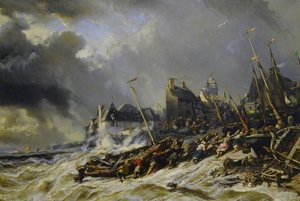
Hurricane before Saint Malo, France

1860 · Oil On Canvas · The Cooper Gallery, Barnsley

The sky over Brittany turns a bruised, heavy shade of charcoal as the storm rolls in. Waves swell with a violent, churning energy, threatening to swallow the horizon whole. In the distance, the port town of Saint-Malo waits under the weight of the darkening clouds. The air feels thick with the salt spray and the impending chaos of the gale. Every line in the composition pulls the eye toward the…

3
Portrait Bust of a Young Woman (1831) by Eugène Isabey

Portrait Bust of a Young Woman

1831 · Watercolor · Rhode Island School of Design Museum of Art, Providence

A soft, directional light brushes against the left side of a young woman's face, casting gentle shadows that give her features a quiet, three-dimensional depth. She sits in a three-quarter profile, her gaze meeting the viewer with an intimacy that feels almost stolen. The composition is held within a delicate oval, a format that draws the eye inward toward the porcelain smoothness of her skin. Her dark hair is styled…

4
The Departure from Tréport of Queen Victoria, 7 September 1843 (1843) by Eugène Isabey

The Departure from Tréport of Queen Victoria, 7 September 1843

1843 · Oil On Canvas · National Trust, Cambridge

To gaze upon this depiction of The Departure from Tréport of Queen Victoria, dated 1843, is to be immediately swept into the heart of maritime drama. This oil on canvas by Eugène Louis Gabriel Isabey transports us not merely to a location, but to a moment suspended between grandeur and chaos. The composition itself speaks volumes; the vast expanse of the ocean serves as both stage and witness to human…

5
Shipwreck on a Rocky Coast (1837) by Eugène Isabey

Shipwreck on a Rocky Coast

1837 · Oil On Canvas · Staatliche Kunsthalle Karlsruhe, Carlsruhe

The churning chaos of the sea takes center stage in Shipwreck on a Rocky Coast. This dramatic seascape, painted by Eugène Isabey, captures a moment of intense struggle against the elements. The scene unfolds around a vessel caught in the violent grip of a storm, its wreckage scattered amidst the crashing waves and jagged stone. It is a work that pulses with the restless energy of the Romantic style, focusing…

6
Seaside (1835) by Eugène Isabey

Seaside

1835 · Oil · National Museum in Warsaw, Warsaw

In "Seaside" by Eugène Isabey, a quiet moment at the edge of the world unfolds. Painted about 1835, this seascape captures a tranquil coastal scene during the soft, diffused light of dawn or dusk. A heavy, grounded wooden boat rests in the foreground, its dark hull anchoring the left side of the view. Nearby, figures gather on the shoreline, their forms softened by the hazy atmosphere. The scene breathes with…

7
Rocks at Saint-Malo (1850) by Eugène Isabey

Rocks at Saint-Malo

1850 · Watercolor · The Louvre, Paris

Eugène Louis Gabriel Isabey’s “Rocks at Saint-Malo,” painted in 1850, isn't merely a depiction of a seaside scene; it’s an immersion into the raw, elemental power of the Atlantic. The painting captures a fleeting moment – perhaps a gathering storm, or simply the quiet dignity of weathered stone meeting relentless sea – imbued with a palpable sense of melancholy and timelessness. It’s a work that speaks to the enduring relationship…

8
Portrait of the painter Jean-Baptiste Isabey, father of the artist (1840) by Eugène Isabey

Portrait of the painter Jean-Baptiste Isabey, father of the artist

1840 · Oil On Canvas · Carnavalet Museum, Paris

In this intimate bust-length portrait, we find ourselves in the presence of an elderly man, captured with a profound sense of dignity. The subject, Jean-Baptiste Isabey, gazes directly at us from within an oval frame, his expression steady and composed. His white, wispy hair frames a high forehead and a receding hairline, lending a sense of wisdom to his features. The lighting, descending from the upper left, casts soft shadows…

9
Portrait of Madame Isabey and her Daughter (1840) by Eugène Isabey

Portrait of Madame Isabey and her Daughter

1840 · Oil On Canvas · Carnavalet Museum, Paris

In this vertical oil on canvas, a woman and a child are positioned within a densely layered interior. The child sits in the foreground, centered in the composition, while the adult woman leans over from behind. The scene is defined by a palette of deep reds, golds, and creams, which contrast with the cool blue upholstery of the armchair. Light enters from the upper left, casting soft highlights across the…

10
Ceremony in de Nieuwe kerk at Delft (1847) by Eugène Isabey

Ceremony in de Nieuwe kerk at Delft

1847 · Oil On Canvas

Ceremony in de Nieuwe kerk at Delft is a painting by Eugène Isabey created about 1847. The work depicts a grand and dramatic historical scene situated within the interior of the Nieuwe Kerk in Delft. The subject matter focuses on a moment of high social and religious significance, likely representing a royal or noble event. The figures are gathered for a formal ceremony, positioned within the architectural framework of the…

Eugène Isabey's famous paintings, numbers 11 to 100

11Portrait of Scipion Corvisart (1850) by Eugène IsabeyPortrait of Scipion Corvisart1850 · Musée national de Malmaison et Bois-Préau 12Two Young Women Standing in a Park (1850) by Eugène IsabeyTwo Young Women Standing in a Park1850 13Full-Length Portrait of a Lady, Sketch (1850) by Eugène IsabeyFull-Length Portrait of a Lady, Sketch1850 · Musee Baron Martin 14Naval Combat (1855) by Eugène IsabeyNaval Combat1855 · National Gallery of Canada 15Duel under Louis XIII (1863) by Eugène IsabeyDuel under Louis XIII1863 · Musee National du Chateau de Compiegne 16Distinguished company at the beach at Scheveningen (1860) by Eugène IsabeyDistinguished company at the beach at Scheveningen1860 17The Departure of Elisabeth of France for Spain (1858) by Eugène IsabeyThe Departure of Elisabeth of France for Spain1858 · Walters Art Museum 18Procession in a Church (1870) by Eugène IsabeyProcession in a Church1870 · Musee National du Chateau de Compiegne 19The Visit to the Château (1866) by Eugène IsabeyThe Visit to the Château1866 · Musee National du Chateau de Compiegne 20Market in a Street (1865) by Eugène IsabeyMarket in a Street1865 21Courtiers in an Interior (1864) by Eugène IsabeyCourtiers in an Interior1864 · Museum of Fine Arts 22Naufrage du trois mats Emily en 1823 (Wreck of the Emily in 1823) (1865) by Eugène IsabeyNaufrage du trois mats Emily en 1823 (Wreck of the Emily in 1823)1865 · Musée Des Beaux 23Louis XIII at the Château de Blois (1874) by Eugène IsabeyLouis XIII at the Château de Blois1874 24The Preacher (1863) by Eugène IsabeyThe Preacher1863 · The Ashmolean Museum of Art And Archaeology 25Fishing Boats on a Beach (1862) by Eugène IsabeyFishing Boats on a Beach1862 · The Cooper Gallery 26The arrival of Alva in Rotterdam (1844) by Eugène IsabeyThe arrival of Alva in Rotterdam1844 · Musée d'Orsay 27The Port of Dunkerque (1831) by Eugène IsabeyThe Port of Dunkerque1831 · Musée des Beaux-Arts de Dunkerque 28Rue dans la casbah d'Alger (1830) by Eugène IsabeyRue dans la casbah d'Alger1830 · Musée d'art et d'histoire de Narbonne 29The dyeworks in the souk, Algiers (1830) by Eugène IsabeyThe dyeworks in the souk, Algiers1830 · Fondation Custodia 30Sunset on the Normandy Coast (1830) by Eugène IsabeySunset on the Normandy Coast1830 31Port Scene (1830) by Eugène IsabeyPort Scene1830 · National Maritime Museum 32Study for Texel (1839) by Eugène IsabeyStudy for Texel1839 33Intérieur d’un Port (Waterfront Market) (1837) by Eugène IsabeyIntérieur d’un Port (Waterfront Market)1837 · Yale University Art Gallery 34Fishing boats between Sand Banks (1834) by Eugène IsabeyFishing boats between Sand Banks1834 35Battle of Texel (1839) by Eugène IsabeyBattle of Texel1839 36The Port of Dieppe (1842) by Eugène IsabeyThe Port of Dieppe1842 · Musee des Beaux-Arts 37Shipwreck (1843) by Eugène IsabeyShipwreck1843 · Museum Gouda 38Marina (1840) by Eugène IsabeyMarina1840 · National Museum of Fine Arts 39After the Storm (1844) by Eugène IsabeyAfter the Storm1844 · Walters Art Museum 40fishing boat (1840) by Eugène Isabeyfishing boat1840 41Visit of Queen Victoria in (1844) by Eugène IsabeyVisit of Queen Victoria in1844 42A Promenade by the Sea (1846) by Eugène IsabeyA Promenade by the Sea1846 · Wallace Collection 43The Wooden Bridge (1850) by Eugène IsabeyThe Wooden Bridge1850 44Effect of Waves (1850) by Eugène IsabeyEffect of Waves1850 45Procession Leaving a Church (1850) by Eugène IsabeyProcession Leaving a Church1850 · Musee des Beaux-Arts 46Landing of Queen Victoria at Le Tréport in 1843 (1850) by Eugène IsabeyLanding of Queen Victoria at Le Tréport in 18431850 · Museum of Dieppe 47View Taken on the Coast of Normandie (1850) by Eugène IsabeyView Taken on the Coast of Normandie1850 48Seascape, Normandy (1853) by Eugène IsabeySeascape, Normandy1853 · Hood Museum of Art 49View of a town by the sea (1850) by Eugène IsabeyView of a town by the sea1850 · National Museum of Fine Arts of Cuba 50Fishing Village (1852) by Eugène IsabeyFishing Village1852 · Museum of Fine Arts, St. Petersburg, Florida, USA 51The Wreck (1854) by Eugène IsabeyThe Wreck1854 · Detroit Institute of Arts 52Shipwreck (1852) by Eugène IsabeyShipwreck1852 · Rhode Island School of Design Museum of Art 53View Along the Norman Coast (1852) by Eugène IsabeyView Along the Norman Coast1852 · Museum of Fine Arts 54Harbor View (1850) by Eugène IsabeyHarbor View1850 · Museum of Fine Arts 55Seascape (1851) by Eugène IsabeySeascape1851 56Cliffs of Normandy (1850) by Eugène IsabeyCliffs of Normandy1850 57A Storm off the Normandy Coast (1850) by Eugène IsabeyA Storm off the Normandy Coast1850 · Metropolitan Museum of Art 58A Love Letter (1852) by Eugène IsabeyA Love Letter1852 59The Young Mother (1852) by Eugène IsabeyThe Young Mother1852 · Wallace Collection 60Low Tide (1861) by Eugène IsabeyLow Tide1861 61The Fire of the Steamer Austria (1858) by Eugène IsabeyThe Fire of the Steamer Austria1858 · Musée des Beaux-Arts de Bordeaux 62The Shipwreck of the Austria (1858) by Eugène IsabeyThe Shipwreck of the Austria1858 63Skipbrudd (1863) by Eugène IsabeySkipbrudd1863 · National Museum of Art, Architecture and Design 64Inn in the 30 years war (1856) by Eugène IsabeyInn in the 30 years war1856 65Landing Stage on the Jetty (1860) by Eugène IsabeyLanding Stage on the Jetty1860 66Good Friday in the Middle Ages (1862) by Eugène IsabeyGood Friday in the Middle Ages1862 · Cooper Gallery 67The Wreck (1860) by Eugène IsabeyThe Wreck1860 · The Cooper Gallery 68The Letter (1862) by Eugène IsabeyThe Letter1862 · Saint Louis Art Museum 69Boat in a Storm (1857) by Eugène IsabeyBoat in a Storm1857 · Йоркський художній музей 70Une visite au château (1862) by Eugène IsabeyUne visite au château1862 · The Cooper Gallery 71Shipwreck of the three-masted Emily in 1823 (1865) by Eugène IsabeyShipwreck of the three-masted Emily in 18231865 72Approaching Storm (1864) by Eugène IsabeyApproaching Storm1864 · Dallas Museum of Art 73Shipwrecking of three-masted ship Emily 1823 (1865) by Eugène IsabeyShipwrecking of three-masted ship Emily 18231865 · Musée Des Beaux 74Fishing boat at the seaside (1865) by Eugène IsabeyFishing boat at the seaside1865 · National Museum in Warsaw 75Boats Leaving Shore (1870) by Eugène IsabeyBoats Leaving Shore1870 · The Cooper Gallery 76Grandfather's Birthday (1866) by Eugène IsabeyGrandfather's Birthday1866 77The Arrival of the Diligence (1875) by Eugène IsabeyThe Arrival of the Diligence1875 · National Gallery of Ireland 78Grandfather's Armor (1876) by Eugène IsabeyGrandfather's Armor1876 · Detroit Institute of Arts 79View of the fort de Bertheaume (1880) by Eugène IsabeyView of the fort de Bertheaume1880 · Fondation Custodia 80Mont Saint-Michel (1880) by Eugène IsabeyMont Saint-Michel1880 · Musée de Picardie 81Market Place in a Small Town (1885) by Eugène IsabeyMarket Place in a Small Town1885 82Portrait of Cardinal de Richelieu by Eugène IsabeyPortrait of Cardinal de RichelieuRhode Island School of Design Museum of Art 83L'embarquement de l'Amiral Ruyter by Eugène IsabeyL'embarquement de l'Amiral Ruyter 84The Smithy by Eugène IsabeyThe SmithyManchester Art Gallery 85Fishing Village (1855) by Eugène IsabeyFishing Village1855 · Art Museum at The University of Kentucky 86Beach at Low Tide (1833) by Eugène IsabeyBeach at Low Tide1833 · The Louvre 87After a Storm (1869) by Eugène IsabeyAfter a Storm1869 · Hermitage Museum 88Court Reception at a Château (1851) by Eugène IsabeyCourt Reception at a Château1851 · Wallace Collection 89Louis XIV Entering Paris (1830) by Eugène IsabeyLouis XIV Entering Paris1830 · Musée de la Ville 90Fisher Girl by Eugène IsabeyFisher GirlThe Art Museum RIGA BOURSE 91The Entrance into Port (1870) by Eugène IsabeyThe Entrance into Port1870 · The Cooper Gallery 92The Fish Market, Dieppe (1845) by Eugène IsabeyThe Fish Market, Dieppe1845 · National Gallery 93Marine by Eugène IsabeyMarineMusée Des Beaux Arts 94Marine by Eugène IsabeyMarineMusée Des Beaux Arts 95Small Boat by Eugène IsabeySmall BoatMuseum of Fine Arts Ghent (MSK) 96The Duel by Eugène IsabeyThe DuelHarvard Art Museums 97The Fishermen by Eugène IsabeyThe Fishermen 98Riders on the Beach with Ship by Eugène IsabeyRiders on the Beach with Ship 99The Storm (also known as Shipwreck)- by Eugène IsabeyThe Storm (also known as Shipwreck)- 100Église de Varengeville by Eugène IsabeyÉglise de Varengeville

Eugène Isabey's famous paintings, period by period

The subjects that held Eugène Isabey's eye

The four subjects that come back most often in these originals, each with its finest example.

The museums that keep Eugène Isabey's originals

The 8 museums that hold the most of the paintings on this page.

Museum City Works by Eugène Isabey Paintings from this list
The Cooper Gallery, BarnsleyThe Cooper Gallery Barnsley 7 Hurricane before Saint Malo, France, Fishing Boats on a Beach, The Wreck
Wallace Collection, LondonWallace Collection London 5 Portrait of a Child, A Promenade by the Sea, The Young Mother
Rhode Island School of Design Museum of Art, ProvidenceRhode Island School of Design Museum of Art Providence 3 Portrait Bust of a Young Woman, Shipwreck, Portrait of Cardinal de Richelieu
Musee National du Chateau de Compiegne, CompiegneMusee National du Chateau de Compiegne Compiegne 3 Duel under Louis XIII, Procession in a Church, The Visit to the Château
Musee des Beaux-Arts, ReimsMusee des Beaux-Arts Reims 3 The Port of Dieppe, Procession Leaving a Church
National Museum in Warsaw, WarsawNational Museum in Warsaw Warsaw 2 Seaside, Fishing boat at the seaside
The Louvre, ParisThe Louvre Paris 2 Rocks at Saint-Malo, Beach at Low Tide
Carnavalet Museum, ParisCarnavalet Museum Paris 2 Portrait of the painter Jean-Baptiste Isabey, father of the artist, Portrait of Madame Isabey and her Daughter

Eugène Isabey across the decades: one unique original for each

Works per decade

Pick a decade to see the original that defines it.

Eugène Isabey's paintings: questions for the gallery

What is the single most famous work of Eugène Isabey?Reveal the answer

Portrait of a Child (1829), Wallace Collection, London. Hurricane before Saint Malo, France (1860) and Portrait Bust of a Young Woman (1831) come next.

At what age did Eugène Isabey create Portrait of a Child?Reveal the answer

26 years old: Portrait of a Child dates from 1829, and Eugène Isabey was born in 1803.

Which ten paintings by Eugène Isabey are the most famous?Reveal the answer

Portrait of a Child, Hurricane before Saint Malo, France, Portrait Bust of a Young Woman, The Departure from Tréport of Queen Victoria, 7 September 1843, Shipwreck on a Rocky Coast, Seaside, Rocks at Saint-Malo, Portrait of the painter Jean-Baptiste Isabey, father of the artist, Portrait of Madame Isabey and her Daughter and Ceremony in de Nieuwe kerk at Delft. The ranking above gives each one's year and museum.

How many works by Eugène Isabey are known?Reveal the answer

Our catalog holds 129 works by Eugène Isabey, dated from 1829 to 1885.

Where can the most famous Eugène Isabey originals be seen?Reveal the answer

Mostly in The Cooper Gallery (Barnsley), Wallace Collection (London) and Rhode Island School of Design Museum of Art (Providence). The museum table above lists them all.

During which period did Eugène Isabey create the best-known paintings?Reveal the answer

In 1850s: 29 of the 100 works on this page were made then, Rocks at Saint-Malo among them.

Which famous Eugène Isabey painting is the earliest, and which the latest?Reveal the answer

On this page, the earliest is Portrait of a Child (1829) and the latest Market Place in a Small Town (1885).

What subjects did Eugène Isabey favour?Reveal the answer

People (8), Woman (6) and Beach (5), across the 100 works on this page.

What materials did Eugène Isabey paint with most?Reveal the answer

Oil On Canvas, for 20 of the 100 works on this page.

Which movement does the work of Eugène Isabey belong to?Reveal the answer

Romanticism, judging by the originals on this page.

What Eugène Isabey originals can I see at the The Cooper Gallery?Reveal the answer

Hurricane before Saint Malo, France, Fishing Boats on a Beach and The Wreck: the The Cooper Gallery, Barnsley holds 6 of the works on this page.

Eugène Isabey: a portrait of the artist

Eugène Louis Gabriel Isabey: A Romantic Master of Marine Landscapes

Eugène Louis Gabriel Isabey (1803-1886) stands as a pivotal figure in French Romantic painting, particularly renowned for his breathtaking depictions of the sea and coastline. Born into a family steeped in artistic tradition – his father, Jean-Baptiste Isabey, was himself a celebrated painter favored by the imperial court – Isabey’s early life foreshadowed a creative destiny. Initially drawn to seafaring adventures, he swiftly recognized that his true vocation lay within the realm of art, spurred on by his father's insistence against pursuing a more conventional path. This decision proved transformative, propelling him toward intensive study at the Louvre and collaborative endeavors with fellow landscape artist Xavier Leprince in Honfleur, establishing a formative partnership that would endure until Leprince’s untimely demise.
  • Early Training & Influences: Isabey's artistic education began under his father’s tutelage, where he diligently absorbed the stylistic principles of Old Masters like Rembrandt and Vermeer. The Louvre served as a crucible for honing his observational skills and developing an appreciation for tonal harmony—a technique that would become characteristic of his oeuvre.
  • Honfleur & Collaboration: His association with Leprince at Honfleur proved invaluable, fostering a shared passion for capturing the dramatic beauty of Brittany’s coastline. Together, they produced canvases brimming with atmospheric perspective and nuanced color palettes, reflecting the burgeoning Impressionist movement's nascent explorations of light and shadow.
  • Salon Exhibitions & Recognition: Isabey debuted his artistic talent at the Salon in 1831, garnering initial acclaim for landscapes showcasing the naval campaign in Morocco—a journey undertaken with Eugène Delacroix, whose influence extended beyond mere companionship; Delacroix’s bold experimentation with color and brushwork undoubtedly shaped Isabey's evolving style.

Royal Patronage & Artistic Evolution

Isabey ascended to prominence during Louis-Philippe’s reign (1830-1848), securing a prestigious position as court painter—a distinction symbolized by his knighthood in the Légion d'honneur. This patronage afforded him access to influential circles and fueled his artistic ambition, resulting in monumental canvases like “The Return of Napoleon from Elba,” commemorating Napoleon Bonaparte’s triumphant return from exile aboard the Belle Poule. During this period, Isabey embraced a more expressive approach, prioritizing dramatic lighting and emotive color combinations—a stylistic hallmark that distinguishes him from earlier Romantic painters. Notably, he studied Turner's masterful handling of atmospheric effects, recognizing the power of tonal gradation to convey mood and grandeur.
  • Notable Paintings: Among Isabey’s most celebrated works are “Rocks at Saint-Malo,” “Fishing Boats on a Beach,” and “The Return of Napoleon from Elba,” each demonstrating his exceptional ability to render the subtleties of marine landscapes with remarkable precision and emotional resonance.
  • Teaching & Mentorship: Recognizing the importance of artistic transmission, Isabey established a studio where he nurtured the talents of aspiring artists—including Eugène Boudin, Johan Barthold Jongkind, and Durand-Brager—solidifying his legacy as a formative influence on subsequent generations of painters.

Legacy & Historical Significance

Isabey’s contribution to French Romantic art transcends mere stylistic innovation; he embodies the spirit of the era's fascination with nature and its exploration of psychological depth. His canvases serve as windows into a bygone world, capturing not only visual splendor but also the emotional complexities inherent in human experience—particularly the anxieties surrounding change and uncertainty. Isabey’s unwavering dedication to his craft and his enduring influence on fellow artists cemented his place among the luminaries of 19th-century art, ensuring that his evocative depictions of the sea continue to captivate audiences today. He remains a testament to the transformative power of artistic passion and the indelible mark left by those who strive to capture the sublime beauty of the natural world.