Portrait of Charles Le Brun

The 100 Most Famous Charles Le Brun Paintings, a Gallery Selection

Updated November 2026 · ranked by our popularity score (searches, visits and orders for each work) · 232 works by Charles Le Brun in our catalogue

In short

Of all the originals Charles Le Brun left, the most famous is Apotheosis of Louis XIV (1600), in the collection of the Szépművészeti Múzeum, Budapest. Close behind it come Louis XIV, King of France and Louis XIV Visiting the Gobelins Factory (1673). Our catalog holds 232 works by Charles Le Brun; the gallery has kept the 100 the world admires most, each shown with its date, its museum and its story.

1619 – 1690, Paris Baroque Most works: The Louvre

Charles Le Brun's top 10 paintings: the gallery's choice

1
Apotheosis of Louis XIV (1600) by Charles Le Brun

Apotheosis of Louis XIV

1600 · Oil On Canvas · Szépművészeti Múzeum, Budapest

Apotheosis of Louis XIV: A Triumph of Baroque Grandeur The painting “Apotheosis of Louis XIV,” executed by Charles Le Brun in 1677, stands as an unparalleled testament to the artistic fervor and opulent ambition of the French Baroque period. Measuring 109.5 x 78.3 cm, this monumental oil on canvas transcends mere depiction; it aspires to elevate Louis XIV—the Sun King—to divine status, embodying the very essence of royal authority and…

2
Louis XIV, King of France by Charles Le Brun

Louis XIV, King of France

Pastel · The Louvre, Paris

The artwork depicts Louis XIV, King of France, positioned as the central figure within a composition. He is shown in regal attire, standing amidst a group of people whose identities are obscured by the artist's choice to leave them faceless. The background features a serene landscape, characterized by a meandering river and mountains rising in the distance under a sky filled with clouds. The scene is rendered in pastel on…

3
Louis XIV Visiting the Gobelins Factory (1673) by Charles Le Brun

Louis XIV Visiting the Gobelins Factory

1673 · Chalk · Château de Versailles, Versailles

Louis XIV Visiting the Gobelins Factory is an artwork by Charles Le Brun. This monumental depiction of the King of France captures a royal visit to the prestigious art institution. The scene focuses on Louis XIV at the Gobelins factory, a moment where the monarch moves through the space of production. It is a study of court life caught in a single, heavy breath.

4
Expressions of the Passions of the Soul (1670) by Charles Le Brun

Expressions of the Passions of the Soul

1670 · Acrylic On Canvas · The Louvre, Paris

Charles Le Brun’s “Expressions of the Passions of the Soul,” created around 1670, stands as a testament to Baroque artistry and psychological depth. More than just a depiction of a man's face, it’s an embodiment of raw emotion—a visceral portrayal of rage captured with meticulous detail and masterful chiaroscuro techniques.

5
The Repentant Magdalen (1655) by Charles Le Brun

The Repentant Magdalen

1655 · Oil On Canvas · The Louvre, Paris

Charles Le Brun’s “The Repentant Magdalen,” painted in 1655, is more than just a portrait; it's a profound meditation on human fallibility, spiritual yearning, and the arduous path to redemption. Housed within the hallowed halls of the Louvre Museum in Paris, this oil-on-canvas masterpiece immediately draws the viewer into a world of intense emotion and carefully constructed symbolism. Le Brun, a pivotal figure in 17th-century French art, masterfully employs his…

6
Pietà (1643) by Charles Le Brun

Pietà

1643 · Oil On Canvas · The Louvre, Paris

In the hallowed stillness of the Musée du Louvre, there exists a canvas that does more than merely depict a biblical event; it captures the very essence of human grief. Charles Le Brun’s Pietà, painted in 1643, is a monumental achievement of the Baroque era, serving as a profound meditation on sorrow, faith, and the weight of mortality. Originally commissioned for the Sainte-Chapelle in Paris—a sanctuary dedicated to the relics…

7
Hercules (detail) (1658) by Charles Le Brun

Hercules (detail)

1658 · Acrylic On Canvas · Château, Vaux le Vicomte

Charles Le Brun’s “Hercules (detail)” is not merely a depiction of a mythological hero; it's an immersive experience, a vibrant tableau vivant that transports the viewer to the heart of 17th-century French courtly life. Painted in 1658, this exquisite work embodies the height of Baroque artistry – a potent blend of classical ideals, dramatic dynamism, and opulent detail. It’s a testament to Le Brun's mastery as both a painter and…

8
Apotheose of Louis XIV (1677) by Charles Le Brun

Apotheose of Louis XIV

1677 · Oil On Canvas · Szépművészeti Múzeum, Budapest

Charles Le Brun’s “Apotheose of Louis XIV,” painted in 1677, isn't merely a portrait; it’s a meticulously crafted declaration of royal authority, a visual embodiment of the Sun King’s absolute power. Commissioned during a pivotal moment in French history – following the scandalous arrest of his predecessor, Nicolas Fouquet – this monumental work served as both a celebration of Louis XIV and a strategic assertion of the monarchy's legitimacy. Le…

9
Martyrdom of St John the Evangelist at Porta Latina (1641) by Charles Le Brun

Martyrdom of St John the Evangelist at Porta Latina

1641 · Acrylic On Canvas · Saint-Nicolas du Chardonnet, Paris

Charles Le Brun’s “Martyrdom of St. John the Evangelist at Porta Latina,” painted in 1641, isn’t merely a historical depiction; it’s a visceral plunge into suffering and faith. This monumental canvas, currently residing within the serene walls of the Saint-Nicolas du Chardonnet in Paris, pulsates with an intensity rarely found in Baroque art. Measuring a commanding 282 x 224 centimeters, the painting immediately overwhelms the viewer with its scale and…

10
The Resurrection of Jesus Christ (1675) by Charles Le Brun

The Resurrection of Jesus Christ

1675 · Oil On Canvas · Museum of Fine Arts of Lyon, Lyon

The canvas erupts from a heavy, shadowed base into a vertical ascent of white and gold. Christ rises, his body an athletic silhouette cutting through the darkness of the tomb. He moves upward, driven by a divine momentum that pulls the eye toward the heavens. Around him, the air seems to churn with the weight of billowing drapery and swirling clouds. The light does not merely illuminate; it emanates from…

The Charles Le Brun selection continues, 11 to 100

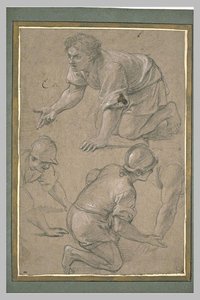
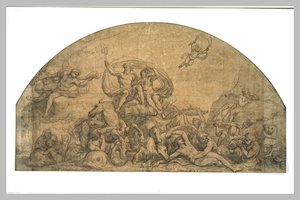
11The Repentant Magdalen (detail) (1655) by Charles Le BrunThe Repentant Magdalen (detail)1655 · The Louvre 12The Triumph of Faith (1658) by Charles Le BrunThe Triumph of Faith1658 · Château 13Portrait of the Sculptor Nicolas Le Brun (1635) by Charles Le BrunPortrait of the Sculptor Nicolas Le Brun1635 · Residenzgalerie 14Louis XIV Visiting the Gobelins Factory by Charles Le BrunLouis XIV Visiting the Gobelins FactoryThe Louvre 15Daedalus and Icarus (1645) by Charles Le BrunDaedalus and Icarus1645 · Hermitage Museum 16Hercules Liberates Hesione (1653) by Charles Le BrunHercules Liberates Hesione1653 · Staatliche Kunsthalle Karlsruhe 17The Holy Family in Egypt (1660) by Charles Le BrunThe Holy Family in Egypt1660 · Minneapolis Institute of Art 18Louis XIV. presenting his sceptre and helmet to Jesus Christ (1674) by Charles Le BrunLouis XIV. presenting his sceptre and helmet to Jesus Christ1674 · Museum of Fine Arts of Lyon 19Christ on the cross surrounded by angels (1600) by Charles Le BrunChrist on the cross surrounded by angels1600 · Groeningemuseum 20The Presentation of Christ in the Temple (1645) by Charles Le BrunThe Presentation of Christ in the Temple1645 · Detroit Institute of Arts 21The Road to Calvary (1600) by Charles Le BrunThe Road to Calvary1600 · Museum of Fine Arts 22The Death of Cato of Utica (1646) by Charles Le BrunThe Death of Cato of Utica1646 23Hercules Vanquishing Diomedes (1640) by Charles Le BrunHercules Vanquishing Diomedes1640 · Nottingham Castle Museum And Art Gallery 24The Crucifixion of Saint Andrew (1647) by Charles Le BrunThe Crucifixion of Saint Andrew1647 25Allegorical Female Figure with Two Putti (1640) by Charles Le BrunAllegorical Female Figure with Two Putti1640 26Bust of an Elderly Woman (1654) by Charles Le BrunBust of an Elderly Woman1654 · Bavarian State Painting Collections 27Allegory of Strength (1654) by Charles Le BrunAllegory of Strength1654 · Bavarian State Painting Collections 28Genius Holding a Shield (1654) by Charles Le BrunGenius Holding a Shield1654 · Bavarian State Painting Collections 29Genius Holding a Shield (1654) by Charles Le BrunGenius Holding a Shield1654 · Bavarian State Painting Collections 30Christ in the Desert Served by Angels (1653) by Charles Le BrunChrist in the Desert Served by Angels1653 31The Descent of the Holy Spirit (1656) by Charles Le BrunThe Descent of the Holy Spirit1656 32The Striking of the Rock (1650) by Charles Le BrunThe Striking of the Rock1650 33The Crucifix with Angels (1650) by Charles Le BrunThe Crucifix with Angels1650 34Door of the Unicorn (1659) by Charles Le BrunDoor of the Unicorn1659 35The Tomb of Seneca (1650) by Charles Le BrunThe Tomb of Seneca1650 36Saint John the Evangelist at Patmos (1656) by Charles Le BrunSaint John the Evangelist at Patmos1656 · Grand Trianon 37The Fall of the Rebel Angels (1650) by Charles Le BrunThe Fall of the Rebel Angels1650 · Opera House 38Presumed Portrait of the Artist Presenting That of a Military Officer (1650) by Charles Le BrunPresumed Portrait of the Artist Presenting That of a Military Officer1650 · Opera House 39The Fall of the Rebel Angels (1650) by Charles Le BrunThe Fall of the Rebel Angels1650 · Opera House 40Christ in the Garden of Olives (1659) by Charles Le BrunChrist in the Garden of Olives1659 41Portrait of Louis XIV (1650) by Charles Le BrunPortrait of Louis XIV1650 · la Cour D'or 42The Brazen Serpent (1649) by Charles Le BrunThe Brazen Serpent1649 43Venus Clipping Cupid’s Wings (1655) by Charles Le BrunVenus Clipping Cupid’s Wings1655 · Museo de Arte de Ponce 44Judgement of Paris (1650) by Charles Le BrunJudgement of Paris1650 · National Museum of Fine Arts of Cuba 45La Lapidation de saint Étienne by Charles Le Brun (1651) by Charles Le BrunLa Lapidation de saint Étienne by Charles Le Brun1651 46Apotheosis of Luis XIV. (1660) by Charles Le BrunApotheosis of Luis XIV.1660 · Slovak National Gallery 47Mary Magdalene (1654) by Charles Le BrunMary Magdalene1654 · Bavarian State Painting Collections 48John at Patmos (1654) by Charles Le BrunJohn at Patmos1654 · Bavarian State Painting Collections 49Portrait of the painter Louis Testelin (1650) by Charles Le BrunPortrait of the painter Louis Testelin1650 50The Martyrdom of St. Andrew (1646) by Charles Le BrunThe Martyrdom of St. Andrew1646 · J. Paul Getty Museum 51Portrait of Nicolas Fouquet (1615-1680) (1650) by Charles Le BrunPortrait of Nicolas Fouquet (1615-1680)1650 52Saint Jean l'évangéliste à Patmos (1658) by Charles Le BrunSaint Jean l'évangéliste à Patmos1658 · Musée Fabre 53Mars and Venus (1650) by Charles Le BrunMars and Venus1650 54Water or The Triumph of Neptune and Amphitrite (1662) by Charles Le BrunWater or The Triumph of Neptune and Amphitrite1662 55Figures and Decorative Motifs (1665) by Charles Le BrunFigures and Decorative Motifs1665 56Air (1664) by Charles Le BrunAir1664 57Figures and Decorative Motifs (1671) by Charles Le BrunFigures and Decorative Motifs1671 58Autumn (1662) by Charles Le BrunAutumn1662 59Mars and Venus (1674) by Charles Le BrunMars and Venus1674 60The Battle of Arbelles (1673) by Charles Le BrunThe Battle of Arbelles1673 61Battle of the Granicus (1673) by Charles Le BrunBattle of the Granicus1673 62Night or Diane (1662) by Charles Le BrunNight or Diane1662 63Evening (1662) by Charles Le BrunEvening1662 64The Massacre of the Innocents (1665) by Charles Le BrunThe Massacre of the Innocents1665 · Dulwich Picture Gallery 65Assumption of the Virgin (1670) by Charles Le BrunAssumption of the Virgin1670 · Muzeum Palacu Króla Jana Iii w Wilanowie 66The Gardener Children: Winter (1675) by Charles Le BrunThe Gardener Children: Winter1675 67Funerary Effigy of Henriette Sélincart (1680) by Charles Le BrunFunerary Effigy of Henriette Sélincart1680 · Musee des Beaux-Arts 68The King governs by himself, 1661 (1681) by Charles Le BrunThe King governs by himself, 16611681 · Château de Versailles 69Order restored in the Kingdom's finances (1681) by Charles Le BrunOrder restored in the Kingdom's finances1681 · Château de Versailles 70capture the citadel (1681) by Charles Le Bruncapture the citadel1681 · Château de Versailles 71Descent from the Cross (1679) by Charles Le BrunDescent from the Cross1679 · Musée des Beaux-Arts 72The Adoration of the Shepherds (1689) by Charles Le BrunThe Adoration of the Shepherds1689 73Christ carrying His cross (1688) by Charles Le BrunChrist carrying His cross1688 74Musée Ingres-Bourdelle - Allégorie à la gloire de Louis XIV - Charles Le Brun (1690) by Charles Le BrunMusée Ingres-Bourdelle - Allégorie à la gloire de Louis XIV - Charles Le Brun1690 · Musée Ingres Bourdelle 75Landscape (1784) by Charles Le BrunLandscape1784 · Statens Museum For Kunst 76Tapestry - “Fire” or “The Forges of Vulcan” (1600) by Charles Le BrunTapestry - “Fire” or “The Forges of Vulcan”1600 · Medeiros e Almeida Museum 77La repas de Chimon by Charles Le BrunLa repas de Chimon 78Alexander and Porus (1665) by Charles Le BrunAlexander and Porus1665 · The Louvre 79Portrait of Turenne (1665) by Charles Le BrunPortrait of Turenne1665 · Château de Versailles 80The Conquest of Franche-Comté (1674) by Charles Le BrunThe Conquest of Franche-Comté1674 · Château de Versailles 81Allegory: Sculpture Working on the King's Bust by Charles Le BrunAllegory: Sculpture Working on the King's BustThe Louvre 82Chancellor Séguier at the Entry of Louis XIV into Paris in 1660 by Charles Le BrunChancellor Séguier at the Entry of Louis XIV into Paris in 1660 83Portrait of Senator Ya.F. Dolgoruky by Charles Le BrunPortrait of Senator Ya.F. DolgorukyHermitage Museum 84The Family of Darius before Alexander (1660) by Charles Le BrunThe Family of Darius before Alexander1660 · Château de Versailles 85The Resolution of Louis XIV to Make War on the Dutch Republic (1671) by Charles Le BrunThe Resolution of Louis XIV to Make War on the Dutch Republic1671 · Musée des Beaux-Arts 86Louis XIV 1 by Charles Le BrunLouis XIV 1 87The Descent from the Cross by Charles Le BrunThe Descent from the CrossShipley Art Gallery 88The Holy Family by Charles Le BrunThe Holy FamilyFitzwilliam Museum 89Le passage du Rhin by Charles Le BrunLe passage du Rhin 90Le baptême de saint Eustache by Charles Le BrunLe baptême de saint Eustache 91Trois hommes à genoux by Charles Le BrunTrois hommes à genoux 92Christ en Croix by Charles Le BrunChrist en Croix 93Alexandre et Porus ou La Défaite de Porus by Charles Le BrunAlexandre et Porus ou La Défaite de Porus 94Un fleuve; une tête de femme by Charles Le BrunUn fleuve; une tête de femme 95Soldat casqué, à mi-corps by Charles Le BrunSoldat casqué, à mi-corps 96Fragment de bataille by Charles Le BrunFragment de bataille 97Homme drapé prosterné. Jeune homme à mi-corps, les bras en avant by Charles Le BrunHomme drapé prosterné. Jeune homme à mi-corps, les bras en avant 98Neptune et Amphitrite ou Le Réveil des eaux by Charles Le BrunNeptune et Amphitrite ou Le Réveil des eaux 99Equestrian Portrait of Louis XIV of France by Charles Le BrunEquestrian Portrait of Louis XIV of France 100Portrait of M. Quatrehomme du Lys by Charles Le BrunPortrait of M. Quatrehomme du Lys

Charles Le Brun's famous paintings, period by period

The subjects that held Charles Le Brun's eye

The four subjects that come back most often in these originals, each with its finest example.

The museums that keep Charles Le Brun's originals

The 8 museums that hold the most of the paintings on this page.

Museum City Works by Charles Le Brun Paintings from this list
The Louvre, ParisThe Louvre Paris 12 Louis XIV, King of France, Expressions of the Passions of the Soul, The Repentant Magdalen
Château de Versailles, VersaillesChâteau de Versailles Versailles 7 Louis XIV Visiting the Gobelins Factory, The King governs by himself, 1661, Order restored in the Kingdom's finances
Bavarian State Painting Collections, MunichBavarian State Painting Collections Munich 6 Bust of an Elderly Woman, Allegory of Strength, Genius Holding a Shield
Opera House, VersaillesOpera House Versailles 3 The Fall of the Rebel Angels, Presumed Portrait of the Artist Presenting That of a Military Officer, The Fall of the Rebel Angels
Szépművészeti Múzeum, BudapestSzépművészeti Múzeum Budapest 2 Apotheosis of Louis XIV, Apotheose of Louis XIV
Château, Vaux le VicomteChâteau Vaux le Vicomte 2 Hercules (detail), The Triumph of Faith
Museum of Fine Arts of Lyon, LyonMuseum of Fine Arts of Lyon Lyon 2 The Resurrection of Jesus Christ, Louis XIV. presenting his sceptre and helmet to Jesus Christ
Hermitage Museum, Saint PetersburgHermitage Museum Saint Petersburg 2 Daedalus and Icarus, Portrait of Senator Ya.F. Dolgoruky

Charles Le Brun decade by decade: the original that defines each

Works per decade

Pick a decade to see the original that defines it.

Collectors' questions about Charles Le Brun's paintings

Which work is Charles Le Brun most famous for?Reveal the answer

Apotheosis of Louis XIV (1600), Szépművészeti Múzeum, Budapest. Louis XIV, King of France and Louis XIV Visiting the Gobelins Factory (1673) come next.

What are the ten most famous Charles Le Brun paintings?Reveal the answer

Apotheosis of Louis XIV, Louis XIV, King of France, Louis XIV Visiting the Gobelins Factory, Expressions of the Passions of the Soul, The Repentant Magdalen, Pietà, Hercules (detail), Apotheose of Louis XIV, Martyrdom of St John the Evangelist at Porta Latina and The Resurrection of Jesus Christ. The ranking above gives each one's year and museum.

How many paintings did Charles Le Brun leave?Reveal the answer

Our catalog holds 232 works by Charles Le Brun, dated from 1635 to 1690.

In which museums do Charles Le Brun's masterpieces hang?Reveal the answer

Mostly in The Louvre (Paris), Château de Versailles (Versailles) and Bavarian State Painting Collections (Munich). The museum table above lists them all.

In which years did Charles Le Brun paint the most famous works?Reveal the answer

In 1650s: 30 of the 100 works on this page were made then, The Repentant Magdalen among them.

What are the first and the last famous originals of Charles Le Brun?Reveal the answer

On this page, the earliest is Portrait of the Sculptor Nicolas Le Brun (1635) and the latest Musée Ingres-Bourdelle - Allégorie à la gloire de Louis XIV - Charles Le Brun (1690).

Which subjects did Charles Le Brun choose most often?Reveal the answer

Man (27), Drapery (24) and Clouds (23), across the 100 works on this page.

Which technique did Charles Le Brun use most?Reveal the answer

Oil On Canvas, for 41 of the 100 works on this page.

To which art movement does Charles Le Brun belong?Reveal the answer

Baroque, judging by the originals on this page.

Which Charles Le Brun works hang at the The Louvre?Reveal the answer

Louis XIV, King of France, Expressions of the Passions of the Soul and The Repentant Magdalen: the The Louvre, Paris holds 8 of the works on this page.

Charles Le Brun: life and work

Early Life and Training

  • Born: Paris, France (1619)
  • Baptised: 24 February 1619
  • Died: 12 February 1690 Paris, Kingdom of France
  • Charles Le Brun displayed artistic talent from a young age. At the age of eleven, he entered the studio of Simon Vouet under the patronage of Chancellor Séguier.
  • He further studied with François Perrier and received early commissions from Cardinal Richelieu, demonstrating considerable skill even at fifteen.
  • A pivotal period in his development was a four-year stay in Rome (1642-1646), where he worked under the guidance of Nicolas Poussin. This experience profoundly shaped his artistic style and theoretical understanding of art.
  • During this time, Le Brun studied ancient Roman sculpture and copied works by Raphael, absorbing influences from both classical antiquity and contemporary Italian masters.

Artistic Development and Style

  • Upon returning to Paris in 1646, Le Brun quickly gained recognition and patronage. His early style reflected the influence of Vouet and Poussin, but he gradually developed a more personal approach.
  • Le Brun's artistic evolution involved moving away from strict adherence to classical models towards a more dynamic and expressive Baroque style.
  • He became known for his grand historical paintings, portraiture, and decorative work, often characterized by dramatic compositions, rich colors, and meticulous detail.
  • A significant series of works depicting the history of Alexander the Great showcased his ability to combine historical narrative with artistic grandeur.

Major Achievements and Royal Service

  • Le Brun's career reached its peak during the reign of Louis XIV, who appointed him First Painter to the King in 1664. This position granted him immense influence over French art.
  • He played a crucial role in decorating the Palace of Versailles, creating iconic works such as the Ambassadors’ Staircase, the Hall of Mirrors, and the Peace and War Rooms. These projects cemented his reputation as a master decorator and designer.
  • Le Brun was also responsible for designing many statues in the gardens of Versailles, demonstrating his versatility across various artistic disciplines.
  • He founded the Académie Royale de Peinture et de Sculpture (Royal Academy of Painting and Sculpture) in 1648, solidifying his position as a leader within the French art world. He served as its director for many years.

Legacy and Historical Significance

  • Charles Le Brun's influence on French art was profound. His work helped define the Baroque style in France and established him as one of the most important artists of his time.
  • As a theorist, he emphasized the importance of intellectual engagement over mere visual appeal, shaping artistic education for generations to come.
  • His decorative schemes at Versailles set a standard for royal palaces throughout Europe.
  • Le Brun's legacy extends beyond his individual works; he played a vital role in establishing and promoting French art on an international stage.