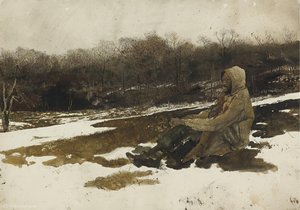
Portrait of Andrew Wyeth

The 61 Most Famous Andrew Wyeth Paintings, Each One of a Kind

Updated October 2026 · ranked by our popularity score (searches, visits and orders for each work) · 61 works by Andrew Wyeth in our catalogue

In short

Christina's World (1948) is the Andrew Wyeth painting that draws the most eyes; the original belongs to the MOMA - Museum of Modern Art, New York City. After it, the eye goes to Lovers (1981) and Winter Fields (1942). Among the 61 works of Andrew Wyeth in our catalog, these 61 are the most famous, each a unique original presented with its year, its museum and the reason it endures.

1917 – 2009, Chadds Ford Township Contemporary realism Most works: Museum of Fine Arts

Top 10 paintings by Andrew Wyeth, through the gallery's eye

1
Christina's World (1948) by Andrew Wyeth

Christina's World

1948 · Tempera On Panel · MOMA - Museum of Modern Art, New York City

Painted in 1948, this iconic work by Andrew Wyeth transcends mere representation, becoming a poignant meditation on longing, isolation, and the human condition. It depicts a young woman, identified as Anna Christina Olson, lying in a field, her gaze fixed upon a distant farmhouse – a scene imbued with both serenity and melancholic yearning.

2
Lovers (1981) by Andrew Wyeth

Lovers

1981 · Oil On Canvas

The artwork titled Lovers was executed by the American artist Andrew Wyeth. This specific piece was created about 1981. The painting was originally given as a gift to the artist's wife, Betsy.

3
Winter Fields (1942) by Andrew Wyeth

Winter Fields

1942 · Tempera On Panel · Whitney Museum of American Art, New York

In the quiet, frost-bitten landscape of Andrew Newell Wyeth’s 1942 masterpiece, Winter Fields, there exists a profound stillness that transcends mere seasonal depiction. At first glance, the viewer is met with a scene of stark, desolate beauty: a single dead crow rests amidst the tall, desiccated grasses of a winter field. Yet, to look closer is to enter a meditative space where the boundaries between life and death, presence and…

4
Day Dream (1980) by Andrew Wyeth

Day Dream

1980 · Oil · Hammer Museum, Los Angeles

Andrew Newell Wyeth, a master of American Regionalism, possessed an extraordinary ability to distill the essence of everyday life into paintings that resonate with profound emotional depth. His 1980 work, "Day Dream," exemplifies this talent, offering a glimpse into a private world of contemplation and subtle yearning. The painting depicts a woman, seemingly lost in thought, reclining on a bed within a modestly furnished room—a scene both familiar and imbued…

8
Grape Wine (1966) by Andrew Wyeth

Grape Wine

1966

This striking portrait depicts Willard Snowden, a drifter who lived in the artist’s Pennsylvania studio for several years and sat for several paintings in the mid-1960s. Wyeth used tempera and set him before a featureless background, elements characteristic of Renaissance portraiture—thereby elevating the humble sitter like the nobility typically featured in such paintings. Sensitively rendered at life-size in a palette of russet browns, the portrait is rich with subtle detail,…

Andrew Wyeth's famous paintings, numbers 11 to 61

The subjects that held Andrew Wyeth's eye

The four subjects that come back most often in these originals, each with its finest example.

The museums that keep Andrew Wyeth's originals

The 8 museums that hold the most of the paintings on this page.

Museum City Works by Andrew Wyeth Paintings from this list
Museum of Fine Arts, BostonMuseum of Fine Arts Boston 3 Sandspit, Corner of the Woods, Anna Christina
Brandywine Museum of Art, Delaware CountyBrandywine Museum of Art Delaware County 2 Sallie Curtis McCoy, The Critic
Smithsonian American Art Museum, Washington, D.C.Smithsonian American Art Museum Washington, D.C. 2 Roaring Reef, November First
MOMA - Museum of Modern Art, New York CityMOMA - Museum of Modern Art New York City 1 Christina's World
Whitney Museum of American Art, New YorkWhitney Museum of American Art New York 1 Winter Fields
Hammer Museum, Los AngelesHammer Museum Los Angeles 1 Day Dream
Pennsylvania Academy of Fine Arts, PhiladelphiaPennsylvania Academy of Fine Arts Philadelphia 1 Young America
Science History Institute, PhiladelphiaScience History Institute Philadelphia 1 The Alchemist

Andrew Wyeth across the decades: one unique original for each

Works per decade

Pick a decade to see the original that defines it.

Andrew Wyeth's paintings: questions for the gallery

What is the single most famous work of Andrew Wyeth?Reveal the answer

Christina's World (1948), MOMA - Museum of Modern Art, New York City. Lovers (1981) and Winter Fields (1942) come next.

At what age did Andrew Wyeth create Christina's World?Reveal the answer

31 years old: Christina's World dates from 1948, and Andrew Wyeth was born in 1917.

Which ten paintings by Andrew Wyeth are the most famous?Reveal the answer

Christina's World, Lovers, Winter Fields, Day Dream, Wind from the Sea, Henry Teel, Anna Christina, Grape Wine, Allen (oodie) lynch and Bikini. The ranking above gives each one's year and museum.

How many works by Andrew Wyeth are known?Reveal the answer

Our catalog holds 61 works by Andrew Wyeth, dated from 1935 to 1990.

Where can the most famous Andrew Wyeth originals be seen?Reveal the answer

Mostly in Museum of Fine Arts (Boston), Brandywine Museum of Art (Delaware County) and Smithsonian American Art Museum (Washington, D.C.). The museum table above lists them all.

During which period did Andrew Wyeth create the best-known paintings?Reveal the answer

In 1950s: 7 of the 61 works on this page were made then, Snow Flurries among them.

Which famous Andrew Wyeth painting is the earliest, and which the latest?Reveal the answer

On this page, the earliest is Sallie Curtis McCoy (1935) and the latest The Critic (1990).

What subjects did Andrew Wyeth favour?Reveal the answer

American art (5), Rural pennsylvania (5) and Interior (3), across the 61 works on this page.

What materials did Andrew Wyeth paint with most?Reveal the answer

Tempera On Panel, for 2 of the 61 works on this page.

Which movement does the work of Andrew Wyeth belong to?Reveal the answer

Contemporary realism and Regionalism, judging by the originals on this page.

What Andrew Wyeth originals can I see at the Museum of Fine Arts?Reveal the answer

Sandspit, Corner of the Woods and Anna Christina: the Museum of Fine Arts, Boston holds 3 of the works on this page.

Andrew Wyeth: a portrait of the artist

Early Life and Family Influences

  • Birth and Background: Andrew Newell Wyeth was born on July 12, 1917, in Chadds Ford, Pennsylvania, to illustrator N.C. Wyeth and Carolyn Bockius Wyeth.
  • Family of Artists: He grew up in a family deeply immersed in the arts. His father was a renowned illustrator, and several of his siblings also pursued artistic careers including Henriette Wyeth Hurd, Carolyn Wyeth, and Nathaniel Wyeth.
  • Home-Schooled Education: Due to frail health, Andrew received a home education from his father, N.C. Wyeth. This fostered a close relationship with his father and allowed for an intensely focused artistic development.
  • Early Artistic Development: His father served as his primary instructor, encouraging him to observe nature closely and develop his own unique style. He began drawing at a very young age, demonstrating remarkable talent early on.

Artistic Style and Techniques

  • Regionalism: Wyeth is often associated with the American Regionalist movement, which emphasized depictions of rural America during the 1930s. However, his work transcended simple regional representation.
  • Realism: His paintings are characterized by a meticulous realism, capturing details and textures with remarkable precision. He strived to portray subjects as they appeared in reality.
  • Egg Tempera and Watercolor: Wyeth primarily used egg tempera for his larger works, a medium known for its luminosity and detail. He also frequently employed watercolor for smaller studies and sketches.
  • Chiaroscuro: A notable aspect of his style is the use of chiaroscuro – the dramatic contrast between light and dark – to create mood and depth in his paintings.

Major Works and Themes

  • Christina’s World (1948): Arguably his most famous work, "Christina's World" depicts a woman crawling through a field towards a farmhouse. It is celebrated for its emotional power and exploration of themes like isolation, perseverance, and the human condition.
  • Other Notable Paintings: Other significant works include “Distant Thunder,” “The Cliffs," “Herring Cove,” "Sledding Hill" and numerous portraits and landscapes depicting rural Pennsylvania and coastal Maine.
  • Recurring Themes: Wyeth’s art frequently explores themes of isolation, memory, the passage of time, and the beauty found in everyday life. His subjects often reflect a sense of quiet contemplation and introspection.
  • Models and Inspiration: He drew inspiration from the people and landscapes around him, particularly Christina Olson, who became a frequent model, and the Cushing, Maine area where he spent summers.

Influences and Legacy

  • Winslow Homer: Wyeth admired the work of Winslow Homer, another prominent American realist painter known for his depictions of marine subjects and rural life.
  • Henry David Thoreau: The writings of Henry David Thoreau, particularly his emphasis on nature and self-reliance, deeply influenced Wyeth’s artistic philosophy.
  • King Vidor's "The Big Parade": He credited King Vidor's film “The Big Parade” as a significant influence on his understanding of family dynamics and storytelling through visual imagery.
  • Critical Reception: While initially met with mixed reviews, Wyeth’s work gained widespread recognition and acclaim over time. He became one of the most celebrated American artists of the 20th century.
  • Historical Significance: Andrew Wyeth's art is considered a significant contribution to American realism, capturing the essence of rural life and exploring universal themes with profound emotional depth. His legacy continues to inspire artists and captivate audiences worldwide.

Later Years and Death

  • Continued Artistic Production: Throughout his later years, Wyeth continued to paint prolifically, exploring new subjects and refining his techniques.
  • Recognition and Awards: He received numerous awards and honors throughout his career, including the National Medal of Arts in 1998.
  • Death: Andrew Wyeth died on January 16, 2009, at his home in Cushing, Maine, at the age of 91. His death marked the end of an era in American art.

All 61 works by Andrew Wyeth →