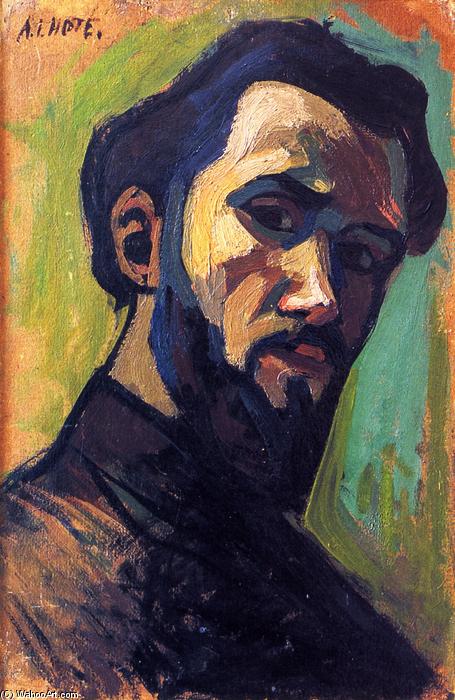
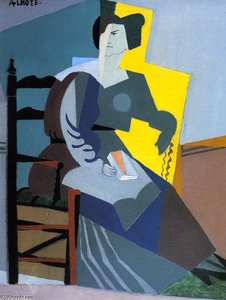
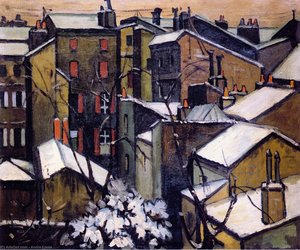
Portrait of André Lhote

The 27 Most Famous André Lhote Paintings, Each One of a Kind

Updated October 2026 · ranked by our popularity score (searches, visits and orders for each work) · 27 works by André Lhote in our catalogue

In short

Study for The Garden of Love'''' (1909) is the André Lhote painting that draws the most eyes. After it, the eye goes to Rugby (1917) and The Sailor's Meal (1914). Among the 27 works of André Lhote in our catalog, these 27 are the most famous, each a unique original presented with its year, its museum and the reason it endures.

1885 – 1962, Bordeaux Cubism Most works: Kelvingrove Art Gallery and Museum

Top 10 paintings by André Lhote, through the gallery's eye

5
View of the City of Nevers (1911) by André Lhote

View of the City of Nevers

1911

The View of the City of Nevers is a stunning oil on canvas painting created by Andre Lhote in 1911. This beautiful cityscape measures 66 x 133 cm and is a prime example of Lhote's unique style, which blends elements of Cubism and Fauvism. As a professional art expert and salesman at https://AllPaintingsStore.com, I can attest that this painting is a must-have for any art enthusiast. Artist Background Andre Lhote…

6
Trees at Avignon (1914) by André Lhote

Trees at Avignon

1914 · Oil On Canvas · Musee Malraux, Havre

To gaze upon André Lhote’s Trees at Avignon is to step through a veil and into a sun-dappled moment suspended in time. This painting captures the profound, almost palpable atmosphere of a dense woodland, rendered with a warmth that seems to emanate from the canvas itself. The subject matter—a cluster of trees bathed in a yellowish, golden light—is deceptively simple. Yet, Lhote elevates this natural scene into something deeply resonant,…

André Lhote's famous paintings, numbers 11 to 27

The subjects that held André Lhote's eye

The four subjects that come back most often in these originals, each with its finest example.

The museums that keep André Lhote's originals

The 6 museums that hold the most of the paintings on this page.

Museum City Works by André Lhote Paintings from this list
Kelvingrove Art Gallery and Museum, GlasgowKelvingrove Art Gallery and Museum Glasgow 2 Nude, Head of a Woman
Centre Pompidou, ParisCentre Pompidou Paris 2 Woman in a Bonnet, Sulking, Portrait of a Woman, Full Face/Profile
Musee Malraux, HavreMusee Malraux Havre 1 Trees at Avignon
National Gallery, AthensNational Gallery Athens 1 Nude
John and Mable Ringling Museum of Art, SarasotaJohn and Mable Ringling Museum of Art Sarasota 1 Harbor
Musée des Beaux-Arts de Bordeaux, BordeauxMusée des Beaux-Arts de Bordeaux Bordeaux 1 Two Friends

André Lhote across the decades: one unique original for each

Works per decade

Pick a decade to see the original that defines it.

André Lhote's paintings: questions for the gallery

What is the single most famous work of André Lhote?Reveal the answer

Study for The Garden of Love'''' (1909). Rugby (1917) and The Sailor's Meal (1914) come next.

At what age did André Lhote create Study for The Garden of Love''''?Reveal the answer

24 years old: Study for The Garden of Love'''' dates from 1909, and André Lhote was born in 1885.

Which ten paintings by André Lhote are the most famous?Reveal the answer

Study for The Garden of Love'''', Rugby, The Sailor's Meal, Nude, View of the City of Nevers, Trees at Avignon, Nude, Harbor, Self-Portrait and Undergrowth. The ranking above gives each one's year and museum.

How many works by André Lhote are known?Reveal the answer

Our catalog holds 27 works by André Lhote, dated from 1908 to 1932.

Where can the most famous André Lhote originals be seen?Reveal the answer

Mostly in Kelvingrove Art Gallery and Museum (Glasgow), Centre Pompidou (Paris) and Musee Malraux (Havre). The museum table above lists them all.

During which period did André Lhote create the best-known paintings?Reveal the answer

In 1910s: 17 of the 27 works on this page were made then, Rugby among them.

Which famous André Lhote painting is the earliest, and which the latest?Reveal the answer

On this page, the earliest is Self-Portrait (1908) and the latest Shooting Gallery (1932).

What subjects did André Lhote favour?Reveal the answer

Geometric forms (2), Fruits (2) and Interior scene (2), across the 27 works on this page.

What materials did André Lhote paint with most?Reveal the answer

Oil On Canvas, for 6 of the 27 works on this page.

Which movement does the work of André Lhote belong to?Reveal the answer

Cubism, judging by the originals on this page.

What André Lhote originals can I see at the Kelvingrove Art Gallery and Museum?Reveal the answer

Nude and Head of a Woman: the Kelvingrove Art Gallery and Museum, Glasgow holds 2 of the works on this page.

André Lhote: a portrait of the artist

André Lhote: A Pioneer of Cubist Vision

André Lhote, born in Bordeaux in 1885 and passing away in Paris in 1962, stands as a pivotal figure in the evolution of French Cubism. More than simply a painter, he was a theorist, critic, and influential educator whose work profoundly shaped the course of modern art. His journey began not within the hallowed halls of an academy, but amidst the practical skills of a woodcarver’s workshop – a grounding that would later inform his unique approach to depicting reality through fragmented forms and intersecting planes. This early exposure to craftsmanship instilled in him a meticulousness and attention to detail that became hallmarks of his mature style. Lhote's artistic development unfolded during a period of immense change and experimentation within the art world. Initially influenced by the vibrant colors and expressive distortions of Paul Gauguin, he quickly moved towards the radical innovations of Cézanne, absorbing the artist’s emphasis on geometric structure and the reduction of natural forms to their essential elements. This shift culminated in his embrace of Cubism, a movement he joined with considerable enthusiasm in 1912, aligning himself with luminaries like Fernand Léger, Albert Gleizes, and Jean Metzinger within the Section d'Or group. This association proved crucial, exposing him to the core tenets of Cubist theory – the simultaneous representation of multiple viewpoints, the fragmentation of objects into geometric components, and the exploration of spatial relationships through overlapping planes. His early works, such as *Port of Bordeaux* (1911), demonstrate this initial foray into Cubism, showcasing a bold departure from traditional perspective and a nascent interest in dissecting forms to reveal their underlying structure.

Early Life and Artistic Foundations

Lhote’s formative years were deeply rooted in the traditions of his native Bordeaux. His father apprenticed him to a furniture maker at the age of twelve, providing an invaluable education in wood carving and sculpture – skills that would later inform his meticulous approach to painting. This early training instilled within him a deep appreciation for craftsmanship and a keen eye for detail, qualities he carried with him throughout his career. He enrolled at the École des Beaux-Arts in Bordeaux in 1898, studying decorative sculpture until 1904, where he honed his technical skills and began to experiment with different artistic styles. Crucially, it was during this period that he developed a passion for painting, pursuing it largely independently of formal instruction. This self-directed learning, combined with the influence of Gauguin and Cézanne, laid the groundwork for his distinctive Cubist vision. Leaving Bordeaux in 1905, Lhote moved to Paris, determined to establish himself as an artist. He initially worked in a Fauvist style, characterized by bold colors and expressive brushstrokes, but quickly recognized the limitations of this approach. He sought a more rigorous and intellectually stimulating path, leading him towards the revolutionary ideas of Cubism. His first solo exhibition at Galerie Druet in 1910 marked a significant milestone, establishing his presence within the Parisian art scene and signaling his commitment to exploring new artistic possibilities.

The Rise of Section d'Or and Theoretical Contributions

Lhote’s arrival in Paris coincided with the emergence of the Section d'Or group, a collective of avant-garde artists who championed Cubism and sought to challenge established artistic conventions. Joining this influential circle in 1912 provided Lhote with invaluable exposure and intellectual stimulation. The Salon de la Section d'Or, held at Galerie La Boëtie in 1912, showcased the group’s radical approach to representation, featuring works by figures such as Pablo Picasso, Georges Braque, and Juan Gris. Lhote’s *Port of Bordeaux* was a key piece within this exhibition, demonstrating his ability to translate complex spatial relationships into a dynamic and visually arresting composition. Beyond his artistic practice, Lhote made significant contributions to the theoretical discourse surrounding Cubism. He became a regular contributor to *La Nouvelle Revue Française*, a journal founded in 1909 that championed modern art and challenged traditional aesthetic values. Through his articles and essays, he articulated the core principles of Cubist theory – emphasizing the importance of analyzing objects from multiple viewpoints, reducing forms to their essential geometric components, and exploring spatial relationships through overlapping planes. His writings were instrumental in shaping the understanding and acceptance of Cubism within the art world.

Teaching, Legacy, and Lasting Influence

Lhote’s influence extended far beyond his own artistic creations. He recognized the importance of educating future generations of artists and established his own school, the Académie André Lhote, in Montparnasse in 1922. This institution became a breeding ground for talent, attracting a diverse cohort of students – including Henri Cartier-Bresson, Conrad O’Brien-ffrench, Elena Mumm Thornton Wilson, and many other prominent figures who would go on to make significant contributions to the art world. His teaching philosophy emphasized rigorous observation, analytical thinking, and a deep understanding of artistic principles. Following World War I, Lhote continued to lecture extensively throughout Europe and beyond, sharing his insights and promoting the ideas of Cubism. He remained actively involved in the art scene until his death in Paris in 1962, leaving behind a rich legacy as a painter, theorist, critic, and educator. André Lhote’s work continues to be studied and admired for its innovative approach to representation, its intellectual rigor, and its enduring influence on the development of modern art. His commitment to both artistic creation and theoretical exploration cemented his place as a truly exceptional figure in the history of 20th-century art.