


1


Updated October 2026 · ranked by our popularity score (searches, visits and orders for each work) · 56 works by Alma Thomas in our catalogue
In short
Of all the originals Alma Thomas left, the most famous is Earth Sermon Beauty, Love And Peace (1971). Close behind it come The Stormy Sea (1958) and Light Blue Nursery (1968). Our catalog holds 56 works by Alma Thomas; the gallery has kept the 49 the world admires most, each shown with its date, its museum and its story.


To stand before Alma Thomas’s "Light Blue Nursery" is to step into a vibrant dreamscape, a place where pure color sings and structure finds joyous release. This painting, executed in 1968, is not merely an arrangement of hues; it is a celebration of childhood wonder filtered through the masterful hand of an artist whose life was itself a testament to enduring spirit. The composition immediately arrests the eye with its…

To gaze upon Celestial Fantasy is to step through a veil into a dreamscape painted with the most delicate touch. Alma Thomas, an artist whose life was a vibrant exploration of color, captured here not merely a view of the heavens, but the very sensation of looking up at them—a moment suspended between wakefulness and wonder. This piece, dating from 1973, exemplifies her mature style, moving beyond mere representation into…


Educated at Howard University and Columbia University, Alma Thomas was associated with the Washington Color School, which also included her contemporaries such as Morris Louis and Sam Gilliam. Thomas was a champion of abstraction as an expressive art form that she believed could transcend specific politics, and chose her imagery and palette in repsonse to nature and scientific phenomena and advancements. Etude in Blue exemplifies a transition from her earlier…

In the vibrant masterpiece Snoopy Sees Earth Wrapped in Sunset, the legendary Alma Thomas invites us into a rhythmic, cosmic exploration of light and warmth. Created in 1970, this work serves as a breathtaking testament to the power of abstraction to evoke profound emotional responses. At first glance, the eye is drawn into a mesmerizing circular composition, where a radiant core of sun-drenched yellow bleeds softly into deep, passionate reds.…


 Red Abstraction1959
12
 Watusi (Hard Edge)1963
13
 Wind Dancing with Spring Flowers1969
14
 Breeze Rustling Through Fall Flowers1968 · The Phillips Collection
15
 Light Blue Nursery1968 · Smithsonian American Art Museum
16
 Cherry Blossom Symphony1968 · The Studio Museum in Harlem
17
 Springtime in Washington1971
18
 Fiery Sunset1973
19
 A Fantastic Sunset1970
20
 Gray Night1972 · Smithsonian American Art Museum
21
 Snow Reflections on Pond1973
22
 Wind and Crepe Myrtle Concerto1973
23
 Arboretum Presents White Dogwood1972
24
 Gray Night1972
25
 White Daisies Rhapsody1973
26
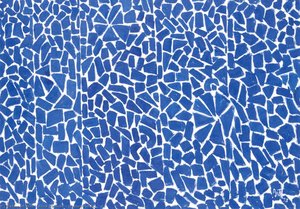 Elysian Fields1973
27
 Aquatic Gardens1973
28
 Spring Grass1973
29
 Atmospheric Effects I1970
30
 Grey Night Phenomenon1972
31
 The Eclipse1970
32
 Atmospheric Effects II1971
33
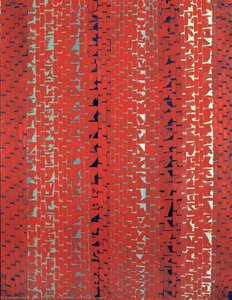 Red Sunset, Old Pond Concerto1972
34
 Snoopy Early Sun Display on Earth1970
35
 Antares1972
36
 White Roses Sing and Sing1976
37
 Red Azaleas Singing and Dancing Rock and Roll Music1976
38
 Before Autumn1974
39
 Fall Begins1976
40
 Grassy Melodic Chant1976
41
 Delightful Song by Red Dahlia1976
42
 Deep Blue1974
43
 Oriental Garden Concerto1976
44
 Untitled (Music Series)1978
45
 Autumn Leaves Fluttering in the Breeze1973
46
 Untitled
47
 Late Night Reflections1972 · Nasher Museum of Art at Duke University
48
 Untitled1970 · The Kinsey African American Art - History Collection
49
 Sky Light1973
The four subjects that come back most often in these originals, each with its finest example.
The 6 museums that hold the most of the paintings on this page.
| Museum | City | Works by Alma Thomas | Paintings from this list |
|---|---|---|---|
 Smithsonian American Art Museum |
Washington, D.C. | 5 | Light Blue Nursery, Celestial Fantasy, Red Abstraction |
 The Studio Museum in Harlem |
New York City | 2 | Untitled, Cherry Blossom Symphony |
 SCAD Museum of Art |
Savannah | 1 | Etude in Blue |
 The Phillips Collection |
Washington, D.C. | 1 | Breeze Rustling Through Fall Flowers |
 Nasher Museum of Art at Duke University |
Durham | 1 | Late Night Reflections |
 The Kinsey African American Art - History Collection |
Los Angeles | 1 | Untitled |
Pick a decade to see the original that defines it.
To stand before Alma Thomas’s "Light Blue Nursery" is to step into a vibrant dreamscape, a place where pure color sings and structure finds joyous release. This painting, executed in 1968, is not merely an arrangement of hues; it is a celebration of childhood wonder filtered through the masterful hand of an artist whose life was itself a testament to enduring spirit. The composition immediately arrests the eye with its…
Earth Sermon Beauty, Love And Peace (1971). The Stormy Sea (1958) and Light Blue Nursery (1968) come next.
80 years old: Earth Sermon Beauty, Love And Peace dates from 1971, and Alma Thomas was born in 1891.
Earth Sermon Beauty, Love And Peace, The Stormy Sea, Light Blue Nursery, Celestial Fantasy, Joe Summerford's Still Life Study, Etude in Blue, Snoopy Sees Earth Wrapped in Sunset, Red Abstraction, Blue and Brown Still Life and Untitled. The ranking above gives each one's year and museum.
Our catalog holds 56 works by Alma Thomas, dated from 1952 to 1978.
Mostly in Smithsonian American Art Museum (Washington, D.C.), The Studio Museum in Harlem (New York City) and SCAD Museum of Art (Savannah). The museum table above lists them all.
In 1970s: 35 of the 49 works on this page were made then, Earth Sermon Beauty, Love And Peace among them.
On this page, the earliest is Joe Summerford's Still Life Study (1952) and the latest Untitled (Music Series) (1978).
Geometric design (4), Geometric abstraction (2) and Patterned design (2), across the 49 works on this page.
Painting, for 3 of the 49 works on this page.
Abstract expressionism and Washington color school, judging by the originals on this page.
Light Blue Nursery, Celestial Fantasy and Red Abstraction: the Smithsonian American Art Museum, Washington, D.C. holds 5 of the works on this page.
