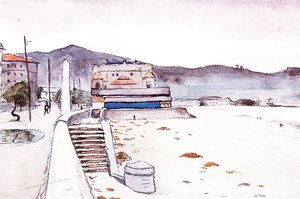
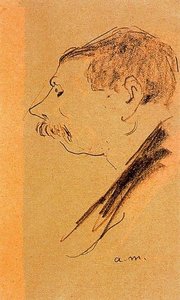
Portrait of Albert Marquet

The 100 Most Famous Albert Marquet Paintings, a Gallery Selection

Updated November 2026 · ranked by our popularity score (searches, visits and orders for each work) · 296 works by Albert Marquet in our catalogue

In short

Of all the originals Albert Marquet left, the most famous is National Holiday at Le Havre (1906), in the collection of the Villa Flora, Winterthur. Close behind it come Louvre Embankment and the New Bridge (1906) and Argel. La Plaza del Gobierno. Our catalog holds 296 works by Albert Marquet; the gallery has kept the 100 the world admires most, each shown with its date, its museum and its story.

1875 – 1947, Bordeaux Fauvism Most works: Hermitage Museum

Albert Marquet's top 10 paintings: the gallery's choice

1
National Holiday at Le Havre (1906) by Albert Marquet

National Holiday at Le Havre

1906 · Oil On Panel · Villa Flora, Winterthur

In 1906, the waterfront of Le Havre became a stage for a quiet, collective joy. This painting captures a national holiday, a moment where the rhythm of the city slows to accommodate the festivities. Along the river, boats sit docked, their presence grounding the scene in the reality of maritime life. People gather in small groups, some lingering near the water's edge while others move along the sidewalks. There is…

2
Louvre Embankment and the New Bridge (1906) by Albert Marquet

Louvre Embankment and the New Bridge

1906 · Oil On Canvas

To stand before Albert Marquet’s Louvre Embankment and the New Bridge is to be instantly transported into the vibrant, exhilarating heart of Paris at the turn of the 20th century. This oil on canvas, dating from 1906, is far more than a mere depiction of an urban vista; it is a captured moment of life—a symphony played out across the cobblestones and along the Seine. Marquet masterfully arrests the energy…

3
Argel. La Plaza del Gobierno by Albert Marquet

Argel. La Plaza del Gobierno

Lithograph

The artwork Argel. La Plaza del Gobierno is a creation by Albert Marquet. Born in 1875, the artist lived until 1947, leaving behind a vision shaped by the light of North Africa and the harbors of Europe. This specific piece captures a moment in Algiers, a place of movement and stone. It is also known by the title Alger, Le Palais Consulaire et La Place du Gouvernement. The work carries…

4
Academia en el taller de Gustave Moreau by Albert Marquet

Academia en el taller de Gustave Moreau

Charcoal

Academia en el taller de Gustave Moreau by Albert Marquet presents a scene centered on the practice of academic study. The subject matter focuses on a single figure positioned within a studio environment. This setting, which suggests a space dedicated to art history or the study of sculpture, contains a shelf populated with various objects that recede into the background. The arrangement of these elements creates a sense of a…

5
Window at Goulette by Albert Marquet

Window at Goulette

Oil

A vase of tulips sits upon a windowsill, their red and yellow petals catching the light. Beyond the glass, the world opens into a quiet expanse of water. A single boat sails across the distant blue, a small shape moving through the stillness. The scene is a quiet intersection of the domestic and the infinite. Inside, the flowers remain rooted and still; outside, the sea carries the vessel toward an…

6
Fruit, Knife and Napkin (1898) by Albert Marquet

Fruit, Knife and Napkin

1898 · Oil

In this 1898 still life, we find a moment of profound stillness captured on a table. The composition is anchored by a collection of fruit—apples, oranges, and pears—arranged with a sense of natural ease. Three apples are positioned across the scene, one to the left, one in the center, and a third toward the right, creating a rhythmic movement for the eye to follow. Two oranges provide weight to the…

7
Fishing Boats Returning, Collioure (1914) by Albert Marquet

Fishing Boats Returning, Collioure

1914 · Oil

The sea carries the weight of the day in its heavy, shifting tones. In this 1914 scene, the water is a vast expanse of color, holding several boats that drift upon its surface. Two sailboats dominate the view, one leaning toward the left and another anchored near the center, their forms cutting through the liquid light. Smaller vessels are scattered like debris across the swells, caught in the quiet rhythm…

8
Tempestad en La Goulette by Albert Marquet

Tempestad en La Goulette

Oil On Canvas

The composition of Tempestad en La Goulette is organized into distinct horizontal bands that define the landscape. At the base, a sandy beach meets the shoreline, where turbulent waves crash against the coast. A weathered wooden pier extends from the foreground into the water, creating a sharp linear element that cuts through the organic movement of the sea. In the distance, a mountain range rises against the horizon, its forms…

10
The Minaret at Sidi Bou Saïd by Albert Marquet

The Minaret at Sidi Bou Saïd

Oil On Canvas

The sun hangs suspended over a Mediterranean landscape, casting a soft, diffused glow across a coastal settlement. In this view of Sidi Bou Saïd, the architecture clings to the terrain, a cluster of geometric forms that seem to grow directly from the earth. A minaret rises above the rooftops, its silhouette a quiet anchor amidst the arrangement of buildings. The sea stretches toward a distant mountain range, where the colors…

The Albert Marquet selection continues, 11 to 100

11Party in Sables d´Olonne by Albert MarquetParty in Sables d´Olonne 12The Louvre Embankment and the Pont-Neuf in Paris (1906) by Albert MarquetThe Louvre Embankment and the Pont-Neuf in Paris1906 · Museum Boijmans Van Beuningen 13Portrait of Clémentine (1895) by Albert MarquetPortrait of Clémentine1895 14Girl Embroidering, Seated in a Garden (1896) by Albert MarquetGirl Embroidering, Seated in a Garden1896 15Nude Lying on a Flowered Drapery (1913) by Albert MarquetNude Lying on a Flowered Drapery1913 16Nude with Raised Arms (1912) by Albert MarquetNude with Raised Arms1912 17Standing Nude (1913) by Albert MarquetStanding Nude1913 18Posters at Trouville (1906) by Albert MarquetPosters at Trouville1906 · National Gallery of Art 19Women of Laghouat (1921) by Albert MarquetWomen of Laghouat1921 · Centre Pompidou 20The Woman in Blue (1928) by Albert MarquetThe Woman in Blue1928 · Musee d'art Moderne de la Ville de Paris 21Bay of Naples (1909) by Albert MarquetBay of Naples1909 · Hermitage Museum 22An Alley in the Jardin du Luxembourg (1901) by Albert MarquetAn Alley in the Jardin du Luxembourg1901 · Hermitage Museum 23View from a Balcony (1945) by Albert MarquetView from a Balcony1945 · Metropolitan Museum of Art 24Paris, Le Pont de l'Institut by Albert MarquetParis, Le Pont de l'Institut 25Samois by Albert MarquetSamois 26View of Saint-Jean-de-Luz (1907) by Albert MarquetView of Saint-Jean-de-Luz1907 · Hermitage Museum 27Pont-Neuf in the Snow (1910) by Albert MarquetPont-Neuf in the Snow1910 28The Garden at Pyla by Albert MarquetThe Garden at Pyla 29View of the Seine and the Monument to Henry IV (1906) by Albert MarquetView of the Seine and the Monument to Henry IV1906 · Hermitage Museum 30The port of Hamburg 2 by Albert MarquetThe port of Hamburg 2 31La Rochelle by Albert MarquetLa Rochelle 32La carreterra de La Frette by Albert MarquetLa carreterra de La Frette 33The port of Hamburg by Albert MarquetThe port of HamburgHermitage Museum 34Sables d'Olonne beach from the promenade by Albert MarquetSables d'Olonne beach from the promenade 35Milliners by Albert MarquetMillinersHermitage Museum 36The Village of Vosges (1892) by Albert MarquetThe Village of Vosges1892 37Young Girl on the Beach (1898) by Albert MarquetYoung Girl on the Beach1898 · Saint Louis Art Museum 38Le jardin de Saint-Cloud (1906) by Albert MarquetLe jardin de Saint-Cloud1906 · Los Angeles County Museum of Art 39Bouquet of Flowers, 1898 (1898) by Albert MarquetBouquet of Flowers, 18981898 40Parisian suburb (1897) by Albert MarquetParisian suburb1897 · Musée des Beaux-Arts et d'Archéologie 41Dock at Havre (1906) by Albert MarquetDock at Havre1906 · Centre Pompidou 42Quai des Grands Augustins (1905) by Albert MarquetQuai des Grands Augustins1905 · Musee des Beaux-Arts 43The Port of Algiers (1900) by Albert MarquetThe Port of Algiers1900 44The Gate of St. Cloud, Paris (1904) by Albert MarquetThe Gate of St. Cloud, Paris1904 · Cleveland Museum of Art 45The Apse of Notre Dame (1902) by Albert MarquetThe Apse of Notre Dame1902 · Musée des Beaux-Arts et d'Archéologie 46Le Port de la Ponche (1905) by Albert MarquetLe Port de la Ponche1905 47Notre Dame under Snow (1905) by Albert MarquetNotre Dame under Snow1905 · Musée cantonal des Beaux-Arts 48Le Pont-Neuf par temps gris (1905) by Albert MarquetLe Pont-Neuf par temps gris1905 49Outskirts of Paris (1905) by Albert MarquetOutskirts of Paris1905 50Rue Norvins and Place du Tertre in Montmartre (1905) by Albert MarquetRue Norvins and Place du Tertre in Montmartre1905 51View of Agay, the Red Rocks (1905) by Albert MarquetView of Agay, the Red Rocks1905 52The Billancourt Bridge (1904) by Albert MarquetThe Billancourt Bridge1904 53The Seine and the Apse of Notre Dame (1901) by Albert MarquetThe Seine and the Apse of Notre Dame1901 · Musee d'Art Moderne de Troyes 54Farmyard at La Percaillerie (1901) by Albert MarquetFarmyard at La Percaillerie1901 55Pot of Flowers (1900) by Albert MarquetPot of Flowers1900 56Perspective Notre-Dame (1904) by Albert MarquetPerspective Notre-Dame1904 · Musée des Beaux-Arts de Pau 57Snowscene at Porte de Versailles (1904) by Albert MarquetSnowscene at Porte de Versailles1904 · National Museum of Western Art 58The Port (1905) by Albert MarquetThe Port1905 · Kunstmuseum Den Haag 59Portrait of Aldre Rouveyre (1904) by Albert MarquetPortrait of Aldre Rouveyre1904 60Port of Hamburg (1909) by Albert MarquetPort of Hamburg1909 · Musee d'Art Moderne de Troyes 61Naked in the Stove by Albert MarquetNaked in the Stove 62Landscape with a Ferry Boat (1911) by Albert MarquetLandscape with a Ferry Boat1911 · Musee d'art Moderne de la Ville de Paris 63Le Havre (1906) by Albert MarquetLe Havre1906 · Foundation E.G. Bührle Collection 64Vedette in Hamburg (1909) by Albert MarquetVedette in Hamburg1909 · Yale University Art Gallery 65Vue de Paris, le quai du Louvre (1906) by Albert MarquetVue de Paris, le quai du Louvre1906 66Honfleur (1911) by Albert MarquetHonfleur1911 · Pushkin State Museum 67The Port of Naples (1909) by Albert MarquetThe Port of Naples1909 · Musée des Beaux-Arts et d'Archéologie 68Le port de Fécamp (1906) by Albert MarquetLe port de Fécamp1906 · Musée des Beaux-Arts de Quimper 69Le Louvre, Cour du Carrousel (1909) by Albert MarquetLe Louvre, Cour du Carrousel1909 · Bavarian State Painting Collections 70The Boardwalk at Sainte-Adresse (1906) by Albert MarquetThe Boardwalk at Sainte-Adresse1906 · Museum of Fine Arts 71Louvre Embankment and the New Bridge (1906) by Albert MarquetLouvre Embankment and the New Bridge1906 · Hermitage Museum 72Louvre Embankment, Summer (1906) by Albert MarquetLouvre Embankment, Summer1906 · Hermitage Museum 73Place de la Trinity in Paris (1911) by Albert MarquetPlace de la Trinity in Paris1911 · Hermitage Museum 74Le Pont Saint-Michel (1910) by Albert MarquetLe Pont Saint-Michel1910 · Los Angeles County Museum of Art 75Pont Saint Michel, Paris (1910) by Albert MarquetPont Saint Michel, Paris1910 · Art Institute of Chicago 76Pont-Neuf in Sunshine (1906) by Albert MarquetPont-Neuf in Sunshine1906 · Art Gallery of Ontario 77View of the beach at Hendaya by Albert MarquetView of the beach at Hendaya 78Two Women by Albert MarquetTwo Women 79Ribera de la Mancha by Albert MarquetRibera de la Mancha 80Mujer de espaldas by Albert MarquetMujer de espaldas 81Desnudo de pie by Albert MarquetDesnudo de pie 82Nude of a woman by Albert MarquetNude of a woman 83Fabrica del extrarradio by Albert MarquetFabrica del extrarradio 84El descanso de la modelo by Albert MarquetEl descanso de la modelo 85En el muelle de Hamburgo by Albert MarquetEn el muelle de Hamburgo 86El Zuavo by Albert MarquetEl Zuavo 87The port of Boulogne by Albert MarquetThe port of Boulogne 88Port of Hamburg by Albert MarquetPort of Hamburg 89Nápoles-El velero by Albert MarquetNápoles-El velero 90André Rouveyre by Albert MarquetAndré RouveyreCentre Pompidou 91Puerta de Saint Cloud by Albert MarquetPuerta de Saint Cloud 92Tempest on the sea by Albert MarquetTempest on the sea 93Mujer en la calle by Albert MarquetMujer en la calle 94Mujer cosiendo by Albert MarquetMujer cosiendo 95El muelle Conti bajo la nieve by Albert MarquetEl muelle Conti bajo la nieve 96Desnudo sobre fondo azul by Albert MarquetDesnudo sobre fondo azul 97Personaje de perfil by Albert MarquetPersonaje de perfil 98Un hombre feliz by Albert MarquetUn hombre feliz 99Hombre en la calle by Albert MarquetHombre en la calle 100Mujer de cabellos largos by Albert MarquetMujer de cabellos largos

Albert Marquet's famous paintings, period by period

The subjects that held Albert Marquet's eye

The four subjects that come back most often in these originals, each with its finest example.

The museums that keep Albert Marquet's originals

The 8 museums that hold the most of the paintings on this page.

Museum City Works by Albert Marquet Paintings from this list
Hermitage Museum, Saint PetersburgHermitage Museum Saint Petersburg 11 Bay of Naples, An Alley in the Jardin du Luxembourg, View of Saint-Jean-de-Luz
Centre Pompidou, ParisCentre Pompidou Paris 14 Women of Laghouat, Dock at Havre, André Rouveyre
Musée des Beaux-Arts et d'Archéologie, BésonçonMusée des Beaux-Arts et d'Archéologie Bésonçon 6 Parisian suburb, The Apse of Notre Dame, The Port of Naples
Musee d'art Moderne de la Ville de Paris, ParisMusee d'art Moderne de la Ville de Paris Paris 6 The Woman in Blue, Landscape with a Ferry Boat
National Museum of Western Art, TokyoNational Museum of Western Art Tokyo 3 Sitting Nude, Snowscene at Porte de Versailles
Los Angeles County Museum of Art, Los AngelesLos Angeles County Museum of Art Los Angeles 2 Le jardin de Saint-Cloud, Le Pont Saint-Michel
Musee d'Art Moderne de Troyes, TroyesMusee d'Art Moderne de Troyes Troyes 2 The Seine and the Apse of Notre Dame, Port of Hamburg
Pushkin State Museum, MoscowPushkin State Museum Moscow 6 Honfleur

Albert Marquet decade by decade: the original that defines each

Works per decade

Pick a decade to see the original that defines it.

Collectors' questions about Albert Marquet's paintings

Which work is Albert Marquet most famous for?Reveal the answer

National Holiday at Le Havre (1906), Villa Flora, Winterthur. Louvre Embankment and the New Bridge (1906) and Argel. La Plaza del Gobierno come next.

What age was Albert Marquet when National Holiday at Le Havre was made?Reveal the answer

31 years old: National Holiday at Le Havre dates from 1906, and Albert Marquet was born in 1875.

What are the ten most famous Albert Marquet paintings?Reveal the answer

National Holiday at Le Havre, Louvre Embankment and the New Bridge, Argel. La Plaza del Gobierno, Academia en el taller de Gustave Moreau, Window at Goulette, Fruit, Knife and Napkin, Fishing Boats Returning, Collioure, Tempestad en La Goulette, Sitting Nude and The Minaret at Sidi Bou Saïd. The ranking above gives each one's year and museum.

How many paintings did Albert Marquet leave?Reveal the answer

Our catalog holds 296 works by Albert Marquet, dated from 1892 to 1945.

In which museums do Albert Marquet's masterpieces hang?Reveal the answer

Mostly in Hermitage Museum (Saint Petersburg), Centre Pompidou (Paris) and Musée des Beaux-Arts et d'Archéologie (Bésonçon). The museum table above lists them all.

In which years did Albert Marquet paint the most famous works?Reveal the answer

In 1900s: 39 of the 100 works on this page were made then, National Holiday at Le Havre among them.

What are the first and the last famous originals of Albert Marquet?Reveal the answer

On this page, the earliest is The Village of Vosges (1892) and the latest View from a Balcony (1945).

Which subjects did Albert Marquet choose most often?Reveal the answer

People (12), Sky (12) and Boats (9), across the 100 works on this page.

Which technique did Albert Marquet use most?Reveal the answer

Oil On Canvas, for 19 of the 100 works on this page.

To which art movement does Albert Marquet belong?Reveal the answer

Fauvism, judging by the originals on this page.

Which Albert Marquet works hang at the Hermitage Museum?Reveal the answer

Bay of Naples, An Alley in the Jardin du Luxembourg and View of Saint-Jean-de-Luz: the Hermitage Museum, Saint Petersburg holds 9 of the works on this page.

Albert Marquet: life and work

A Life Immersed in Light and Color

Born in Bordeaux, France, in 1875, Albert Marquet’s artistic journey was one of subtle evolution, beginning with the explosive energy of Fauvism and ultimately settling into a deeply personal form of naturalistic expression. His early life took a pivotal turn at fifteen when he moved to Paris and enrolled at the École des Arts Décoratifs. It was here that his path intertwined with that of Henri Matisse – a friendship that would prove profoundly influential. The two young artists not only shared camaraderie but also a studio, fostering an environment of creative exchange that shaped their early work. Marquet continued his studies at the prestigious École des Beaux-Arts under Gustave Moreau, absorbing the Symbolist aesthetic while simultaneously charting his own course toward modern expression. These formative years laid the groundwork for his participation in exhibitions that would challenge conventional artistic norms and redefine the landscape of art.

From Fauve Ferocity to Serene Landscapes

Marquet’s emergence as an artist coincided with the birth of Fauvism, a movement celebrated for its bold use of color and expressive brushwork. He exhibited alongside Matisse, André Derain, Maurice de Vlaminck, and others at the infamous 1905 Salon d'Automne, where critics derisively labeled them “les fauves” – the wild beasts. While embracing the Fauvist palette, Marquet’s approach remained uniquely his own. Unlike some contemporaries who reveled in unrestrained chromatic intensity, he possessed a remarkable control over drawing and light, subtly modulating colors to create harmonious compositions. This inherent restraint hinted at his later evolution towards a more naturalistic style. Around 1910, Marquet began distancing himself from the purely expressive fervor of Fauvism, increasingly turning to landscapes as his primary subject matter. He embarked on extensive travels throughout Europe and North Africa, seeking inspiration in the ports, beaches, and cityscapes that would become hallmarks of his mature work. These journeys weren’t merely about depicting locations; they were explorations of atmosphere, light, and the subtle poetry of everyday life.
A Master of Atmosphere and Light

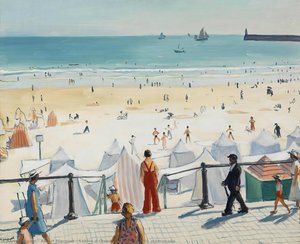
Marquet's artistic vision was deeply rooted in a sensitivity to light and atmosphere. His landscapes are not simply representations of places but rather evocations of mood and sensation. He masterfully captured shimmering reflections on water, the hazy glow of sunlight filtering through mist, and the subtle nuances of color that define a particular time of day or season. He often returned to the same locations repeatedly, observing how light transformed the scene over time – a testament to his dedication to capturing ephemeral effects. This is vividly evident in his numerous paintings of the Seine River in Paris, the harbors of Normandy, and the coastal landscapes of North Africa. His technique involved abbreviated brushstrokes and a muted palette—grays, blues, and ochres—allowing him to convey both form and atmosphere with remarkable economy. Matisse himself recognized a kinship between Marquet’s work and that of Japanese masters like Hokusai, noting a shared emphasis on calligraphic simplicity and the evocative power of line. The artist wasn't interested in merely reproducing what he saw; he sought to capture the feeling of being there.

Legacy and Enduring Influence

Albert Marquet passed away in 1947, leaving behind a body of work that continues to captivate audiences with its quiet beauty and subtle emotional depth. His paintings are held in prestigious museums worldwide, including the Musée National d'Art Moderne in Paris, attesting to his enduring significance in the history of modern art. While initially recognized as a key figure in Fauvism, Marquet’s lasting legacy lies in his ability to transcend stylistic labels and create a uniquely personal vision. He demonstrated that it was possible to embrace modernity without sacrificing traditional values such as draftsmanship and composition. His influence can be seen in the work of subsequent generations of landscape painters who sought to capture the fleeting beauty of the natural world with sensitivity and restraint. Marquet’s art reminds us of the power of observation, the importance of light, and the enduring appeal of a serene and contemplative vision. He remains a testament to the artist's ability to find profound meaning in the everyday.

Key Characteristics of Marquet’s Style

  • Fauvist Beginnings: Early works demonstrate bold color palettes characteristic of Fauvism, though with more restraint than some contemporaries.
  • Emphasis on Light and Atmosphere: A defining feature of his mature work, focusing on capturing the ephemeral qualities of light and its effect on landscapes.
  • Muted Palette: A preference for grays, blues, and ochres to convey atmosphere and form with economy.
  • Abbreviated Brushstrokes: A technique used to suggest rather than define details, enhancing the sense of movement and light.
  • Influence of Japanese Art: A noted appreciation for the calligraphic simplicity and evocative power of line found in Japanese prints.