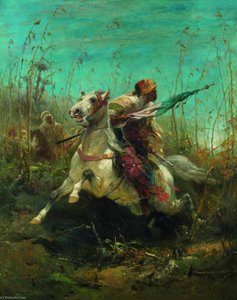
Portrait of Adolf Schreyer

Adolf Schreyer Paintings: The 84 Most Famous, Through a Gallery's Eye

Updated November 2026 · ranked by our popularity score (searches, visits and orders for each work) · 85 works by Adolf Schreyer in our catalogue

In short

To the gallery's eye, Adolf Schreyer's most famous painting is Arabian Horseman Near A Watering Place. Arab on Horseback (1853) and truck at a waterplace (1853) complete the trio every eye recognises. Of the 85 works by Adolf Schreyer in our catalog, the gallery presents the 84 most famous below, each original with its year, its museum and what makes it unique.

1828 – 1899, Frankfurt Academicism Most works: Art Institute of Chicago

The gallery's top 10 Adolf Schreyer paintings

1
Arabian Horseman Near A Watering Place by Adolf Schreyer

Arabian Horseman Near A Watering Place

Oil On Canvas

Arabian Horseman Near A Watering Place is an oil painting by Adolf Schreyer. The canvas captures a moment of stillness in the desert, where riders and horses gather near a source of water. This work reflects the specific focus of Schreyer, a German Orientalist artist who spent his life observing the light and movement of the East. He was associated with the Düsseldorf school of painting, a tradition known for…

2
Arab on Horseback (1853) by Adolf Schreyer

Arab on Horseback

1853 · Lithograph

In this work, titled Arab on Horseback, we encounter the hand of Adolf Schreyer. The piece dates to about 1853, a period when the artist was beginning to establish his presence within the European art scene. Schreyer, who was born in Frankfurt, Germany, in 1828, brought a specific, disciplined perspective to his depictions of life and movement.

3
truck at a waterplace (1853) by Adolf Schreyer

truck at a waterplace

1853 · Oil

There is a profound sense of gravity in this 1853 oil painting. We find ourselves observing a heavy, horse-drawn wagon as it navigates a rugged, rural landscape. The scene captures a moment of laborious movement, where the sheer weight of the load is felt through the straining muscles of the horses and the deep, textured tracks left in the dirt. This work, often identified as a Wallachian transport, follows a…

4
Arabs Resting by a Marble Fountain (1856) by Adolf Schreyer

Arabs Resting by a Marble Fountain

1856 · Oil · Städel Museum, Frankfurt

Arabs Resting by a Marble Fountain is an oil painting by the German artist Adolf Schreyer. Executed in 1856, the work emerged during a period when Schreyer was traveling through Egypt and Syria. His presence in these regions allowed for a direct engagement with the landscapes and subjects that would define his career.

6
Hungarian landscape with a herd of horses (1857) by Adolf Schreyer

Hungarian landscape with a herd of horses

1857 · Oil On Canvas

The oil on canvas titled Hungarian landscape with a herd of horses was executed by the German painter Adolf Schreyer. Created about 1857, the work captures a specific moment of movement across the plains. A group of riders on horseback moves through a grassy field, their forms integrated into the wide expanse of the terrain.

7
Arabs on the March (1873) by Adolf Schreyer

Arabs on the March

1873 · Oil On Canvas · Metropolitan Museum of Art, New York

The oil on canvas work titled Arabs on the March belongs to the artist Adolf Schreyer. Born in Frankfurt, Germany, in 1828, Schreyer developed a style deeply rooted in the observation of distant lands. This specific piece is an Orientalist painting. It resides within the collection of the Metropolitan Museum of Art in New York.

8
Arabian Horsemen (1885) by Adolf Schreyer

Arabian Horsemen

1885 · Oil On Canvas · Phoenix Art Museum, Phoenix

The oil painting Arabian Horsemen by Adolf Schreyer captures a group of riders moving through a rugged, arid landscape. Dated 1885, the work focuses on the nobility and intensity of nomadic life. A central white horse moves through the scene, its pale coat contrasting against the deep ochre and sienna tones of the earth. The riders wear flowing garments that catch the light of a vast sky.

9
An Arab Horseman On The March by Adolf Schreyer

An Arab Horseman On The March

Oil On Canvas

An Arab Horseman On The March is an oil on canvas work by Adolf Schreyer. The artist, born in Frankfurt, Germany, in 1828, practiced during a period when Academicism was a dominant style in French art. This movement emphasized traditional techniques and historical themes, qualities reflected in Schreyer's approach to his subjects.

10
Arab Horsemen 1 by Adolf Schreyer

Arab Horsemen 1

Oil On Canvas

Arab Horsemen 1 is a painting by the German artist Adolf Schreyer. Born in Frankfurt, Germany, in 1828, Schreyer spent much of his career documenting the landscapes and people of the East. He remained active in his profession until his death in 1899. This specific work focuses on a group of Arab horsemen as they traverse a desert landscape.

Adolf Schreyer paintings, ranked 11 to 84

11Arab Horsemen by Adolf SchreyerArab Horsemen 12The Chase by Adolf SchreyerThe Chase 13Arab Warrior Leading A Charge by Adolf SchreyerArab Warrior Leading A Charge 14carriage + horses in moore-landscape (1853) by Adolf Schreyercarriage + horses in moore-landscape1853 15Arab Caravan (1860) by Adolf SchreyerArab Caravan1860 · Dayton Art Institute 16landscape four Cossacks with their horses (1857) by Adolf Schreyerlandscape four Cossacks with their horses1857 17The Charge (1869) by Adolf SchreyerThe Charge1869 18Halt at the Inn (1872) by Adolf SchreyerHalt at the Inn1872 · Detroit Institute of Arts 19The Attack (1881) by Adolf SchreyerThe Attack1881 · New York Historical Society 20In Front of the Tavern by Adolf SchreyerIn Front of the TavernBavarian State Painting Collections 21Arabs by Adolf SchreyerArabsSaint Louis Art Museum 22Eastern Soldiers with a Horse Drinking by Adolf SchreyerEastern Soldiers with a Horse DrinkingNational Gallery of Ireland 23Arab Horsemen Resting at a Fountain by Adolf SchreyerArab Horsemen Resting at a FountainMuseum of Fine Arts 24Arabs on Horseback by Adolf SchreyerArabs on Horseback 25The Wallachian Team by Adolf SchreyerThe Wallachian Team 26Arab Horsemen by Adolf SchreyerArab HorsemenReading Public Museum 27The Plains of Hungary by Adolf SchreyerThe Plains of HungaryWalters Art Museum 28Cossacks In A Landscape by Adolf SchreyerCossacks In A Landscape 29Cossacks Watering Their Horses by Adolf SchreyerCossacks Watering Their Horses 30Horseman On The Russian Steppe by Adolf SchreyerHorseman On The Russian Steppe 31Arab Scouts On Horseback by Adolf SchreyerArab Scouts On Horseback 32Battle Scene: Arabs Making a Detour by Adolf SchreyerBattle Scene: Arabs Making a DetourMetropolitan Museum of Art 33Persued By Wolves by Adolf SchreyerPersued By Wolves 34Arab Chieftain And His Entourage by Adolf SchreyerArab Chieftain And His Entourage 35Horses at the Water by Adolf SchreyerHorses at the WaterBavarian State Painting Collections 36Arab Horsemen by Adolf SchreyerArab HorsemenNational Gallery of Ireland 37Two Arab Horsemen by Adolf SchreyerTwo Arab HorsemenMuseum of Fine Arts 38Untitled (D2X838) by Adolf SchreyerUntitled (D2X838) 39Arab Warriors by Adolf SchreyerArab Warriors 40Wallachian Wagon Under Attack by Adolf SchreyerWallachian Wagon Under Attack 41Wallachian Horsemen In A Winter Landscape by Adolf SchreyerWallachian Horsemen In A Winter Landscape 42The Shelter by Adolf SchreyerThe Shelter 43Man with Lance Riding Through the Snow by Adolf SchreyerMan with Lance Riding Through the SnowArt Institute of Chicago 44Arabs in Egypt, Sunrise by Adolf SchreyerArabs in Egypt, SunriseWalters Art Museum 45Cavaliers by Adolf SchreyerCavaliersNational Museum in Warsaw 46Ottoman Encampment by Adolf SchreyerOttoman Encampment 47Wallachian Blizzard by Adolf SchreyerWallachian Blizzard 48A Rest By The Fountain by Adolf SchreyerA Rest By The Fountain 49The Lonely Rider by Adolf SchreyerThe Lonely Rider 50Arab Horseman In A Landscape by Adolf SchreyerArab Horseman In A Landscape 51The Chase Of The Cossacks by Adolf SchreyerThe Chase Of The Cossacks 52The Warrior by Adolf SchreyerThe Warrior 53Hitching Horses to the Wagon by Adolf SchreyerHitching Horses to the Wagon 54The Watering Place by Adolf SchreyerThe Watering Place 55Arabs Watering Their Horses by Adolf SchreyerArabs Watering Their Horses 56The Ambush by Adolf SchreyerThe Ambush 57The Pursuit by Adolf SchreyerThe Pursuit 58The Lion Hunt by Adolf SchreyerThe Lion Hunt 59A Horse Race In The Hippodrome by Adolf SchreyerA Horse Race In The Hippodrome 60Arabs On Horseback by Adolf SchreyerArabs On Horseback 61A Troika In Winter by Adolf SchreyerA Troika In Winter 62Arab Horsemen On The March by Adolf SchreyerArab Horsemen On The March 63The Messenger by Adolf SchreyerThe Messenger 64The Pass Over The Hills by Adolf SchreyerThe Pass Over The Hills 65A Rest before the Battle by Adolf SchreyerA Rest before the Battle 66Approaching The City by Adolf SchreyerApproaching The City 67Arabian Patrol by Adolf SchreyerArabian Patrol 68Arabian Horseman by Adolf SchreyerArabian Horseman 69The Skirmish by Adolf SchreyerThe Skirmish 70Arabs on Horseback 1 by Adolf SchreyerArabs on Horseback 1 71Caravan On The Open Road by Adolf SchreyerCaravan On The Open Road 72Arab Horsemen By A Watering Hole by Adolf SchreyerArab Horsemen By A Watering Hole 73Arab Cavalry Approaching An Oasis by Adolf SchreyerArab Cavalry Approaching An Oasis 74In Pursuit by Adolf SchreyerIn Pursuit 75On The March by Adolf SchreyerOn The March 76At The Watering Place by Adolf SchreyerAt The Watering Place 77Scouts On The Lookout by Adolf SchreyerScouts On The Lookout 78Fording a Stream by Adolf SchreyerFording a Stream 79Desert Canter by Adolf SchreyerDesert Canter 80Homeward Bound by Adolf SchreyerHomeward Bound 81Arabischer Schimmelreiter by Adolf SchreyerArabischer Schimmelreiter 82Arab Warriors On A Hillside by Adolf SchreyerArab Warriors On A Hillside 83The Oasis by Adolf SchreyerThe Oasis 84Arabischer Reiter An Einter Tranke by Adolf SchreyerArabischer Reiter An Einter Tranke

Adolf Schreyer's famous paintings, period by period

The subjects that held Adolf Schreyer's eye

The four subjects that come back most often in these originals, each with its finest example.

The museums that keep Adolf Schreyer's originals

The 8 museums that hold the most of the paintings on this page.

Museum City Works by Adolf Schreyer Paintings from this list
Art Institute of Chicago, ChicagoArt Institute of Chicago Chicago 2 Peasants and Horses, Man with Lance Riding Through the Snow
Metropolitan Museum of Art, New YorkMetropolitan Museum of Art New York 2 Arabs on the March, Battle Scene: Arabs Making a Detour
Bavarian State Painting Collections, MunichBavarian State Painting Collections Munich 2 In Front of the Tavern, Horses at the Water
National Gallery of Ireland, Dublin CityNational Gallery of Ireland Dublin City 2 Eastern Soldiers with a Horse Drinking, Arab Horsemen
Museum of Fine Arts, BostonMuseum of Fine Arts Boston 2 Arab Horsemen Resting at a Fountain, Two Arab Horsemen
Walters Art Museum, BaltimoreWalters Art Museum Baltimore 2 The Plains of Hungary, Arabs in Egypt, Sunrise
Städel Museum, FrankfurtStädel Museum Frankfurt 1 Arabs Resting by a Marble Fountain
Phoenix Art Museum, PhoenixPhoenix Art Museum Phoenix 1 Arabian Horsemen

Adolf Schreyer, one signature painting per decade

Works per decade

Pick a decade to see the original that defines it.

Adolf Schreyer's paintings: the gallery answers

Which Adolf Schreyer painting is the most famous of all?Reveal the answer

Arabian Horseman Near A Watering Place. Arab on Horseback (1853) and truck at a waterplace (1853) come next.

Which are Adolf Schreyer's top 10 paintings?Reveal the answer

Arabian Horseman Near A Watering Place, Arab on Horseback, truck at a waterplace, Arabs Resting by a Marble Fountain, Peasants and Horses, Hungarian landscape with a herd of horses, Arabs on the March, Arabian Horsemen, An Arab Horseman On The March and Arab Horsemen 1. The ranking above gives each one's year and museum.

How many works did Adolf Schreyer create?Reveal the answer

Our catalog holds 85 works by Adolf Schreyer, dated from 1853 to 1885.

Where do Adolf Schreyer's most famous originals hang?Reveal the answer

Mostly in Art Institute of Chicago (Chicago), Metropolitan Museum of Art (New York) and Bavarian State Painting Collections (Munich). The museum table above lists them all.

When did Adolf Schreyer create the most famous paintings?Reveal the answer

In 1850s: 6 of the 84 works on this page were made then, Arab on Horseback among them.

Which are Adolf Schreyer's earliest and latest famous works?Reveal the answer

On this page, the earliest is Arab on Horseback (1853) and the latest Arabian Horsemen (1885).

Which subjects did Adolf Schreyer return to most?Reveal the answer

Horses (15), Wars (11) and Landscape (10), across the 84 works on this page.

Which medium did Adolf Schreyer work in most?Reveal the answer

Oil On Canvas, for 7 of the 84 works on this page.

Which movement is Adolf Schreyer associated with?Reveal the answer

Academicism, judging by the originals on this page.

Which Adolf Schreyer originals does the Art Institute of Chicago hold?Reveal the answer

Peasants and Horses and Man with Lance Riding Through the Snow: the Art Institute of Chicago, Chicago holds 2 of the works on this page.

Adolf Schreyer: the artist

A Life Immersed in Equine Grace and Eastern Light

Adolf Schreyer, born in Frankfurt in 1828, was a painter whose life became inextricably linked to the powerful beauty of horses and the evocative landscapes of the East. His artistic journey began within the structured walls of the Städel Institute in his hometown, followed by formative studies in Stuttgart and Munich—a classical foundation upon which he would build a remarkably distinctive style. However, it was Schreyer’s travels that truly ignited his creative spirit and defined his enduring legacy. He wasn't merely observing these lands; he immersed himself within them, accompanying Prince Maximilian Karl of Thurn and Taxis on extensive journeys through Hungary, Wallachia, Russia, and Turkey. These weren’t superficial visits but deep dives into diverse cultures, allowing Schreyer to absorb the atmosphere, the light, and most importantly, the lives of the people he encountered. This early exposure instilled in him a fascination with both the grandeur of equestrian life and the vibrant tapestry of Eastern cultures—themes that would dominate his oeuvre for decades to come.

From Battlefield Sketches to Orientalist Visions

Schreyer’s artistic development took a pivotal turn in 1854 when he documented the Austrian army's movements across the Wallachian frontier. This experience, far from being solely a military commission, provided him with invaluable insight into the realities of conflict and the role of horses within it. He wasn’t simply recording events; he was capturing the energy, the chaos, and the raw power of battle—a skill that would later manifest in compelling depictions of imperial guard artillery charges. Yet, his artistic heart lay elsewhere. Following this period, Schreyer ventured further afield, to Egypt and Syria in 1856, and then Algeria in 1861. It was in North Africa that he truly found his muse. He didn’t remain a detached observer; he learned Arabic, rode with Bedouin horsemen, and became deeply integrated into their way of life. This intimate understanding allowed him to portray these cultures with an authenticity rarely seen in Orientalist paintings of the time. His canvases weren't simply exotic representations but heartfelt tributes to a world that had captivated his imagination.

A Master of Equine Anatomy and Atmospheric Detail

Schreyer’s technical skill was as remarkable as his adventurous spirit. He possessed an exceptional understanding of equine anatomy, born not just from observation but also from personal experience as a rider. His horses weren't merely props within a scene; they were dynamic, living creatures rendered with meticulous detail and anatomical precision. This mastery extended to his landscapes, which are often imbued with a palpable sense of atmosphere—the shimmering heat of the desert, the vastness of the Russian steppe, or the dramatic skies over Wallachian plains. He employed a rich palette and a confident brushstroke, creating paintings that were both visually stunning and emotionally resonant. His work stands apart from some of his contemporaries through its avoidance of overly romanticized depictions; instead, he strived for realism grounded in genuine observation.

Recognition and Enduring Legacy

Throughout his career, Schreyer received considerable recognition for his talent. He exhibited regularly at the Paris Salon, earning medals in 1864, 1865, 1867, and 1876—a testament to the esteem in which his work was held by the French art establishment. His paintings found their way into prestigious collections across Europe and America, including the Metropolitan Museum of Art in New York, the Kunsthalle in Hamburg, and the Städel Institute in Frankfurt. Notably, several prominent American collectors – members of families like the Rockefellers, Vanderbilts, and Astors – eagerly acquired his works, recognizing their unique quality and artistic merit. Today, Schreyer’s paintings continue to captivate audiences with their blend of historical detail, cultural sensitivity, and technical brilliance. He remains a significant figure in 19th-century art, celebrated for his ability to capture the essence of both equine grace and the allure of distant lands. His legacy endures not only through the beauty of his canvases but also as a reminder of the power of travel, observation, and genuine cultural immersion to inspire artistic greatness.