Portrait of Achille Devéria

The 55 Most Famous Achille Devéria Paintings, Each One of a Kind

Updated November 2026 · ranked by our popularity score (searches, visits and orders for each work) · 55 works by Achille Devéria in our catalogue

In short

The Model's Pose (1838) is the Achille Devéria painting that draws the most eyes; the original belongs to the Musée de la Vie Romantique, Paris. After it, the eye goes to Madame Lavergne and her husband on the cart of the condemned? (1840) and The Glorification of Saint Clotilde (1851). Among the 55 works of Achille Devéria in our catalog, these 55 are the most famous, each a unique original presented with its year, its museum and the reason it endures.

1800 – 1857, Paris Romanticism Most works: Musée de la Vie Romantique

Top 10 paintings by Achille Devéria, through the gallery's eye

1
The Model's Pose (1838) by Achille Devéria

The Model's Pose

1838 · Oil On Canvas · Musée de la Vie Romantique, Paris

The Model's Pose is a genre painting by the French artist Achille Devéria. Created about 1838, this oil on canvas work captures a specific moment within an artist's studio. The scene focuses on the creative environment, presenting a cluttered interior that contains various objects, artworks, and sculptures. The composition centers on the interaction between an artist seated at an easel and a model posing nearby.

2
Madame Lavergne and her husband on the cart of the condemned? (1840) by Achille Devéria

Madame Lavergne and her husband on the cart of the condemned?

1840 · Oil On Canvas · Museum of the French Revolution, Vizille

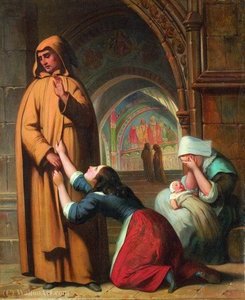
In this somber scene from 1840, we find ourselves amidst the heavy, suffocating atmosphere of a crowded urban procession. The composition is dense, pulling the viewer into a narrow street where the architecture seems to lean inward, heightening the sense of claustrophobia. At the heart of this chaos, a woman in a light-colored bodice reaches toward the sky, her gesture one of profound appeal or perhaps sheer desperation. Beside her,…

3
The Glorification of Saint Clotilde (1851) by Achille Devéria

The Glorification of Saint Clotilde

1851 · Oil

Achille Devéria painted The Glorification of Saint Clotilde about 1851. The work centers on the hagiographic narrative of Saint Clotilde, the queen and consort of the Merovingian king Clovis I. Through her upward-reaching gesture, the composition symbolizes divine favor and spiritual triumph within a celestial realm.

4
Example - (46374) by Achille Devéria

Example - (46374)

Oil

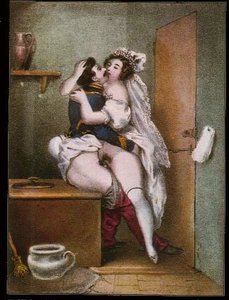
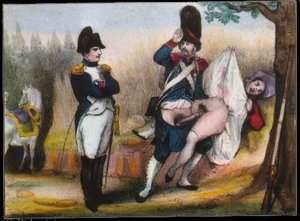
Example - (46374) is a colorful work by the French painter Achille Devéria. The composition centers on a man in military uniform engaging in sexual activity with another person. The figure in uniform is positioned on top of the second individual, who lies down within the scene.

5
Small and innocent games by Achille Devéria

Small and innocent games

A woman sits upon the ground, her blue dress spreading like a pool of ink against the earth. Her legs are parted, a posture of unstudied ease amidst a crowd of figures. Above her, a person stands, casting a shadow that anchors the composition. Nearby, a book lies discarded on the floor, its pages silent and still. The scene is a collection of human moments, a social gathering caught in…

6
Example - (23316) by Achille Devéria

Example - (23316)

Painting

Example - (23316) emerges as a painting by the French artist Achille Devéria. This work captures a quiet, social gathering where the air seems thick with the scent of old paper and the soft clink of glassware. Within the scene, four figures—two men and two women—find themselves suspended in a moment of shared leisure. The men occupy sturdy chairs while the women rest upon couches, creating a relaxed geometry of…

7
Example - (56456) by Achille Devéria

Example - (56456)

Painting

Example - (56456) is an artwork by Achille Devéria. The artist, born in Paris, France, in 1800, captured the fleeting movements of human life through his brush. His hand moved with precision until his death in 1857. This piece exists as a fragment of his long creative output, a moment held still within the frame.

Achille Devéria's famous paintings, numbers 11 to 55

The subjects that held Achille Devéria's eye

The four subjects that come back most often in these originals, each with its finest example.

The museums that keep Achille Devéria's originals

The 3 museums that hold the most of the paintings on this page.

Museum City Works by Achille Devéria Paintings from this list
Musée de la Vie Romantique, ParisMusée de la Vie Romantique Paris 1 The Model's Pose
Museum of the French Revolution, VizilleMuseum of the French Revolution Vizille 1 Madame Lavergne and her husband on the cart of the condemned?
The Fryderyk Chopin Institute, WarsawThe Fryderyk Chopin Institute Warsaw 1 Portrait of Jane Wilhelmine Stirling with a girl

Achille Devéria across the decades: one unique original for each

Works per decade

Pick a decade to see the original that defines it.

Achille Devéria's paintings: questions for the gallery

What is the single most famous work of Achille Devéria?Reveal the answer

The Model's Pose (1838), Musée de la Vie Romantique, Paris. Madame Lavergne and her husband on the cart of the condemned? (1840) and The Glorification of Saint Clotilde (1851) come next.

At what age did Achille Devéria create The Model's Pose?Reveal the answer

38 years old: The Model's Pose dates from 1838, and Achille Devéria was born in 1800.

Which ten paintings by Achille Devéria are the most famous?Reveal the answer

The Model's Pose, Madame Lavergne and her husband on the cart of the condemned?, The Glorification of Saint Clotilde, Example - (46374), Small and innocent games, Example - (23316), Example - (56456), Hugues-bernard maret, Aruj - (19th cent) and La déclaration d'amour. The ranking above gives each one's year and museum.

How many works by Achille Devéria are known?Reveal the answer

Our catalog holds 55 works by Achille Devéria, dated from 1838 to 1851.

Where can the most famous Achille Devéria originals be seen?Reveal the answer

Mostly in Musée de la Vie Romantique (Paris), Museum of the French Revolution (Vizille) and The Fryderyk Chopin Institute (Warsaw). The museum table above lists them all.

Which famous Achille Devéria painting is the earliest, and which the latest?Reveal the answer

On this page, the earliest is The Model's Pose (1838) and the latest The Glorification of Saint Clotilde (1851).

What subjects did Achille Devéria favour?Reveal the answer

Woman (4), People (3) and Man (2), across the 55 works on this page.

What materials did Achille Devéria paint with most?Reveal the answer

Oil On Canvas, for 2 of the 55 works on this page.

Which movement does the work of Achille Devéria belong to?Reveal the answer

Romanticism, judging by the originals on this page.

Achille Devéria: a portrait of the artist

Achille Devéria: A Painter of Intimacy and Artistic Reverie

Achille Jacques Jean Marie Devéria stands as a singular figure in French Romantic painting, distinguished not merely by his artistic skill but also by the profound psychological depth he imbued into his canvases. Born in Paris on February 6, 1800, amidst the burgeoning intellectual fervor of the era, Devéria’s life was marked by both personal tragedy and remarkable creative output—a duality that profoundly shaped his oeuvre. While biographical details remain somewhat sparse, scholarly research illuminates a man deeply attuned to the currents of artistic discourse and passionately committed to capturing fleeting moments of human emotion.

Devéria’s artistic journey began in the heart of Paris, where he received rigorous instruction from masters such as Louis Lafitte and Anne-Louis Girodet-Trioson. This foundational training provided him with a technical command that would later allow him to navigate various mediums with ease. By 1822, he had begun exhibiting at the prestigious Paris Salon, quickly establishing himself within the competitive landscape of French art. His early years were characterized by a growing mastery over line and light, as he sought to find his own voice amidst the established traditions of Neoclassicism and the rising tide of Romanticism.

The Art of the Portrait and the Literary Circle

As his career matured, Devéria became a celebrated portraitist, earning a reputation for his ability to capture the very essence of his subjects. He possessed a rare talent for looking beyond the surface, utilizing subtle nuances of expression to convey the inner psychological complexities of the era's most prominent figures. His professional life was inextricably linked to the vibrant literary circles of Paris; he secured commissions from and became a close observer of legendary writers such as Victor Hugo, Lamartine, Vigny, and Alexandre Dumas fils. These portraits were more than mere likenesses; they were visual embodiments of the Romantic spirit, capturing the intellectual and emotional weight of the men who shaped French literature.

Beyond the realm of oil painting, Devéria was a prolific lithographer and illustrator, a role that allowed him to reach a much broader audience. His work in printmaking—ranging from delicate watercolors to bold engravings—demonstrated his versatility and his commitment to the dissemination of art. He published numerous lithographic albums and notebooks, including notable illustrations for the works of Goethe, which helped cement his status as a key visual communicator of his generation. This ability to bridge the gap between high art and popular illustration allowed his aesthetic influence to permeate various layers of French society.

Technique, Style, and Lasting Legacy

The hallmark of Devéria’s style lies in his sophisticated use of sfumato, a technique he adapted to create hazy, atmospheric effects that prioritized mood over rigid detail. This soft-focus approach lent an ethereal, dreamlike quality to his intimate scenes and portraits, inviting the viewer into a space of quiet observation and emotional resonance. Whether working in the opulent grisaille of Le Banquet Oriental or the delicate lines of his portraiture, Devéria maintained a focus on the ephemeral beauty of the moment.

His contributions extended even to the decorative arts, as seen in his designs for stained glass, such as his 1844 cartoon Généalogie d’Abraham. Toward the end of his life, his deep connection to the art world led him to serve as the curator of the Cabinet des Estampes in Paris, a position that reflected his profound respect for the history of printmaking and graphic arts. When he passed away in Paris in 1857, he left behind a legacy defined by:

  • Psychological Depth: An unparalleled ability to translate the inner lives of famous intellectuals onto canvas.
  • Versatility of Medium: Mastery across painting, lithography, illustration, and stained-glass design.
  • Romantic Sensibility: A pivotal role in documenting the emotional and literary landscape of 19th-century France.
  • Technical Innovation: The skillful application of atmospheric techniques to evoke intimacy and mystery.