Portrait of Thomas Moran

The 100 Most Famous Thomas Moran Paintings, Each One of a Kind

Updated October 2026 · ranked by our popularity score (searches, visits and orders for each work) · 373 works by Thomas Moran in our catalogue

In short

The Teton Range (1897) is the Thomas Moran painting that draws the most eyes; the original belongs to the Metropolitan Museum of Art, New York. After it, the eye goes to East Moriches (1900) and The Mountain of the Holy Cross, Colorado (1876). Among the 373 works of Thomas Moran in our catalog, these 100 are the most famous, each a unique original presented with its year, its museum and the reason it endures.

1837 – 1926, Bolton Hudson river school Most works: Smithsonian American Art Museum

Top 10 paintings by Thomas Moran, through the gallery's eye

1
The Teton Range (1897) by Thomas Moran

The Teton Range

1897 · Oil On Canvas · Metropolitan Museum of Art, New York

In the late nineteenth century, as the American frontier began to yield to the encroaching shadows of industrialization, Thomas Moran captured a world that felt both eternal and untouched. The Teton Range, executed in 1897, is far more than a mere topographical record of the Wyoming wilderness; it is a profound window into the soul of the American West. Through his masterful use of oil on canvas, Moran invites the…

2
East Moriches (1900) by Thomas Moran

East Moriches

1900 · Oil On Canvas

East Moriches is a landscape painting created by the artist Thomas Moran. The work dates to 1900. The composition focuses on a riverbank scene situated under an overcast sky. This depiction of the natural world centers on the interaction between the sky, the river, and the surrounding vegetation.

3
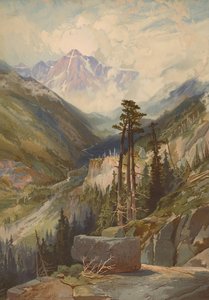
The Mountain of the Holy Cross, Colorado (1876) by Thomas Moran

The Mountain of the Holy Cross, Colorado

1876 · Watercolor · Amon Carter Museum of American Art, Fort Worth

This monumental composition presents a breathtaking vista of the American West, dominated by towering, snow-capped peaks that pierce the sky. The landscape captures the immense scale of the Rockies, with the rugged terrain rising dramatically to meet the heavens. Throughout the scene, clusters of trees are scattered across the slopes, providing a sense of life and organic texture against the stony expanse. A substantial rock formation is positioned prominently in…

4
Fingal's Cave, Island of Staffa, Scotland (1884) by Thomas Moran

Fingal's Cave, Island of Staffa, Scotland

1884 · Oil On Canvas · High Museum of Art, Atlanta

The scene unfolds before us in Fingal's Cave, Island of Staffa, Scotland, a work painted by Thomas Moran. Created between 1884 and 1885, this oil on canvas captures a moment of intense natural activity. The subject is the geological marvel of Fingal's Cave, located on the remote Island of Staffa in Scotland. Here, the artist turns his gaze toward the rugged edges of the Atlantic, focusing on the dramatic interplay…

5
Grand Canyon (1912) by Thomas Moran

Grand Canyon

1912 · Oil On Canvas · Nelson-Atkins Museum of Art, Kansas City

To gaze upon Thomas Moran’s 1912 masterpiece, Grand Canyon, is to step into the very heart of the American Romantic spirit. This is not merely a geological record of one of Earth's most profound chasms; it is an evocative embodiment of the sublime, designed to stir the deepest recesses of the human soul. As a prominent figure of the Hudson River School, Moran possessed a rare ability to translate the…

6
Grand Canyon Scene at Eastern End of Canyon (1920) by Thomas Moran

Grand Canyon Scene at Eastern End of Canyon

1920 · Oil On Canvas · Centennial One Object Exhibit, Unknown

To gaze upon this depiction of the Grand Canyon at its Eastern End is to feel an immediate, profound sense of awe—a quiet confrontation with geological time itself. Thomas Moran, the celebrated painter whose brushstrokes helped define the visual narrative of the American frontier, has gifted us a scene that transcends mere landscape painting. It is a meditation on permanence against the fleeting breath of cloud and light. The composition…

7
Mountain of the Holy Cross (1875) by Thomas Moran

Mountain of the Holy Cross

1875 · Oil On Canvas · Autry Museum of the American West, Los Angeles County

In the annals of American landscape painting, few works command the same reverence and awe as Thomas Moran’s Mountain of the Holy Cross. Painted in 1875, this breathtaking oil on canvas serves as a profound window into the untamed majesty of the American West. The scene unfolds with a dramatic orchestration of light and earth, presenting a landscape where snow-capped peaks pierce the heavens, their jagged silhouettes rendered in ethereal…

8
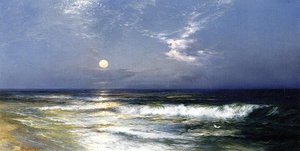
Moonlit Seascape (1891) by Thomas Moran

Moonlit Seascape

1891 · Oil On Canvas

The night air feels heavy and salt-laden in Moonlit Seascape, a work by the American artist Thomas Moran. Created in 1891, this oil on canvas captures a moment where the ocean meets the dark sky under a lunar glow. The scene unfolds with a quiet intensity, pulling the viewer toward the rhythmic movement of waves crashing against a shoreline. In the distance, the silhouettes of boats drift upon the water,…

9
Moonlight in Venice (1898) by Thomas Moran

Moonlight in Venice

1898 · Oil

Moonlight in Venice is an 1898 work by the artist Thomas Moran. This painting captures a nocturnal scene within the Venetian landscape. It belongs to the American Romantic movement, a style that seeks to translate the atmosphere of a place into a specific emotional resonance. The canvas holds the quietude of the Italian night.

10
Grand Canyon with Rainbows (1912) by Thomas Moran

Grand Canyon with Rainbows

1912 · Oil On Canvas · Fine Arts Museums of San Francisco, San Francisco

The sun breaks through heavy, turbulent clouds, casting a radiant glow across the immense rock faces of the canyon. Light filters down in ethereal hues, illuminating patches of foliage and the rugged textures of granite and sandstone. A rainbow arches through the sky, a sudden streak of color amidst the dramatic shadows of the gorge. The scale of the landscape feels overwhelming, pulling the eye toward the vastness of the…

Thomas Moran's famous paintings, numbers 11 to 100

11Childe Roland to the Dark Tower Came (1859) by Thomas MoranChilde Roland to the Dark Tower Came1859 12Temple of Venus, Castle of Baiae (1867) by Thomas MoranTemple of Venus, Castle of Baiae1867 13Fort George Island (1878) by Thomas MoranFort George Island1878 14Sunset near Land's End, Cornwall, England (1909) by Thomas MoranSunset near Land's End, Cornwall, England1909 · Thyssen-Bornemisza Museum 15Romantic Landscape (1885) by Thomas MoranRomantic Landscape1885 16The Gate of Venice (1895) by Thomas MoranThe Gate of Venice1895 17Landscape with Waterfall (1893) by Thomas MoranLandscape with Waterfall1893 18Moonlit Shipwreck at Sea (1901) by Thomas MoranMoonlit Shipwreck at Sea1901 19Long Island Landscape (1902) by Thomas MoranLong Island Landscape1902 20Moonlit Seascape (1902) by Thomas MoranMoonlit Seascape1902 21Sunset after a Storm (1901) by Thomas MoranSunset after a Storm1901 22Grand Canal, Venice (1906) by Thomas MoranGrand Canal, Venice1906 23Tantallon Castle, North Berwick, Scotland (1910) by Thomas MoranTantallon Castle, North Berwick, Scotland1910 24Icebergs in Mid-Atlantic (1909) by Thomas MoranIcebergs in Mid-Atlantic1909 25Monterey Coast (1912) by Thomas MoranMonterey Coast1912 26Old Windmill, East Hampton, Long Island, New York (1912) by Thomas MoranOld Windmill, East Hampton, Long Island, New York1912 27The Cavern, California Coast (also known as Sinbad Wrecked) (1919) by Thomas MoranThe Cavern, California Coast (also known as Sinbad Wrecked)1919 28Shepherdess Watching Her Flock (1867) by Thomas MoranShepherdess Watching Her Flock1867 29Vera Cruz Harbor (1884) by Thomas MoranVera Cruz Harbor1884 30Sunset in Mid-Ocean (1904) by Thomas MoranSunset in Mid-Ocean1904 31View of East Hampton (1900) by Thomas MoranView of East Hampton1900 32Shoshone Falls on the Snake River (1900) by Thomas MoranShoshone Falls on the Snake River1900 · Gilcrease Museum 33Fiercely the Red Sun Descending, Burned His Way across the Heavens (1875) by Thomas MoranFiercely the Red Sun Descending, Burned His Way across the Heavens1875 34Hopi Museum, Arizona (1916) by Thomas MoranHopi Museum, Arizona1916 35Golden Bough (after Joseph Mallor William Turner) (1862) by Thomas MoranGolden Bough (after Joseph Mallor William Turner)1862 36Lake Como (1867) by Thomas MoranLake Como1867 · Metropolitan Museum of Art 37Venice 1 by Thomas MoranVenice 1 38Venice (1905) by Thomas MoranVenice1905 39Near Tula (1907) by Thomas MoranNear Tula1907 40An English Fishing Village, Polperro, Cornwall (1907) by Thomas MoranAn English Fishing Village, Polperro, Cornwall1907 41Cliffs of Green River (1874) by Thomas MoranCliffs of Green River1874 · Amon Carter Museum of American Art 42Slave Hunt, Dismal Swamp, Virginia (1862) by Thomas MoranSlave Hunt, Dismal Swamp, Virginia1862 43June, East Hampton by Thomas MoranJune, East Hampton 44Sunset on Long Island 1 by Thomas MoranSunset on Long Island 1 45The Angry Sea by Thomas MoranThe Angry Sea 46Caledonia, Stern and Wild by Thomas MoranCaledonia, Stern and Wild 47The Autumnal Woods (aka Under the Trees) by Thomas MoranThe Autumnal Woods (aka Under the Trees) 48A Mexican Hacienda, Lake Cuitzeo (1885) by Thomas MoranA Mexican Hacienda, Lake Cuitzeo1885 · Smithsonian American Art Museum 49The Dell (1878) by Thomas MoranThe Dell1878 · Cleveland Museum of Art 50The Much Resounding Sea (1884) by Thomas MoranThe Much Resounding Sea1884 · National Gallery of Art 51View of Venice by Thomas MoranView of Venice 52Angangueo, Mexico by Thomas MoranAngangueo, Mexico 53Venetian Scene 1 by Thomas MoranVenetian Scene 1 54Sunset, Long Island Sound (1907) by Thomas MoranSunset, Long Island Sound1907 55Sunset Cloud, Green River, Wyoming (1917) by Thomas MoranSunset Cloud, Green River, Wyoming1917 · Smithsonian American Art Museum 56Valley of the Catawissa in Autumn (1862) by Thomas MoranValley of the Catawissa in Autumn1862 · Crystal Bridges Museum of American Art 57Western Landscape with Waterfall, (painting) (1857) by Thomas MoranWestern Landscape with Waterfall, (painting)1857 58Haunted House (1858) by Thomas MoranHaunted House1858 59Summer Landscape with Cows (1856) by Thomas MoranSummer Landscape with Cows1856 60Dusk Wings (1860) by Thomas MoranDusk Wings1860 61View of Fairmont Waterworks, Philadelphia (1860) by Thomas MoranView of Fairmont Waterworks, Philadelphia1860 62A Scene on the Tohickon Creek: Autumn (1868) by Thomas MoranA Scene on the Tohickon Creek: Autumn1868 · Minneapolis Institute of Art 63The Juniata, Evening (1864) by Thomas MoranThe Juniata, Evening1864 · National Gallery of Art 64The Shores of Lake Superior (1866) by Thomas MoranThe Shores of Lake Superior1866 · Crystal Bridges Museum of American Art 65The Sacrifice of Isaac (1868) by Thomas MoranThe Sacrifice of Isaac1868 66Indians on a Cliff (1864) by Thomas MoranIndians on a Cliff1864 67The Wilds of Lake Superior (1864) by Thomas MoranThe Wilds of Lake Superior1864 · New Britain Museum of American Art 68The Evening Hunter (1867) by Thomas MoranThe Evening Hunter1867 69The Yellowstone Range from near Fort Ellis (1871) by Thomas MoranThe Yellowstone Range from near Fort Ellis1871 70Children of the Mountain (1867) by Thomas MoranChildren of the Mountain1867 71Fort George Island, Florida (1878) by Thomas MoranFort George Island, Florida1878 · Cleveland Museum of Art 72Tower Falls at Yellowstone (1876) by Thomas MoranTower Falls at Yellowstone1876 73The Golden Hour (1875) by Thomas MoranThe Golden Hour1875 · Blanton Museum of Art 74The Cliffs of Green River, Wyoming Territory (1875) by Thomas MoranThe Cliffs of Green River, Wyoming Territory1875 · Cincinnati Art Museum 75Green River, Wyoming (1878) by Thomas MoranGreen River, Wyoming1878 · Crystal Bridges Museum of American Art 76Green River of Wyoming (1878) by Thomas MoranGreen River of Wyoming1878 77Hot Springs of the Yellowstone (1872) by Thomas MoranHot Springs of the Yellowstone1872 · Los Angeles County Museum of Art 78Mammoth Hot Springs, Yellowstone (1872) by Thomas MoranMammoth Hot Springs, Yellowstone1872 · Smithsonian American Art Museum 79Fort George Island, Florida (1878) by Thomas MoranFort George Island, Florida1878 · Smithsonian American Art Museum 80Excelsior Geyser, Yellowstone Park (1873) by Thomas MoranExcelsior Geyser, Yellowstone Park1873 · Smithsonian American Art Museum 81Above Tower Falls, Yellowstone (1872) by Thomas MoranAbove Tower Falls, Yellowstone1872 · Smithsonian American Art Museum 82Green River, Wyoming (1878) by Thomas MoranGreen River, Wyoming1878 · Crystal Bridges Museum of American Art 83Yellowstone Lake (1874) by Thomas MoranYellowstone Lake1874 84Yellowstone Lake (1874) by Thomas MoranYellowstone Lake1874 85Tower Falls and Sulphur Rock, Yellowstone (1874) by Thomas MoranTower Falls and Sulphur Rock, Yellowstone1874 86Cliffs of the Rio Virgin, South Utah (1872) by Thomas MoranCliffs of the Rio Virgin, South Utah1872 87Tower Falls (1872) by Thomas MoranTower Falls1872 88Crossing the Brook Near Plainfield, New Jersey (1878) by Thomas MoranCrossing the Brook Near Plainfield, New Jersey1878 89Environs of Salt Lake, Utah (1877) by Thomas MoranEnvirons of Salt Lake, Utah1877 90Chasm of the Colorado (1873) by Thomas MoranChasm of the Colorado1873 · Smithsonian American Art Museum 91Sunset on the Great Salt Lake, Utah (1877) by Thomas MoranSunset on the Great Salt Lake, Utah1877 92Shoshone Falls, Snake River, Idaho (1873) by Thomas MoranShoshone Falls, Snake River, Idaho1873 93A Side Canyon, Grand Canyon, Arizona (1905) by Thomas MoranA Side Canyon, Grand Canyon, Arizona1905 94Bringing Home the Cattle - Coast of Florida (1879) by Thomas MoranBringing Home the Cattle - Coast of Florida1879 · Buffalo AKG Art Museum 95Study of a Water Lotus (1879) by Thomas MoranStudy of a Water Lotus1879 · Yale University Art Gallery 96Green River Cliffs, Wyoming (1881) by Thomas MoranGreen River Cliffs, Wyoming1881 · National Gallery of Art 97Looking over Niagara Falls (1885) by Thomas MoranLooking over Niagara Falls1885 98Misty Morning, Appaquogue (1885) by Thomas MoranMisty Morning, Appaquogue1885 99Tahoe (1879) by Thomas MoranTahoe1879 100Long Island Landscape (1884) by Thomas MoranLong Island Landscape1884

Thomas Moran's famous paintings, period by period

The subjects that held Thomas Moran's eye

The four subjects that come back most often in these originals, each with its finest example.

The museums that keep Thomas Moran's originals

The 8 museums that hold the most of the paintings on this page.

Museum City Works by Thomas Moran Paintings from this list
Smithsonian American Art Museum, Washington, D.C.Smithsonian American Art Museum Washington, D.C. 15 A Mexican Hacienda, Lake Cuitzeo, Sunset Cloud, Green River, Wyoming, Mammoth Hot Springs, Yellowstone
Crystal Bridges Museum of American Art, BentonvilleCrystal Bridges Museum of American Art Bentonville 4 Valley of the Catawissa in Autumn, The Shores of Lake Superior, Green River, Wyoming
National Gallery of Art, WashingtonNational Gallery of Art Washington 3 The Much Resounding Sea, The Juniata, Evening, Green River Cliffs, Wyoming
Amon Carter Museum of American Art, Fort WorthAmon Carter Museum of American Art Fort Worth 3 The Mountain of the Holy Cross, Colorado, Cliffs of Green River
Metropolitan Museum of Art, New YorkMetropolitan Museum of Art New York 2 The Teton Range, Lake Como
Cleveland Museum of Art, ClevelandCleveland Museum of Art Cleveland 2 The Dell, Fort George Island, Florida
Gilcrease Museum, TulsaGilcrease Museum Tulsa 4 Shoshone Falls on the Snake River
Thyssen-Bornemisza Museum, MadridThyssen-Bornemisza Museum Madrid 3 Sunset near Land's End, Cornwall, England

Thomas Moran across the decades: one unique original for each

Works per decade

Pick a decade to see the original that defines it.

Thomas Moran's paintings: questions for the gallery

What is the single most famous work of Thomas Moran?Reveal the answer

The Teton Range (1897), Metropolitan Museum of Art, New York. East Moriches (1900) and The Mountain of the Holy Cross, Colorado (1876) come next.

At what age did Thomas Moran create The Teton Range?Reveal the answer

60 years old: The Teton Range dates from 1897, and Thomas Moran was born in 1837.

Which ten paintings by Thomas Moran are the most famous?Reveal the answer

The Teton Range, East Moriches, The Mountain of the Holy Cross, Colorado, Fingal's Cave, Island of Staffa, Scotland, Grand Canyon, Grand Canyon Scene at Eastern End of Canyon, Mountain of the Holy Cross, Moonlit Seascape, Moonlight in Venice and Grand Canyon with Rainbows. The ranking above gives each one's year and museum.

How many works by Thomas Moran are known?Reveal the answer

Our catalog holds 373 works by Thomas Moran, dated from 1856 to 1920.

Where can the most famous Thomas Moran originals be seen?Reveal the answer

Mostly in Smithsonian American Art Museum (Washington, D.C.), Crystal Bridges Museum of American Art (Bentonville) and National Gallery of Art (Washington). The museum table above lists them all.

During which period did Thomas Moran create the best-known paintings?Reveal the answer

In 1870s: 32 of the 100 works on this page were made then, The Mountain of the Holy Cross, Colorado among them.

Which famous Thomas Moran painting is the earliest, and which the latest?Reveal the answer

On this page, the earliest is Summer Landscape with Cows (1856) and the latest Grand Canyon Scene at Eastern End of Canyon (1920).

What subjects did Thomas Moran favour?Reveal the answer

Landscape (16), Sunset (11) and Mountains (10), across the 100 works on this page.

What materials did Thomas Moran paint with most?Reveal the answer

Oil On Canvas, for 24 of the 100 works on this page.

Which movement does the work of Thomas Moran belong to?Reveal the answer

Hudson river school, judging by the originals on this page.

What Thomas Moran originals can I see at the Smithsonian American Art Museum?Reveal the answer

A Mexican Hacienda, Lake Cuitzeo, Sunset Cloud, Green River, Wyoming and Mammoth Hot Springs, Yellowstone: the Smithsonian American Art Museum, Washington, D.C. holds 7 of the works on this page.

Thomas Moran: a portrait of the artist

Early Life, Family and Artistic Training

Bolton, Lancashire, England, provides the setting for the birth of Thomas Moran on February 12, 1837. He is born to Thomas Moran Sr. and Mary Higson. The family's stability shifts in 1844. At seven years old, Moran leaves his birthplace for the United States, seeking a different life across the Atlantic.

The transition to American life leads him to Philadelphia. In 1853, the teenage Moran enters an apprenticeship with the wood-engraving firm Scattergood & Telfer. The work is meticulous. He spends his spare time working on watercolors, a practice that begins to pull him away from the rigid demands of engraving. He seeks formal guidance from local painter James Hamilton to refine his developing eye. By 1856, the transition from graphic illustration to fine art is marked by his first oil painting, Among the Ruins There He Lingered.

Artistic Development and Influences

The transition from wood-engraving to fine art begins with a shift in focus. While his early years are defined by the meticulous, repetitive labor of carving illustrations for Philadelphia firms, a deeper ambition takes hold. By 1861, the focus moves toward the masters. Moran travels to London, seeking the direct presence of the works that define a new visual language. He stands before the canvases of Claude Lorrain and J.M.W. Turner, absorbing the mechanics of light and atmosphere.

The 1862 trip to England marks a definitive turning point. He does not merely observe Turner; he emulates him. He adopts Turner’s specific approach to color and his selection of landscape subjects, translating these European sensibilities into a new American context. This period transforms him into a talented illustrator and a colorist of significant skill. The technical precision of his engraving background merges with this new, atmospheric sensibility. He moves away from the rigid lines of the engraver toward the fluid, emotive power of watercolor and oil.

The Landscapes of the American West

The vastness of the Far West demands a scale that traditional portraiture cannot accommodate. Moran meets this demand through gigantic canvases that capture the immensity of the frontier. He moves beyond the established conventions of the Hudson River School to embrace the role of a landscape painter focused on the grandiose. This fascination with the scale of nature drives him toward the rugged territories of the West, where the landscape is not merely a backdrop but a primary subject of intense study.

In 1872, the focus shifts to the Yosemite Valley in California. Here, the sheer verticality and geological complexity of the terrain provide the perfect subject for his evolving vision. He becomes a central figure in the Rocky Mountain School of landscape painters, a group defined by their commitment to these specific, high-altitude environments. His work translates the raw, physical reality of the mountains into a visual language of immense proportions.

Expeditions and Major Commissions

The year 1871 marks a sudden shift in Moran's trajectory. Before this, he was a staff illustrator for Scribner’s magazine, tasked with visualizing territories most Americans had never seen. The magazine commissioned him to create illustrations of the Yellowstone area, a project that required more than mere imagination. His resulting illustrations appeared in the May and June 1871 issues of Scribner’s, providing the public with their first visual encounter with the region's geothermal wonders and rugged terrain.

This assignment leads directly to the field. Moran joins the Hayden Expedition of 1871, traveling as a guest artist with the Geological Survey of the Territories. He moves from the controlled environment of the studio to the raw reality of the frontier. The expedition provides the raw material for his most significant works, as he attempts to translate the "boiling mud and pools" and "water shooting skyward from the ground" into a visual language. The sketches made during these travels transform his career from that of a magazine illustrator to a primary chronicler of the American West.

Technique and Artistic Style

The precision of a wood-engraver remains embedded in Moran's approach to the canvas. His early apprenticeship in Philadelphia instilled a meticulous eye for detail, a trait that transitioned seamlessly into his later mastery of watercolor and oil. He does not merely record a landscape; he constructs it through a sophisticated command of atmospheric perspective. Distant peaks and canyon walls fade into hazy blues and greys, creating a tangible sense of immense, open space. This technical control allows the vastness of the Rocky Mountains to feel physically present, even when rendered through the delicate washes of a watercolor field sketch.

Moran’s versatility extends into the realm of printmaking, where he moves between the sharp lines of etching and the layered depth of lithography. He mastered multiple printing media, including wood-engraving and chromolithography, which allowed his visions of the American West to reach a massive audience through major magazines. His ability to translate the dramatic lighting of a sunset into both a singular oil painting and a mass-produced print demonstrates a technical range that bridges fine art and commercial illustration. He uses color not as a decorative element, but as a tool to define the very air between the viewer and the horizon.

Key Works and Notable Paintings

The scale of Moran's vision often required years of sustained effort. Between 1893 and 1901, he worked on The Grand Canyon of the Yellowstone, a massive undertaking that captured the geological drama of the region. This period of intense focus coincided with his ability to translate the raw textures of the American West into large-scale compositions. His ability to render the immense depth of the landscape is evident in Chasm of the Colorado, where the sheer verticality of the canyon walls dominates the viewer's perspective.

Light and atmosphere dictate the mood of his most significant compositions. In Sunset, Pueblo del Walpe, Arizona, painted about 1880, the sky becomes a primary subject, casting a specific glow over the terrain. This mastery of light extends to his depictions of the mountain ranges, such as The Three Tetons in 1895. Even when his focus shifted toward European subjects, the influence of his atmospheric training remained. In 1900, he produced Venice from the Tower of San Giorgio, applying his understanding of light and water to the canals of Italy.

Legacy and Enduring Influence

Moran’s illustrations do more than depict scenery; they act as a catalyst for national curiosity. When his sketches for Scribner’s magazine reached the public, they transformed the unknown territories of the West into a tangible reality for an audience hungry for expansion. These images helped pique the attention of the nation, turning distant, imagined landscapes into specific destinations for exploration and settlement. He helped establish a visual language for understanding the American West, providing the imagery that would define the frontier in the collective American mind.

His influence extends into the very fabric of American conservation. By bringing the grandeur of the West to the eyes of the public, his work became a tool for promotion, driving interest in the vast territories that lay beyond the established borders. As a key figure in the Hudson River School, he bridged the gap between traditional landscape painting and the raw, untamed reality of the Rocky Mountains. His ability to translate the scale of the canyon and the heat of the desert into a visual format helped shape how a growing nation perceived its own natural identity.

Later Years and Death

The later years of Moran's life find him settled in New York. He shares this life with his wife, Mary Nimmo Moran, a Scottish-born etcher and landscape painter. Together, they navigate a world where the rugged landscapes they once documented from the field have become established parts of the American visual identity. Their residence in New York serves as a base for a life built on the shared language of art and observation.

The final chapter of his life moves away from the bustling East Coast. He passes away in Santa Barbara, California, on August 25, 1926. His death marks the end of a long career that helped define the visual perception of the American West.

Where to See His Works Today

His canvases reside in major institutions across several continents. The Smithsonian American Art Museum in Washington, D.C., holds his major works, preserving the scale of his vision for public viewing. In Europe, the Thyssen-Bornemisza Museum in Madrid maintains a collection of three of his paintings, including his 1909 depiction of the Cornish coast.

The American West remains central to his presence in various galleries. The Amon Carter Museum of American Art in Fort Worth, Texas, houses three of his works. Meanwhile, the Buffalo Bill Center of the West preserves his prints, which once brought the imagery of the frontier into domestic spaces across the country.