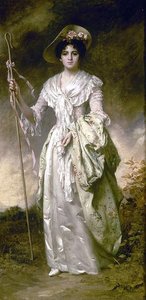
Portrait of Thomas Benjamin Kennington

Thomas Benjamin Kennington Paintings: The 45 Most Famous, Through a Gallery's Eye

Updated November 2026 · ranked by our popularity score (searches, visits and orders for each work) · 45 works by Thomas Benjamin Kennington in our catalogue

In short

To the gallery's eye, Thomas Benjamin Kennington's most famous painting is Homeless (1890). Reverie (1875) and Parchedig David Edwardes (1836–1916), MA (1903) complete the trio every eye recognises. Of the 45 works by Thomas Benjamin Kennington in our catalog, the gallery presents the 45 most famous below, each original with its year, its museum and what makes it unique.

1856 – 1916, Grimsby Academic realism Most works: National Library of Wales

The gallery's top 10 Thomas Benjamin Kennington paintings

1
Homeless (1890) by Thomas Benjamin Kennington

Homeless

1890 · Oil On Canvas

In this 1890 oil on canvas, Thomas Benjamin Kennington presents "Homeless," a work that offers a quiet, unflinching look at the urban poor. The painting captures a specific moment of human connection amidst the hardships of the late 19th century. It focuses on a woman dressed in black clothing, known as widow's weeds, who has paused her labors to offer comfort. She is seen dropping a washing bundle to console…

7
Orphans (1885) by Thomas Benjamin Kennington

Orphans

1885 · Acrylic On Canvas · Tate Gallery, London

Thomas Benjamin Kennington's "Orphans," painted in 1885, isn’t merely a depiction of two children; it’s a poignant distillation of Victorian anxieties surrounding poverty and the vulnerability of childhood. The painting immediately draws the viewer into a scene of quiet desperation, yet also imbued with an unexpected tenderness. Kennington, a key figure within the New English Art Club, eschewed grand historical narratives or heroic subjects in favor of intimate portrayals of…

Thomas Benjamin Kennington paintings, ranked 11 to 45

Thomas Benjamin Kennington's famous paintings, period by period

The subjects that held Thomas Benjamin Kennington's eye

The four subjects that come back most often in these originals, each with its finest example.

The museums that keep Thomas Benjamin Kennington's originals

The 3 museums that hold the most of the paintings on this page.

Museum City Works by Thomas Benjamin Kennington Paintings from this list
National Library of Wales, AberystwythNational Library of Wales Aberystwyth 1 Parchedig David Edwardes (1836–1916), MA
Tate Gallery, LondonTate Gallery London 1 Orphans
Art Gallery of South Australia, AdelaideArt Gallery of South Australia Adelaide 1 The pinch of poverty

Thomas Benjamin Kennington, one signature painting per decade

Works per decade

Pick a decade to see the original that defines it.

Thomas Benjamin Kennington's paintings: the gallery answers

Which Thomas Benjamin Kennington painting is the most famous of all?Reveal the answer

Homeless (1890). Reverie (1875) and Parchedig David Edwardes (1836–1916), MA (1903) come next.

How old was Thomas Benjamin Kennington on completing Homeless?Reveal the answer

34 years old: Homeless dates from 1890, and Thomas Benjamin Kennington was born in 1856.

Which are Thomas Benjamin Kennington's top 10 paintings?Reveal the answer

Homeless, Reverie, Parchedig David Edwardes (1836–1916), MA, Pandora, A Plume Of Smoke, The Toy Shop, Orphans, Widowed and Fatherless, Chatterboxes and The Pinch of poverty. The ranking above gives each one's year and museum.

How many works did Thomas Benjamin Kennington create?Reveal the answer

Our catalog holds 45 works by Thomas Benjamin Kennington, dated from 1875 to 1914.

Where do Thomas Benjamin Kennington's most famous originals hang?Reveal the answer

Mostly in National Library of Wales (Aberystwyth), Tate Gallery (London) and Art Gallery of South Australia (Adelaide). The museum table above lists them all.

When did Thomas Benjamin Kennington create the most famous paintings?Reveal the answer

In 1890s: 5 of the 45 works on this page were made then, Homeless among them.

Which are Thomas Benjamin Kennington's earliest and latest famous works?Reveal the answer

On this page, the earliest is Reverie (1875) and the latest Temptation (1914).

Which subjects did Thomas Benjamin Kennington return to most?Reveal the answer

Victorian era (10), Poverty (3) and Family (3), across the 45 works on this page.

Which movement is Thomas Benjamin Kennington associated with?Reveal the answer

Academic realism and Realism, judging by the originals on this page.

Thomas Benjamin Kennington: the artist

Thomas Benjamin Kennington: A Victorian Painter of Empathetic Realism

Thomas Benjamin Kennington (1856-1916) stands as a significant figure in British art history, particularly within the realm of genre painting and social realism. Born in Grimsby, Lincolnshire, he embarked on an artistic journey marked by rigorous training at prestigious institutions like Liverpool School of Art and the Royal College of Art, fostering connections with influential contemporaries such as Ford Madox Brown and William Holman Hunt. Kennington’s dedication to capturing the human condition—often portraying vulnerable subjects facing hardship—established him as a champion of compassionate observation and a pivotal voice in the burgeoning New English Art Club movement.
  • Early Life & Training: Kennington's formative years were spent honing his artistic skills at Liverpool School of Art, where he secured a gold medal for excellence. Subsequently, he pursued advanced studies at the Royal College of Art in London and honed his technique under Bougereau and Robert-Fleury in Paris, immersing himself in the stylistic innovations of Impressionism.
  • Notable Exhibitions & Associations: Kennington’s artistic career unfolded across decades of active participation in prominent exhibitions, including those hosted by the Royal Academy and the Royal Society of British Artists (RBA). He was a founding member of the New English Art Club (NEAC), an organization dedicated to fostering realism and moral seriousness within British art.

Kennington’s Artistic Style & Themes: Capturing Victorian Humanity

Kennington's artistic style distinguished itself through its meticulous attention to detail and its ability to convey profound emotion. He excelled in both oil painting and watercolor, favoring a technique characterized by subtle tonal gradations and expressive brushwork—influences from Murillo are evident in his depictions of street children. However, Kennington’s true brilliance resided in his unflinching portrayal of social realities. Paintings like “Orphans,” “Widowed and Fatherless,” and “Homeless” confronted viewers with the grim circumstances endured by impoverished families during Victorian Britain, prompting contemplation on compassion and societal responsibility. These works weren't merely aesthetically pleasing; they served as powerful catalysts for empathy and critique.
  • Genre Painting & Social Commentary: Kennington’s genre paintings—scenes of everyday life—were infused with a humanist spirit, reflecting his belief in the importance of portraying individuals grappling with adversity.
  • Influence of Murillo: Scholars suggest that Kennington's artistic sensibilities were shaped by Murillo’s masterful depictions of marginalized figures, demonstrating a shared commitment to conveying dignity and pathos.

Major Achievements & Legacy

Kennington achieved considerable acclaim during his lifetime, securing a bronze medal at the Exposition Universelle of 1889 and earning recognition for his contributions to artistic discourse. His son, Eric Henri Kennington (1888–1960), followed in his father’s footsteps as an artist, illustrator, and sculptor—further cementing Kennington's influence on British art culture. Today, Thomas Benjamin Kennington’s paintings continue to resonate with audiences worldwide, serving as enduring reminders of Victorian compassion and the transformative power of empathetic observation. His legacy resides not only in his artistic output but also in his unwavering dedication to elevating the visual arts as a vehicle for social awareness.

Notable Works