Portrait of Samuel Palmer

The 28 Most Famous Samuel Palmer Paintings, a Gallery Selection

Updated November 2026 · ranked by our popularity score (searches, visits and orders for each work) · 31 works by Samuel Palmer in our catalogue

In short

Of all the originals Samuel Palmer left, the most famous is Magic Apple Tree (1830), in the collection of the Fitzwilliam Museum. Close behind it come Harvesting detail (1851) and Sketchbook, folio 5 verso (1824). Our catalog holds 31 works by Samuel Palmer; the gallery has kept the 28 the world admires most, each shown with its date, its museum and its story.

1805 – 1881, Newington Romanticism Most works: Birmingham Museum and Art Gallery

Samuel Palmer's top 10 paintings: the gallery's choice

1
Magic Apple Tree (1830) by Samuel Palmer

Magic Apple Tree

1830 · Watercolor · Fitzwilliam Museum

The composition is framed by two dark, heavy tree trunks on the left and right, creating a natural vignette that directs the eye toward a brightly illuminated hillside in the background. In the immediate foreground, a small human figure sits near a flock of sheep at the base of these large trees. The middle ground is occupied by dense foliage rendered in shades of red and orange. Beyond this, a…

2
Harvesting detail (1851) by Samuel Palmer

Harvesting detail

1851 · Oil

Harvesting detail is an oil painting by Samuel Palmer. This work was created about 1851. The composition focuses on a rural scene where figures gather around a hay wagon on a hillside. The landscape is divided into a foreground containing the wagon and foliage, a middle ground of rolling hills, and a background featuring a distant cityscape under a stormy sky.

3
Sketchbook, folio 5 verso (1824) by Samuel Palmer

Sketchbook, folio 5 verso

1824 · Pencil · Victoria and Albert Museum, London

In the quiet intimacy of Sketchbook, folio 5 verso, we are invited to witness the raw, unmediated pulse of a creative mind at work. Created in 1824 by the visionary British Romantic painter Samuel Palmer, this sketchbook page serves as a profound temporal bridge, transporting the viewer back to an era of intense spiritual and natural inquiry. Rather than a polished, finished masterpiece intended for a gallery wall, this folio…

4
Moonrise (1826) by Samuel Palmer

Moonrise

1826 · Gouache · Leeds Museums - Galleries, Leeds

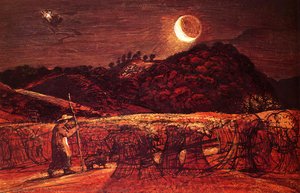
To gaze upon this depiction of Moonrise is to step across the threshold into a realm where the tangible world dissolves into the ethereal glow of spiritual contemplation. Painted in 1826, this work by Samuel Palmer captures more than just a nocturnal scene; it encapsulates a profound yearning for the sublime—a moment when the veil between the earthly and the divine seems impossibly thin. The local countryside of Shoreham in…

5
Early Morning (detail) (1825) by Samuel Palmer

Early Morning (detail)

1825 · Engraving · Ashmolean Museum, Oxford

Samuel Palmer's "Early Morning (detail)," painted in 1825, isn’t merely a depiction of a woodland scene; it’s an immersion into a world steeped in Romantic sensibility and imbued with a profound sense of quiet contemplation. This exquisite engraving, now part of the Ashmolean Museum’s collection, offers a glimpse into the artist's uniquely personal vision of nature – a vision profoundly shaped by his encounters with William Blake and a deep…

7
At Festiniog, North Wales (1835) by Samuel Palmer

At Festiniog, North Wales

1835 · Ink On Paper · Birmingham Museum and Art Gallery, Birmingham

In this work, titled At Festiniog, North Wales, we encounter a quiet moment from the career of Samuel Palmer. Created about 1835, the piece captures a naturalistic scene of a valley or mountain pass in North Wales. It belongs to a period when the artist was beginning to move away from the intense, mystical landscapes of his earlier years toward a more conventional approach to the natural world.

8
A View Of Ancient Rome (1838) by Samuel Palmer

A View Of Ancient Rome

1838 · Watercolor · Birmingham Museum and Art Gallery, Birmingham

We are looking at A View Of Ancient Rome, a work by the British artist Samuel Palmer. Created about 1838, this piece emerged from a specific period of transition in the artist's life. It was produced during a two-year honeymoon trip to Italy, a time when Palmer's approach to the landscape began to shift toward a more naturalistic precision.

10
View of Lee, North Devon (1834) by Samuel Palmer

View of Lee, North Devon

1834 · Oil On Canvas · Fitzwilliam Museum

Created in 1834, this work reflects the sensibilities of English Romanticism, focusing on the sublime qualities found in the natural environment. The mood is one of tranquility, yet there is an underlying sense of the vastness of the world. The way the mist clings to the water's surface and the light settles upon the hills suggests a landscape that is both observed and felt. It is a study of light…

The Samuel Palmer selection continues, 11 to 28

Samuel Palmer's famous paintings, period by period

The subjects that held Samuel Palmer's eye

The four subjects that come back most often in these originals, each with its finest example.

The museums that keep Samuel Palmer's originals

The 7 museums that hold the most of the paintings on this page.

Museum City Works by Samuel Palmer Paintings from this list
Birmingham Museum and Art Gallery, BirminghamBirmingham Museum and Art Gallery Birmingham 7 At Festiniog, North Wales, A View Of Ancient Rome, A View of Modern Rome During the Carnival
Yale Center for British Art, New HavenYale Center for British Art New Haven 4 Sketch from Nature in Sion Park, The Harvest Moon, The Timber Wain
Ashmolean Museum, OxfordAshmolean Museum Oxford 3 Early Morning (detail), Self-Portrait, Early Morning
Fitzwilliam MuseumFitzwilliam Museum 2 Magic Apple Tree, View of Lee, North Devon
Victoria and Albert Museum, LondonVictoria and Albert Museum London 1 Sketchbook, folio 5 verso
Leeds Museums - Galleries, LeedsLeeds Museums - Galleries Leeds 1 Moonrise
Tate Britain, LondonTate Britain London 1 The Gleaning Field

Samuel Palmer decade by decade: the original that defines each

Works per decade

Pick a decade to see the original that defines it.

Collectors' questions about Samuel Palmer's paintings

Which work is Samuel Palmer most famous for?Reveal the answer

Magic Apple Tree (1830), Fitzwilliam Museum. Harvesting detail (1851) and Sketchbook, folio 5 verso (1824) come next.

What age was Samuel Palmer when Magic Apple Tree was made?Reveal the answer

25 years old: Magic Apple Tree dates from 1830, and Samuel Palmer was born in 1805.

What are the ten most famous Samuel Palmer paintings?Reveal the answer

Magic Apple Tree, Harvesting detail, Sketchbook, folio 5 verso, Moonrise, Early Morning (detail), Sketch from Nature in Sion Park, At Festiniog, North Wales, A View Of Ancient Rome, A View of Modern Rome During the Carnival and View of Lee, North Devon. The ranking above gives each one's year and museum.

How many paintings did Samuel Palmer leave?Reveal the answer

Our catalog holds 31 works by Samuel Palmer, dated from 1819 to 1877.

In which museums do Samuel Palmer's masterpieces hang?Reveal the answer

Mostly in Birmingham Museum and Art Gallery (Birmingham), Yale Center for British Art (New Haven) and Ashmolean Museum (Oxford). The museum table above lists them all.

In which years did Samuel Palmer paint the most famous works?Reveal the answer

In 1830s: 9 of the 28 works on this page were made then, Magic Apple Tree among them.

What are the first and the last famous originals of Samuel Palmer?Reveal the answer

On this page, the earliest is Sketch from Nature in Sion Park (1819) and the latest Tityrus Restored to his Patrimony (1877).

Which subjects did Samuel Palmer choose most often?Reveal the answer

Landscape (11), Trees (9) and Sky (6), across the 28 works on this page.

Which technique did Samuel Palmer use most?Reveal the answer

Watercolor, for 8 of the 28 works on this page.

To which art movement does Samuel Palmer belong?Reveal the answer

Romanticism, judging by the originals on this page.

Which Samuel Palmer works hang at the Birmingham Museum and Art Gallery?Reveal the answer

At Festiniog, North Wales, A View Of Ancient Rome and A View of Modern Rome During the Carnival: the Birmingham Museum and Art Gallery, Birmingham holds 7 of the works on this page.

Samuel Palmer: life and work

Early Life and the Seeds of Vision

Samuel Palmer, born in London in 1805, emerged from a world steeped in both intellectual curiosity and spiritual seeking. His father, a bookseller and Baptist minister, instilled in him a love for literature and a contemplative nature, while his early artistic inclinations manifested remarkably early – by the age of twelve, he was already diligently painting churches, demonstrating an innate talent for observation and detail. This precocious ability quickly gained recognition; at just fourteen years old, Palmer exhibited works inspired by J.M.W. Turner at the Royal Academy, signaling a promising start to his artistic journey. Though receiving limited formal training – a brief stint at Merchant Taylors' School offered little in the way of structured art education – his path was irrevocably altered by a pivotal encounter with William Blake in 1824, facilitated through the landscape painter John Linnell. This meeting proved transformative, as Blake’s visionary style and profound spiritual depth resonated deeply within Palmer, becoming a cornerstone of his artistic identity.

The Shoreham Period: A Realm of Mystical Pastoral

The years spent near Shoreham, Kent (1826-1835), represent the most intensely creative and distinctive phase of Samuel Palmer’s career. He purchased a humble cottage, affectionately nicknamed “Rat Abbey,” and it was here, amidst the rolling hills and ancient woodlands, that he forged his unique artistic voice. This period wasn't merely about depicting landscapes; it was about *transforming* them into realms of mystical beauty and spiritual resonance. Palmer’s Shoreham paintings are characterized by their evocative use of sepia tones, creating a sense of timelessness and melancholy, and often bathed in the ethereal glow of moonlight. These weren’t simply representations of nature but idealized visions, imbued with personal symbolism and a deep connection to the land. He wasn't alone in this pursuit; Palmer became associated with a group of like-minded artists known as “the Ancients,” including George Richmond and Edward Calvert, all drawn to Blake’s mystical leanings and seeking to revive a spiritual dimension within their art. This collective fostered an environment of shared ideas and mutual inspiration, solidifying Palmer's commitment to visionary pastoral painting.

Shifting Tides: London, Italy, and the Pursuit of Stability

In 1835, Palmer returned to London, marking a turning point in his artistic trajectory. The intensely mystical style of his Shoreham paintings began to give way to more conventional landscapes and watercolors, a shift partly dictated by financial necessity and pragmatic advice from his father-in-law, John Linnell, who urged him to cater to prevailing public tastes. While he continued to paint prolifically, Palmer increasingly relied on watercolor as a means of income, a popular medium in England at the time but one that perhaps didn’t fully satisfy his artistic ambitions. A honeymoon trip to Italy with his wife, Hannah Linnell, in 1837-1839 broadened his palette and introduced brighter colors into his work, though these sometimes resulted in hues considered overly vivid by contemporaries. To supplement his income, Palmer worked as a private drawing master, a demanding occupation that limited the time he could dedicate to his own artistic pursuits. Financial difficulties plagued him throughout this period, exacerbated by the unfortunate actions of his brother, who pawned many of his early paintings – forcing Palmer to redeem them at considerable expense.

Later Years and Enduring Legacy

A move to Furze Hill House in Redhill, Surrey, in 1862 brought a degree of financial stability to Palmer’s life, allowing him to revisit the visionary style of his earlier Shoreham paintings, albeit with a more mature and refined technique. His later works include exquisite illustrations for Milton’s poems *L'Allegro* and *Il Penseroso*, demonstrating his continued mastery of line and composition, as well as a series of evocative etchings illustrating Virgil. The Lonely Tower, completed in 1879, is widely considered one of his finest later achievements, showcasing his exceptional skill in etching and capturing a mood of poignant solitude. The death of his son, Thomas More Palmer, in 1861 cast a long shadow over these final years, adding a layer of melancholy to his work. Samuel Palmer passed away in 1881, leaving behind a body of work that, while initially overlooked, has since been recognized as profoundly significant within the context of British Romanticism. He stands as a key figure in visionary art, demonstrating the lasting impact of William Blake’s artistic and philosophical ideas and helping to foster a revival of interest in spiritual themes during the 19th century. His unique ability to blend meticulous observation with imaginative vision continues to captivate audiences today, solidifying his place as an enduringly important artist.