Preview
 Send
Send Share
Share
 Details
 Guide
Guide

 Download
 Similars
 X-Ray
X-Ray Diaporama
 Stats
StatsMoonrise


 Read More
Hand Made Oil Reproduction
Hand-painted oil on canvas in your size and frame, made to order by our artists. ( Switch to Print Switch to Digital Image)




P118B $10

P118H $10

P118W $10

P438Z $10

P508JH $12

P508YH $12

P805H $10

P805Z $10

P919BZ $10

P919G $10

P919XJ $10

P959ZH $10

P968JZ $12

W106C $8

W218G $10

W218JH $8

W218Y $10

W307PJ $10

W316G $10

W316PJ $8

W316Y $10

W398PJ $8

W4111J $10

W500HY $15

W500JH $15

W692G $12

W849H $8

W940BG $15

W953PJ $8




Pick from our preset sizes that match the artwork's original proportions.

You may enter your own dimensions to fit a specific frame or space. If your selected size does not match the original image's proportions, we will either crop the artwork or extend the painting with additional hand-painted elements. A digital mockup will be sent for your approval before production begins.
Please note that the on-screen preview does not reflect the actual cropping or extension. Only the mockup will accurately show the final composition.
While custom sizes are available, we recommend selecting a dimension from the predefined list to preserve the original proportions.
After order, OriginalUniqueArt.com team will email client for instructions and provide a mockup preview
Worldwide Delivery () in 3/4 weeks instead of standard 5 weeks. (13 October). No compromise on quality.

Free Worldwide Express Shipping

High-Quality Linen Canvas

Full Shipping Insurance

Customs Tax Refund Guarantee

True Color Matching Guarantee

100-Day Return Policy (Defects Only)

100% Money-Back Guarantee

Bulk Discount Offer
 Glass option is only available in size under 110 CM

Moonrise
Reproduction Medium
Reproduction Size
-


Total Price
$ 300
A Vision Caught in Twilight: Exploring Samuel Palmer's Moonrise
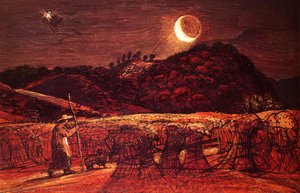
To gaze upon this depiction of Moonrise is to step across the threshold into a realm where the tangible world dissolves into the ethereal glow of spiritual contemplation. Painted in 1826, this work by Samuel Palmer captures more than just a nocturnal scene; it encapsulates a profound yearning for the sublime—a moment when the veil between the earthly and the divine seems impossibly thin. The local countryside of Shoreham in Sussex, which served as its inspiration, was not merely a backdrop but a catalyst for vision, leading Palmer to describe such places as a veritable ‘Valley of Vision.’
The Alchemy of Light and Shadow
Technically, the piece resonates with the delicate beauty of gouache on paper, lending it an immediate sense of age and precious fragility. The composition is dominated by the luminous presence of the moon, which hangs like a celestial beacon over the dark, silhouetted forms of the forest. These trees, rendered in deep, mysterious tones, frame the scene, creating pockets of profound shadow that invite the viewer deeper into the painting’s mystery. Scattered throughout this tranquil expanse are figures—small, almost incidental against the grandeur of nature and sky. They do not command attention through portraiture, but rather by their very presence, suggesting shared wonder among those who have paused to witness such an enchanting confluence of light.
Spiritual Resonance and Blakean Influence
The historical context surrounding this painting is inseparable from the artist’s own spiritual awakening. Palmer's encounter with William Blake proved transformative, steering his artistic gaze away from mere observation toward a more imaginative and deeply spiritual interpretation of nature. This work embodies that shift. It speaks to Palmer’s lifelong quest for a synthesis—a harmonious marriage between the natural world and the inner life. The moonlight itself becomes symbolic; it is not just illumination, but a purifying force, echoing his own poetic descriptions of the soul's ‘infabulous alchymy.’
Creating an Atmosphere of Enchantment
For the collector or designer seeking to infuse a space with depth and quiet contemplation, Moonrise offers unparalleled atmospheric quality. It is not merely decorative; it is evocative. Imagine this piece lending its serene, mysterious glow to a study or drawing-room—a place where one might pause amidst the clamor of modern life to feel the weight of history and the lightness of pure imagination. The overall emotional impact is one of profound tranquility mixed with an undeniable sense of wonder, inviting quiet reflection under a celestial gaze.
Questions & Answers
Where in Samuel Palmer's career does "Moonrise" fall, given its date?
Given its 1826 date, "Moonrise" falls in Samuel Palmer's Blake influence period.
What print size of "Moonrise" by Samuel Palmer fits the recommended room?
In a living room, "Moonrise" is suggested at a medium print size.
How do contrast and harmony combine in "Moonrise"?
In "Moonrise", a statement contrast is paired with a unified palette harmony.
What are the author and date of "Moonrise"?
The author of "Moonrise" is Samuel Palmer, and the work is dated 1826.
What style does "Moonrise" belong to?
"Moonrise" by Samuel Palmer belongs to the Romanticism movement. This movement provides the stylistic context of the work.
How is "Moonrise" situated historically?
The art-historical classification of "Moonrise" by Samuel Palmer is Romanticism, in the 19th-Century period.
In which movement and which era is "Moonrise" by Samuel Palmer placed?
In "Moonrise" by Samuel Palmer, the Romanticism movement meets the 19th-Century era.
Who is "Moonrise" suggested for as a present, and for what use?
The gift recommendation for "Moonrise" by Samuel Palmer combines anniversary with accent.
Artist Biography
Early Life and the Seeds of Vision
Samuel Palmer, born in London in 1805, emerged from a world steeped in both intellectual curiosity and spiritual seeking. His father, a bookseller and Baptist minister, instilled in him a love for literature and a contemplative nature, while his early artistic inclinations manifested remarkably early – by the age of twelve, he was already diligently painting churches, demonstrating an innate talent for observation and detail. This precocious ability quickly gained recognition; at just fourteen years old, Palmer exhibited works inspired by J.M.W. Turner at the Royal Academy, signaling a promising start to his artistic journey. Though receiving limited formal training – a brief stint at Merchant Taylors' School offered little in the way of structured art education – his path was irrevocably altered by a pivotal encounter with William Blake in 1824, facilitated through the landscape painter John Linnell. This meeting proved transformative, as Blake’s visionary style and profound spiritual depth resonated deeply within Palmer, becoming a cornerstone of his artistic identity.The Shoreham Period: A Realm of Mystical Pastoral
The years spent near Shoreham, Kent (1826-1835), represent the most intensely creative and distinctive phase of Samuel Palmer’s career. He purchased a humble cottage, affectionately nicknamed “Rat Abbey,” and it was here, amidst the rolling hills and ancient woodlands, that he forged his unique artistic voice. This period wasn't merely about depicting landscapes; it was about *transforming* them into realms of mystical beauty and spiritual resonance. Palmer’s Shoreham paintings are characterized by their evocative use of sepia tones, creating a sense of timelessness and melancholy, and often bathed in the ethereal glow of moonlight. These weren’t simply representations of nature but idealized visions, imbued with personal symbolism and a deep connection to the land. He wasn't alone in this pursuit; Palmer became associated with a group of like-minded artists known as “the Ancients,” including George Richmond and Edward Calvert, all drawn to Blake’s mystical leanings and seeking to revive a spiritual dimension within their art. This collective fostered an environment of shared ideas and mutual inspiration, solidifying Palmer's commitment to visionary pastoral painting.Shifting Tides: London, Italy, and the Pursuit of Stability
In 1835, Palmer returned to London, marking a turning point in his artistic trajectory. The intensely mystical style of his Shoreham paintings began to give way to more conventional landscapes and watercolors, a shift partly dictated by financial necessity and pragmatic advice from his father-in-law, John Linnell, who urged him to cater to prevailing public tastes. While he continued to paint prolifically, Palmer increasingly relied on watercolor as a means of income, a popular medium in England at the time but one that perhaps didn’t fully satisfy his artistic ambitions. A honeymoon trip to Italy with his wife, Hannah Linnell, in 1837-1839 broadened his palette and introduced brighter colors into his work, though these sometimes resulted in hues considered overly vivid by contemporaries. To supplement his income, Palmer worked as a private drawing master, a demanding occupation that limited the time he could dedicate to his own artistic pursuits. Financial difficulties plagued him throughout this period, exacerbated by the unfortunate actions of his brother, who pawned many of his early paintings – forcing Palmer to redeem them at considerable expense.Later Years and Enduring Legacy
A move to Furze Hill House in Redhill, Surrey, in 1862 brought a degree of financial stability to Palmer’s life, allowing him to revisit the visionary style of his earlier Shoreham paintings, albeit with a more mature and refined technique. His later works include exquisite illustrations for Milton’s poems *L'Allegro* and *Il Penseroso*, demonstrating his continued mastery of line and composition, as well as a series of evocative etchings illustrating Virgil. The Lonely Tower, completed in 1879, is widely considered one of his finest later achievements, showcasing his exceptional skill in etching and capturing a mood of poignant solitude. The death of his son, Thomas More Palmer, in 1861 cast a long shadow over these final years, adding a layer of melancholy to his work. Samuel Palmer passed away in 1881, leaving behind a body of work that, while initially overlooked, has since been recognized as profoundly significant within the context of British Romanticism. He stands as a key figure in visionary art, demonstrating the lasting impact of William Blake’s artistic and philosophical ideas and helping to foster a revival of interest in spiritual themes during the 19th century. His unique ability to blend meticulous observation with imaginative vision continues to captivate audiences today, solidifying his place as an enduringly important artist.
Samuel Palmer
1805 - 1881 , United Kingdom
Quick Facts
- Full Name: Samuel Palmer
- Nationality: British
- Date Of Birth: 1805
- Date Of Death: 1881
- Place Of Birth: London, United Kingdom
- Notable Artworks:
- Cornfield by Moonlight
- Self-Portrait
- Harvesting
- The Lonely Tower
- Artistic Movement Or Style: Romanticism
- Artists Who Influenced This Artist:
- William Blake
- J.M.W. Turner
- Artists Or Movements Influenced By This Artist: ['The Ancients']
Related Articles

William Blake: Romantic Visionary & Mystical Genius of the Imagination
Explore the mystical art & poetic genius of William Blake (1757-1827). Discover his revolutionary illuminated printing, rich symbolism, and lasting influence on Romanticism. Find handmade reproductions at OriginalUniqueArt.

Romantic Landscapes: 10 Masterpieces for Your Home | OriginalUniqueArt
Journey through 10 Romantic landscape masterpieces by Friedrich, Turner & Cole. Explore emotional art, sublime nature scenes & iconic 19th-century paintings. Find museum-quality reproductions for your home at OriginalUniqueArt.com – discover the full collection online!

John Constable's Masterpieces: Explore 25 Iconic Landscapes for Your Home
Journey through John Constable's 25 most celebrated landscapes. Explore Romanticism, Dedham Vale & his masterful use of light in iconic paintings like 'Hay Wain'. Find museum-quality art reproductions and elevate your home decor on OriginalUniqueArt.com.
John Varley I: Intimate Observation & the British Romantic Landscape
Explore the serene landscapes of John Varley I, a key figure in British Romanticism. Discover his unique watercolour style, collaboration with William Blake & lasting artistic legacy. Learn about collecting Varley's work.

Evocations of Place: A Historical Journey Through Landscape Art
Explore the rich history of landscape art with OriginalUniqueArt. Discover renowned artists, movements like Impressionism & Romanticism, and expert guidance for collecting timeless pieces. Find your perfect serene escape today!