1


Updated November 2026 · ranked by our popularity score (searches, visits and orders for each work) · 16 works by Pieter Post in our catalogue
In short
To the gallery's eye, Pieter Post's most famous painting is Dune Landscape with Haystack (1633), whose original hangs in the Mauritshuis, The Hague. Ambushing an Army Convoy (1631) and Cavalry Engagement (1631) complete the trio every eye recognises. Of the 16 works by Pieter Post in our catalog, the gallery presents the 14 most famous below, each original with its year, its museum and what makes it unique.


The four subjects that come back most often in these originals, each with its finest example.
The 5 museums that hold the most of the paintings on this page.
| Museum | City | Works by Pieter Post | Paintings from this list |
|---|---|---|---|
 Mauritshuis |
The Hague | 3 | Dune Landscape with Haystack, Ambushing an Army Convoy, Cavalry Engagement |
 Rijksmuseum |
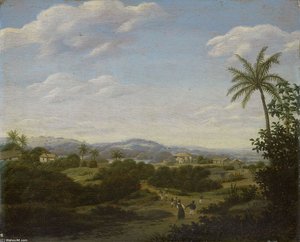
Amsterdam | 2 | Landscape By The River Senhor De Engenho, Brazilian Landscape |
 Fondation Custodia |
Paris | 1 | View of the bleaching fields near Haarlem |
 Statens Museum For Kunst |
Copenhagen | 1 | Landscape with Riders on a Sandy Road |
 Frans Hals Museum |
Haren | 1 | Italianate Landscape With The Parting Of Jacob And Laban |
Pick a decade to see the original that defines it.
Dune Landscape with Haystack (1633), Mauritshuis, The Hague. Ambushing an Army Convoy (1631) and Cavalry Engagement (1631) come next.
25 years old: Dune Landscape with Haystack dates from 1633, and Pieter Post was born in 1608.
Dune Landscape with Haystack, Ambushing an Army Convoy, Cavalry Engagement, View of the bleaching fields near Haarlem, Landscape with Riders on a Sandy Road, Italianate Landscape, Assembly Room In The Binnenhof, The Hague, Landscape, Landscape, A Village In Middle Distance And Hills In The Background and Landscape By The River Senhor De Engenho. The ranking above gives each one's year and museum.
Our catalog holds 16 works by Pieter Post, dated from 1631 to 1669.
Mostly in Mauritshuis (The Hague), Rijksmuseum (Amsterdam) and Fondation Custodia (Paris). The museum table above lists them all.
In 1630s: 4 of the 14 works on this page were made then, Dune Landscape with Haystack among them.
On this page, the earliest is Ambushing an Army Convoy (1631) and the latest Italianate Landscape (1669).
Dune Landscape with Haystack, Ambushing an Army Convoy and Cavalry Engagement: the Mauritshuis, The Hague holds 3 of the works on this page.
Pieter Jansz Post stands as a pivotal figure in the Dutch Golden Age, a master whose creative spirit bridged the gap between the structural precision of architecture and the evocative beauty of landscape painting. Born in Haarlem in 1608, Post was immersed in an artistic lineage from his earliest days; he was the son of a skilled stained-glass painter and the elder brother to the renowned landscape artist Frans Post. This familial foundation provided him with more than just technical training; it offered a deep connection to the vibrant guild systems of the Netherlands, where the boundaries between different artistic disciplines were often fluid and interconnected.
His early career was marked by a dual mastery that would define his legacy. While he began his journey in Haarlem as a painter—producing notable battle scenes and landscapes during the 1630s—it was his architectural vision that would eventually reshape the physical landscape of the Netherlands. Post’s talent for capturing the atmospheric nuances of nature was matched by an innate understanding of symmetry, grandeur, and classical order. This rare combination allowed him to approach both canvas and stone with a singular, cohesive aesthetic sense, making him a true polymath of the seventeenth century.
The most enduring chapter of Post’s life was written through his profound architectural collaborations, most notably with Jacob van Campen. Together, this duo became the architects of Dutch Classicism, a style that sought to bring the refined elegance of the Renaissance to the burgeoning Dutch Republic. Their partnership was instrumental in designing some of the most iconic structures in the Netherlands, including the legendary Mauritshuis in The Hague. This palace, designed to reflect maritime prowess and cultural sophistication, remains a testament to their shared ability to blend monumental scale with delicate ornamentation.
Post’s architectural influence extended far beyond a single building. His hand can be seen in the very fabric of Dutch civic and royal life, serving as an overseer for significant additions to Paleis Noordeinde and acting as the architect for Huis ten Bosch under the patronage of Stadhouder Frederik Hendrik. His portfolio of work is a sprawling map of Dutch history, encompassing:
While history often remembers him for the permanence of his buildings, Post’s contributions to painting offered a more intimate window into the Dutch soul. His early works, such as View of the bleaching fields near Haarlem (1631), demonstrate a keen interest in the topographical realities and the shifting light of the Low Countries. Unlike his brother Frans, who would go on to document the exotic landscapes of Brazil, Pieter’s focus remained deeply rooted in the familiar, yet transformed, landscapes of his homeland through a lens of classical refinement.
The significance of Pieter Jansz Post lies in his ability to harmonize the disparate elements of his era. He did not merely build walls or paint trees; he constructed an aesthetic language that communicated authority, stability, and beauty. Through his work, the Dutch Golden Age found a visual rhythm—a balance between the rugged reality of the terrain and the idealized order of classical architecture. Even as the centuries passed, his influence persisted through his descendants, including his son Maurits, who followed in his architectural footsteps, ensuring that the Post name remained synonymous with the structural and artistic elegance of the Netherlands.