


1


Updated November 2026 · ranked by our popularity score (searches, visits and orders for each work) · 60 works by Peter Jacob Horemans in our catalogue
In short
Of all the originals Peter Jacob Horemans left, the most famous is Portrait of Frau Heigl (1738), in the collection of the Bavarian State Painting Collections, Munich. Close behind it come Kitchen Still Life with Coffee Drinker (1765) and Musical Still Life with Horn Player (1765). Our catalog holds 60 works by Peter Jacob Horemans; the gallery has kept the 58 the world admires most, each shown with its date, its museum and its story.


 The Smoker1764 · Bavarian State Painting Collections
12
 Hunting Still Life with Hunter1765 · Bavarian State Painting Collections
13
 Hunting Still Life with Hunter1765 · Bavarian State Painting Collections
14
 Kitchen Interior with Beer Drinker1765 · Bavarian State Painting Collections
15
 Kitchen Still Life with Female Figure Counting Money and Parrot1760 · Bavarian State Painting Collections
16
 Still Life with Violinist1763 · Bavarian State Painting Collections
17
 The Tailor's Workshop1759
18
 Still life with a distinguished gentleman1762 · Bavarian State Painting Collections
19
 Fruit still life with a female figure drinking wine1764 · Bavarian State Painting Collections
20
 Kitchen still life with female figure and parrot (An allegory of feeling)1760 · Bavarian State Painting Collections
21
 Shoemakers-shop1759
22
 Still Life with Female Figure1770 · Bavarian State Painting Collections
23
 Kitchen Still Life with Female Figure and Parrot1771 · Bavarian State Painting Collections
24
 Court Musician Felix Reiner with Bassoon1774 · Bavarian State Painting Collections
25
 Court Musician with Violin (Johann Georg Holzbogen)1774 · Bavarian State Painting Collections
26
 Still Life "The Treasurer"1773 · Bavarian State Painting Collections
27
 Kitchen Still Life with Female Figure and Parrot1771 · Bavarian State Painting Collections
28
 Portrait of District Administrator Josef Heigl1768 · Bavarian State Painting Collections
29
 Spring (Johanna de Lasence Having Coffee in the Garden)1767 · Bavarian State Painting Collections
30
 Self-portrait in the artist's atelier1766 · Bavarian State Painting Collections
31
 Bildnis eines Silberdieners1772 · Bavarian State Painting Collections
32
 Portrait of court sculptor Roman Anton Boos (1730-1810) in his studio next to a bust of elector Maximilian III1766 · Bavarian State Painting Collections
33
 Hunting a wild boar1773 · National Museum in Warsaw
34
 Hunting with falcons1773 · National Museum in Warsaw
35
 Picnic in the park1776 · Lenbachhaus
36
 Concert in the garden1776 · Lenbachhaus
37
 Still Life with Plucked Chicken1764 · Bavarian State Painting Collections
38
 Still Life with Pork Knuckle and Squirrel1765 · Bavarian State Painting Collections
39
 Still Life with Dead Partridge1764 · Bavarian State Painting Collections
40
 Still Life with Fish1765 · Bavarian State Painting Collections
41
 Still Life with Pork Knuckle and Parrot1765 · Bavarian State Painting Collections
42
 Still Life with Fruit1765 · Bavarian State Painting Collections
43
 Still Life with Dead Lamb1765 · Bavarian State Painting Collections
44
 Still Life with Dead Hare1764 · Bavarian State Painting Collections
45
 Still Life with Fruit1765 · Bavarian State Painting Collections
46
 Still Life with Kitchen Utensils and Plucked Chicken1765 · Bavarian State Painting Collections
47
 Still Life with Kitchen Utensils and Dead Partridge1765 · Bavarian State Painting Collections
48
 Still Life with Lobster1765 · Bavarian State Painting Collections
49
 Still Life with Lobster1766 · Bavarian State Painting Collections
50
 Still Life with Grapes and Apples1768 · Bavarian State Painting Collections
51
 Fruit Still Life1770 · Bavarian State Painting Collections
52
 Still Life with Crabs1766 · Bavarian State Painting Collections
53
 Fruit Still Life1768 · Bavarian State Painting Collections
54
 Fruit Snack1770 · Bavarian State Painting Collections
55
 Still Life with Fruit and Dead Birds1771 · Bavarian State Painting Collections
56
 Still Life with Fruit and Dead Birds1771 · Bavarian State Painting Collections
57
 A Musical Gathering at the Court of the Elector Karl Albrecht of Bavaria1730 · Metropolitan Museum of Art
58
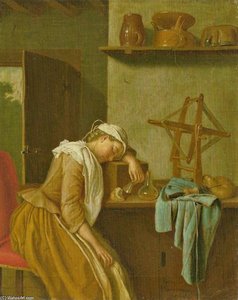 Schlafendes KüchenmädchenBavarian State Painting Collections
The 4 museums that hold the most of the paintings on this page.
| Museum | City | Works by Peter Jacob Horemans | Paintings from this list |
|---|---|---|---|
 Bavarian State Painting Collections |
Munich | 51 | Portrait of Frau Heigl, Kitchen Still Life with Coffee Drinker, Musical Still Life with Horn Player |
 National Museum in Warsaw |
Warsaw | 2 | Hunting a wild boar, Hunting with falcons |
 Lenbachhaus |
Munich | 2 | Picnic in the park, Concert in the garden |
 Metropolitan Museum of Art |
New York | 1 | A Musical Gathering at the Court of the Elector Karl Albrecht of Bavaria |
Pick a decade to see the original that defines it.

Portrait of Frau Heigl (1738), Bavarian State Painting Collections, Munich. Kitchen Still Life with Coffee Drinker (1765) and Musical Still Life with Horn Player (1765) come next.
38 years old: Portrait of Frau Heigl dates from 1738, and Peter Jacob Horemans was born in 1700.
Portrait of Frau Heigl, Kitchen Still Life with Coffee Drinker, Musical Still Life with Horn Player, Still Life with Female Figure with Flowers, Still Life with Elegant Lady, Still Life with Fruit and Female Figure, The Soup Eater, Still Life with Female Figure with Beer Glass, Still Life with Female Figure and Musical Still Life with Male Figure. The ranking above gives each one's year and museum.
Our catalog holds 60 works by Peter Jacob Horemans, dated from 1730 to 1776.
Mostly in Bavarian State Painting Collections (Munich), National Museum in Warsaw (Warsaw) and Lenbachhaus (Munich). The museum table above lists them all.
In 1760s: 36 of the 58 works on this page were made then, Kitchen Still Life with Coffee Drinker among them.
On this page, the earliest is A Musical Gathering at the Court of the Elector Karl Albrecht of Bavaria (1730) and the latest Picnic in the park (1776).
Portrait of Frau Heigl, Kitchen Still Life with Coffee Drinker and Musical Still Life with Horn Player: the Bavarian State Painting Collections, Munich holds 51 of the works on this page.