Portrait of Osias Beert

The 43 Most Famous Osias Beert Paintings, a Gallery Selection

Updated November 2026 · ranked by our popularity score (searches, visits and orders for each work) · 44 works by Osias Beert in our catalogue

In short

Of all the originals Osias Beert left, the most famous is Still life with oysters and sweets, in the background "Lazarus and the Rich Man" (1610). Close behind it come Fleurs, fruits, vases et autres objets and Still-Life with Cherries and Strawberries in China Bowls (detail) (1608). Our catalog holds 44 works by Osias Beert; the gallery has kept the 43 the world admires most, each shown with its date, its museum and its story.

1580 – 1623, Antwerp Baroque Most works: Musée de Grenoble

Osias Beert's top 10 paintings: the gallery's choice

1
Still life with oysters and sweets, in the background "Lazarus and the Rich Man" (1610) by Osias Beert

Still life with oysters and sweets, in the background "Lazarus and the Rich Man"

1610 · Oil On Panel

In this work, titled Still life with oysters and sweets, in the background "Lazarus and the Rich Man", we encounter a significant example of early seventeenth-century Flemish composition. Painted in 1610, the piece presents a dual narrative, merging the tangible textures of a banquet with a subtle biblical reference. It is a work that invites a quiet, close observation of how material abundance can coexist with spiritual themes.

3
Still-Life with Cherries and Strawberries in China Bowls (detail) (1608) by Osias Beert

Still-Life with Cherries and Strawberries in China Bowls (detail)

1608 · Oil · Staatliche Museen zu Berlin, Berlin

In the quiet intimacy of this exquisite detail from 1608, we encounter a masterclass in the art of the miniature and the profound beauty found in the simplest of offerings. Osias Beert the Elder, a pioneer of the Flemish still life tradition, invites us into a sensory experience where the boundaries between reality and painted illusion dissolve. The composition centers on a delicate arrangement of cherries and strawberries nestled within…

The Osias Beert selection continues, 11 to 43

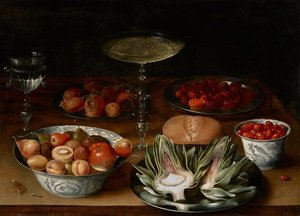
11Still-life with oysters. (1610) by Osias BeertStill-life with oysters.1610 · National Museum in Warsaw 12Bouquet of Flowers in a Serpentine Vase (1610) by Osias BeertBouquet of Flowers in a Serpentine Vase1610 13Flowers and fruit in vases with other objects (1612) by Osias BeertFlowers and fruit in vases with other objects1612 · Musée de Grenoble 14Fruit and glasses (1612) by Osias BeertFruit and glasses1612 · Musée de Grenoble 15Still life with roses, tulips, carnations and other flowers in a Chinese lacquer basket and in a glass vase (1609) by Osias BeertStill life with roses, tulips, carnations and other flowers in a Chinese lacquer basket and in a glass vase1609 16Vase of flowers in a niche (1620) by Osias BeertVase of flowers in a niche1620 · Pinacoteca Ambrosiana 17Still-life with fruit (1615) by Osias BeertStill-life with fruit1615 18Still-Life of Fruit (1610) by Osias BeertStill-Life of Fruit1610 19Still-Life with Oysters and Pastries (1610) by Osias BeertStill-Life with Oysters and Pastries1610 · Staatsgalerie 20Still life with fruit, sweetmeats and wine, in a niche (1625) by Osias BeertStill life with fruit, sweetmeats and wine, in a niche1625 · Museum Voor Moderne Kunst 21Still life with flowers in a woven basket and a floral bouquet in a porcelain vase on a table top with insects (1624) by Osias BeertStill life with flowers in a woven basket and a floral bouquet in a porcelain vase on a table top with insects1624 22Still-Life by Osias BeertStill-LifeMuseo del Prado 23a still life of porcelain vessels containing sweets, pewter plates bearing sweets and chestnuts, three pieces of glassware and a bread roll on a table draped with a mauve cloth by Osias Beerta still life of porcelain vessels containing sweets, pewter plates bearing sweets and chestnuts, three pieces of glassware and a bread roll on a table draped with a mauve cloth 24Banquet Still Life, Osias Beert (I) (follower of), c. 1620 - c. 1650 (1650) by Osias BeertBanquet Still Life, Osias Beert (I) (follower of), c. 1620 - c. 16501650 · Rijksmuseum 25Dishes with Oysters, Fruit, and Wine (1625) by Osias BeertDishes with Oysters, Fruit, and Wine1625 · National Gallery of Art 26Tableware by Osias BeertTablewareNational Museum in Warsaw 27Still life with flowers by Osias BeertStill life with flowersBavarian State Painting Collections 28Still life with artichoke by Osias BeertStill life with artichokeMusée de Grenoble 29Oysters on a pewter plate, sweetmeats and biscuits in a silver tazza, two façon-de-venise wine glasses and an orange in a niche by Osias BeertOysters on a pewter plate, sweetmeats and biscuits in a silver tazza, two façon-de-venise wine glasses and an orange in a niche 30Fruits et verres by Osias BeertFruits et verres 31Fruits et pain by Osias BeertFruits et pain 32Artichaut, fruits et coupes by Osias BeertArtichaut, fruits et coupes 33Stil life with three wine glasses in a niche by Osias BeertStil life with three wine glasses in a niche 34Nature morte à l'artichaut by Osias BeertNature morte à l'artichaut 35Nature morte au poulet et aux friandises by Osias BeertNature morte au poulet et aux friandises 36Life with Cherries and Strawberries in China Bowls by Osias BeertLife with Cherries and Strawberries in China BowlsGemäldegalerie 37Bouquet in a Niche by Osias BeertBouquet in a NicheRockox House 38Nature morte au singe by Osias BeertNature morte au singe 39Still-life by Osias BeertStill-lifeWallraf-Richartz-Museum 40Dishes with Oysters, Fruit, and Wine, by Osias Beert the Elder, Flemish, by Osias BeertDishes with Oysters, Fruit, and Wine, by Osias Beert the Elder, Flemish, 41Still Life of Grapes and Other Fruits with a Knife, Façon de Venise Wineglasses and other Objects on a Draped Table by Osias BeertStill Life of Grapes and Other Fruits with a Knife, Façon de Venise Wineglasses and other Objects on a Draped Table 42A still life of apples and grapes in a blue and white porcelain bowl, raspberries and walnuts in pewter dishes, plums on a pewter dish atop a stand, together with three wine glasses and sprigs of apricots and gooseberries upon a wooden table by Osias BeertA still life of apples and grapes in a blue and white porcelain bowl, raspberries and walnuts in pewter dishes, plums on a pewter dish atop a stand, together with three wine glasses and sprigs of apricots and gooseberries upon a wooden table 43Still Life with Artichoke, Fruit in Kraak Porcelain Ware, a Salt Cellar/Pepper Castor, Osias Beert (I), c. 1605 - c. 1615 (1615) by Osias BeertStill Life with Artichoke, Fruit in Kraak Porcelain Ware, a Salt Cellar/Pepper Castor, Osias Beert (I), c. 1605 - c. 16151615 · Rijksmuseum

The subjects that held Osias Beert's eye

The four subjects that come back most often in these originals, each with its finest example.

The museums that keep Osias Beert's originals

The 8 museums that hold the most of the paintings on this page.

Museum City Works by Osias Beert Paintings from this list
Musée de Grenoble, GrenobleMusée de Grenoble Grenoble 3 Flowers and fruit in vases with other objects, Fruit and glasses, Still life with artichoke
National Museum in Warsaw, WarsawNational Museum in Warsaw Warsaw 2 Still-life with oysters., Tableware
Rijksmuseum, AmsterdamRijksmuseum Amsterdam 2 Banquet Still Life, Osias Beert (I) (follower of), c. 1620 - c. 1650, Still Life with Artichoke, Fruit in Kraak Porcelain Ware, a Salt Cellar/Pepper Castor, Osias Beert (I), c. 1605 - c. 1615
Staatliche Museen zu Berlin, BerlinStaatliche Museen zu Berlin Berlin 1 Still-Life with Cherries and Strawberries in China Bowls (detail)
Nationalmuseum, StockholmNationalmuseum Stockholm 1 Still Life with Cherries
Royal Museums of Fine Arts of Belgium, BrusselsRoyal Museums of Fine Arts of Belgium Brussels 1 Still Life with Oysters, Confectionery and Glasses on a Table
Dallas Museum of Art, DallasDallas Museum of Art Dallas 1 Basket of Flowers
Museum of Fine Arts, BostonMuseum of Fine Arts Boston 1 Still Life with Various Vessels on a Table

Osias Beert decade by decade: the original that defines each

Works per decade

Pick a decade to see the original that defines it.

Collectors' questions about Osias Beert's paintings

Which work is Osias Beert most famous for?Reveal the answer

Still life with oysters and sweets, in the background "Lazarus and the Rich Man" (1610). Fleurs, fruits, vases et autres objets and Still-Life with Cherries and Strawberries in China Bowls (detail) (1608) come next.

What age was Osias Beert when Still life with oysters and sweets, in the background "Lazarus and the Rich Man" was made?Reveal the answer

30 years old: Still life with oysters and sweets, in the background "Lazarus and the Rich Man" dates from 1610, and Osias Beert was born in 1580.

What are the ten most famous Osias Beert paintings?Reveal the answer

Still life with oysters and sweets, in the background "Lazarus and the Rich Man", Fleurs, fruits, vases et autres objets, Still-Life with Cherries and Strawberries in China Bowls (detail), Still Life with Cherries, Still Life with Oysters, Confectionery and Glasses on a Table, Basket of Flowers, Still Life with Various Vessels on a Table, Still Life of Flowers in a Basket, Still life with flowers, fruits and nuts and Basket of Flowers. The ranking above gives each one's year and museum.

How many paintings did Osias Beert leave?Reveal the answer

Our catalog holds 44 works by Osias Beert, dated from 1600 to 1620.

In which museums do Osias Beert's masterpieces hang?Reveal the answer

Mostly in Musée de Grenoble (Grenoble), National Museum in Warsaw (Warsaw) and Rijksmuseum (Amsterdam). The museum table above lists them all.

In which years did Osias Beert paint the most famous works?Reveal the answer

In 1610s: 14 of the 43 works on this page were made then, Still life with oysters and sweets, in the background "Lazarus and the Rich Man" among them.

What are the first and the last famous originals of Osias Beert?Reveal the answer

On this page, the earliest is Still Life with Cherries (1600) and the latest Still Life of Flowers in a Basket (1620).

Which subjects did Osias Beert choose most often?Reveal the answer

Life (6), Still life (4) and Oysters (3), across the 43 works on this page.

Which technique did Osias Beert use most?Reveal the answer

Oil On Panel, for 2 of the 43 works on this page.

To which art movement does Osias Beert belong?Reveal the answer

Baroque, judging by the originals on this page.

Which Osias Beert works hang at the Musée de Grenoble?Reveal the answer

Flowers and fruit in vases with other objects, Fruit and glasses and Still life with artichoke: the Musée de Grenoble, Grenoble holds 3 of the works on this page.

Osias Beert: life and work

Osias Beert the Elder: Pioneer of Flemish Still Life

Osias Beert (c. 1580 – 1623) stands as a pivotal figure in the burgeoning field of Northern European still life painting during the Dutch Golden Age, specifically recognized for his groundbreaking approach to depicting floral arrangements and banquet scenes—a style that would come to be known as “breakfast paintings.” Born around 1580 in Antwerp, Beert’s artistic journey began under the tutelage of Andries van Baseroo, establishing him firmly within the influential Antwerp art milieu. This formative period instilled in him a meticulous attention to detail and a masterful command of chiaroscuro—the dramatic interplay of light and shadow—techniques that would characterize his distinctive oeuvre.
  • Early Influences: Beert’s artistic sensibilities were undoubtedly shaped by the prevailing Baroque aesthetic, which emphasized grandeur, theatricality, and emotional intensity. However, he distinguished himself from many contemporaries through a subtle yet profound exploration of naturalism, prioritizing accurate representation over mere decorative embellishment.
  • Technique & Style: Beert's signature style involved layering textures—fruit skins glistening with dew, velvety petals unfurling—to create immersive visual experiences for the viewer. He skillfully employed atmospheric perspective to convey depth and realism, capturing fleeting moments of beauty with remarkable precision.

Notable Works & Artistic Development

Beert’s artistic output spanned approximately 40 paintings, primarily focused on opulent banquet scenes populated by exquisitely rendered fruit, flowers, and tableware—a genre that anticipated the later developments championed by artists like Willem van Hemsterhuysen. His celebrated “Dishes with Oysters” exemplifies this style perfectly, showcasing a lavish display of seafood alongside vibrant blossoms arranged in Kraak porcelain ware. The painting’s dramatic lighting enhances the sumptuousness of the composition, conveying both visual splendor and symbolic richness. Similarly, "Still Life with Artichoke, Fruit in Kraak Porcelain Ware, a Salt Cellar/Pepper Castor" demonstrates Beert's dedication to capturing naturalistic detail and masterful chiaroscuro.
  • Key Paintings: Among his most recognizable works are “Fruit Still Life,” “Bouquet of Flowers,” and “Still Life with Wine Bottles.” These paintings exemplify Beert’s ability to distill complex emotions into carefully constructed visual narratives.

Symbolism & Artistic Significance

Beert's work transcends mere aesthetic pleasure; it engages in a sophisticated dialogue with humanist philosophical concepts prevalent during the Renaissance and Baroque eras. The inclusion of symbolic elements—such as skulls representing mortality—underscores the contemplation of human existence and the ephemeral nature of beauty. Like many artists of his time, Beert utilized still life to convey moral lessons and explore themes of vanitas—the futility of earthly pursuits in contrast to spiritual salvation.

Legacy & Influence

Osias Beert’s contribution to Flemish art history is undeniable. He established himself as a pioneer in the development of flower paintings, influencing subsequent generations of artists who embraced his meticulous observation and expressive use of light and shadow. His work continues to inspire admiration for its beauty and intellectual depth, cementing his place among the most important figures of the Dutch Golden Age—a period characterized by unparalleled artistic innovation and cultural flourishing.