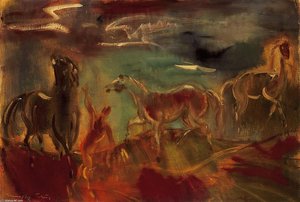
Portrait of Ödön Márffy

The 63 Most Famous Ödön Márffy Paintings, a Gallery Selection

Updated November 2026 · ranked by our popularity score (searches, visits and orders for each work) · 64 works by Ödön Márffy in our catalogue

In short

Of all the originals Ödön Márffy left, the most famous is Peaches (1930), in the collection of the Hungarian National Gallery, Budapest. Close behind it come Self-portrait and Woman With Lace Kerchief. Our catalog holds 64 works by Ödön Márffy; the gallery has kept the 63 the world admires most, each shown with its date, its museum and its story.

1878 – 1959, Budapest Impressionism Most works: Hungarian National Gallery

Ödön Márffy's top 10 paintings: the gallery's choice

2
Self-portrait by Ödön Márffy

Self-portrait

Black and White Photography · Hungarian National Gallery, Budapest

The work titled Self-portrait is an expression of the artist Ödön Márffy. Born in Budapest, Hungary, in 1878, the artist navigated the shifting currents of modernism until his death in 1959. This specific piece exists within the permanent collection of the Hungarian National Gallery.

The Ödön Márffy selection continues, 11 to 63

The subjects that held Ödön Márffy's eye

The four subjects that come back most often in these originals, each with its finest example.

The museums that keep Ödön Márffy's originals

The museum that holds the most of the paintings on this page.

Museum City Works by Ödön Márffy Paintings from this list
Hungarian National Gallery, BudapestHungarian National Gallery Budapest 3 Peaches, Self-portrait, Reclining Zdenka

Ödön Márffy year by year: the originals that define each

Ödön Márffy's dated works in this selection cover only 5 years, from 1926 to 1930: a brief career, shown here year by year.

Works per year

Pick a year to see its originals.

Collectors' questions about Ödön Márffy's paintings

Which work is Ödön Márffy most famous for?Reveal the answer

Peaches (1930), Hungarian National Gallery, Budapest. Self-portrait and Woman With Lace Kerchief come next.

What age was Ödön Márffy when Peaches was made?Reveal the answer

52 years old: Peaches dates from 1930, and Ödön Márffy was born in 1878.

What are the ten most famous Ödön Márffy paintings?Reveal the answer

Peaches, Self-portrait, Woman With Lace Kerchief, Portrait Of Endre Ady, Boats At The Balaton, Siesta, Dynamic Sefl-portrait, Rowers, Lovers On The Bench and Girl From Nyerges. The ranking above gives each one's year and museum.

How many paintings did Ödön Márffy leave?Reveal the answer

Our catalog holds 64 works by Ödön Márffy, dated from 1926 to 1930.

In which museums do Ödön Márffy's masterpieces hang?Reveal the answer

Mostly in Hungarian National Gallery (Budapest). The museum table above lists them all.

What are the first and the last famous originals of Ödön Márffy?Reveal the answer

On this page, the earliest is Reclining Zdenka (1926) and the latest Peaches (1930).

Which subjects did Ödön Márffy choose most often?Reveal the answer

Portraits (8), Hungarian art (8) and Flowers (5), across the 63 works on this page.

To which art movement does Ödön Márffy belong?Reveal the answer

Impressionism and Expressionism, judging by the originals on this page.

Which Ödön Márffy works hang at the Hungarian National Gallery?Reveal the answer

Peaches, Self-portrait and Reclining Zdenka: the Hungarian National Gallery, Budapest holds 3 of the works on this page.

Ödön Márffy: life and work

Early Life and Parisian Awakening

Ödön Márffy, born in Budapest in 1878, emerged as a pivotal figure in the modernization of Hungarian art. His journey began with foundational training in his homeland, but it was a grant to study in Paris from 1902 that truly ignited his artistic evolution. Immersing himself in the vibrant Parisian art scene, he first studied under Jean-Paul Laurens at the Académie Julian and later refined his skills with Fernand Cormon at the École des Beaux-Arts. This period proved transformative, exposing him to the burgeoning avant-garde movements that would shape his aesthetic vision. He frequented Ambroise Vollard’s gallery, where the revolutionary canvases of Paul Cézanne, Henri Matisse, Pierre Bonnard, and Georges Braque left an indelible mark on his sensibility. Márffy even claimed a personal encounter with Matisse in 1905, a testament to his engagement with the leading figures of artistic innovation. These Parisian experiences weren’t merely about adopting new styles; they were about absorbing a spirit of experimentation and challenging conventional norms—a spirit he would carry back to Hungary.

The Eight and a New Hungarian Vision

Upon returning to Budapest in 1907, Márffy didn't simply transplant Parisian ideas onto Hungarian soil. He became a catalyst for change, actively participating in the formation of new artistic collectives. Initially involved with “Miénk” (Circle of Hungarian Impressionists and Naturalists), he soon joined forces with a group that would become historically significant as "The Eight" (Nyolcak). This collective—comprising Róbert Berény, Dezső Czignány, Béla Czóbel, Károly Kernstok, Dezső Orbán, Bertalan Pór, and Lajos Tihanyi—represented a bold departure from traditional Hungarian art. Between 1909 and 1911, The Eight held three groundbreaking exhibitions that showcased their collective vision, challenging the established artistic order and introducing modern sensibilities to a wider audience. Márffy wasn’t isolated within the realm of painting; he actively engaged with Hungary's intellectual elite, forging connections with writers like Endre Ady and Dezső Kosztolányi, and composers such as Béla Bartók and Zoltán Kodály. This cross-disciplinary dialogue fueled a period of intense artistic transformation for Márffy, his work evolving from the vibrant hues of Fauvism towards increasingly expressive and constructivist forms. His paintings during this time reflect a constant search for new ways to represent reality, moving beyond mere imitation toward subjective interpretation.

Maturity, Recognition, and Lasting Influence

The year 1920 marked a turning point in Márffy’s life, both personally and professionally. His marriage to Berta Ady, the widow of the celebrated poet Endre Ady, brought emotional stability and financial security, allowing him to focus more fully on his art. This period also saw increasing international recognition, with exhibitions held across Europe and even in the United States—in Italy, Poland, Vienna, Nuremberg, and Munich. In 1924, he became a founding member of “Kut” (New Society of Visual Artists), further demonstrating his commitment to modern art movements. He assumed leadership of Kut from 1927 to 1937, solidifying his position as a leading figure in the Hungarian art scene. Interestingly, Márffy’s style underwent another subtle shift during the 1920s, becoming more accessible and decorative, influenced by artists like Moïse Kisling and Raoul Dufy. This wasn't a retreat from modernism but rather an evolution—a softening of edges that broadened his appeal without sacrificing his artistic integrity.

A Pioneer Remembered

Ödön Márffy’s legacy extends far beyond his individual paintings. He is rightfully recognized as a pioneer who courageously introduced Cubism, Fauvism, and Expressionism to Hungary, breaking down barriers and paving the way for future generations of artists. His participation in "The Eight" was instrumental in shaping the development of modern Hungarian art, fostering a spirit of experimentation and innovation that continues to resonate today. Márffy’s work embodies the artistic ferment and intellectual dynamism of early 20th-century Europe, filtered through a uniquely Hungarian lens. He wasn't simply copying trends; he was adapting them, transforming them, and making them his own. His willingness to embrace new ideas and challenge conventions inspired countless artists who followed in his footsteps. He died in 1959, leaving behind a substantial body of work that continues to captivate viewers with its vibrancy, emotional depth, and enduring relevance—a testament to the power of an artist who dared to push boundaries and redefine what Hungarian art could be. His paintings remain vibrant testaments to a pivotal moment in artistic history.