Portrait of Leonaert Bramer

Leonaert Bramer Paintings: The 65 Most Famous, Through a Gallery's Eye

Updated November 2026 · ranked by our popularity score (searches, visits and orders for each work) · 68 works by Leonaert Bramer in our catalogue

In short

To the gallery's eye, Leonaert Bramer's most famous painting is Soldiers with Horses before a House (1655), whose original hangs in the Museum Kunstpalast, Duesseldorf. Adoration of the Magi (1639) and The Sacrifice of Iphigenia (1623) complete the trio every eye recognises. Of the 68 works by Leonaert Bramer in our catalog, the gallery presents the 65 most famous below, each original with its year, its museum and what makes it unique.

1596 – 1674, Delft Baroque Most works: Nationalmuseum

The gallery's top 10 Leonaert Bramer paintings

1
Soldiers with Horses before a House (1655) by Leonaert Bramer

Soldiers with Horses before a House

1655 · Oil On Canvas · Museum Kunstpalast, Duesseldorf

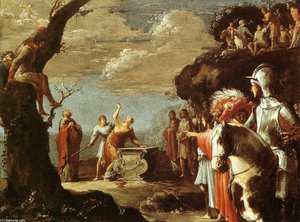
In the masterful oil painting "Soldiers with Horses before a House," Leonaert Bramer invites viewers into a meticulously crafted moment from the Dutch Golden Age. The scene, captured with profound anatomical accuracy, centers on two mounted soldiers who command the viewer's attention through their expressive poses and the palpable energy of their movement. Bramer employs a sophisticated technique of hatching and cross-hashing, particularly evident in the metallic sheen of the…

2
Adoration of the Magi (1639) by Leonaert Bramer

Adoration of the Magi

1639 · Oil On Panel · Hermitage Museum, Saint Petersburg

The darkness of a vast, desolate landscape presses in from every side, swallowing the horizon in a heavy, nocturnal shroud. In this quiet, shadowy realm, a sudden, intense glow emanates from the center of the scene, cutting through the gloom like a physical presence. This light does not merely illuminate; it transforms. It spills across the figures in the lower left, catching the textures of ornate, heavy garments and the…

3
The Sacrifice of Iphigenia (1623) by Leonaert Bramer

The Sacrifice of Iphigenia

1623 · Oil On Copper · Het Prinsenhof, Delft

Leonaert Bramer produced The Sacrifice of Iphigenia during his time in Italy. This work is one of the few paintings known to have been executed by the artist in Rome. It represents a significant period of his development, occurring after his departure from Delft and his involvement with the Bentvueghels.

4
The Adoration of the Magi (1642) by Leonaert Bramer

The Adoration of the Magi

1642 · Oil On Copper · Statens Museum For Kunst, Copenhagen

The Adoration of the Magi emerges from the shadows of 1639, a moment frozen in oil where the sacred meets the earthly. Leonaert Bramer captures the Holy Family and the Magi in a quiet, intense encounter. The scene centers on the Wise Men as they approach to present their precious gifts to the Christ-child. Every figure exists within a heavy, atmospheric stillness, caught in the act of reverence.

5
Four Latin Fathers of the Church and Saints (verso) (1650) by Leonaert Bramer

Four Latin Fathers of the Church and Saints (verso)

1650 · Oil On Canvas · British Museum, London

Leonaert Bramer's "Four Latin Fathers of the Church and Saints (verso)" isn’t merely a painting; it’s an intimate portrait of artistic process, a whispered secret revealed through layers of paint, time, and deliberate obscurity. This remarkable work, currently housed in the British Museum, offers a captivating journey into the mind of a pivotal 17th-century Dutch artist – a man often dubbed “Leonardo della Notte” for his mastery of nocturnal scenes…

6
Allegory of Vanity (Vanitas) (1650) by Leonaert Bramer

Allegory of Vanity (Vanitas)

1650 · Oil On Canvas · Kunsthistorisches Museum, Vienna

In this somber Dutch Golden Age composition, we find ourselves in a space defined by shadow and light. The scene is arranged in a triangular formation, drawing the eye toward a cluttered table where the objects of earthly pleasure lie scattered. A strong light source from the upper left cuts through the darkness, illuminating the polished wood of a lute and the metallic sheen of silver vessels. These textures—the soft…

7
Dying Vision of Mary Magdalene (1633) by Leonaert Bramer

Dying Vision of Mary Magdalene

1633 · Oil On Panel · Hermitage Museum, Saint Petersburg

The oil on panel titled Dying Vision of Mary Magdalene was created by Leonaert Bramer in 1633. This religious work captures a moment of spiritual revelation through the heavy application of pigment. The canvas holds the gaze of a woman kneeling in the shadows, her eyes turned toward a celestial light.

9
Crucifixion (1650) by Leonaert Bramer

Crucifixion

1650 · Oil On Panel · Hermitage Museum, Saint Petersburg

The air feels heavy, thick with the silence of a world gone dark. In this somber Baroque scene, the central figure of Christ hangs upon the cross, his body illuminated by a sudden, sharp light that cuts through the surrounding gloom. This light catches the pale tones of his flesh and the tension in his musculature, pulling him forward from a near-black background. Below him, the weight of grief takes…

10
Journey of the Three Magi to Bethlehem (1638) by Leonaert Bramer

Journey of the Three Magi to Bethlehem

1638 · Oil On Canvas · New York Historical Society, New York City

In the quiet, shadowed corridors of the Dutch Golden Age, few artists possessed the ability to conjure atmosphere as masterfully as Leonaert Bramer. His 1638 masterpiece, Journey of the Three Magi to Bethlehem, is not merely a depiction of a biblical pilgrimage; it is a profound immersion into a world of divine mystery and dramatic tension. As the viewer approaches this canvas, they are immediately swept into the urgent movement…

Leonaert Bramer paintings, ranked 11 to 65

11St Peter"s Denial, Leonaert Bramer, 1642 (1642) by Leonaert BramerSt Peter"s Denial, Leonaert Bramer, 16421642 · Rijksmuseum 12Christ before Pilate (1635) by Leonaert BramerChrist before Pilate1635 · Bavarian State Painting Collections 13The Finding of Pyramus and Thisbe (1624) by Leonaert BramerThe Finding of Pyramus and Thisbe1624 · Gemäldegalerie 14Five men playing music in an interior (1633) by Leonaert BramerFive men playing music in an interior1633 · Staatliche Kunsthalle Karlsruhe 15The Adoration of the Shepherds (1635) by Leonaert BramerThe Adoration of the Shepherds1635 · Nationalmuseum 16The Martyrdom of the Prophet Isaiah (1625) by Leonaert BramerThe Martyrdom of the Prophet Isaiah1625 17Abraham and the Three Angels (1640) by Leonaert BramerAbraham and the Three Angels1640 · Museo del Prado 18The circumcision of the Christ-child by the priest in the temple (1640) by Leonaert BramerThe circumcision of the Christ-child by the priest in the temple1640 · Groninger Museum 19Solomon's idolatry (1 Kings 11:7-8) (1642) by Leonaert BramerSolomon's idolatry (1 Kings 11:7-8)1642 · Wallraf-Richartz-Museum 20Saphan reads the book of Law aloud to Josiah (2 Kings 8-10) (1642) by Leonaert BramerSaphan reads the book of Law aloud to Josiah (2 Kings 8-10)1642 21The presentation in the temple (1642) by Leonaert BramerThe presentation in the temple1642 · New York Historical Society 22The Betrayal of Christ (1637) by Leonaert BramerThe Betrayal of Christ1637 23Marcus Curtius Leaping into the Abyss on His Horse (1657) by Leonaert BramerMarcus Curtius Leaping into the Abyss on His Horse1657 24Quevedo Sees Chicotus in the Battle (1659) by Leonaert BramerQuevedo Sees Chicotus in the Battle1659 · Staatliche Graphische Sammlung 25Figures in a Loggia (1660) by Leonaert BramerFigures in a Loggia1660 · Victoria and Albert Museum 26Jacob's Dream (1657) by Leonaert BramerJacob's Dream1657 · Koninklijke Tichelaar 27The Judgment of Solomon (detail) (1640) by Leonaert BramerThe Judgment of Solomon (detail)1640 · Metropolitan Museum of Art 28Money Combats the World, the Flesh, and the Devil (1659) by Leonaert BramerMoney Combats the World, the Flesh, and the Devil1659 · Staatliche Graphische Sammlung 29The Judgment of Solomon (1640) by Leonaert BramerThe Judgment of Solomon1640 · Metropolitan Museum of Art 30The Fall of Simon Magus (1623) by Leonaert BramerThe Fall of Simon Magus1623 31The Quarrel between Ajax and Odysseus (1623) by Leonaert BramerThe Quarrel between Ajax and Odysseus1623 · Het Prinsenhof 32Quevedo and the Skeletons of Juan de la Encina and King Perico (1659) by Leonaert BramerQuevedo and the Skeletons of Juan de la Encina and King Perico1659 · Staatliche Graphische Sammlung 33Scene from the Metamorphoses (1660) by Leonaert BramerScene from the Metamorphoses1660 34Scene from the Metamorphoses (1660) by Leonaert BramerScene from the Metamorphoses1660 35Scenes from the Life of Christ (1660) by Leonaert BramerScenes from the Life of Christ1660 36Allegory of Transitoriness (1640) by Leonaert BramerAllegory of Transitoriness1640 · Kunsthistorisches Museum 37The Temptation of Christ (1645) by Leonaert BramerThe Temptation of Christ1645 · Hessisches Landesmuseum 38Design for a wall decoration (1645) by Leonaert BramerDesign for a wall decoration1645 · Nasjonalgalleriet 39Pashur Smiting Jeremiah in the Temple, Leonaert Bramer, c. 1648 (1648) by Leonaert BramerPashur Smiting Jeremiah in the Temple, Leonaert Bramer, c. 16481648 · Rijksmuseum 40Musicians in an Interior (1660) by Leonaert BramerMusicians in an Interior1660 · Rijksmuseum 41The Trials of Job (1630) by Leonaert BramerThe Trials of Job1630 · Courtauld Gallery 42Joseph and Potiphar's Wife (1630) by Leonaert BramerJoseph and Potiphar's Wife1630 · Courtauld Gallery 43A Peasant and Two Soldiers Playing Dice by Leonaert BramerA Peasant and Two Soldiers Playing DiceNationalmuseum 44Soldiers Arguing by Leonaert BramerSoldiers ArguingNationalmuseum 45Musical Company by Leonaert BramerMusical CompanyNationalmuseum 46Company around a Table by Leonaert BramerCompany around a TableNationalmuseum 47Anchias Fleeing Troy with His Father and Son by Leonaert BramerAnchias Fleeing Troy with His Father and Son 48the curious ones by Leonaert Bramerthe curious ones 49Résurrection de Jésus by Leonaert BramerRésurrection de Jésus 50SCENE DE SORCELLERIE by Leonaert BramerSCENE DE SORCELLERIE 51L'Arrestation de Jésus Jésus au Jardin des Oliviers by Leonaert BramerL'Arrestation de Jésus Jésus au Jardin des Oliviers 52Christ among the Doctors by Leonaert BramerChrist among the Doctors 53Salome Presented with the Head of St John the Baptist by Leonaert BramerSalome Presented with the Head of St John the BaptistMusée des Beaux-Arts 54Christ before Caiaphas by Leonaert BramerChrist before CaiaphasBirmingham Museum and Art Gallery 55LE DRAGON DE CADMUS by Leonaert BramerLE DRAGON DE CADMUS 56LA DECOUVERTE DES CORPS DE PYRAME ET DE THISBE by Leonaert BramerLA DECOUVERTE DES CORPS DE PYRAME ET DE THISBEThe Louvre 57portrait of a man by Leonaert Bramerportrait of a man 58Peasants by a Fire by Leonaert BramerPeasants by a Fire 59Scenes from the Life of Christ by Leonaert BramerScenes from the Life of Christ 60The Adoration of the Magi by Leonaert BramerThe Adoration of the MagiDetroit Institute of Arts 61Concert of Angels (recto) by Leonaert BramerConcert of Angels (recto) 62Musicians on a Terrace by Leonaert BramerMusicians on a Terrace 63The Liberation of Saint Peter by Leonaert BramerThe Liberation of Saint PeterLos Angeles County Museum of Art 64Christ among the Doctors by Leonaert BramerChrist among the Doctors 65Circumcision of Christ (1640) by Leonaert BramerCircumcision of Christ1640 · National Museum in Warsaw

Leonaert Bramer's famous paintings, period by period

The subjects that held Leonaert Bramer's eye

The four subjects that come back most often in these originals, each with its finest example.

The museums that keep Leonaert Bramer's originals

The 8 museums that hold the most of the paintings on this page.

Museum City Works by Leonaert Bramer Paintings from this list
Nationalmuseum, StockholmNationalmuseum Stockholm 5 The Adoration of the Shepherds, A Peasant and Two Soldiers Playing Dice, Soldiers Arguing
Hermitage Museum, Saint PetersburgHermitage Museum Saint Petersburg 3 Adoration of the Magi, Dying Vision of Mary Magdalene, Crucifixion
Rijksmuseum, AmsterdamRijksmuseum Amsterdam 3 St Peter"s Denial, Leonaert Bramer, 1642, Pashur Smiting Jeremiah in the Temple, Leonaert Bramer, c. 1648, Musicians in an Interior
Staatliche Graphische Sammlung, MunichStaatliche Graphische Sammlung Munich 3 Quevedo Sees Chicotus in the Battle, Money Combats the World, the Flesh, and the Devil, Quevedo and the Skeletons of Juan de la Encina and King Perico
Het Prinsenhof, DelftHet Prinsenhof Delft 2 The Sacrifice of Iphigenia, The Quarrel between Ajax and Odysseus
Kunsthistorisches Museum, ViennaKunsthistorisches Museum Vienna 2 Allegory of Vanity (Vanitas), Allegory of Transitoriness
New York Historical Society, New York CityNew York Historical Society New York City 2 Journey of the Three Magi to Bethlehem, The presentation in the temple
Metropolitan Museum of Art, New YorkMetropolitan Museum of Art New York 2 The Judgment of Solomon (detail), The Judgment of Solomon

Leonaert Bramer, one signature painting per decade

Works per decade

Pick a decade to see the original that defines it.

Leonaert Bramer's paintings: the gallery answers

Which Leonaert Bramer painting is the most famous of all?Reveal the answer

Soldiers with Horses before a House (1655), Museum Kunstpalast, Duesseldorf. Adoration of the Magi (1639) and The Sacrifice of Iphigenia (1623) come next.

How old was Leonaert Bramer on completing Soldiers with Horses before a House?Reveal the answer

59 years old: Soldiers with Horses before a House dates from 1655, and Leonaert Bramer was born in 1596.

Which are Leonaert Bramer's top 10 paintings?Reveal the answer

Soldiers with Horses before a House, Adoration of the Magi, The Sacrifice of Iphigenia, The Adoration of the Magi, Four Latin Fathers of the Church and Saints (verso), Allegory of Vanity (Vanitas), Dying Vision of Mary Magdalene, The Raising of Lazarus (John 11: 43-44), Crucifixion and Journey of the Three Magi to Bethlehem. The ranking above gives each one's year and museum.

How many works did Leonaert Bramer create?Reveal the answer

Our catalog holds 68 works by Leonaert Bramer, dated from 1623 to 1660.

Where do Leonaert Bramer's most famous originals hang?Reveal the answer

Mostly in Nationalmuseum (Stockholm), Hermitage Museum (Saint Petersburg) and Rijksmuseum (Amsterdam). The museum table above lists them all.

When did Leonaert Bramer create the most famous paintings?Reveal the answer

In 1640s: 15 of the 65 works on this page were made then, The Adoration of the Magi among them.

Which are Leonaert Bramer's earliest and latest famous works?Reveal the answer

On this page, the earliest is The Sacrifice of Iphigenia (1623) and the latest Figures in a Loggia (1660).

Which subjects did Leonaert Bramer return to most?Reveal the answer

People (12), Figures (11) and Shadows (10), across the 65 works on this page.

Which medium did Leonaert Bramer work in most?Reveal the answer

Oil On Canvas, for 11 of the 65 works on this page.

Which movement is Leonaert Bramer associated with?Reveal the answer

Baroque and Dutch golden age, judging by the originals on this page.

Which Leonaert Bramer originals does the Nationalmuseum hold?Reveal the answer

The Adoration of the Shepherds, A Peasant and Two Soldiers Playing Dice and Soldiers Arguing: the Nationalmuseum, Stockholm holds 5 of the works on this page.

Leonaert Bramer: the artist

A Life Illuminated: The World of Leonaert Bramer

Leonaert Bramer, a name resonating with the echoes of 17th-century Delft, was more than just a painter; he was an adventurer, innovator, and a pivotal figure in the Dutch Golden Age. Born in 1596, his life unfolded as a compelling narrative woven with extensive travel, artistic experimentation, and deep engagement within the vibrant cultural tapestry of his time. Bramer’s legacy isn't simply defined by the canvases he filled but by the unique perspective he brought to them – a penchant for dramatic nocturnal scenes infused with exotic details that set him apart from many of his contemporaries. He wasn’t merely depicting reality; he was crafting worlds steeped in atmosphere and intrigue, earning him the evocative moniker “Leonardo della Notte” or "Leonardo of the Night" during his sojourn in Italy.

From Delft to Rome: A Journey of Artistic Formation

Bramer's artistic journey began with a bold departure from his native Delft at the tender age of eighteen, embarking on a grand tour that would shape his aesthetic sensibilities. This wasn’t a leisurely exploration but an immersive apprenticeship in the heart of European art centers. Passing through cities like Atrecht, Amiens, and Paris, he eventually arrived in Rome in 1616, a crucible for artistic ambition. There, he joined the ranks of the *Bentvueghels*, a society of Northern artists who adopted satirical nicknames and engaged in lively intellectual discourse. Bramer became known as “Nestelghat” (Fidget), hinting at a restless energy that permeated both his life and art. His time in Italy wasn’t without its clashes; accounts detail a physical altercation with the renowned Claude Lorraine, demonstrating a passionate spirit unafraid of confrontation. However, it was within this dynamic environment that Bramer honed his skills, mastering fresco painting – a technique relatively uncommon in Northern Europe – while absorbing the influence of masters like Adam Elsheimer and Agostino Tassi. He traveled extensively throughout Italy, visiting Mantua and Venice, each location adding another layer to his developing style.

Return to Delft: Patronage, Innovation, and Artistic Versatility

Returning to Delft in 1628, Bramer seamlessly integrated into the local art scene, joining the Guild of Saint Luke in 1629. He quickly garnered patronage from prominent figures, including members of the House of Orange and influential local officials, securing a stable foundation for his artistic endeavors. But Bramer was no one-dimensional artist; he embraced diverse creative pursuits beyond painting. He designed intricate patterns for tapestry firms, creating works that adorned homes across the Netherlands. Furthermore, he undertook ambitious mural projects, employing illusionistic techniques to transform interior spaces into immersive environments. Sadly, many of these frescos were lost over time due to the harsh Dutch climate, but their existence testifies to Bramer’s remarkable versatility and willingness to push artistic boundaries. His unique style, characterized by a nervous energy and masterful depiction of light reflection, consistently favored Italianate themes over the more conventional Dutch landscapes or still lifes, marking him as an individualist within his milieu.

A Mentor's Touch: Bramer’s Influence and Lasting Legacy

Bramer’s influence extended beyond his own artistic output. He is believed to have played a crucial role in the early career of Johannes Vermeer, defending the young artist when his future mother-in-law attempted to prevent his marriage. This act suggests a close relationship, leading many scholars to speculate that Bramer may have served as Vermeer’s teacher – though concrete evidence remains elusive. His intellectual curiosity was further demonstrated through the creation of the “Album Bramer” (1642-1654), a collection of drawings offering invaluable insights into the art collections and artistic practices prevalent in Delft during his time. Leonaert Bramer passed away in Delft before February 10, 1674, leaving behind a body of work that continues to captivate and intrigue. While his fame waned for a period after his death, recent scholarship has sparked renewed interest in his life and art, solidifying his position as an important – and often overlooked – figure in Dutch artistic history. He remains a testament to the power of individual vision and the enduring allure of a life lived in pursuit of artistic excellence.