Portrait of Konrad Witz

The 33 Most Famous Konrad Witz Paintings, Each One of a Kind

Updated November 2026 · ranked by our popularity score (searches, visits and orders for each work) · 33 works by Konrad Witz in our catalogue

In short

Mary with child (1430) is the Konrad Witz painting that draws the most eyes; the original belongs to the Kunstmuseum Basel, Basel. After it, the eye goes to Antipater before Julius Caesar (1435) and Abraham before Melchizedek (1435). Among the 33 works of Konrad Witz in our catalog, these 33 are the most famous, each a unique original presented with its year, its museum and the reason it endures.

1400 – 1445, Rottweil Northern renaissance Most works: Kunstmuseum Basel

Top 10 paintings by Konrad Witz, through the gallery's eye

1
Mary with child (1430) by Konrad Witz

Mary with child

1430 · Tempera On Panel · Kunstmuseum Basel, Basel

The air feels heavy with the scent of incense and the weight of devotion as we gaze upon this intimate encounter. A luminous, textured gold background envelops the figures, pushing them forward into our immediate space. This is not a scene of vast landscapes, but a close-up portrait of profound spiritual intimacy. Mary, draped in deep blues and soft pinks, holds the infant Jesus against a backdrop of embossed, patterned…

2
Antipater before Julius Caesar (1435) by Konrad Witz

Antipater before Julius Caesar

1435 · Tempera On Panel · Kunstmuseum Basel, Basel

In this work, titled Antipater before Julius Caesar, the artist Konrad Witz presents a moment of profound political and personal tension. Created about 1435, the painting captures a specific encounter from Roman history, focusing on the interaction between the figure of Antipater and the Roman leader Julius Caesar. The scene is characterized by a sense of gravity, focusing on the weight of the figures and the significance of their meeting.

3
Abraham before Melchizedek (1435) by Konrad Witz

Abraham before Melchizedek

1435 · Tempera On Panel · Kunstmuseum Basel, Basel

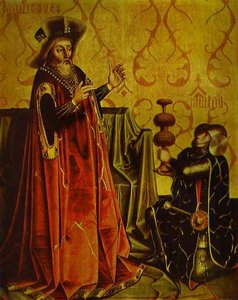
The scene unfolds in a compressed, intimate space where two figures command the center of the frame. On the left, a regal man sits enthroned, his presence defined by the heavy, sculptural folds of his deep crimson robes. Opposite him, a knight kneels in a gesture of reverence. They are locked in a ritualistic exchange, their hands meeting over a golden chalice that catches the light. This central interaction anchors…

4
St Augustine (1435) by Konrad Witz

St Augustine

1435 · Oil On Panel · Musée des Beaux-Arts de Dijon, Digione

In this 1435 portrait, St. Augustine is presented as a solemn and highly detailed figure within an interior setting. The subject is depicted as an elderly man with a weathered face, standing in a vertical profile-oriented composition. He is adorned in elaborate liturgical vestments, including a white alb and a heavy green cope featuring wide gold borders. Atop his head sits a tall white mitre decorated with gold. In his…

5
Heilsspiegelaltar - Augustus and Sibyl of Tibur (1435) by Konrad Witz

Heilsspiegelaltar - Augustus and Sibyl of Tibur

1435 · Tempera On Panel · Musée des Beaux-Arts de Dijon, Digione

The air feels heavy with a sacred stillness as two figures emerge from a shimmering expanse of gold. On the left, Augustus, the Roman emperor, reaches upward, his hands raised in a sudden, trembling gesture of prayer or awe. He is draped in a voluminous red robe, the fabric heavy and sculptural, trimmed with thick grey fur that suggests a tangible, physical weight. His gaze is fixed on something unseen…

6
Pietà (1440) by Konrad Witz

Pietà

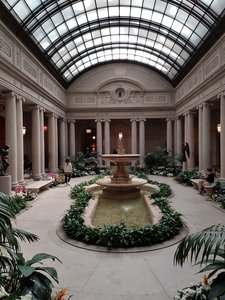
1440 · Tempera On Panel · The Frick Collection, New York City

The Pietà is a painting attributed to the artist Konrad Witz. This work was executed about 1440. The subject matter depicts the Virgin Mary cradling the lifeless body of Jesus, a composition accompanied by two mourning figures in heavy, voluminous robes. The figures are set against a landscape that includes a detailed cityscape and a Gothic cathedral.

7
Byblis Writing to Caunus (1450) by Konrad Witz

Byblis Writing to Caunus

A reclining female figure dominates the composition, her pale skin luminous against a backdrop of deep crimson and forest green drapery. She lies horizontally across the frame, propped by white pillows that catch the directional light. One arm is tucked behind her head, while the other rests near her torso, creating a pose of relaxed poise. The heavy folds of the fabric suggest weight and texture, framing the subject within…

8
Saint Christopher (Berlin) (1445) by Konrad Witz

Saint Christopher (Berlin)

1445 · Oil On Panel · Gemäldegalerie, Berlin

The river churns with a dark, restless energy, its surface broken into white foam and heavy, muddy swells. Through this turbulent water, a massive figure wades, his body leaning into the weight of the current. This is Saint Christopher, his muscles strained as he navigates the deep. Perched upon his shoulders sits the Christ Child, a small, luminous presence amidst the chaos of the elements. The saint’s tunic is a…

9
The Council of Salvation (1445) by Konrad Witz

The Council of Salvation

1445 · Tempera On Panel · Gemäldegalerie, Berlin

In "The Council of Salvation" by Konrad Witz, a celestial council unfolds within a highly detailed and ornate Late Gothic altarpiece design. The scene is structured around a central throne-like setting that anchors the divine assembly. To the left, God the Father, Christ, and the Holy Spirit, appearing as a dove, occupy the sacred space. Opposite them, on the right, two female figures face the divine presence. This arrangement creates…

10
St Bartholomew (1435) by Konrad Witz

St Bartholomew

1435 · Oil On Panel · Öffentliche Kunstsammlung, Basel

In this work, titled St Bartholomew, the artist Konrad Witz presents a quiet, religious study of a saint. Created around 1435, the painting focuses on the figure of the apostle, rendered with a sense of stillness that invites close observation. The subject is depicted in a three-quarter pose, a choice that allows for a detailed view of his traditional attire and the subtle expression on his face.

Konrad Witz's famous paintings, numbers 11 to 33

The subjects that held Konrad Witz's eye

The four subjects that come back most often in these originals, each with its finest example.

The museums that keep Konrad Witz's originals

The 8 museums that hold the most of the paintings on this page.

Museum City Works by Konrad Witz Paintings from this list
Kunstmuseum Basel, BaselKunstmuseum Basel Basel 9 Mary with child, Antipater before Julius Caesar, Abraham before Melchizedek
Gemäldegalerie, BerlinGemäldegalerie Berlin 3 Saint Christopher (Berlin), The Council of Salvation, Crucifixion
Öffentliche Kunstsammlung, BaselÖffentliche Kunstsammlung Basel 3 St Bartholomew, Saint Christopher, The Synagoge
Musée des Beaux-Arts de Dijon, DigioneMusée des Beaux-Arts de Dijon Digione 2 St Augustine, Heilsspiegelaltar - Augustus and Sibyl of Tibur
Staatliche Museen zu Berlin, BerlinStaatliche Museen zu Berlin Berlin 2 King Solomon and the Queen of Sheba, Christ on the Cross
Musée d'Art et d'Histoire, ЖеневаMusée d'Art et d'Histoire Женева 2 The Liberation of St Peter, The Miraculous Draught of Fishes
The Frick Collection, New York CityThe Frick Collection New York City 1 Pietà
Glasgow Museums Resource CentreGlasgow Museums Resource Centre 1 Byblis Writing to Caunus

Konrad Witz across the years: the unique originals of each

A long career of 16 years, 1430 to 1445: Konrad Witz's most famous originals, shown year by year.

Works per year

Pick a year to see its originals.

Konrad Witz's paintings: questions for the gallery

What is the single most famous work of Konrad Witz?Reveal the answer

Mary with child (1430), Kunstmuseum Basel, Basel. Antipater before Julius Caesar (1435) and Abraham before Melchizedek (1435) come next.

At what age did Konrad Witz create Mary with child?Reveal the answer

30 years old: Mary with child dates from 1430, and Konrad Witz was born in 1400.

Which ten paintings by Konrad Witz are the most famous?Reveal the answer

Mary with child, Antipater before Julius Caesar, Abraham before Melchizedek, St Augustine, Heilsspiegelaltar - Augustus and Sibyl of Tibur, Pietà, Byblis Writing to Caunus, Saint Christopher (Berlin), The Council of Salvation and St Bartholomew. The ranking above gives each one's year and museum.

How many works by Konrad Witz are known?Reveal the answer

Our catalog holds 33 works by Konrad Witz, dated from 1430 to 1445.

Where can the most famous Konrad Witz originals be seen?Reveal the answer

Mostly in Kunstmuseum Basel (Basel), Gemäldegalerie (Berlin) and Öffentliche Kunstsammlung (Basel). The museum table above lists them all.

During which period did Konrad Witz create the best-known paintings?Reveal the answer

In 1435: 14 of the 33 works on this page were made then, Antipater before Julius Caesar among them.

Which famous Konrad Witz painting is the earliest, and which the latest?Reveal the answer

On this page, the earliest is Mary with child (1430) and the latest Saint Christopher (Berlin) (1445).

What subjects did Konrad Witz favour?Reveal the answer

Woman (10), Man (10) and Book (6), across the 33 works on this page.

What materials did Konrad Witz paint with most?Reveal the answer

Oil On Panel, for 16 of the 33 works on this page.

Which movement does the work of Konrad Witz belong to?Reveal the answer

Northern renaissance, judging by the originals on this page.

What Konrad Witz originals can I see at the Kunstmuseum Basel?Reveal the answer

Mary with child, Antipater before Julius Caesar and Abraham before Melchizedek: the Kunstmuseum Basel, Basel holds 9 of the works on this page.

Konrad Witz: a portrait of the artist

The Dawn of Realism: The Life and Legacy of Konrad Witz

In the shifting landscape of fifteenth-century European art, few figures cast as long a shadow over the transition from Gothic tradition to Renaissance naturalism as Konrad Witz. Born around 1400 in the German region of Rottenburg am Neckar, Witz emerged as a visionary whose brushwork began to peel away the stylized abstractions of the Middle Ages to reveal the breathing, textured world beneath. While much of his early life remains shrouded in the mists of history, his presence in Basel, Switzerland, is well-documented, marking him as a master who flourished within the prestigious guild systems of the era. His journey was one of profound technical evolution, moving from the rigid formalities of late Gothic art toward an unprecedented devotion to topographical accuracy and emotional depth.

The true genius of Witz lies in his ability to marry sacred narrative with the tangible reality of the physical world. He is most celebrated for his pioneering role in landscape painting, a feat epitomized by his masterpiece, Miraculous Draught of Fishes. In this work, scholars identify one of the earliest instances of a faithful, identifiable topographical scene in Western art. Rather than presenting a generic, symbolic backdrop, Witz captured the specific essence of a place, inviting the viewer to step into a recognizable environment. This innovation transformed the landscape from a mere stage for religious drama into a living protagonist, capable of conveying atmosphere, light, and depth.

Masterworks of Devotion and Detail

Witz’s oeuvre is characterized by a breathtaking duality: the ability to execute monumental, complex altarpieces while maintaining an intimate, poignant touch in smaller devotional scenes. His Heilspiegel Altarpiece stands as a towering achievement of his career, showcasing the meticulous craftsmanship required for high-level ecclesiastical commissions. Through intricately carved panels and vibrant frescoes, Witz wove together biblical narratives and saintly figures with a level of detail that commanded reverence. This work serves as a testament to his mastery of the late Gothic style, even as he began to experiment with the burgeoning realism that would define the coming century.

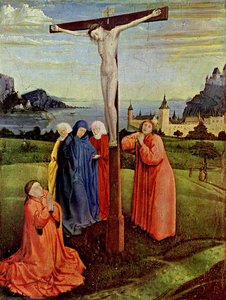
Beyond the grand scale of altarpieces, Witz’s talent for capturing human emotion is profoundly evident in works such as Christ on the Cross. Here, the artist blends Gothic drama with an early, raw realism, using subtle shading and expressive gestures to evoke a deep sense of pathos. Similarly, his depiction of King Solomon and the Queen of Sheba demonstrates his capacity for storytelling through rich detail and landscape innovation, illustrating biblical grandeur through a lens of Renaissance artistry. Whether painting the quiet sorrow of a saint or the majestic encounter of monarchs, Witz utilized light and form to bridge the gap between the divine and the human experience.

Historical Significance and Artistic Evolution

The historical importance of Konrad Witz cannot be overstated; he acted as a vital conduit between two eras. His development represents the slow, deliberate movement away from the symbolic language of the 14th century toward the observational science of the Renaissance. By integrating recognizable landscapes and naturalistic textures into religious iconography, he paved the way for future generations of Northern European painters to explore the beauty of the natural world.

His enduring legacy is found in the following artistic milestones:

  • Landscape Innovation: The introduction of topographical accuracy, making the environment a central element of narrative painting.
  • Technical Mastery: The seamless blending of late Gothic decorative elegance with early Renaissance naturalism and light manipulation.
  • Emotional Depth: A shift toward more humanized, expressive depictions of biblical figures, fostering a deeper emotional connection with the viewer.

Though his life was relatively short, ending around 1446, the impact of Konrad Witz remains etched in the foundations of Western painting. He taught the eye to look closer at the earth and the sky, finding the sacred within the very details of the world we inhabit.