Portrait of Jörg Breu the Elder

Jörg Breu the Elder Paintings: The 22 Most Famous, Through a Gallery's Eye

Updated November 2026 · ranked by our popularity score (searches, visits and orders for each work) · 26 works by Jörg Breu the Elder in our catalogue

In short

To the gallery's eye, Jörg Breu the Elder's most famous painting is Portrait of a Woman (1515), whose original hangs in the Detroit Institute of Arts, Detroit. Aggsbacher altarpiece: Flight into Egypt (1501) and Christ Carrying the Cross (1510) complete the trio every eye recognises. Of the 26 works by Jörg Breu the Elder in our catalog, the gallery presents the 22 most famous below, each original with its year, its museum and what makes it unique.

1475 – 1537, Augsburg Most works: Bavarian State Painting Collections

The gallery's top 10 Jörg Breu the Elder paintings

1
Portrait of a Woman (1515) by Jörg Breu the Elder

Portrait of a Woman

1515 · Oil On Panel · Detroit Institute of Arts, Detroit

In this 1515 oil on panel, we encounter a woman captured in a moment of profound stillness. She is positioned in a three-quarter view, her gaze directed toward the left, away from the viewer, creating an air of private contemplation. The composition is centered and intimate, set against a dark, almost black background that pushes her figure forward. This deliberate use of contrast allows the viewer to focus entirely on…

2
Aggsbacher altarpiece: Flight into Egypt (1501) by Jörg Breu the Elder

Aggsbacher altarpiece: Flight into Egypt

1501 · Oil · Germanisches Nationalmuseum, Nuremberg

The Aggsbacher altarpiece: Flight into Egypt emerges from the shadows of the early sixteenth century, a work that carries the weight of history within its wooden panels. Painted by Jörg Breu the Elder, this piece captures a moment of urgent movement. It is also recognized as the Aggsbacher Altar, a name that links it to its origins as a wing altar from Aggsbach. The scene unfolds with a sense of…

3
Christ Carrying the Cross (1510) by Jörg Breu the Elder

Christ Carrying the Cross

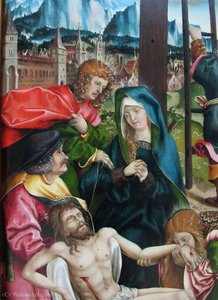
A heavy, splintered beam presses against a shoulder. The wood is dark, weathered, and carries the physical gravity of the scene. Christ moves through a thicket of humanity, his body strained under the crushing burden of the cross. Around him, the air is thick with the presence of others. Roman soldiers in metallic armor and onlookers in heavy, textured fabrics press inward, creating a claustrophobic squeeze of limbs and gazes.…

4
Coronation of the holy virgin (1518) by Jörg Breu the Elder

Coronation of the holy virgin

1518 · Oil On Panel

The heavens open in a vertical surge of light and shadow. At the center of this divine drama, the Virgin Mary receives her crown. Two figures, God the Father and Jesus Christ, reach through a mandorla of swirling clouds to bestow the diadem. A single dove descends, a white flicker of the Holy Spirit amidst the celestial movement. Below this luminous event, a dense crowd of saints gathers. They press…

5
Mary with the child, Saint Catherine, Saint Barbara and angels (1512) by Jörg Breu the Elder

Mary with the child, Saint Catherine, Saint Barbara and angels

1512 · Oil On Panel · Gemäldegalerie, Berlin

The composition follows a hierarchical arrangement, positioning the Madonna and Christ Child as the central focus of the grouping. They are flanked by Saint Catherine and Saint Barbara, creating a structured sacred assembly. This central group is set against a vast, atmospheric landscape that extends toward the horizon. The arrangement of figures is balanced, with celestial beings occupying the upper and lower registers of the scene.

6
Mockery of Christ (1522) by Jörg Breu the Elder

Mockery of Christ

1522 · Oil On Panel · Bavarian State Painting Collections, Munich

The painting presents a dense, crowded scene centered on the figure of Jesus, who is positioned in a state of passivity amidst a group of tormentors and soldiers. The composition is tightly packed, creating a shallow, stage-like space that pushes the figures into the immediate foreground. Light is applied through chiaroscuro, casting deep shadows that define the sculptural volume of the bodies and the heavy folds of their clothing. In…

7
The Last Judgment: Hell (1519) by Jörg Breu the Elder

The Last Judgment: Hell

1519 · Oil On Panel · Bavarian State Painting Collections, Munich

In "The Last Judgment: Hell" by Jörg Breu the Elder, a terrifying and chaotic vision unfolds across a vertical panel. The scene captures a moment of absolute upheaval, focusing entirely on the harrowing depths of Hell. Every inch of the composition is densely packed with figures, creating a sense of overwhelming claustrophobia that seems to press against the viewer. There is no stillness here; instead, a frantic, swirling movement drives…

8
St. Lucy (1614) by Jörg Breu the Elder

St. Lucy

1614 · Oil On Panel · Bavarian State Painting Collections, Munich

In St. Lucy by Jörg Breu the Elder, a solemn and highly detailed religious portrait emerges from a narrow, vertical composition. The saint stands in full length against a distant landscape, her presence commanding the space with a serene yet somber expression. A prominent halo surrounds her head, composed of fine, radiating lines that catch the light. She holds an open book in her hands, a quiet gesture of devotion…

9
Mary with Child and Goldfinch 1523 (1523) by Jörg Breu the Elder

Mary with Child and Goldfinch 1523

1523 · Oil · Kunsthistorisches Museum, Vienna

The oil painting depicts the Virgin Mary holding the Christ Child within a structural archway. The figures are positioned centrally, framed by the architectural opening that leads to a deep, receding landscape. Mary wears drapery in shades of deep black and teal, which contrasts with the soft blue of the sky in the background. Her head is adorned with a floral crown. The Christ Child holds a thin red thread…

10
The Suicide of Lucretia (1528) by Jörg Breu the Elder

The Suicide of Lucretia

1528 · Fresco · Alte Pinakothek, Munich

To stand before this depiction of The Suicide of Lucretia is to be enveloped by an atmosphere so thick with dramatic tension, it feels almost palpable. Painted around 1528 by Jörg the Elder Breu, this fresco fragment captures a moment of profound historical and moral reckoning. The scene unfolds within what appears to be an intimate, yet dramatically charged chamber. At the heart of the composition lies the figure of…

Jörg Breu the Elder paintings, ranked 11 to 22

The subjects that held Jörg Breu the Elder's eye

The four subjects that come back most often in these originals, each with its finest example.

The museums that keep Jörg Breu the Elder's originals

The 8 museums that hold the most of the paintings on this page.

Museum City Works by Jörg Breu the Elder Paintings from this list
Bavarian State Painting Collections, MunichBavarian State Painting Collections Munich 5 Mockery of Christ, The Last Judgment: Hell, St. Lucy
Detroit Institute of Arts, DetroitDetroit Institute of Arts Detroit 1 Portrait of a Woman
Germanisches Nationalmuseum, NurembergGermanisches Nationalmuseum Nuremberg 1 Aggsbacher altarpiece: Flight into Egypt
Kroměříž Archdiocesan MuseumKroměříž Archdiocesan Museum 1 Christ Carrying the Cross
Gemäldegalerie, BerlinGemäldegalerie Berlin 1 Mary with the child, Saint Catherine, Saint Barbara and angels
Kunsthistorisches Museum, ViennaKunsthistorisches Museum Vienna 1 Mary with Child and Goldfinch 1523
Alte Pinakothek, MunichAlte Pinakothek Munich 1 The Suicide of Lucretia
Thyssen-Bornemisza Museum, MadridThyssen-Bornemisza Museum Madrid 1 Nuptial Portrait of Coloman Helmschmid and Agnes Breu

Jörg Breu the Elder, one signature painting per decade

Works per decade

Pick a decade to see the original that defines it.

Jörg Breu the Elder's paintings: the gallery answers

Which Jörg Breu the Elder painting is the most famous of all?Reveal the answer

Portrait of a Woman (1515), Detroit Institute of Arts, Detroit. Aggsbacher altarpiece: Flight into Egypt (1501) and Christ Carrying the Cross (1510) come next.

How old was Jörg Breu the Elder on completing Portrait of a Woman?Reveal the answer

40 years old: Portrait of a Woman dates from 1515, and Jörg Breu the Elder was born in 1475.

Which are Jörg Breu the Elder's top 10 paintings?Reveal the answer

Portrait of a Woman, Aggsbacher altarpiece: Flight into Egypt, Christ Carrying the Cross, Coronation of the holy virgin, Mary with the child, Saint Catherine, Saint Barbara and angels, Mockery of Christ, The Last Judgment: Hell, St. Lucy, Mary with Child and Goldfinch 1523 and The Suicide of Lucretia. The ranking above gives each one's year and museum.

How many works did Jörg Breu the Elder create?Reveal the answer

Our catalog holds 26 works by Jörg Breu the Elder, dated from 1501 to 1530.

Where do Jörg Breu the Elder's most famous originals hang?Reveal the answer

Mostly in Bavarian State Painting Collections (Munich), Detroit Institute of Arts (Detroit) and Germanisches Nationalmuseum (Nuremberg). The museum table above lists them all.

When did Jörg Breu the Elder create the most famous paintings?Reveal the answer

In 1510s: 5 of the 22 works on this page were made then, Portrait of a Woman among them.

Which are Jörg Breu the Elder's earliest and latest famous works?Reveal the answer

On this page, the earliest is Aggsbacher altarpiece: Flight into Egypt (1501) and the latest History Cycle: The Victory of P. Cornelius Scipio over Hannibal in the Battle of Zama (1530).

Which subjects did Jörg Breu the Elder return to most?Reveal the answer

Woman (6), Landscape (5) and Soldiers (4), across the 22 works on this page.

Which medium did Jörg Breu the Elder work in most?Reveal the answer

Oil On Panel, for 8 of the 22 works on this page.

Which Jörg Breu the Elder originals does the Bavarian State Painting Collections hold?Reveal the answer

Mockery of Christ, The Last Judgment: Hell and St. Lucy: the Bavarian State Painting Collections, Munich holds 5 of the works on this page.

Jörg Breu the Elder: the artist

Jörg Breu the Elder: A Master of Augsburg’s Renaissance

Born in Augsburg around 1475, Jörg Breu the Elder emerged as a significant figure within the burgeoning artistic landscape of late fifteenth-century Germany. His early life, shrouded in relative obscurity – he was the son of a weaver – belies the remarkable trajectory he would forge as a painter and master craftsman. Breu’s journey began with an apprenticeship under Ulrich Apt the Elder, a respected artist in Augsburg, providing him with a foundational understanding of traditional German painting techniques. However, it wasn't merely imitation that defined his artistic development; Breu possessed a keen eye for detail and a willingness to experiment, ultimately establishing himself as a key member of the influential Lederer circle – a group known for its innovative approach to religious art.

Breu’s early career was marked by a prolific output of altarpieces and devotional panels, primarily executed in the rich, jewel-toned palette characteristic of the Danube School. His work during this period demonstrates a masterful command of perspective and a growing interest in incorporating elements of naturalism into his compositions. A particularly striking example is the ‘Bernhard Altar,’ currently housed at the Städel Museum in Frankfurt, which showcases his skill in depicting scenes from the life of Saint Bernard with a remarkable attention to detail and a subtle use of atmospheric perspective. The painting’s earthy tones and symbolic representation of labor—monks harvesting wheat—offer a compelling glimpse into the social and religious concerns of Augsburg at the time.

Travels and Influences: Italy and Beyond

Breu's artistic development took a significant turn with his travels to Austria in 1500-02, where he created elaborate multi-panel altarpieces for monasteries like Melk Abbey. These early Austrian commissions established him as a highly sought-after artist, capable of executing complex and ambitious projects. However, Breu’s ambition extended beyond the Danube region; he undertook two significant journeys to Italy – once around 1508 and again in 1514/15 – experiences that profoundly shaped his artistic style.

These Italian sojourns exposed him to the innovations of Renaissance art, particularly the work of masters like Masaccio and Botticelli. He absorbed their techniques for linear perspective, anatomical accuracy, and a greater emphasis on naturalistic representation. Returning to Augsburg, Breu skillfully integrated these influences into his own style, creating works that retained the traditional German aesthetic while incorporating elements of Italian dynamism and elegance. The ‘Crucifixion’ painting, available on OriginalUniqueArt.com, exemplifies this synthesis – it displays both the solemnity of medieval iconography and a nascent understanding of Renaissance spatial techniques.

Religious Themes and Artistic Style

Breu's artistic output was overwhelmingly focused on religious subjects, reflecting the prevailing devotional climate of his time. He frequently depicted scenes from the lives of saints, biblical narratives, and representations of the Virgin Mary – all rendered with a meticulous attention to detail and a deep understanding of theological symbolism. His compositions often feature a balanced arrangement of figures within carefully constructed spaces, utilizing rich colors and intricate patterns to create visually arresting images.

A key characteristic of Breu’s style is his use of woodcuts and drawings, particularly for stained glass designs. These works demonstrate his versatility as an artist and his ability to translate complex visual ideas into concise and effective forms. His work on the Fugger Chapel in St Anne's showcases this skill, with intricate border drawings that add a layer of decorative richness to the overall design. Furthermore, Breu’s chronicle, meticulously kept from 1512 until his death, offers valuable insights into the social and religious context of Augsburg during the Reformation era, revealing a complex individual grappling with both traditional beliefs and emerging Protestant ideas.

Legacy and Artistic Lineage

Jörg Breu the Elder’s influence extended beyond his own lifetime. After his death in 1537, his son, Jörg Breu the Younger, continued to lead the Augsburg workshop until his own passing a decade later. The younger Breu maintained many of his father's artistic principles and techniques, ensuring the continuation of the family’s legacy within the city’s thriving art scene.

Breu’s work is now recognized as a crucial link between the late Gothic tradition and the early Renaissance in Germany. His paintings offer a valuable window into the cultural and religious life of Augsburg during a period of significant social and artistic transformation. His legacy endures through his surviving works, which are displayed in museums across Europe, and through the continued study of his life and art by scholars seeking to understand the complexities of German Renaissance painting.