Portrait of Jan Provoost

The 55 Most Famous Jan Provoost Paintings, a Gallery Selection

Updated November 2026 · ranked by our popularity score (searches, visits and orders for each work) · 56 works by Jan Provoost in our catalogue

In short

Of all the originals Jan Provoost left, the most famous is The Virgin and Child (1505), in the collection of the Scottish National Gallery, Edinburgh. Close behind it come The Dispute of Saint Catherine of Alexandria (1505) and Zechariah (1510). Our catalog holds 56 works by Jan Provoost; the gallery has kept the 55 the world admires most, each shown with its date, its museum and its story.

1465 – 1529, Mons Northern renaissance Most works: Groeningemuseum

Jan Provoost's top 10 paintings: the gallery's choice

1
The Virgin and Child (1505) by Jan Provoost

The Virgin and Child

1505 · Oil On Panel · Scottish National Gallery, Edinburgh

The composition centers on the Virgin Mary, her form framed by a structured arch that defines a sacred, enclosed space. She holds the Christ Child against a backdrop of rolling hills and dark foliage under a pale sky. A deep red mantle covers her shoulders, contrasting with the dark blue of her inner garment and the white of her veil. The figures occupy the immediate foreground, their porcelain-like skin rendered…

3
Zechariah (1510) by Jan Provoost

Zechariah

1510 · Oil On Panel · Museo del Prado, Madrid

A single man occupies the center of the frame, his body carved from light and shadow. He is an elderly figure, leaning slightly forward as if caught in a moment of quiet reception. His hands are extended, palms open, reaching into the space between himself and the viewer. There is a stillness in his gaze, a directness that meets the eye with a sense of serene expectation. He is framed…

4
The Last Judgment (1525) by Jan Provoost

The Last Judgment

1525 · Oil On Panel · Detroit Institute of Arts, Detroit

The Last Judgment by Jan Provoost unfolds as a dramatic vision of the final reckoning. Created around 1525, this oil painting captures the moment of divine judgment as Jesus Christ reigns in glory. The scene presents a celestial hierarchy where the heavens meet the earthly realm, presenting a vision of the end of all mankind. It remains a prime example of the Northern Renaissance style, where every corner of the…

5
Mourning of Christ (1490) by Jan Provoost

Mourning of Christ

1490 · Tempera On Panel · Kunsthaus Zürich, Zurich

The composition centers on the body of Christ, which is being lowered from the cross by Nicodemus and John. The pale skin of the deceased figure contrasts with the deep reds and blues of the surrounding garments. Mary Magdalene, Mary the mother of Jesus, and Joseph of Arimathea are positioned closely around the central event, their forms creating a tight, organized arrangement within a shallow landscape. In the background, a…

6
The Annunciate Virgin, Saint Andrew with a Donor and His Sons, Saint Catherine of Alexandria with a Donor and Her Daughters, and the Annunciate Angel (1514) by Jan Provoost

The Annunciate Virgin, Saint Andrew with a Donor and His Sons, Saint Catherine of Alexandria with a Donor and Her Daughters, and the Annunciate Angel

1514 · Oil On Panel · Philadelphia Museum of Art, Philadelphia

The Annunciate Virgin, Saint Andrew with a Donor and His Sons, Saint Catherine of Alexandria with a Donor and Her Daughters, and the Annunciate Angel emerges from the early 16th century as a complex devotional structure. This work by Jan Provoost presents a multi-layered vision of faith, where the sacred and the earthly meet within a single wooden frame. The piece currently resides within the Philadelphia Museum of Art, where…

7
The Virgin and Child (1500) by Jan Provoost

The Virgin and Child

1500 · Oil On Panel · Museo del Prado, Madrid

In this intimate oil on panel, we find ourselves in the presence of a tender, maternal encounter. The Virgin Mary is depicted in a moment of nursing, her form draped in a mantle of deep teal and blue that holds a sculptural weight. She stands against a patterned backdrop, perhaps a carved screen or a heavy textile, which provides a structured, formal setting for this private act. The composition is…

8
Madonna and Child with angels (1480) by Jan Provoost

Madonna and Child with angels

1480 · Oil On Panel

The painting presents a seated Virgin Mary positioned centrally within a lush, enclosed garden. She wears a heavy, dark gown that contrasts with the lighter tones of the surrounding environment. In her right hand, she holds a small bouquet consisting of a red poppy and a white carnation. Above her head, two angelic figures hold a golden crown. To her left, the infant Christ reaches toward his mother's chest with…

9
Entombment of Christ (1490) by Jan Provoost

Entombment of Christ

1490 · Oil On Panel

The heavy silence of the tomb hangs over the Entombment of Christ, a work painted by Jan Provoost around 1490. In this somber scene, the weight of Christian sorrow settles deeply upon the figures gathered in the shadows. The air feels thick with the grief of the Deposition of Christ, capturing a moment where the physical reality of death meets the spiritual ache of those left behind. Every line and…

10
Annunciation (1500) by Jan Provoost

Annunciation

1500 · Oil · Musei di Strada Nuova, Genoa

The Annunciation is an oil painting by Jan Provoost, created about 1500. The work depicts a religious scene within a domestic interior, featuring the Virgin Mary and the Archangel Gabriel. Mary is positioned on the left side of the composition in a seated, prayerful posture, wearing a deep red gown. To the right, the Archangel Gabriel appears with large wings and a light blue robe. A white dove, representing the…

The Jan Provoost selection continues, 11 to 55

11The Last Judgement (1500) by Jan ProvoostThe Last Judgement1500 · Fogg Museum 12The Lamentation (1490) by Jan ProvoostThe Lamentation1490 13Crucifixion (1500) by Jan ProvoostCrucifixion1500 · Groeningemuseum 14Saint Jerome in the Wilderness (1512) by Jan ProvoostSaint Jerome in the Wilderness1512 · Royal Museums of Fine Arts of Belgium 15Flagellation (1512) by Jan ProvoostFlagellation1512 · Saint Louis Art Museum 16The Nativity at Night (1507) by Jan ProvoostThe Nativity at Night1507 · Upton House 17Saint Clare (1510) by Jan ProvoostSaint Clare1510 18John the Baptist (1503) by Jan ProvoostJohn the Baptist1503 · Rijksmuseum Twenthe 19Saint Dominicus (1503) by Jan ProvoostSaint Dominicus1503 · Rijksmuseum Twenthe 20The Angel of the Annunciation in a stone niche (1503) by Jan ProvoostThe Angel of the Annunciation in a stone niche1503 21Crucifixion (1503) by Jan ProvoostCrucifixion1503 · Groeningemuseum 22Calvary (1517) by Jan ProvoostCalvary1517 · Museum of Fine Arts Ghent (MSK) 23Saint Barbara from Nicodemia (1505) by Jan ProvoostSaint Barbara from Nicodemia1505 · Royal Museum of Fine Arts Antwerp 24Adoration of the Magi (1505) by Jan ProvoostAdoration of the Magi1505 · Gemäldegalerie 25Virgin Mary and sleeping child enthroned by angels (1503) by Jan ProvoostVirgin Mary and sleeping child enthroned by angels1503 · Staatliche Kunsthalle Karlsruhe 26Diptych with Christ carrying the Cross and Portrait of a Friar Minor, memento mori (reverse) (1522) by Jan ProvoostDiptych with Christ carrying the Cross and Portrait of a Friar Minor, memento mori (reverse)1522 · Sint-Janshospitaal 27Last Judgement (1525) by Jan ProvoostLast Judgement1525 · Groeningemuseum 28The Virgin and Child in a Landscape (1512) by Jan ProvoostThe Virgin and Child in a Landscape1512 · National Gallery 29Allegory of Christianity (1515) by Jan ProvoostAllegory of Christianity1515 30Flowers in a vase in a niche (1480) by Jan ProvoostFlowers in a vase in a niche1480 31Crucifixion (1500) by Jan ProvoostCrucifixion1500 32Crucifixion (1500) by Jan ProvoostCrucifixion1500 33Saint Catherine of Alexandria (1505) by Jan ProvoostSaint Catherine of Alexandria1505 · Museum Boijmans Van Beuningen 34The Virgin and Saint Joseph at Bethlehem (recto) and Virgin Annunciate (verso) (1507) by Jan ProvoostThe Virgin and Saint Joseph at Bethlehem (recto) and Virgin Annunciate (verso)1507 · Upton House 35Triptych of The Adoration of the Magi and Shepherds (centre) with The Annunciation (left wing) and The Madonna adoring the Christ Child (right wing) and Saint John the Baptist and Saint Margaret (closed) (1507) by Jan ProvoostTriptych of The Adoration of the Magi and Shepherds (centre) with The Annunciation (left wing) and The Madonna adoring the Christ Child (right wing) and Saint John the Baptist and Saint Margaret (closed)1507 36Portrait of a Female Donor (1505) by Jan ProvoostPortrait of a Female Donor1505 · Thyssen-Bornemisza Museum 37The Last Judgment (1525) by Jan ProvoostThe Last Judgment1525 · Hamburger Kunsthalle 38Abraham, Sarah, and the Angel by Jan ProvoostAbraham, Sarah, and the Angel 39Last Judgement (1525) by Jan ProvoostLast Judgement1525 40The Martyrdom of St Catherine by Jan ProvoostThe Martyrdom of St CatherineRoyal Museum of Fine Arts Antwerp 41St. Andrew in landscape by Jan ProvoostSt. Andrew in landscape 42Donor with St. Nicholas and his Wife with St. Godelina by Jan ProvoostDonor with St. Nicholas and his Wife with St. Godelina 43Triptych with Virgin and Child, Saint John the Evangelist (left wing) and Mary Magdalene (right wing), Jan Provoost, c. 1505 - c. 1525 (1525) by Jan ProvoostTriptych with Virgin and Child, Saint John the Evangelist (left wing) and Mary Magdalene (right wing), Jan Provoost, c. 1505 - c. 15251525 · Mauritshuis 44St. Catherine by Jan ProvoostSt. Catherine 45The Coronation of the Virgin by Jan ProvoostThe Coronation of the Virgin 46The Coronation of the Virgin (detail) by Jan ProvoostThe Coronation of the Virgin (detail) 47The Martyrdom of St. Catherine by Jan ProvoostThe Martyrdom of St. Catherine 48Death and the Miser by Jan ProvoostDeath and the MiserGroeningemuseum 49Virgin and Child by Jan ProvoostVirgin and Child 50Virgin and Child Enthroned, with Saints Jerome and John the Baptist and a Carthusian Monk, Jan Provoost (attributed to), c. 1510 (1510) by Jan ProvoostVirgin and Child Enthroned, with Saints Jerome and John the Baptist and a Carthusian Monk, Jan Provoost (attributed to), c. 15101510 · Rijksmuseum 51Triptych of Our Lady of Mercy (1515) by Jan ProvoostTriptych of Our Lady of Mercy1515 · National Museum of Ancient Art 52Triptych of the Calheta Matrix Church (1520) by Jan ProvoostTriptych of the Calheta Matrix Church1520 · Sacred Art Museum of Funchal 53The Virgin Mary in Glory (1524) by Jan ProvoostThe Virgin Mary in Glory1524 · Hermitage Museum 54Virgin and Child by Jan ProvoostVirgin and ChildHermitage Museum 55Virgin Giving Breast by Jan ProvoostVirgin Giving BreastMusée Des Beaux

Jan Provoost's famous paintings, period by period

The subjects that held Jan Provoost's eye

The four subjects that come back most often in these originals, each with its finest example.

The museums that keep Jan Provoost's originals

The 8 museums that hold the most of the paintings on this page.

Museum City Works by Jan Provoost Paintings from this list
Groeningemuseum, BruggeGroeningemuseum Brugge 4 Crucifixion, Crucifixion, Last Judgement
Museum Boijmans Van Beuningen, RotterdamMuseum Boijmans Van Beuningen Rotterdam 2 The Dispute of Saint Catherine of Alexandria, Saint Catherine of Alexandria
Museo del Prado, MadridMuseo del Prado Madrid 2 Zechariah, The Virgin and Child
Upton House, BanburyUpton House Banbury 2 The Nativity at Night, The Virgin and Saint Joseph at Bethlehem (recto) and Virgin Annunciate (verso)
Rijksmuseum Twenthe, EnschedeRijksmuseum Twenthe Enschede 2 John the Baptist, Saint Dominicus
Royal Museum of Fine Arts Antwerp, AntwerpRoyal Museum of Fine Arts Antwerp Antwerp 2 Saint Barbara from Nicodemia, The Martyrdom of St Catherine
Hermitage Museum, Saint PetersburgHermitage Museum Saint Petersburg 2 The Virgin Mary in Glory, Virgin and Child
Scottish National Gallery, EdinburghScottish National Gallery Edinburgh 1 The Virgin and Child

Jan Provoost decade by decade: the original that defines each

Works per decade

Pick a decade to see the original that defines it.

Collectors' questions about Jan Provoost's paintings

Which work is Jan Provoost most famous for?Reveal the answer

The Virgin and Child (1505), Scottish National Gallery, Edinburgh. The Dispute of Saint Catherine of Alexandria (1505) and Zechariah (1510) come next.

What age was Jan Provoost when The Virgin and Child was made?Reveal the answer

40 years old: The Virgin and Child dates from 1505, and Jan Provoost was born in 1465.

What are the ten most famous Jan Provoost paintings?Reveal the answer

The Virgin and Child, The Dispute of Saint Catherine of Alexandria, Zechariah, The Last Judgment, Mourning of Christ, The Annunciate Virgin, Saint Andrew with a Donor and His Sons, Saint Catherine of Alexandria with a Donor and Her Daughters, and the Annunciate Angel, The Virgin and Child, Madonna and Child with angels, Entombment of Christ and Annunciation. The ranking above gives each one's year and museum.

How many paintings did Jan Provoost leave?Reveal the answer

Our catalog holds 56 works by Jan Provoost, dated from 1480 to 1525.

In which museums do Jan Provoost's masterpieces hang?Reveal the answer

Mostly in Groeningemuseum (Brugge), Museum Boijmans Van Beuningen (Rotterdam) and Museo del Prado (Madrid). The museum table above lists them all.

In which years did Jan Provoost paint the most famous works?Reveal the answer

In 1500s: 20 of the 55 works on this page were made then, The Virgin and Child among them.

What are the first and the last famous originals of Jan Provoost?Reveal the answer

On this page, the earliest is Madonna and Child with angels (1480) and the latest The Last Judgment (1525).

Which subjects did Jan Provoost choose most often?Reveal the answer

Woman (13), Child (9) and Landscape (9), across the 55 works on this page.

Which technique did Jan Provoost use most?Reveal the answer

Oil On Panel, for 25 of the 55 works on this page.

To which art movement does Jan Provoost belong?Reveal the answer

Northern renaissance, judging by the originals on this page.

Which Jan Provoost works hang at the Groeningemuseum?Reveal the answer

Crucifixion, Crucifixion and Last Judgement: the Groeningemuseum, Brugge holds 4 of the works on this page.

Jan Provoost: life and work

The Renaissance Polymath: The Life and Legacy of Jan Provoost

In the vibrant tapestry of the Northern Renaissance, few figures weave together the threads of art, science, and intellect as masterfully as Jan Provoost. Born around 1462 in Mons, or perhaps Mouscron, Provoost emerged not merely as a painter, but as a true Renaissance man whose reach extended far beyond the easel. While his name is etched into history through the delicate brushstrokes of Flemish Primitives, his mind wandered through the realms of cartography, engineering, and architecture. This rare combination of technical precision and spiritual depth allowed him to bridge the gap between the pious traditions of the Middle Ages and the burgeoning humanism of a new era.

The early years of Provoost’s life were marked by a profound immersion in the artistic currents of the Low Countries. Though much of his formative training remains shrouded in the mists of time, scholars often trace his stylistic lineage back to the legendary Hans Memling. By absorbing the meticulous attention to detail and the luminous, atmospheric qualities characteristic of the Bruges school, Provoost developed a visual language that was both serene and deeply symbolic. His career saw him managing influential workshops in both Bruges—where he achieved the prestigious status of a burgher in 1494—and Antwerp, the bustling economic heart of the region. This dual presence allowed his influence to permeate the most significant artistic hubs of Europe.

A Symphony of Symbolism and Technique

To gaze upon a work by Jan Provoost is to enter a world where every shadow holds a secret and every color tells a story. His technique was defined by the masterful use of glazing, applying thin, translucent layers of oil paint to create a sense of inner light that seems to radiate from within the wood panels themselves. This method allowed him to render the heavy, sculptural folds of drapery and the soft, dewy textures of skin with an almost tactile realism. His compositions often centered on the Virgin and Child, subjects he approached with an understated elegance that eschewed dramatic theatricality in favor of a profound, quiet sanctity.

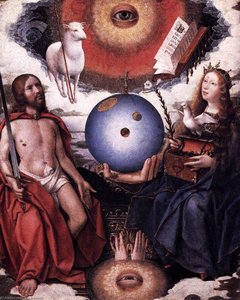
Beyond his devotional works, Provoost’s ability to navigate complex allegorical themes is evident in masterpieces such as Allegory of Christianity. In this work, the artist utilizes a sophisticated vocabulary of symbols—books, boxes, and celestial spheres—to communicate the intricate doctrines of faith. His skill lay in his ability to balance these dense intellectual layers with a harmonious color palette and a clarity of form that remained accessible to the viewer. Whether depicting the solemnity of the Last Judgement or the intimate tenderness of a Nursing Madonna, Provoost possessed a unique capacity to capture the divine within the human experience.

The Enduring Influence of the Provoost Workshop

The true magnitude of Jan Provoost’s contribution lies not only in his individual hand but in the enduring vitality of his workshop. His studio functioned as a vital incubator for talent, fostering a style that would influence generations of Netherlandish painters. The output of the Workshop of Jan Provoost was characterized by a seamless blend of Gothic piety and emerging Renaissance aesthetics, ensuring that the traditions of the Flemish Primitives evolved rather than vanished. Through his collaborative spirit and his ability to attract students and masters alike, he helped sustain the artistic prestige of Bruges and Antwerp during a period of immense cultural transition.

As we reflect on his life, we see an artist who was as much a scientist as a creator. His encounters with luminaries like Albrecht Dürer in Antwerp suggest a man deeply engaged with the shifting intellectual tides of Europe. Provoost’s legacy is found in the quiet strength of his portraits, the architectural precision of his designs, and the luminous depth of his religious icons. He remains a pivotal figure whose work serves as a window into a transformative moment in human history, where the devotion of the old world met the inquisitive spirit of the new.