Portrait of Jan Massys

The 16 Most Famous Jan Massys Paintings, a Gallery Selection

Updated November 2026 · ranked by our popularity score (searches, visits and orders for each work) · 16 works by Jan Massys in our catalogue

In short

Of all the originals Jan Massys left, the most famous is Judith, in the collection of the Koninklijk Museum voor Schone Kunsten, Antwerp. Close behind it come Lot and His Daughters (1565) and David and Bathsheba (1562). Our catalog holds 16 works by Jan Massys; the gallery has kept the 16 the world admires most, each shown with its date, its museum and its story.

1466 – 1530, Antwerp Northern renaissance Most works: Koninklijk Museum voor Schone Kunsten

Jan Massys's top 10 paintings: the gallery's choice

1
Judith by Jan Massys

Judith

Oil On Panel · Koninklijk Museum voor Schone Kunsten, Antwerp

In the heart of the sixteenth-century Flemish Renaissance, few images command the viewer's attention with as much visceral intensity as Jan Massys’s Judith. This monumental oil on wood panel, painted around 1559, serves as a breathtaking window into an era where religious devotion and artistic innovation collided. The scene captures the climactic moment of a biblical legend: the heroine Judith, driven by divine purpose, stands resolute over the fallen King…

2
Lot and His Daughters (1565) by Jan Massys

Lot and His Daughters

1565 · Oil On Canvas · Musées Royaux des Beaux-Arts, Brussels

The oil on canvas depicts a scene from the Book of Genesis involving Lot and his two daughters. In the composition, an older man with a grey beard sits on the left, draped in a robe secured by a patterned belt. His posture is seated and stationary. To his side, two younger women stand; one is positioned centrally while the other is to the right. The central figure is partially…

3
David and Bathsheba (1562) by Jan Massys

David and Bathsheba

1562 · Oil On Canvas · The Louvre, Paris

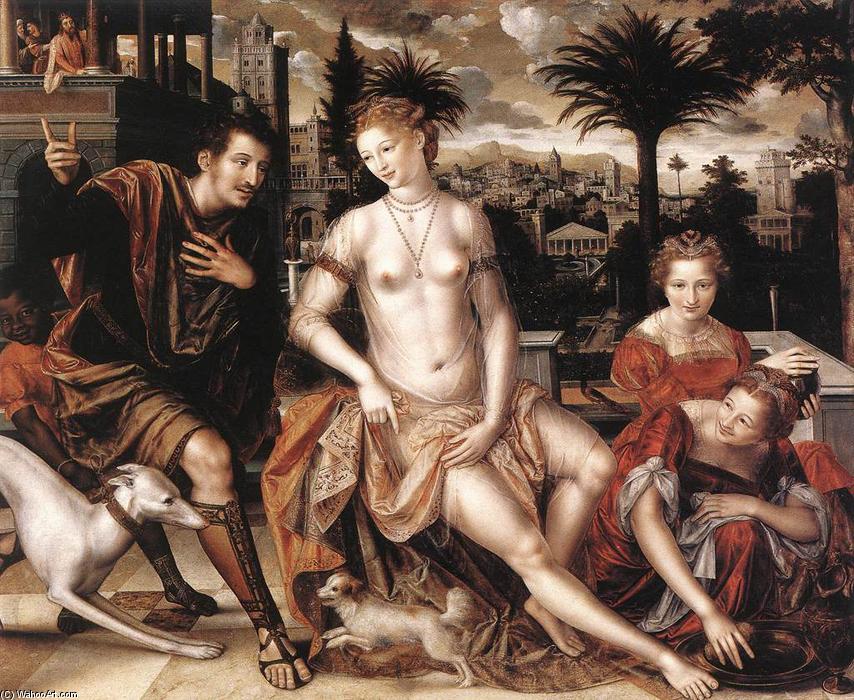
In the heart of Renaissance Antwerp, a period defined by both profound religious devotion and burgeoning worldly curiosity, Jan Massys captured a scene of unparalleled emotional and narrative tension. His 1562 masterpiece, David and Bathsheba, is far more than a mere biblical illustration; it is a window into the human psyche, capturing the exact moment where desire meets consequence. The painting recounts the clandestine encounter between King David and the…

5
Holy Virgin and Child (1564) by Jan Massys

Holy Virgin and Child

1564 · Oil On Canvas · Sint-Jacobskerk, Antwerp

Jan Massys completed Holy Virgin and Child in 1564. This oil on canvas work presents the Holy Virgin Mary alongside the Christ Child. The figures are positioned against a dark background, a choice that focuses attention on the subjects in the foreground.

8
The Rest on the Flight into Egypt (1537) by Jan Massys

The Rest on the Flight into Egypt

1537 · Metropolitan Museum of Art, New York

This depiction masterfully demonstrates advances in the development of new genres of painting in the 1530s in Antwerp, namely landscape and still-life, and the introduction of figural motifs derived from the works of Leonardo da Vinci. Increasingly characteristic was a division of labor in workshops where one artist—Jan Massys—painted the figures, and another—the Master of the Liège Disciples at Emmaus—added the landscape.

The Jan Massys selection continues, 11 to 16

The subjects that held Jan Massys's eye

The four subjects that come back most often in these originals, each with its finest example.

The museums that keep Jan Massys's originals

The 8 museums that hold the most of the paintings on this page.

Museum City Works by Jan Massys Paintings from this list
Koninklijk Museum voor Schone Kunsten, AntwerpKoninklijk Museum voor Schone Kunsten Antwerp 1 Judith
Musées Royaux des Beaux-Arts, BrusselsMusées Royaux des Beaux-Arts Brussels 1 Lot and His Daughters
The Louvre, ParisThe Louvre Paris 1 David and Bathsheba
Musee de la Chartreuse, DuffelMusee de la Chartreuse Duffel 1 The Healing of Tobit
Sint-Jacobskerk, AntwerpSint-Jacobskerk Antwerp 1 Holy Virgin and Child
Royal Museum of Fine Arts Antwerp, AntwerpRoyal Museum of Fine Arts Antwerp Antwerp 1 The holy family
Metropolitan Museum of Art, New YorkMetropolitan Museum of Art New York 1 The Rest on the Flight into Egypt
Girona Art Museum, GironaGirona Art Museum Girona 1 Madonna with Child and angel general

Collectors' questions about Jan Massys's paintings

Which work is Jan Massys most famous for?Reveal the answer

Judith, Koninklijk Museum voor Schone Kunsten, Antwerp. Lot and His Daughters (1565) and David and Bathsheba (1562) come next.

What are the ten most famous Jan Massys paintings?Reveal the answer

Judith, Lot and His Daughters, David and Bathsheba, The Healing of Tobit, Holy Virgin and Child, Pietà, The holy family, The Rest on the Flight into Egypt, Madonna with Child and angel general and Depicting the nonagenarian Andrea Doria. The ranking above gives each one's year and museum.

How many paintings did Jan Massys leave?Reveal the answer

Our catalog holds 16 works by Jan Massys.

In which museums do Jan Massys's masterpieces hang?Reveal the answer

Mostly in Koninklijk Museum voor Schone Kunsten (Antwerp), Musées Royaux des Beaux-Arts (Brussels) and The Louvre (Paris). The museum table above lists them all.

Which subjects did Jan Massys choose most often?Reveal the answer

Woman (3), Allegory (2) and Landscape (2), across the 16 works on this page.

Which technique did Jan Massys use most?Reveal the answer

Oil On Panel, for 3 of the 16 works on this page.

To which art movement does Jan Massys belong?Reveal the answer

Northern renaissance, judging by the originals on this page.

Jan Massys: life and work

A Flemish Master Forging a New Path

Jan Massys, also known as Jan Massijs, stands as a pivotal figure in the flourishing artistic landscape of 16th-century Flanders. Born around 1466 in Leuven, Belgium, his life and work represent a fascinating intersection of tradition and innovation, religious devotion and shrewd social commentary. While legends initially painted a picture of an ironsmith turned artist—a narrative suggesting a humble origin story fueled by passion—historical accounts reveal a family with established means, indicating that Massys’s dedication to painting stemmed from artistic inclination rather than economic necessity. Karel van Mander suggests illness prompted his shift from the forge, leading him to decorate prints for carnival celebrations, an early outlet for his burgeoning creativity. He likely received foundational training in Leuven before relocating to Antwerp around 1491, where he swiftly ascended within the Guild of Saint Luke, establishing himself as a master painter and laying the groundwork for what would become known as the Antwerp School. It is believed that Joachim Patinir, renowned for his evocative landscapes, studied under Massys’s tutelage, contributing to the atmospheric backgrounds found in some of his works—a testament to the collaborative spirit within the artist's workshop.

Echoes of Tradition and a Rising Voice

Massys’s artistic style is deeply rooted in the Flemish tradition, consciously reviving the meticulous detail and expressive power of masters like Jan van Eyck and Rogier van der Weyden. He masterfully combined firm outlines with nuanced modeling, achieving a remarkable clarity and depth within his compositions. His paintings are characterized by a glowing richness derived from transparent pigments, lending an ethereal quality to both religious scenes and secular portraits. However, Massys wasn’t merely replicating the past; he infused it with a distinctly personal vision. He possessed an exceptional ability to capture earnest emotion and minutely detailed renderings, paying particular attention to textures—the gleam of jewelry, the intricate edging of garments, the subtle ornamentation that elevated his work beyond mere representation. This meticulous approach extended to his exploration of light and shadow, creating subdued yet captivating effects that drew viewers into the heart of each scene. He wasn’t afraid to tackle complex themes, seamlessly blending religious narratives with insightful observations of human nature and societal dynamics.

Satire, Spirituality, and Lasting Impressions

Massys's oeuvre is remarkably diverse, encompassing both deeply reverent religious altarpieces and boldly satirical portraits that challenged conventional norms. His most celebrated works include The Ugly Duchess (1513), a now-iconic image that sparked debate with its unflinching portrayal of aging and societal beauty standards; Portrait of an Elderly Man (1513) which continues this vein of social commentary, and The Money Changer and His Wife (1514), a compelling depiction of greed and avarice within the merchant class. These satirical pieces were groundbreaking for their time, offering a relatively uncommon form of critique through portraiture—a testament to Massys’s courage and artistic vision. Beyond these striking portraits, he created numerous religious altarpieces and triptych panels, including significant commissions for the Church of Saint Peter in Leuven, demonstrating his versatility and skill in large-scale devotional works. Even pieces like Venus of Cythera (1561) reveal a fascination with classical themes and potentially reflect an awareness of artistic developments unfolding in Italy.

A Legacy Forged in Antwerp

Jan Massys’s influence extended far beyond his own lifetime, solidifying his position as a founder of the esteemed Antwerp School alongside his son Quinten Massys and brother Cornelis Massys. He skillfully synthesized influences from earlier Flemish masters—Dirk Bouts, Hans Memling, Rogier van der Weyden, and Jan van Eyck—while simultaneously incorporating elements from Italy and other regions of the Low Countries. This fusion created a unique artistic identity that defined the Antwerp School for generations to come. His emphasis on individual characterization and realistic depiction of human emotions resonated with subsequent artists, inspiring them to explore new avenues of expression. Later in life, Massys faced periods of adversity, including banishment from Antwerp due to religious beliefs, leading him to seek refuge in Italy and France before eventually returning home. Despite these challenges, he continued to receive commissions, demonstrating his enduring reputation and artistic prowess until his death in 1575. His legacy remains secure—a testament to a painter who not only mastered the techniques of his predecessors but also dared to challenge conventions and offer a uniquely insightful vision of the world around him.

Exploring Jan Massys’s World Today